
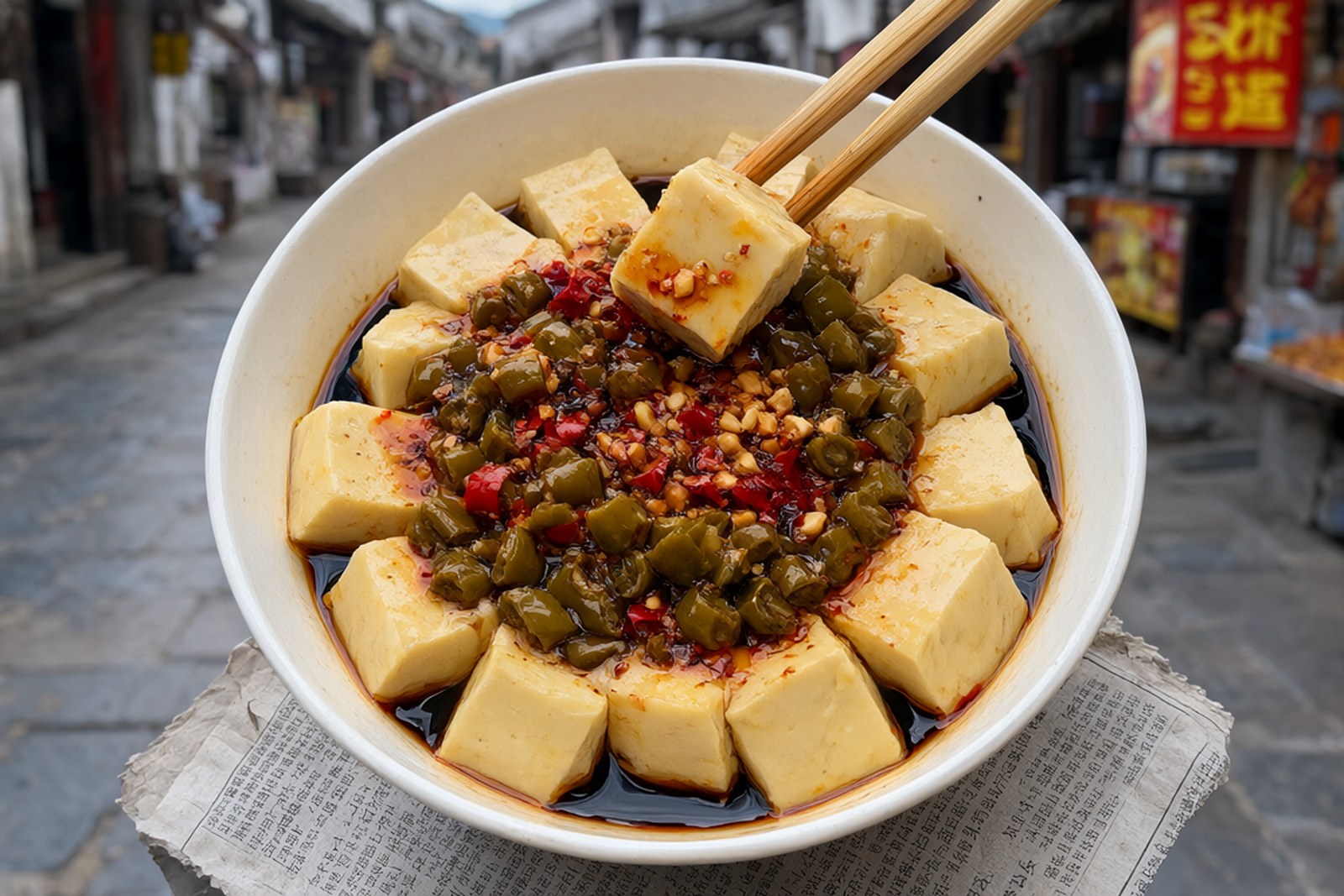
It is the wrong shape to be tofu and the wrong colour to be anything else, and the first thing your mouth reports is cold. 米豆腐 mǐdòufu — rice tofu — comes out of the pot as a pale yellow set jelly, gets cut into cubes or long slivers, and lands in a bowl under a spoonful of red chilli oil, a heap of chopped 酸豆角 suāndòujiǎo pickled beans, garlic water, a little soy and vinegar, crushed peanuts and scallions. It is slick and cool and coats the tongue, and then the chilli arrives a second later and everything reorganises itself. On a Hunan afternoon in August, there is no better three spoonfuls of food in the province.
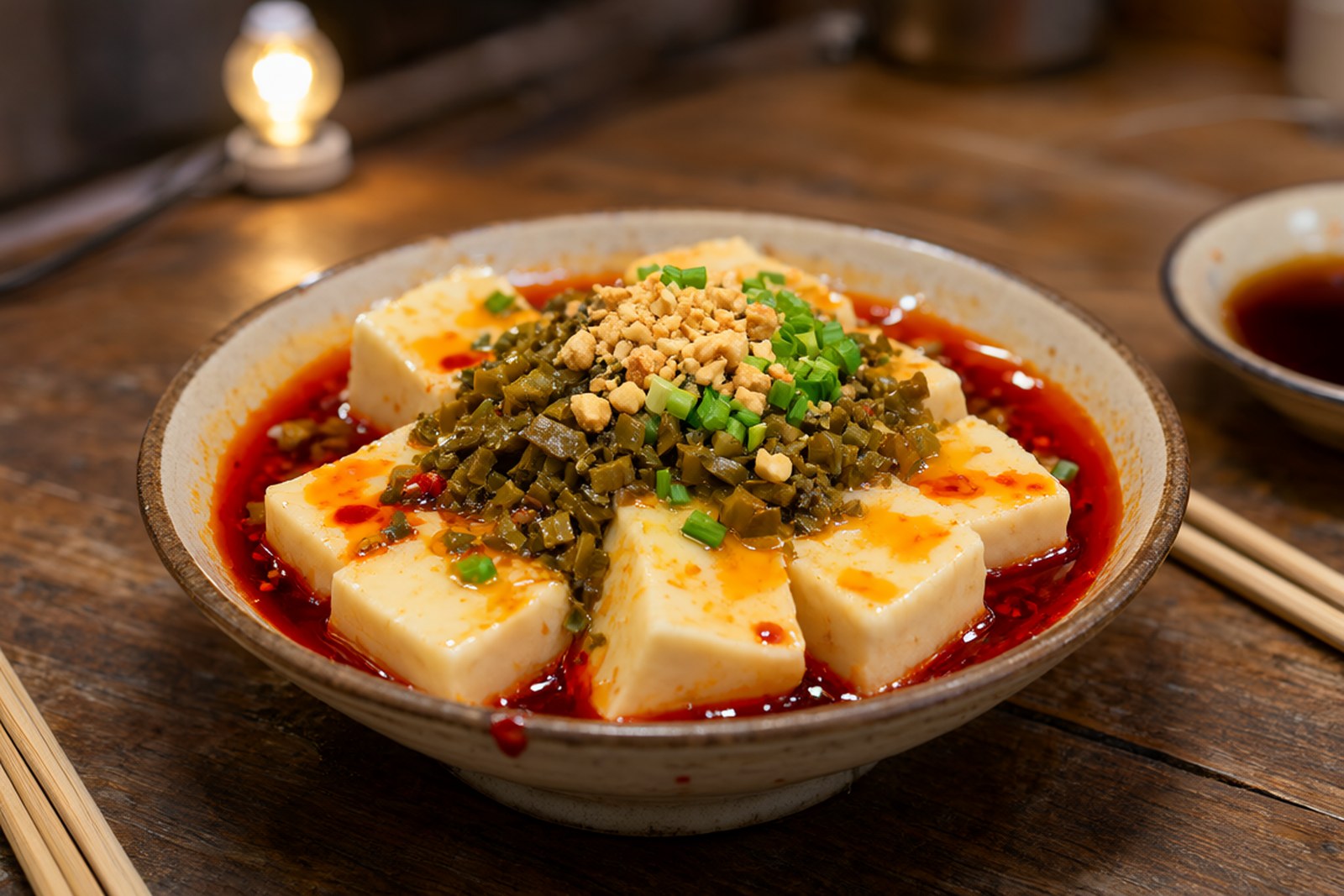
The bowl I remember was in 芙蓉镇 Fúróngzhèn, a town of stilt houses stacked up a gorge in 永顺县 Yǒngshùn Xiàn, in 湘西土家族苗族自治州 Xiāngxī, and the reason I was eating it there is the reason everyone eats it there: a film. In 1986 谢晋 Xiè Jìn released 芙蓉镇, adapted from 古华’s novel about a woman who sells 米豆腐 through the Cultural Revolution, and 刘晓庆 Liú Xiǎoqìng played her. The town has been selling the dish to visitors ever since, and there are now something like fifty shops doing it, most of them with a photograph of 刘晓庆 on the wall and a sign calling it 刘晓庆米豆腐.
Rice, Lime and a Set Jelly
There is no soy anywhere in this. The name is entirely about the texture.
Rice is soaked for hours, then ground with water into a slurry. Into the slurry goes 石灰水 shíhuīshuǐ — lime water, or in some households 草木灰 cǎomùhuī, wood ash, filtered — and that is the whole trick. The alkali does two things at once. It pushes the starch into setting properly when the mixture is boiled, and it gives the finished block its faint yellow tint and its slightly soapy, mineral bite, which is the flavour people mean when they say that 米豆腐 from one town tastes different from the same dish in the next valley over.
The boiled slurry is poured into trays and left to cool and set, and by the next morning you have something that cuts like a firm panna cotta and does not taste like rice at all. It is one of those dishes that exists in a dozen provinces under a dozen names — 贵州 and 重庆 both claim it — and every version is set with something alkaline, because there is no other way to make it work.
Cold, Fried or in Soup
Cold is the classic. Cut into cubes, dressed with chilli oil, pickles, garlic water and vinegar, eaten with a spoon out of a bowl on a hot day. The dressing matters more than the tofu, and the 酸豆角 suāndòujiǎo is not garnish — it is the salt and the crunch and the reason the dish works.
Fried is the winter answer. The cubes go into a wok with 腊肉 lāròu cured pork, 蒜苗 suànmáo and a spoon of 豆瓣酱, and they hold their shape while picking up the smoke of everything around them. This version is a main dish, not a snack.
In broth is for cold mornings. Sliced thin into a pork or chicken stock with a handful of greens, it becomes something close to a noodle soup that has lost its nerve — slippery, comforting, and much lighter than it looks.
All three are worth eating and they are genuinely different dishes. Order the cold one first even if it is January; that is what the town does.
Words and Names
米 mǐ is rice, husked but uncooked. 豆腐 dòufu is tofu, and the word is used here purely for the shape and the texture, the way English says “head cheese” about a thing with no cheese in it. 米豆腐 is therefore rice pretending to be tofu, and the pretence is convincing enough that visitors spend the first mouthful trying to work out what happened.
芙蓉镇 Fúróngzhèn, Hibiscus Town, was called 王村 Wángcūn for most of its history — a real 酉水 Yǒushuǐ river port with a Song-dynasty 铜柱 tóngzhù bronze pillar standing at the head of the street. The name changed once the film made the other one famous.
What the Locals Know
Judge it on the cut. A good block has a clean edge and no weeping. If it is sweating water into the bowl, the set was too weak.
Say how much chilli you want and mean it. 微辣 wēilà here is what most of the rest of the country would call 中辣. If you want none at all, say 不要辣椒 and accept that you will be getting a different dish.
Ask for it 现切 xiànqiē. Cut to order, not scooped from a tray that has been sitting since morning. It costs nothing to ask and it is the whole difference between the good version and the sad one.
The lime is not a worry. Visitors sometimes hear 石灰 shíhuī and flinch. The water is settled and filtered, the alkali is consumed in the setting, and the dish has been made this way in these valleys for centuries.
Eat it where the water is local. The whole thing is rice, water and alkali, which is why the best 米豆腐 is always the one made with the spring up the hill.
Where to Eat It
In 芙蓉镇 the shops run the length of the main street from the 摆手堂 down to the river, and any of them will serve you a bowl for the price of a coffee back home. The dish is also everywhere in 吉首 Jíshǒu, 凤凰 Fènghuáng and the towns along the 酉水 Yǒushuǐ, usually from a cart or a window rather than a restaurant, and the carts are often better. Look for 米豆腐 on the signboard with 凉拌 liángbàn underneath it, which means it is the cold version, which is the one you want.
flowcloud would say that a dish invented to make rice go further in a poor mountain county, and then made famous by a film about surviving a decade nobody wants to talk about, is the most Xiangxi thing there is — food that keeps its dignity and its sense of humour under pressure.
Where to find it: 米豆腐 (mǐdòufu, rice tofu), sold all over 湘西 (Xiāngxī) and most famously along the main street of 芙蓉镇 (Fúróngzhèn), 永顺县 (Yǒngshùn), western Hunan. A bowl of the cold 凉拌 version is ¥5–10, the 腊肉 stir-fried version ¥28–45 as a main dish, and the soup about ¥20. Ask for it cut to order, ask for 微辣 only if you are confident, and do not skip the 酸豆角 (suāndòujiǎo) pickled beans, which are half the dish.