
Roast Goose
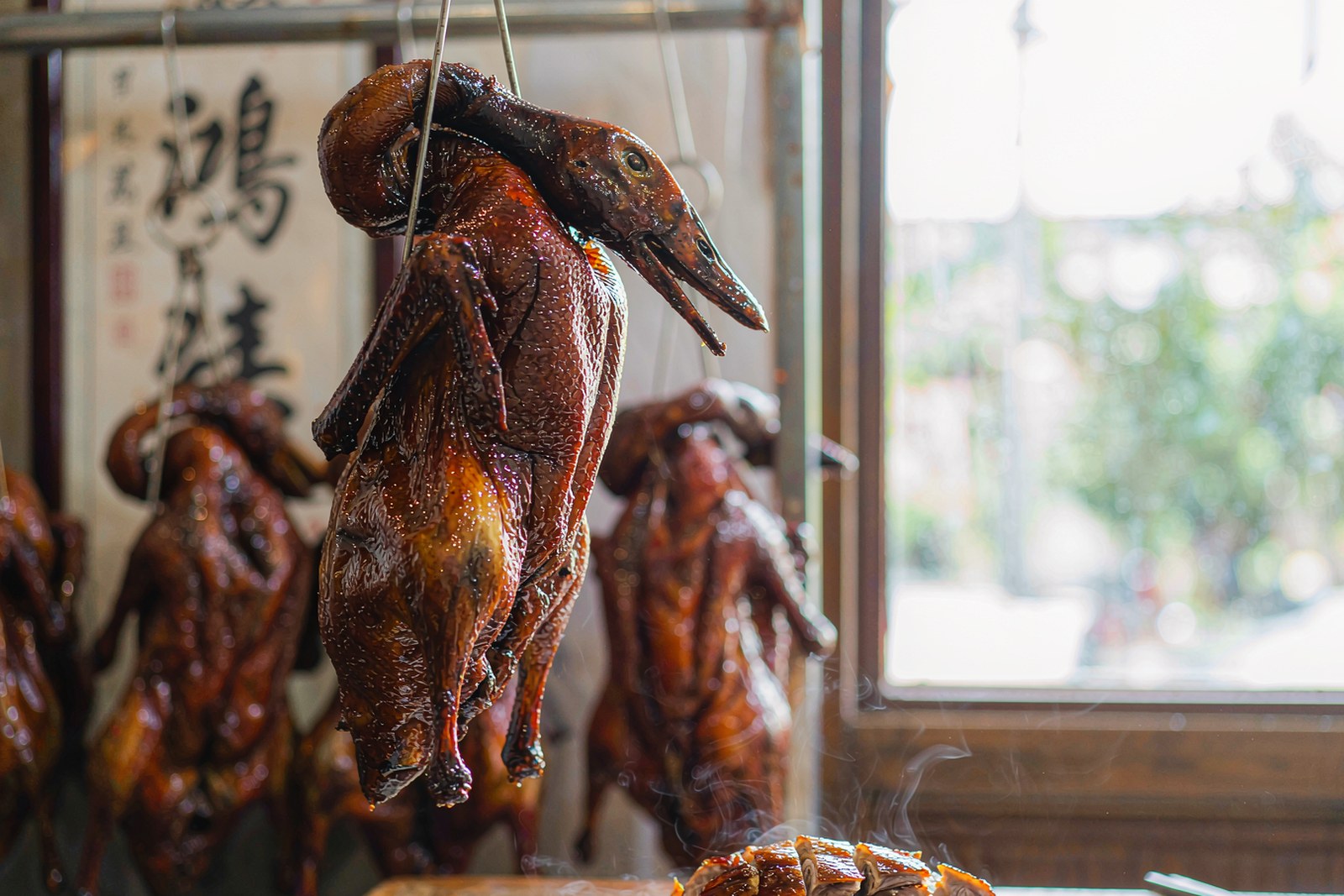
The smell hits you on the street a block before the shop: rendered fat, toasted malt, and the deep, meaty smoke of a wood-fired oven. I pressed my face to the glass and watched a whole goose swing on its hook, mahogany and glistening, the skin tight as lacquer. When the slicer finally laid it on my plate, crackling under the chopsticks, I bit through the shell of skin into meat so juicy it ran down my wrist. This is 烧鹅 shāo’é, and in Guangdong it is the roast meat people will cross a city for.
烧鹅 shāo’é means “roasted goose,” and its home is the southern suburbs of Guangzhou, especially 深井 Shēnjǐng in 黄埔 Huángpǔ, where the dish was perfected in the late Qing era. The local 乌鬃鹅 wūzōng’é, a dark-plumed, lean-breasted goose, was stuffed, seasoned, and hung over fruitwood until the skin turned to glass. It matters in Guangdong because roasting is the province’s argument with fire itself: where white-cut chicken shows off restraint, roast goose shows off control, turning a humble farm bird into something close to confection.
The Craft
A proper 烧鹅 begins with a young 乌鬃鹅 wūzōng’é, cleaned and dried, then filled through the neck cavity with a wet seasoning of fermented bean paste, five-spice, liquor, scallion, and ginger. The opening is stitched shut and the bird is inflated with air between the skin and the flesh, a step called 打气 dǎqì that lets the fat render out and the skin separate into its own crisp layer.
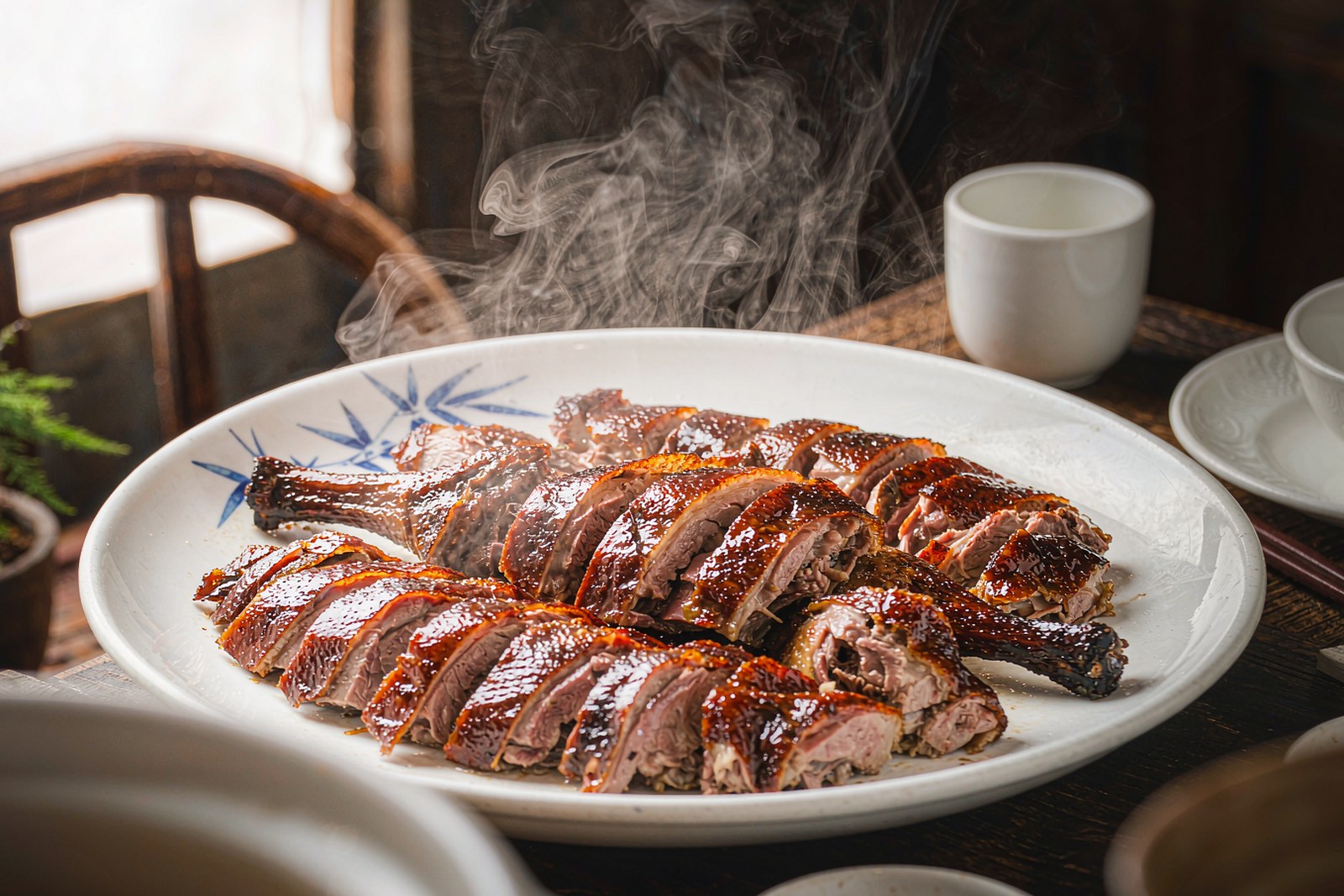
Next it is scalded in boiling water to tighten the skin, brushed with a maltose-and-vinegar glaze, and hung to dry for hours so the surface turns tacky. Only then does it go into a searing oven, traditionally fired with 荔枝木 lìzhīmù lychee wood, turned slowly until the skin is deep red-brown and the fat beneath has melted away. The slicer chops it through bone and skin into pieces, keeping a shard of crackling with every morsel of meat.
The final trick is the sauce: a sweet-sour 酸梅酱 suānméijiàng made from salted plums, which cuts the richness and makes the fat taste clean rather than heavy.
How to Eat It
Order it by the piece, not by weight alone, and always ask for a mix of 鹅腩 é nǎn (fatty belly) and 鹅腿 é tuǐ (leg). The skin is the star, so eat it first and loud. Dip lightly in the plum sauce, never drown it. In Guangdong the cult centers on 深井烧鹅 Shēnjǐng shāo’é from Guangzhou and the 脆皮烧鹅 cuìpí shāo’é (crisp-skin roast goose) of Hong Kong’s old shops, but the dish refuses to be a tourist souvenir; locals eat it over plain 米饭 mǐfàn rice or tucked into a 濑粉 làifěn rice-noodle bowl.
Words and Names
The name 烧鹅 is only two characters: 烧 shāo “to roast or burn” and 鹅 é “goose.” Spoken in Cantonese as siu1 ngo4, it is one of the 烧味 siu1 mei6 (“roast flavors”), the family of Cantonese barbecue that also includes 叉烧 chāshāo and 烧鸭 shāo yā roast duck. The 深井 Shēnjǐng in 深井烧鹅 is not a well but a place name, a village now folded into Guangzhou. To call a goose 靓 leng3 (“beautiful”) is the highest praise a Cantonese diner gives the bird.
What the Locals Know
Demand 脆皮 cuìpí (crisp skin) the louder the crackle the better the dry and the fire.
Mix 腩 and 腿 lean meat alone misses the point, you want fat with it.
Use the plum sauce 酸梅酱 suānméijiàng is not optional, it balances the fat.
Go early the best shops sell out of the breast and belly by lunch.
Eat it the same day roast goose loses its skin overnight, never order it delivered cold.
flowcloud would say that fire is just another spice, and the goose is the song it sings.
Where to find it: Roast goose, 烧鹅 shāo’é, is a Guangdong staple best chased in Guangzhou, where 深井烧鹅 Shēnjǐng shāo’é from the 黄埔 Huángpǔ district is the benchmark, and in the old roast-meat shops of 荔湾 Lìwān and 越秀 Yuèxiù. Order 例牌 laipáai (a standard plate) or 半只 bun1 jek3 (half a goose) with 酸梅酱 suānméijiàng and a bowl of plain rice; a half goose for two to three people runs roughly 120 to 200 yuan, with the famous 乌鬃鹅 wūzōng’é birds at the top of that range.