
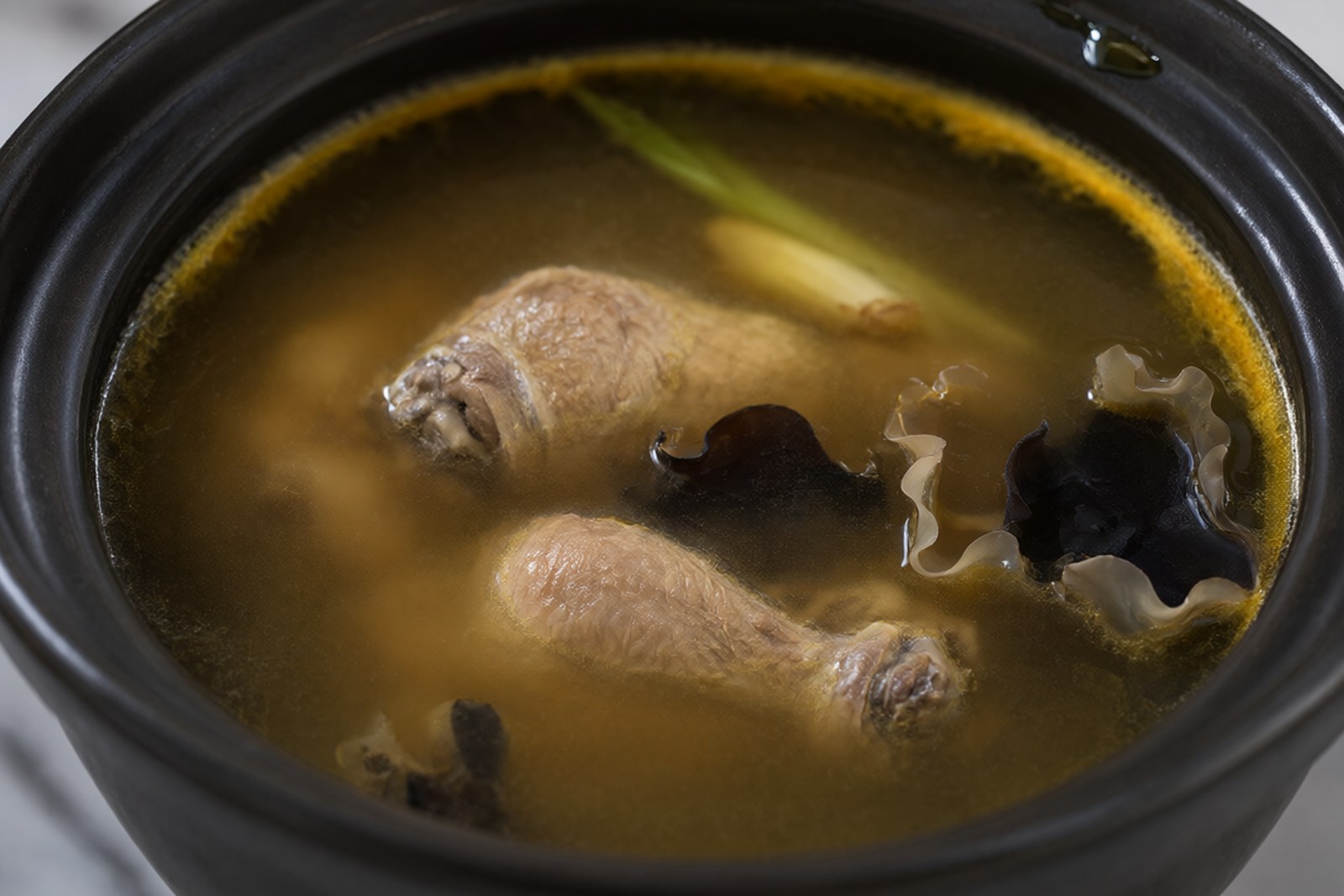
The soup is almost clear, with a faint amber glow in it where the light gets through, and there is a thin film of chicken oil across the surface that breaks into rings when you dip a spoon. Underneath are pieces of chicken and something you have not seen before: dark, thin, frilled pieces of a fungus, each one small, each one slightly translucent at the edge, soft but not mushy, and tasting of forest floor and rain-soaked stone. 岩耳炖土鸡 yán’ěr dùn tǔjī — rock ear stewed with free-range chicken — is the most expensive and most treasured dish in 张家界 Zhāngjiājiè, and it is the only one on this site’s Hunan list that grows on a cliff face.
A Lichen, Not a Mushroom
岩耳 yán’ěr translates literally as “rock ear”, and it is not a mushroom. It is a lichen — a composite organism of fungus and alga — that grows on bare stone. The related 石耳 shí’ěr, “stone ear”, is the name used in the pharmacopoeia and in most reference works, and the two terms describe the same thing in local use. The one that grows here is a specialist of the quartz sandstone cliffs of 武陵源 Wǔlíngyuán, the sandstone pillar landscape that made this region famous, and it will only grow in specific conditions: on bare rock faces, at altitude, in gaps and fissures where water runs but does not stand, and, according to the pickers, mostly on slopes that face north-west and catch the sun.
The growth rate is the reason for everything about it. Rock ear puts on less than a centimetre a year, and a piece worth harvesting is four or five years old. A patch that has been picked will not produce again for three or four years. There is no cultivation — nobody has managed to farm it — which means the entire supply of this ingredient in the world comes from people going down the faces of cliffs with a rope and lifting it off the stone by hand.
The Pickers
岩耳客 yán’ěrkè, the rock-ear gatherers, are a recognised trade in the villages around 武陵源 Wǔlíngyuán and one of the more serious jobs in China. The historical description in the county records is blunt: the picker ties one end of a long rope around his waist and the other to an iron stake driven into the top of the cliff, and lowers himself over the edge. The same records add the detail that if the rope is cut — by a rockfall, or, as the older accounts have it, by the local flying squirrels worrying at it — 则立成齑粉, there is nothing left of him worth burying.
The work happens in two short seasons, spring and autumn, and a day’s effort produces a few ounces. This is why rock ear has always been expensive, and why it has always been a gift rather than a staple. It was a tribute item for the imperial court, and the local saying that summarises its value is 三斗谷换一两岩耳 — three pecks of grain for one ounce of rock ear. In some periods it was accepted in place of tax. As recently as 1982, when tourism here was just beginning, it was selling at about ¥3.50 per 两 liǎng — fifty grams — at a time when a carpenter in the same district earned 15 fen for a day’s work. That is roughly twenty days’ wages for a handful of lichen. The gathering technique itself is now protected as a provincial-level item of intangible cultural heritage, which is the state’s way of saying that the skills exist in a handful of families and will not survive on their own.
How It Is Cooked
The dish is a two-ingredient recipe and almost all the technique is in the timing.
The chicken should be a 土鸡 tǔjī, a genuine free-range bird — the local ones scratch about on the hillsides for insects and wild fruit and come home at night, and they take twice as long to cook and taste of something a battery chicken does not. Six months old is the usual standard.
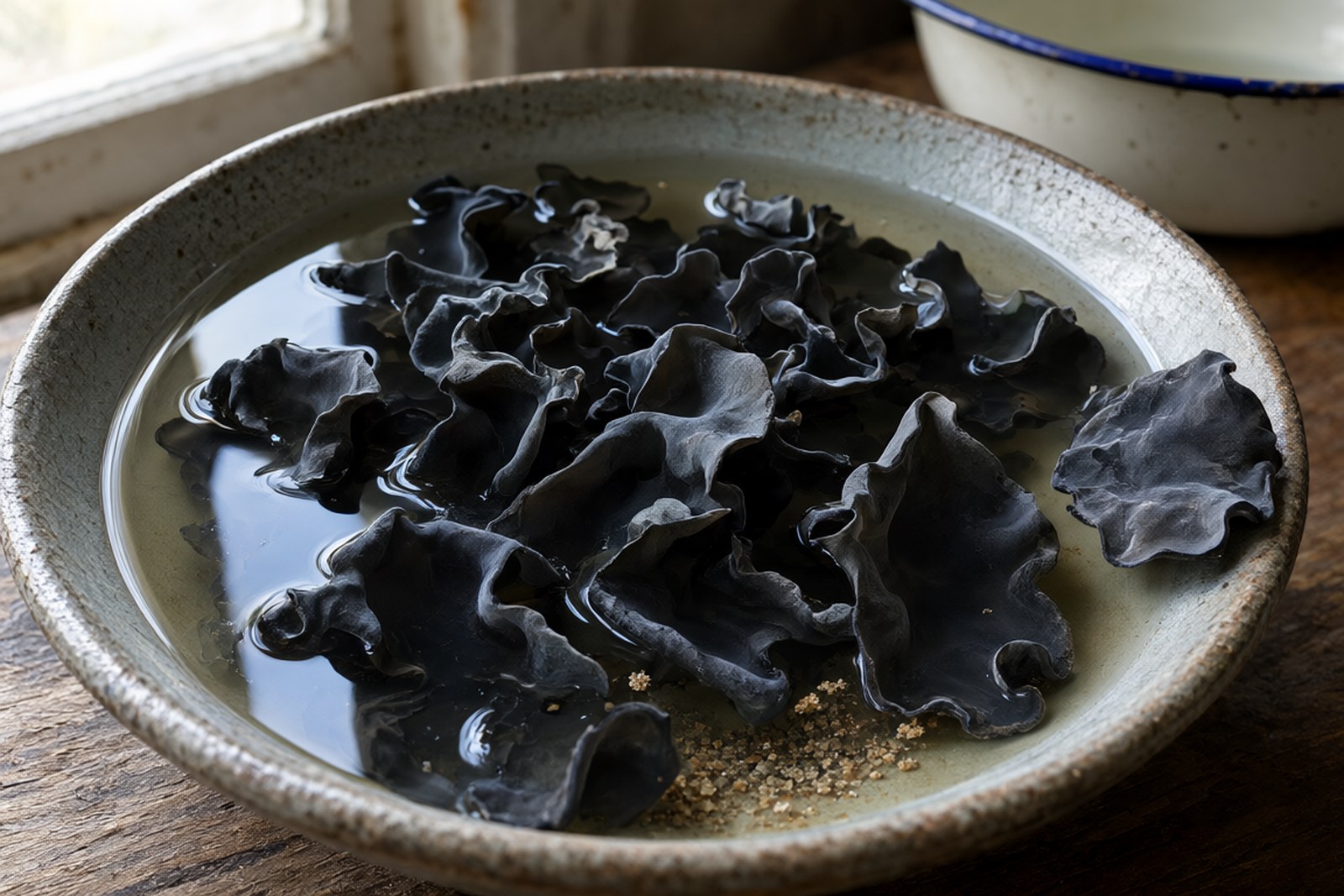
The rock ear has to be rehydrated, and this takes patience: seven or eight hours in warm water, until the pieces unfurl, then rubbed gently with 淘米水 táomǐshuǐ, the cloudy water left from washing rice, which lifts the grit out of the folds, and rinsed until nothing sandy is left. This step cannot be skipped, and it cannot be rushed — rock ear that has grown on a cliff face for five years has five years of dirt in it.
Then the chicken is chopped into pieces, blanched, briefly stir-fried in hot oil with ginger to lift the aroma, and put into a clay pot with water to simmer. No soy. No chilli. No stock cube. The only seasoning is salt and a little cooking wine. It simmers for an hour or more, and then, in the last ten minutes, the rock ear goes in. Not earlier: rock ear cooked too long dissolves into the broth and loses its texture. Not later: put in at the end it stays hard and tastes of nothing. It needs those last few minutes to absorb the chicken fat and soften, and that is the whole art of the dish.
The result is a soup that tastes strongly of chicken and mildly, strangely, of the rock — there is a mineral note in it, and something resinous and green that no cultivated mushroom produces. The rock ear itself ends up with a texture somewhere between a mushroom and a piece of soft cartilage: slippery, springy, and full of soup.
Words and Names
岩耳 yán’ěr and 石耳 shí’ěr both mean rock or stone ear, and both are used here; the local kitchen usually says 岩耳, while 石耳 is the term you will find in 本草纲目 Běncǎo Gāngmù, the sixteenth-century materia medica, which records it and notes that it is better in soup than wood ear. 岩耳客 yán’ěrkè, rock-ear guest or rock-ear visitor, is the word for the picker, with 客 kè used the way it is in 背包客 bēibāokè, backpacker — a person defined by what they do.
武陵源 Wǔlíngyuán is the name of the scenic area and the district; 武陵 Wǔlíng is an old poetic name for the region and 源 yuán means source. 石英砂岩 shíyīng shāyán, quartz sandstone, is the rock the pillars are made of, and the reason the cliffs are vertical and clean enough for a lichen to colonise. 土鸡 tǔjī, “earth chicken”, is the standard term for a free-range village bird, as opposed to 饲料鸡 sìliàojī, a chicken fed on compound feed.
What the Locals Know
Order it in advance. This is a dish that takes an hour and depends on having a rehydrated batch of rock ear ready. Every good restaurant here will ask for a day’s notice, or at least a morning’s, and the ones that can produce it in twenty minutes are using pre-soaked stock of uncertain age.
Check the price and the grade before you agree. Rock ear is sold by grade, and the difference between small broken pieces and whole fronds is large. A bowl of chicken soup with a modest amount of rock ear runs about ¥180–280; genuine wild 岩耳 yán’ěr at the top grade pushes a pot well past ¥400, and a few places quote far more. Ask what grade is going in and, if the answer is vague, order something else.
Eat the soup first, unseasoned. Taste it before you add anything, and then again after the rock ear has been in for a few minutes. The change is the point of the dish and it only happens once.
Do not add vegetables. The local instruction is explicit about this. A few pieces of potato or radish sometimes go in, but cabbage, tomato or anything acid will flatten the flavour completely. Rice and the soup is the whole meal.
Skip the farmed substitutes. Dried wood ear sold in tourist markets as 岩耳 yán’ěr is a different and much cheaper fungus. Real rock ear is small, thin, frilled, dark grey-black on one side and lighter underneath, and brittle when dry. If it looks like the wood ear in your local supermarket, it is.
Where to Eat It
The dish is served across 张家界 Zhāngjiājiè, but the serious versions are in the farmhouse restaurants of 武陵源 Wǔlíngyuán — 土家小院 Tǔjiā Xiǎoyuàn, 山里人家 Shānlǐ Rénjiā and their equivalents — where the chickens are their own and the rock ear is bought directly from pickers in the villages. Order 岩耳炖土鸡 yán’ěr dùn tǔjī when you book, with a plate of greens and rice. Budget ¥80–100 a head at the low end and considerably more if you go for the top grade. If you only have one serious meal in this region and you are willing to pay for it, this is the one.
flowcloud would say that a soup whose main ingredient took five years to grow on a cliff face and involves a rope, an iron stake and a certain fatalism should be drunk slowly, and that the reason this dish is a gift in this culture rather than a menu item is that everybody eating it knows exactly what it cost somebody else.
Where to find it: 岩耳炖土鸡 (yán’ěr dùn tǔjī), 张家界 (Zhāngjiājiè) and 武陵源 (Wǔlíngyuán), north-western 湖南 (Húnán). Farmhouse restaurants in and around the 武陵源 (Wǔlíngyuán) scenic area and in 张家界 (Zhāngjiājiè) city; order at least half a day ahead. ¥180–280 for a pot with a moderate quantity of rock ear, well over ¥400 at the top grade. Ask which grade is being used before you agree to the price, drink the broth before and after the rock ear goes in, and add nothing but rice.