
瑶家烟熏肉 yáo jiā yān xūn ròu is the smoked pork of the 过山瑶 guò shān yáo, the Yao who used to farm the hill slopes in 乳源瑶族自治县 Rǔ yuán Yáo zú Zì zhì xiàn, the Yao autonomous county in the mountains of northern 韶关市 Sháo guān shì, and it is also called 火烟肉 huǒ yān ròu, fire-smoke meat, or 瑶山熏肉 yáo shān xūn ròu, Yao mountain smoked meat. It is made from a pig that was raised in the village and killed in the village, cut into pieces of one or two kilos, cured in a crock for a couple of days and then hung above the household fire for months. The reason it exists is not a culinary idea but a practical one: the Yao lived high in the 南岭 Nán lǐng far from any market, and a household that killed a pig in winter with no way to buy meat later had to make that pig last. Everything about the technique follows from that single constraint. What is smoked here is not a delicacy made in small quantities for a season of entertaining: it is the household’s meat supply for the year, made in a kitchen that also had to stay warm, and the smoking is a by-product of the fire the family was burning anyway. That is why the technique has measurements in it – a height above the fire, a spacing between the joints, a fuel that has to be chosen correctly – rather than a recipe, and it is why the county can say what happens when a household gets it wrong. A visitor who has eaten the strong cured meats of Hunan and Sichuan next door will find this one sits between them: saltier and harder than the Hunan version, far less heavily spiced than the Sichuan one, and with a smoke that is wood rather than chilli or Sichuan pepper. It is also the one of the three that you are most likely to be given by a family rather than bought in a shop, because a village household that has a fire burning every day has no reason to buy smoked pork and a great many reasons to make it. The county’s own name for the technique is 瑶族瑶家烟熏腊肉制作技艺 Yáo zú yáo jiā yān xūn là ròu zhì zuò jì yì, the Yao household smoked cured-meat making technique of the Yao people, filed in the heritage database with the project number CNGD-440232-0304-0004 under the heading of folk arts and techniques, and it is a district-level record of a craft that was never written down before anyone thought to file it.
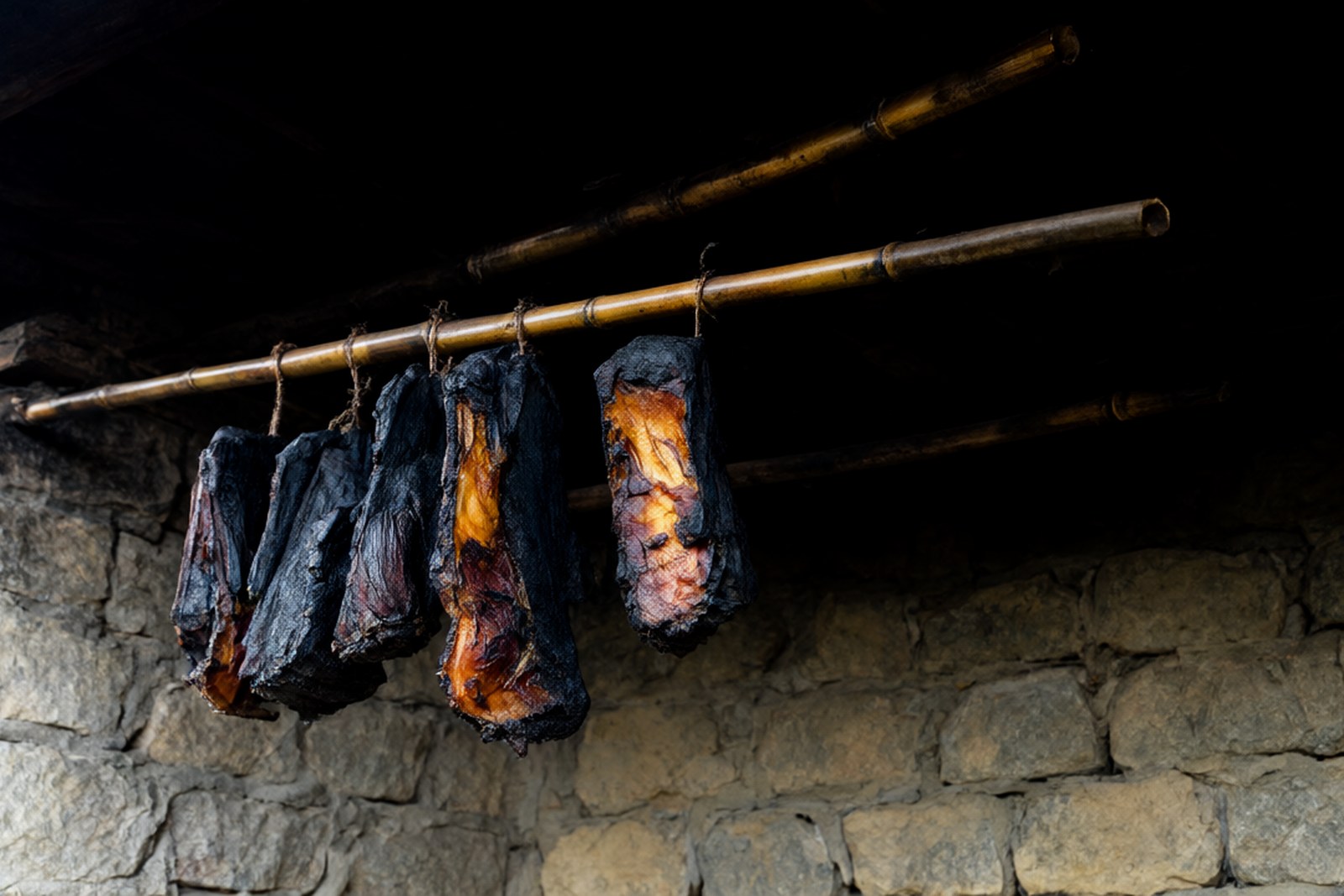
The smoking structure is the kitchen. In a 过山瑶 house the fire is not in a stove but on a hearth slab, 火塘 huǒ táng, built into the floor of the main room, and above it is a rack. The 必背瑶寨 Bì bèi yáo zhài and the other villages of the county – 瑶塘 Yáo táng and 大寮坑 Dà liáo kēng among them – all built to the same logic, and the county’s own account of the craft is a set of measurements: the meat hangs from a bar of 毛竹竿 máo zhú gān, bamboo, or of some stouter timber, suspended between one point two and one point five metres above the fire, and the joints are spaced so that they do not touch each other. That distance is doing work. Too low and the meat cooks and drips, and the fat that drips is the flavour that has been lost; too high and the smoke arrives cool and thin and nothing much happens to the meat at all. A metre and a bit above a slow fire is a temperature and a smoke density that will cure a joint over a winter without ever cooking it.
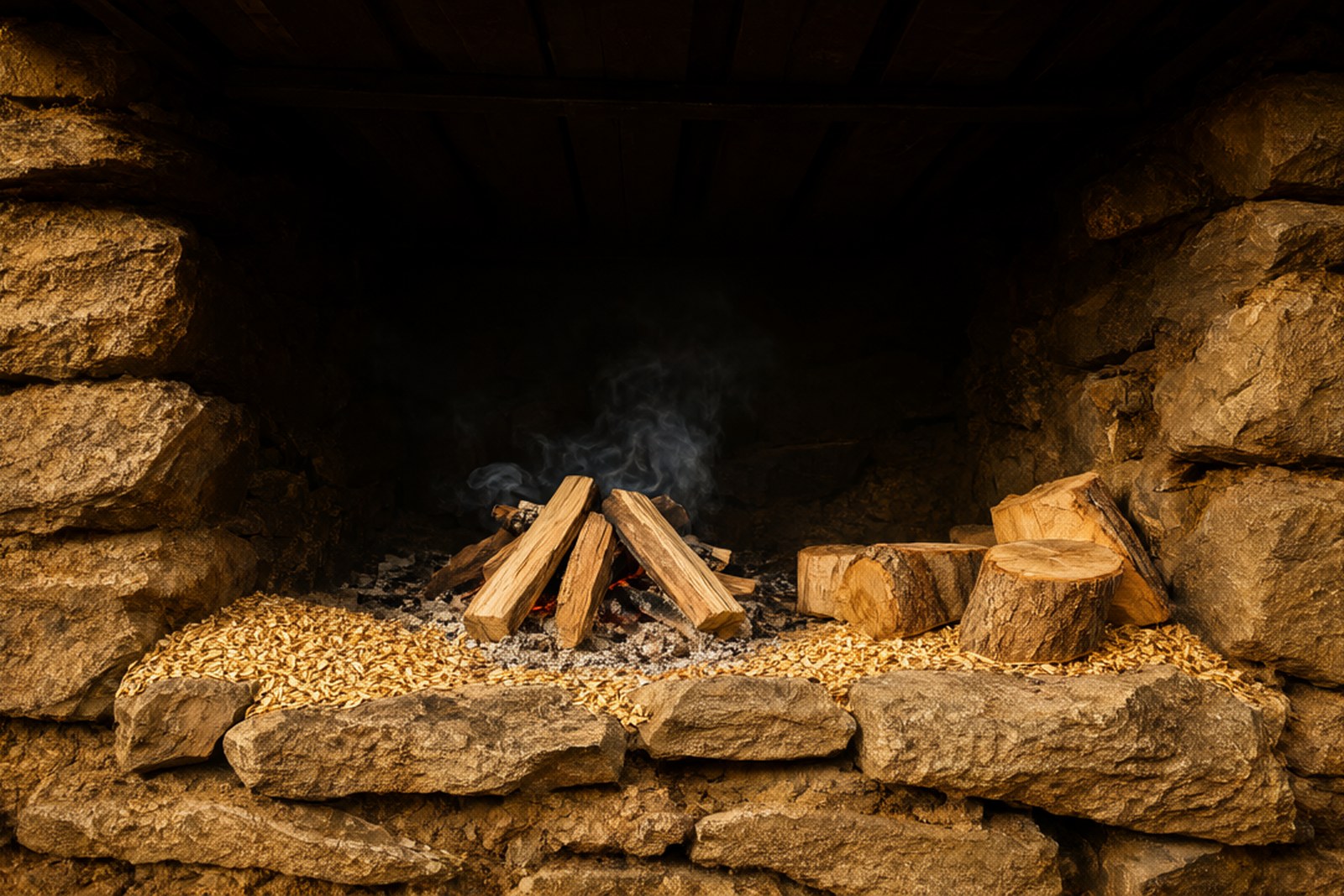
The wood is the part of the technique that the county insists on and it is also the part most easily got wrong. Yao households burn whatever the hills give them, but a rack of smoking meat is not a stove, and the county’s own description of the rule is that which timber may be used and which may not is a matter of experience alone, because the wrong wood makes the meat bitter or gives it a taste that is simply wrong; the phrase used for the risk is 用柴不当,熏出的腊肉会有苦味或怪味 yòng chái bù dàng, xūn chū de là ròu huì yǒu kǔ wèi huò guài wèi. The good fuels are the wood that has some aroma of its own – the stump wood, 柴蔸 chái dōu, is the preferred material, and there is a specific instruction that the fire must not be allowed to get big, because a large fire draws the fat out through the skin and the fat is where the fragrance lives. The county also records a substitution that changes the result for the better: if the household burns 谷壳 gǔ ké, rice husk, or 玉米棒渣 yù mǐ bàng zhā, the ground cobs of maize, or grass stems rather than split logs, the smoke is denser and the colour and the smell come out stronger. And there is one condition that cannot be worked around, which is that the fire has to be lit every day. A rack that is not under continuous smoke does not cure properly; it goes soft, it draws flies, and it can be lost. The county’s line for this is that the choice and the burning of the fuel is the most important thing of all in making smoked pork, and it is not a claim about flavour, it is a claim about the process working at all.
The sequence before the smoking is short and it is done in one day. The pig is killed after 立冬 Lì dōng or in the twelfth month when the year pig is slaughtered, and the first step is 开水烫毛再以稻草烧 kāi shuǐ tàng máo zài yǐ dào cǎo shāo, scalding the bristle off with boiling water and then singeing the carcass over burning rice straw, which leaves the skin slightly blistered and is why the rind of a finished piece is leathery in a way that a hair-removed skin is not. The meat is cut into pieces of one or two kilos and packed in layers into a clean earthenware crock, and each layer is sprinkled with salt, rice wine and five-spice powder, 食盐、米酒、五香粉 shí yán, mǐ jiǔ, wǔ xiāng fěn, before the next goes in. The crock is covered and stood somewhere cool and airy, and the whole thing rests for two or three days while the salt and the wine go through the meat. Then the pieces are strung on 竹篾 zhú miè, split bamboo, or on 棕叶子 zōng yè zi, palm leaf, and hung. The colour goes from raw white to a cured yellow-brown over the first weeks, and after long enough the outside is a matte black from soot while the meat just under it is a translucent yellow that the county’s own phrase describes as 橙黄腊透 chéng huáng là tòu, cured yellow-orange all the way through.
What the person eating it sees first is the cross-section. The county’s description is 肥肉晶莹透明,瘦肉干红暗黑 féi ròu jīng yíng tòu míng, shòu ròu gān hóng àn hēi – the fat translucent, the lean dry red and dark – and it is a fair description of a properly smoked joint: the fat of a pig that spent its life walking a hill is firm and takes the smoke as colour, and it reads as glass rather than as lard. The outside of the piece is a hard, oiled, gold-brown skin, and the smell off it before it is cooked is smoke and salt and pig, with nothing sweet in it. It keeps a long time in the conditions it was made in. The county’s own account says that meat smoked this way has kept for years, and specifically that in the right circumstance it can be held as long as five years; the heritage text for the craft, which is more cautious about the conditions, says that in a particular environment it can keep for ten or more. Both statements are about a cool, dry, smoky kitchen with a fire burning in it daily, and neither is a claim about a freezer.
Cooking It, and What Goes With It
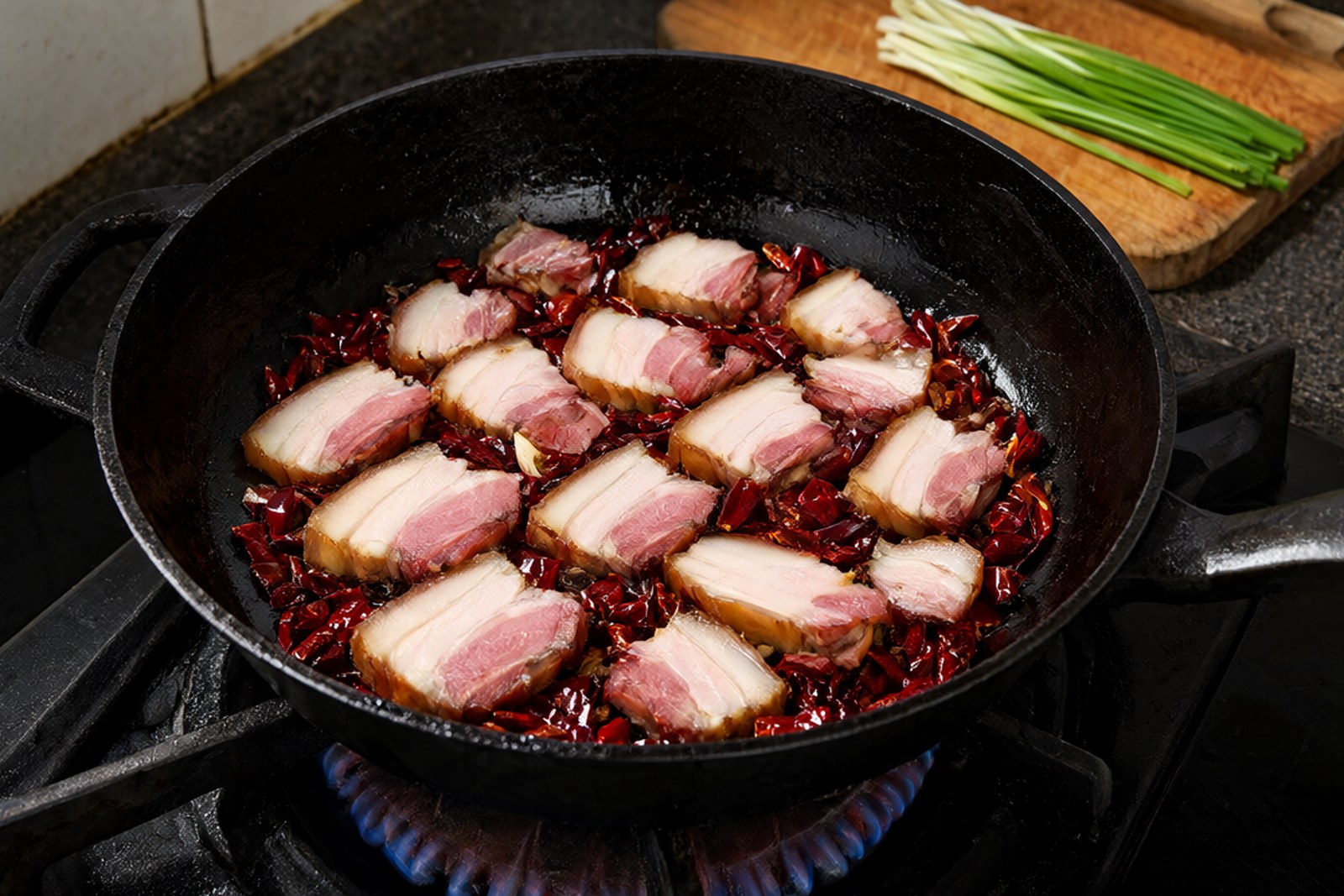
The first step in the kitchen is to get the soot off, and it is done with hot water and a handful of straw. A piece is steeped in water at about 45 degrees Celsius and then wiped with 禾草 hé cǎo, a small bundle of rice straw, until the black film comes away and the yellow of the cured meat is underneath it, and the county’s phrase for the moment is 露出橙黄腊透的肉 lù chū chéng huáng là tòu de ròu, the cured translucent yellow meat is exposed. The rule for cutting is a rule and not a suggestion: the pieces are cut into blocks half a centimetre thick, two to three centimetres wide and about four centimetres long – 厚 0.5 厘米、宽 2–3 厘米、长约 4 厘米 – and not into thin slices, because a slice of smoked meat that thin loses its smoke to the pan and turns into a strip of salt. The cooking is 姜片、蒜头 jiāng piàn, suàn tóu, ginger and garlic, with 茶油 chá yóu, tea-seed oil, in the pan, then soy sauce, salt and dried chilli, covered and fried until it cracks and spits, then water and a gentle simmer for twenty minutes, and finally 蒜苗 suàn miáo, garlic shoots, added at the end and cooked until the liquid has gone. The county’s own pairing is 石韭菜 shí jiǔ cài, stone chive, a wild garlic that grows out of rock crevices in the hills, and the two together are the household dish of the county rather than a restaurant one.
The drink that goes with it is 苦爽酒 kǔ shuǎng jiǔ, made from glutinous rice with some ordinary rice mixed in, steamed, inoculated, and fermented twice before being filtered, and the reason it is worth mentioning beside the meat is that it is the counterpart in texture: it smells strongly of rice wine and it tastes bitter first and sweet afterwards, and against a mouthful of smoked pork the bitterness resets the palate in a way that a sweet wine does not. The two dishes that make up the rest of the table are 豆腐圆 dòu fu yuán, the tofu ball, which is the first of the 瑶家十八酿 yáo jiā shí bā niàng, the eighteen stuffed dishes of the Yao, made with bean curd set from local spring water, and 荷包扎 hé bāo zhā, rice flour and pork steamed in a leaf. The three together – smoked pork, the bitter wine, the bean curd – are what the county calls 瑶家三宝 yáo jiā sān bǎo, the three treasures of the Yao household, and the meal they belong to is the long table, 长桌宴 cháng zhuō yàn, at which the courses arrive on a single bench and everyone eats standing and sitting along it.
Words and Names
瑶家烟熏肉 yáo jiā yān xūn ròu is the dish: 瑶家 the Yao household, 烟熏 yān xūn smoked, 肉 ròu meat. 火烟肉 huǒ yān ròu, fire-smoke meat, and 瑶山熏肉 yáo shān xūn ròu, Yao mountain smoked meat, are the other names. 过山瑶 guò shān yáo, the Yao who crossed the mountains, is the branch that lives in this county, and 火塘 huǒ táng is the hearth the meat hangs above; 柴蔸 chái dōu is stump wood, the preferred fuel, and 谷壳 gǔ ké rice husk, which the county says smokes meat more strongly. 石韭菜 shí jiǔ cài is the wild stone chive cooked with the meat, 苦爽酒 kǔ shuǎng jiǔ the bitter-then-sweet rice wine of the table, 豆腐圆 dòu fu yuán the tofu ball, and 瑶家三宝 yáo jiā sān bǎo, the three treasures of the Yao household, names the trio of pork, wine and bean curd. 必背瑶寨 Bì bèi yáo zhài is the best-known Yao village in the county.
What the Locals Know
Do not treat it as bacon. It is saltier, harder and much more smoky, and a piece cooked the way bacon is cooked will be inedible; it wants to be cut thick, parboiled or steamed first if it is very dry, and then cooked down with something that can take the salt – a vegetable, a bowl of rice, a handful of garlic shoots. Wash it in warm water and rub the black off with a rough cloth or a wad of straw before you cut it; the soot is not flavour and it is not meant to be eaten. The fat is the good part, and anyone who trims it off has removed the reason for the process. A good piece is heavy and stony for its size, with a matte black outside and an amber or glassy interior when cut, and it should smell of wood smoke and salt and nothing sweet or sharp. Hang what you buy in the open air rather than sealing it in plastic, because a piece of smoked pork that sweats in a bag goes musty – the whole method is a method for a kitchen with air moving through it and a fire burning every day, and the county’s own account of its shelf life assumes both. Expect it on the long table with the bitter wine and the bean curd; a household that feeds you smoked pork, tofu balls and garlic shoots is feeding you the county’s own dinner rather than a visitor’s version of it. The smoke is a matter of taste among locals as well as visitors – some families hold their meat high and light, others leave it dark and heavy – so if one household’s version tastes too strong, that is a house style and not a fault.
flowcloud would say that a county isolated by mountains spent centuries turning one winter pig into a year of dinners, and that the rule which looks most like superstition – that a certain wood will ruin the meat – is simply the accumulated cost of every household that ever got it wrong.
Where to find it: the Yao villages of 乳源瑶族自治县 Rǔ yuán Yáo zú Zì zhì xiàn in northern 韶关市 Sháo guān shì, above all 必背瑶寨 Bì bèi yáo zhài, which sits in the high country about fifty-four kilometres north-east of the county town, and in 瑶塘 Yáo táng and 大寮坑 Dà liáo kēng; the farmhouse kitchens and the long-table meals of the county, and the cured-meat stalls of the county market. 乳源 is about forty minutes by road from 韶关市区 and is served by buses from 韶关东站; the villagers who make it best are the ones who still cook on a hearth rather than a stove, which is a shrinking number, so the pork sold in shops is often a smaller, quicker version of the household article. Buy from a village rather than a city counter if you can arrange it, ask how long it was smoked, and take the black rind as the sign that it was actually smoked and not simply dried.