
山城小汤圆 Shānchéng xiǎo tāngyuán, Shancheng tangyuan, the small “mountain-city” glutinous rice balls, are the deliberate sweet in one of China’s most fiercely spicy cities: longan-sized filled balls, thin-skinned enough that the dark sesame paste inside just shows through, served plain or floating in fermented sweet rice. Chongqing is a municipality of southwest China, and Yuzhong is its central district on the peninsula where the Yangtze meets the Jialing River; the balls belong to the 八一路 Bāyī Lù Bayi Road of that district, the food street at the foot of the monument, and their story is not one of local invention but of arrival – a Hangzhou family craft that walked to Chongqing in wartime, re-planted itself with the local rice dough, and took the mountain city’s name in 1964.
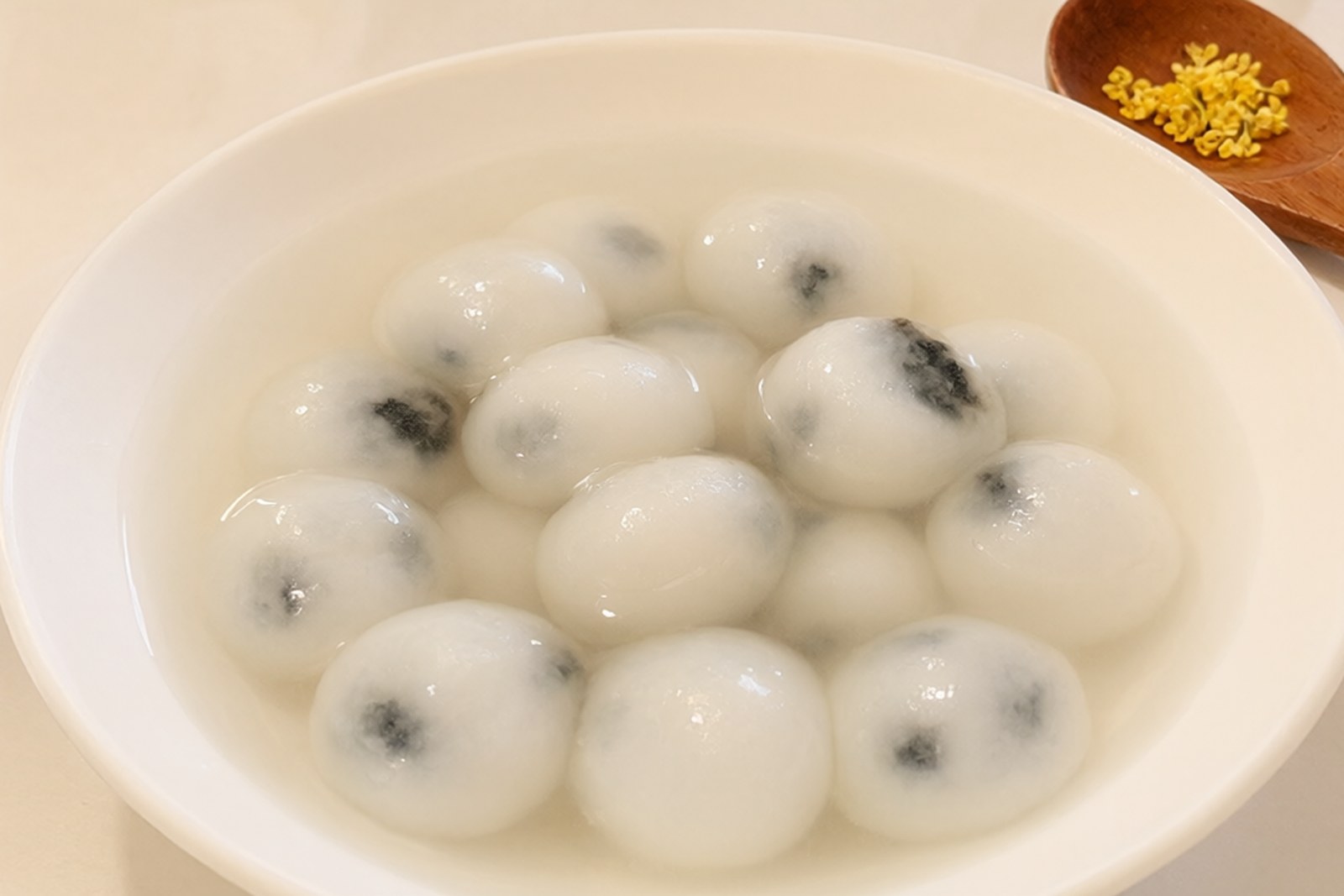
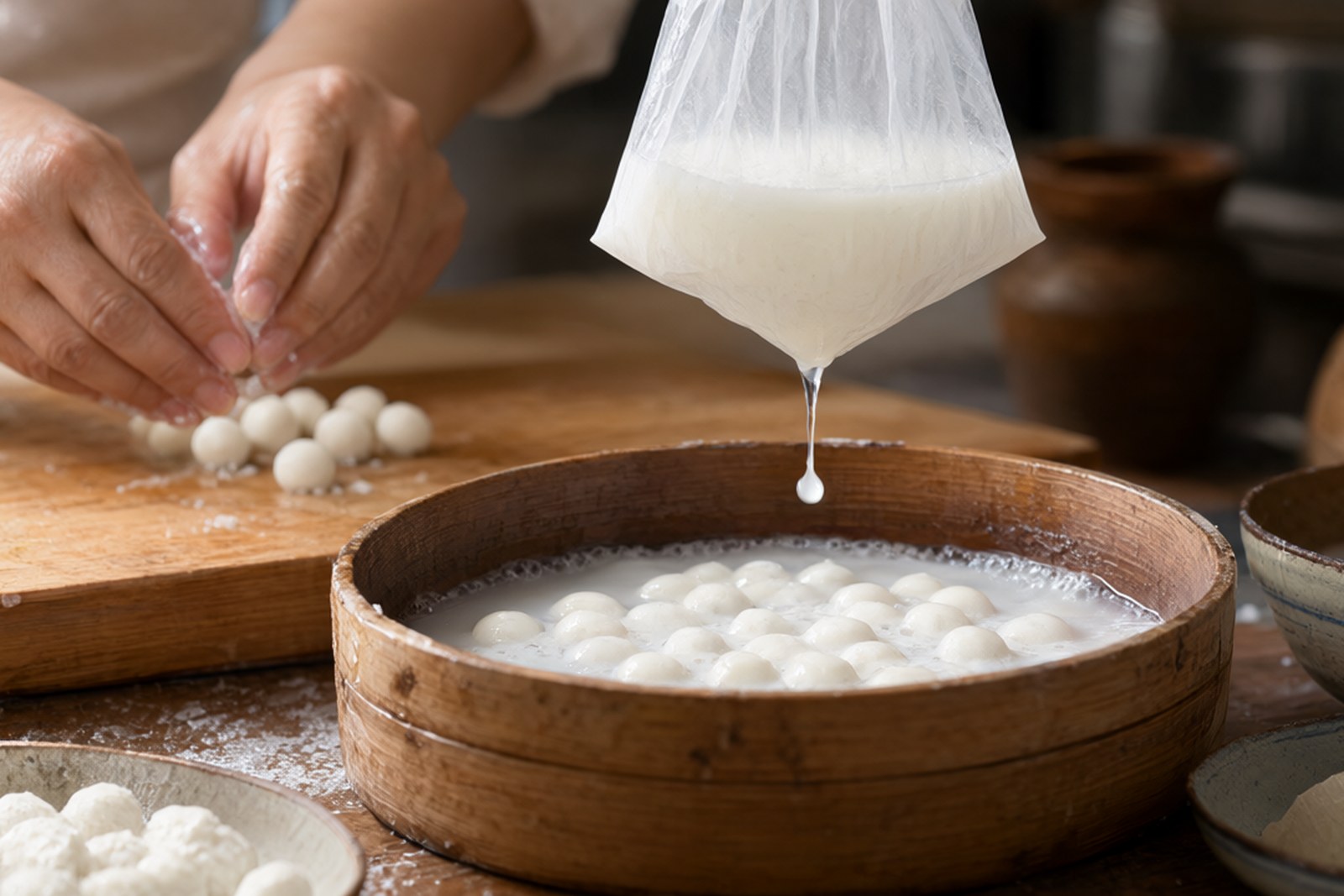
The making is the local half of the story. 吊浆 diàojiāng, the old Chongqing method, soaks the rice, stone-mills it into milk and hangs the milk in cloth to drain into a dough, which gives a skin that is moist and slippery where a plainer dough would be chalky; the filling is black-sesame paste with sugar and fat; and the whole is rolled to the size of a longan, small enough that a bowl holds a dozen and the sweetness stays a sentence rather than a speech. The smallness is the point, because the ball was built to be eaten after a bowl of something fiercely hot. By the trade’s own telling each ball carries about ten grams of skin around five of filling, is dropped into boiling water and taken through two cold-water pauses as it floats – a counted method the trade repeats rather than any written standard.
The craft’s own dates are three, and they are kept apart. The family line runs to 1911 in Hangzhou, where the Yan household held the method – its keeper 颜钧 Yán Jūn Yan Jun was born in 1883 and died in 1962. In the early 1940s the second generation, the couple 余国骅 Yú Guóhuà Yu Guohua and 陈秀卿 Chén Xiùqīng Chen Xiuqing of Hangzhou, carried the family craft up the river out of the war and opened a sweet shop on 保安路 Bǎo’ān Lù Bao’an Road, today’s Bayi Road, selling the balls under the plain name of Hangzhou tangyuan. In 1964, after the public-private merger years, the product took the name it wears now: 山城小汤圆, the mountain-city tangyuan. The line broke somewhere in the city’s changes, and in 2009 the third generation, 余瑛 Yú Yīng Yu Ying and 余兆放 Yú Zhàofàng Yu Zhaofang, brought the name back under a food company, Shangziyuan, registered in the district with its factory down the river in Banan – the craft, the shop and the name each carrying its own year, none of them borrowed from the others.
The recognitions came late and in a row. In August 2013 the brand’s holding company was named a Chongqing Time-honoured Brand by the municipal commerce commission; in 2016 the Yuji Shancheng tangyuan making technique entered the district’s intangible-heritage list; in 2017 the balls took a gold medal at the first China Gold Medal Tourism Snack awards; and in 2019 the technique entered the municipality’s sixth municipal intangible-heritage list. One discipline holds through all of it: the listed subject is 余记山城小汤圆 Yújì Shānchéng xiǎo tāngyuán, the Yuji line of Shangziyuan – and the shops on Bayi Road that sell similar bowls under other names are separate operators, so no shop on the street is written here as the heritage house.
Tangyuan are not a Chongqing invention – the filled rice ball belongs to the whole Jiangnan kitchen. What is local here is the landing: a Hangzhou family craft re-planted on Bao’an Road with the local diaojiang method, renamed Shancheng – mountain city – in 1964, and listed as municipal intangible heritage in 2019. On this site the sweet sits against the 糖不甩 tángbùshuǐ of Dongguan, the syrup-tossed pellets of a Cantonese kitchen, unfilled and glossy with sugar – a different line of the same grain. The noodle bowl of this district has its own story elsewhere on this site; this is the bowl that comes after it. At Lantern Festival the balls carry the same reunion meaning they carry anywhere in China, which is why the festival weeks are when the name most often reaches the news.
Words and Names
山城小汤圆 Shānchéng xiǎo tāngyuán is the category, the small mountain-city glutinous rice balls; 余记 Yújì, “Yu’s”, marks the listed line of the Shangziyuan company, and 吊浆 diàojiāng the water-milled, hung-to-drain rice dough that makes the skin. 醪糟 láozāo is the fermented sweet rice the balls are served in, and 包心 bāoxīn, “filled heart”, is the filled style that distinguishes them from the plain pellet. 保安路 Bǎo’ān Lù is Bao’an Road, today’s 八一路 Bāyī Lù Bayi Road, where the shop landed. The three dates are the page’s spine: the craft dates to 1911 in Hangzhou, the shop to the early 1940s on Bao’an Road, the name to 1964. The site’s tangbusui page keeps Dongguan’s syrup sweet; this page keeps the filled ball that walked.
What the Locals Know
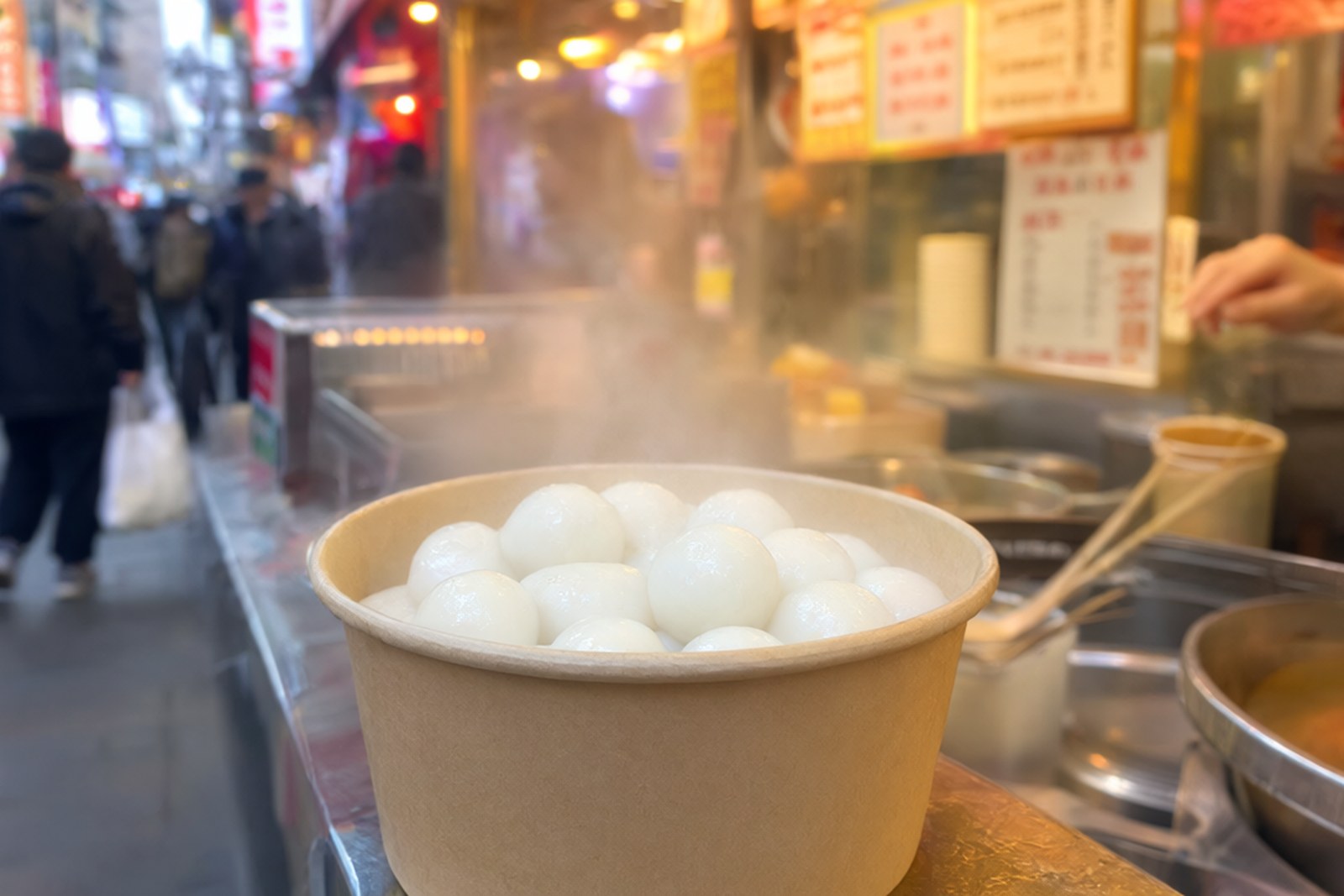
The sweet is eaten where it is sold, on and around Bayi Road at the edge of the pedestrian circle, a short walk from the metro at 较场口 Jiàochǎngkǒu Jiaochangkou or 临江门 Línjiāngmén Linjiangmen. Order the filled balls plain first, then in 醪糟 láozāo, the fermented sweet rice, which is the older way to take them; a bowl costs a few yuan, the cheapest dessert in the district, and the figure moves with the season on a 2026-10 snapshot that fluctuates, so no fixed price is printed here. Shops selling bowls of the same name and shape stand side by side on the street, and which one is the listed house and which is not is a distinction this page makes without adjudicating for the visitor – the record names the company, not a counter.
A day that makes sense of the sweet puts it last. The morning belongs to the stairways and the stalls below, the middle of the day to the pedestrian circle, the evening to a pot on its own page, and the tangyuan at the end of it, small enough that a dozen leave room for the walk home. What the record refuses is stated plainly: no claim that Chongqing invented the filled ball, because the craft’s own record starts in Hangzhou; no current retail or gift-box price, because none carries an official source; no company accounts or store counts; and no “flagship store” for any shopfront on the street, because the listed subject is a technique under a company and not a counter. The three dates stay apart, and the sweet stays small.
flowcloud would say that Shancheng tangyuan are the longan-sized filled rice balls of Yuzhong District – a Hangzhou family craft dating to 1911 that walked to Bao’an Road, today’s Bayi Road, in the early 1940s, re-planted in the local water-milled diaojiang dough and renamed for the mountain city in 1964 – listed as district heritage in 2016 and on the municipality’s sixth municipal intangible-heritage list in 2019, and the deliberate sweet bowl in one of China’s most fiercely spicy cities.
Where to find it: the tangyuan counters on and around 八一路 Bāyī Lù Bayi Road at the 解放碑 Jiěfàngbēi Jiefangbei pedestrian circle, in 渝中区 Yúzhōng Qū Yuzhong District, Chongqing Municipality, the craft’s landing street since the early 1940s; the listed subject is the Yuji technique of the Shangziyuan company, district heritage in 2016 and municipal heritage in 2019, and the shops on the street are separate operators; a bowl costs a few yuan and prices move with the season on a 2026-10 snapshot that fluctuates, and the three dates – 1911, the early 1940s, 1964 – are the page’s spine.