
Shangbixiang Street Market
Every city keeps its real self in a market, and Changsha keeps its real self behind a stone archway at the mouth of the south gate, where 书院路 (Shuyuan Road) slices an old lane in two and the neighbourhood buys its vegetables, its pickles, and its calendar.
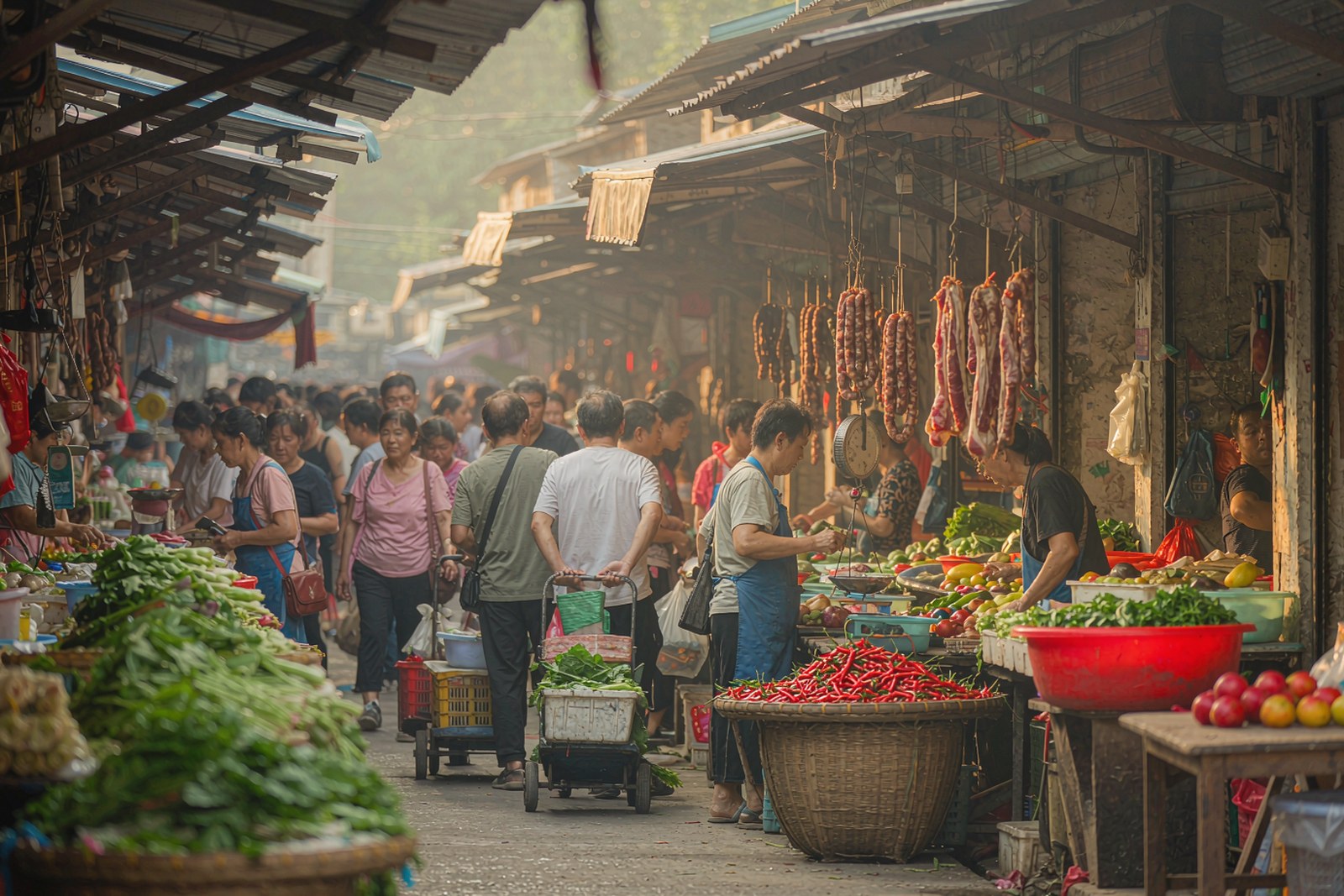
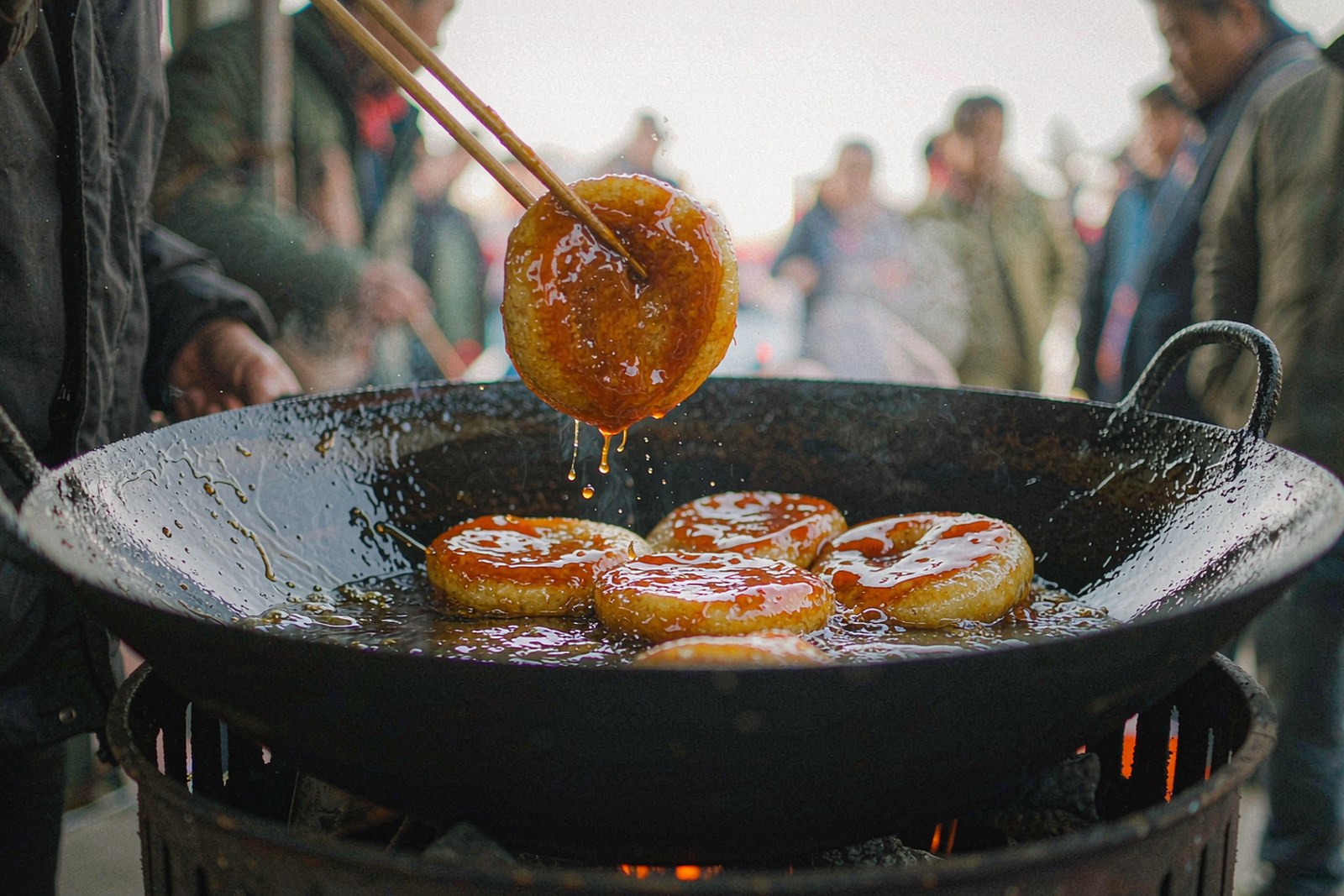
I went on a Saturday, which is a mistake and also the entire point. By half past eight the lane was already one slow river of people — grandmothers with trolleys, delivery riders pushing scooters, three teenagers filming a bowl of something on a phone held at arm’s length. Near the entrance a man was frying 糖油粑粑 (tangyou baba) in a wok the size of a bathtub, and the smell of hot caramel had spread a good twenty metres past the archway. That is how you find the place. You do not need the address. You need to be within smelling distance of the sugar.
The Street Behind the Archway
The street is called 碧湘街 (Bixiang Street), and it is older than almost everything around it. More than a thousand years ago, in the Five Dynasties and Ten Kingdoms, a king of Chu named 马希范 (Ma Xifan) built a garden palace on this ground — 碧湘宫, the Palace of the Azure Xiang — with pavilions set among green trees above the river. The palace is gone. The name stayed, and in time it settled onto a lane a couple of hundred metres long, which 书院路 now cuts neatly into two halves: 上碧湘街 (Shangbixiang Street) in the east, loud, crowded and almost entirely devoted to food; and 下碧湘街 (Xiabixiang Street) in the west, quieter, tilting toward the river, where the fishmongers work.
Nobody in the neighbourhood calls it 碧湘街. They call it 南门口菜市场 (Nanmenkou cai shichang) — the Nanmenkou market, after the south gate that once stood at the end of the road. The metro station still carries the name: line 1, 南门口, exit 2, and five minutes on foot. You come up the steps, turn the corner, and walk under a stone archway with a small tablet set into its base that reads, plainly, Site of the Palace of the Azure Xiang. Then the noise closes over your head and you are inside.
What a Market Sounds Like at Six
There is a version of this street that exists before the cameras arrive, and it is the better one.
At six in the morning the lane belongs to the people who live on it. A rice-cake steamer lets out a column of white steam that hangs in the cold air like laundry. Somebody is roasting peppers over charcoal, turning them with bare fingers while the skins blister and pop. A woman the street calls 刘姐 (Sister Liu) works a stone mortar outside her stall, pounding fire-roasted peppers with a peeled century egg and a little garlic — 烧辣椒皮蛋 (shao lajiao pidan) — the smell sharp enough to wake the whole block. Across from her the sugar-oil rice cakes drop into the oil and come up amber, and the first customers stand with both hands wrapped around a paper bag, eating upright, because sitting down would waste time.
“微辣啵?” — a little spicy? — someone asks. “表皮脆还是心子软?” — crisp skin or soft centre? — answers someone else. That, more or less, is the whole conversation of the street before nine o’clock: a negotiation about how much heat and how much crunch.
By nine the grandmothers have gone home. By noon the lane is briefly, strangely quiet. Then at six in the evening it fills again with people who have finished work and want something hot to carry home. The market never really closes. It only changes hands.
The Stalls That Outlasted the City
What separates 上碧湘街 from the pretty food streets a few blocks away is that almost nothing here was built for visitors. These are family workshops, and most have been in one family for decades.
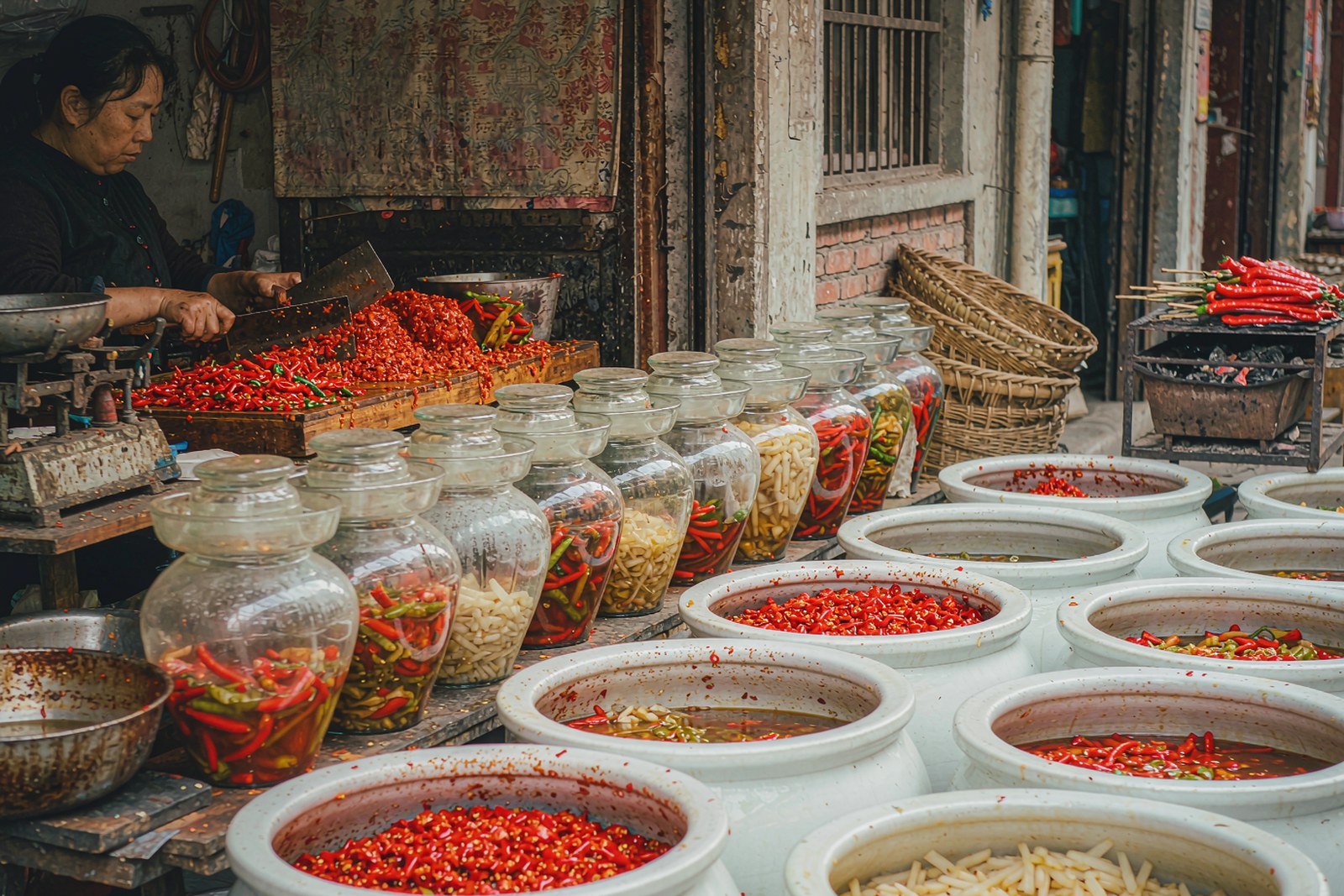
At number 2, right at the entrance, stands 湘军剁辣椒 (Xiangjun duolajiao), a chili shop that has occupied the same fifteen square metres since 1998. The recipe came from the owner’s mother: bird’s-eye chilies chopped by hand, salted, dressed with light soy, packed into jars labelled with the date and the hour of packing, then left a week before they are sold. Nothing is added to keep them. The bestseller is 木瓜丝 (mugua si), shredded papaya tossed in red oil — bright, sharp, and gone within the week. You can taste before you buy; there is a jar of toothpicks on the counter for exactly that. A good share of the orders leave the country.
At the western end, two shops sell 捆鸡 (kunji) side by side — 勇哥 (Brother Yong) and 浪哥 (Brother Lang) — two families, thirty years each, one of them run by a father and his daughter, both insisting theirs is the only real one, neither of them remotely worried about the other. 捆鸡 is bean curd skin bound into a tight roll and braised until it slices like meat; Brother Yong’s comes in three strengths, plain, garlic and hot, and it is the hot one you want — garlic first, then chili, then the long slow return of the braising liquid. Next door, Brother Lang sells the same thing to a clientele that cannot be argued out of it. In most cities that would be a war. Here it is simply how the street works: the same trade, clustered together, each stall with its own people.
There is 汪记生煎包 (Wang’s shengjian bao), which opens only between April and November, because — the owner says — once the weather turns hot the dough will not rise evenly, and a shengjian bun with an uneven skin is not worth selling. There is 碧湘源炒货 (Bixiangyuan roasted seeds) at number 46, four generations and more than thirty years in one shop, the first on the street to roast plain watermelon seeds; the grandmothers buy them by the bag, along with dried sweet potato, hawthorn slices and salt-dried melon seeds. There is 湘潭易哥 (Xiangtan’s Brother Yi) frying 葱油粑粑 (congyou baba), scallion-oil rice cakes, two yuan each, crisp enough to shed flakes down your shirt. And there is 芙蓉嘴 (Furong Mouth), the newest thing on the street: potato crisps fried to order and mixed from eight flavours while you wait, which is precisely the kind of stall those teenagers were filming by the archway.
A Calendar You Can Eat
Here is the thing I keep coming back for. A vegetable market is a calendar, and this one is more honest than most.
The old Hunanese phrase is 不时不食 — do not eat what is out of season. On this street it is not a philosophy. It is an inventory. Come just after 立春 (Lichun, the start of spring) and the first 香椿 (xiangchun, Chinese toon) and 水芹 (shuiqin, water dropwort) appear at the entrance in small, expensive, entirely worthwhile bundles. Come at 惊蛰 (Jingzhe), when the first thunder rolls, and the 地木耳 (di muer, “earth ear” fungus) has come up dark and gritty on the wet grass, sold by the handful. Around 谷雨 (Guyu) the bamboo shoots lie in a sloping heap, still carrying their soil. 立夏 (Lixia) brings green broad beans and young edamame; 夏至 (Xiazhi) brings lotus stems, river snails and the first small crayfish. When 立秋 (Liqiu) arrives the chestnuts go into the wok with sugar and black sand, and by winter the western end of the lane is hung with cured pork and sausages, 糍粑 (ciba, pounded glutinous rice cakes) stacked in trays, and jars of sweet fermented rice standing on every counter.
Walk this street in July and again in December and you eat two entirely different cities. Very few restaurants in Changsha can say that. A market can.
Then the Internet Found It
I should be honest about what has changed, because a great deal has.
上碧湘街 is now, by any measure, a 网红 (wanghong) — an internet-famous place. Open the short-video apps on any afternoon and you will find the same shots, endlessly re-cut: a close-up of caramel pulling off a rice cake; a slow pan along the chili jars; a young woman holding a paper cone of fried potato and telling the camera that you have to come here. There are guides listing the “must-eat seven”. There are queues at nine in the morning where three years ago there were none.
It would be easy to be precious about this. I am not going to be. A market that survives on the custom of its own neighbourhood and nothing else is a market that eventually closes. The grandmothers who buy the watermelon seeds are getting older, and not all of their children are going to take over a counter selling dried hawthorn. If a phone brings money to a woman who has chopped chili for twenty-five years, that is not a loss. That is a pension.
And there is a real difference between this street and the ones built to be photographed. There is no 茶颜悦色 here. There is no neon, no brunch menu, no queue rope. Nothing has been re-fronted to look older than it is. The stalls that are busy now were busy before — only with different people. The street did not change itself in order to be discovered; it was discovered exactly as it already was. That is the whole reason it is worth the trip.
What I would ask of anyone who comes, and what I ask of myself, is simple: buy something. Not photograph something — buy it. A jar of the shredded papaya. A roll of the hot 捆鸡. Two yuan of scallion rice cake, eaten standing up with the oil still on your fingers. This is a shop, not a set, and the people in it are at work. Stand aside for the trolleys. Do not block the scales. And when you point a phone at a wok, remember that the person behind it has been standing there since five.
How to Walk It
Go in the morning. Eight to nine is the sweet spot — the produce is at its best, every snack stall is up, and the crowd is still local. Noon is dead, which is its own small pleasure. The evening rush, after six, is the other good window, though by then the day’s best vegetables have gone.
Take metro line 1 to 南门口 (Nanmenkou) and leave by exit 2; the archway is five minutes on foot. Buses stop at 碧湘街 as well. If you drive, do not park along the road, however tempting the neat row of parked cars appears — that row is policed with remarkable efficiency. There is a proper car park across the road.
Enter from the archway on 书院路 (Shuyuan Road) and walk east to west, which is downhill in spirit if not in fact. The lane is only a few hundred metres long: walk the whole of it once without buying anything at all, so that you know what you are choosing between. Then walk back and start eating. The fried things — the rice cakes, the shengjian buns, the crisps — must be eaten on the spot, within minutes, or not at all. The things that travel — the chili, the 捆鸡, the roasted seeds, the cured meats — buy more of than you think you need; they are the whole reason to come. A person eating from one end to the other can do it for around thirty yuan and still have change for the bus.
The last word I want to leave is not about food. Stand at the western end, where the lane tips toward the river and the crowd thins, and you can see 杜甫江阁 (Du Fu Pavilion) standing above the rooftops, with the smoke of the streets drifting under it. A thousand years ago this was a palace garden. Then it was a vegetable market, then a chili shop, then a place on a phone. It has been all of these things without ever once announcing itself. It is still, on a Saturday morning, simply where Changsha buys dinner.
Come early. Bring small notes. Buy something.
Where to find it: 上碧湘街 (Shangbixiang Street), Nanmenkou, Changsha — the lane behind the stone archway on 书院路 (Shuyuan Road), a five-minute walk from metro line 1, 南门口 station, exit 2. Mornings, eight to nine.