
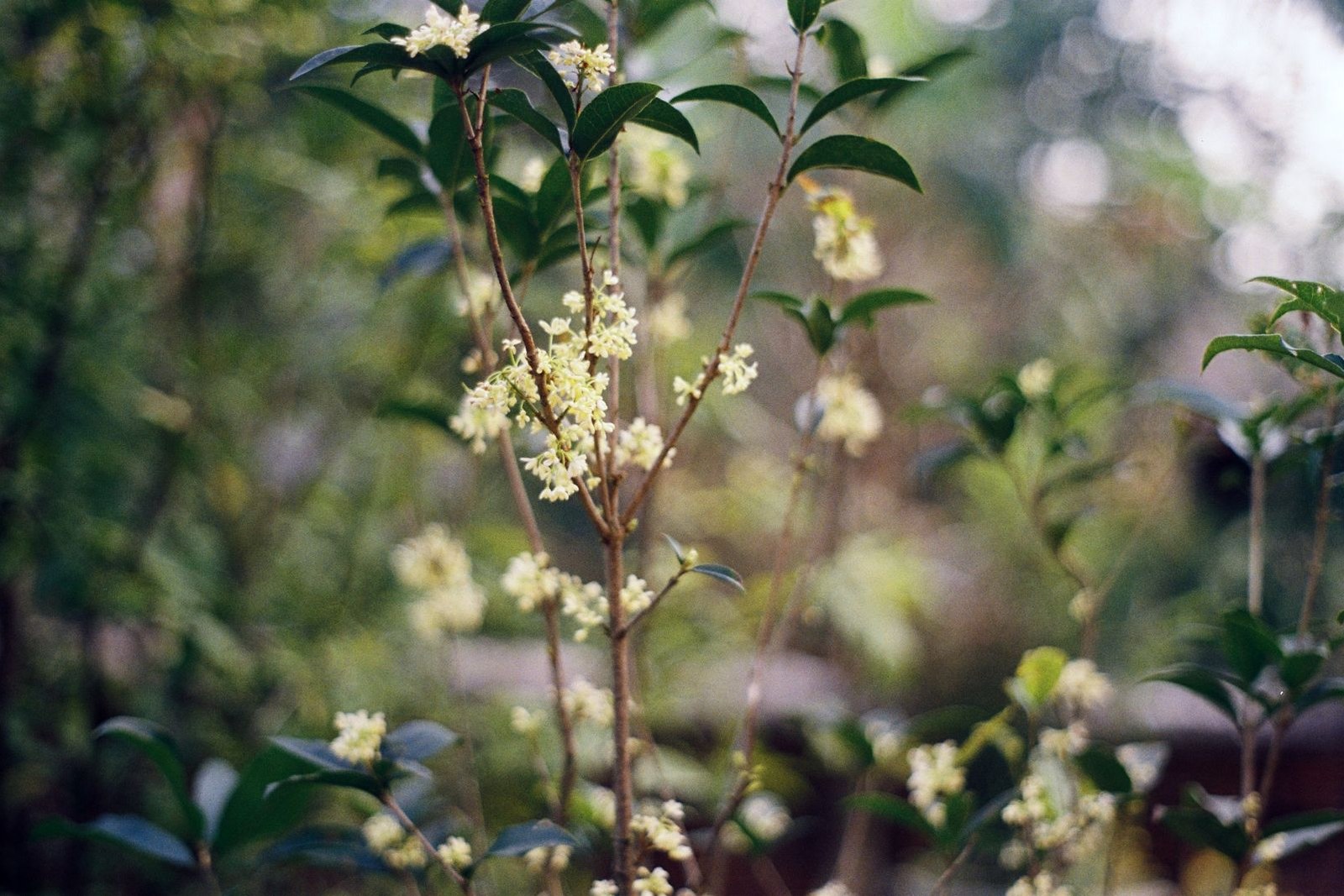
On an August morning on 南山 Nánshān Nanshan, before the heat, pickers go up the osmanthus rows with baskets and white cloths, and by afternoon the blossom has come down the mountain to the streets at its foot. Chongqing is a municipality of southwest China, and 南岸区 Nán’àn Qū Nan’an, its south-bank district, holds both ends of that journey: the ridge where the flowers grow, and 上新街 Shàngxīnjiē Shangxinjie at the mountain’s foot, where a family workshop turns them into wine. This page is about that bottle – the district’s drink to its spring-water chicken, which keeps its own page – and five generations of one family’s calendar: the flower, the sorghum spirit, three hundred unhurried stirs.
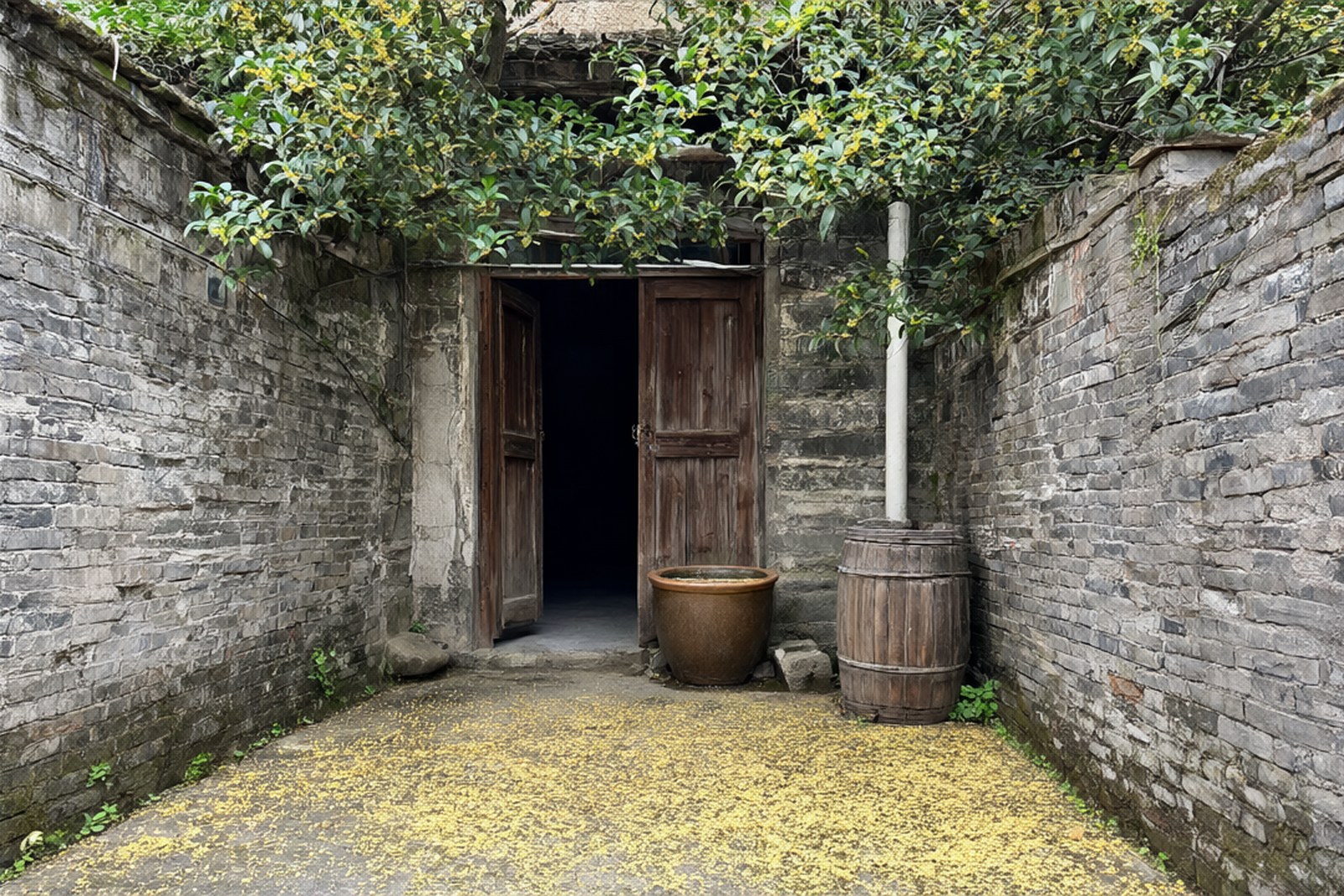
The workshop is the 贾氏桂花酒 Jiǎshì guìhuā jiǔ, the Jia family’s osmanthus wine, down a lane off the Shangxinjie road behind a wall of old brick and green. By the family’s account, the craft was set out in the late Qing and early Republican years by the great-grandfather 贾同绿 Jiǎ Tónglǜ Jia Tonglü, and has passed hand to hand for a century – the recipe, the family notes, now older than the hundred-year osmanthus trees it depends on. The state’s paperwork confirms the standing: in January 2014 the technique entered Chongqing’s fourth batch of municipal intangible cultural heritage, the fourth-generation brewer named its representative bearer, and the house holds the time-honoured-brand designation – a Chongqing municipal title, this page notes, not a national one.
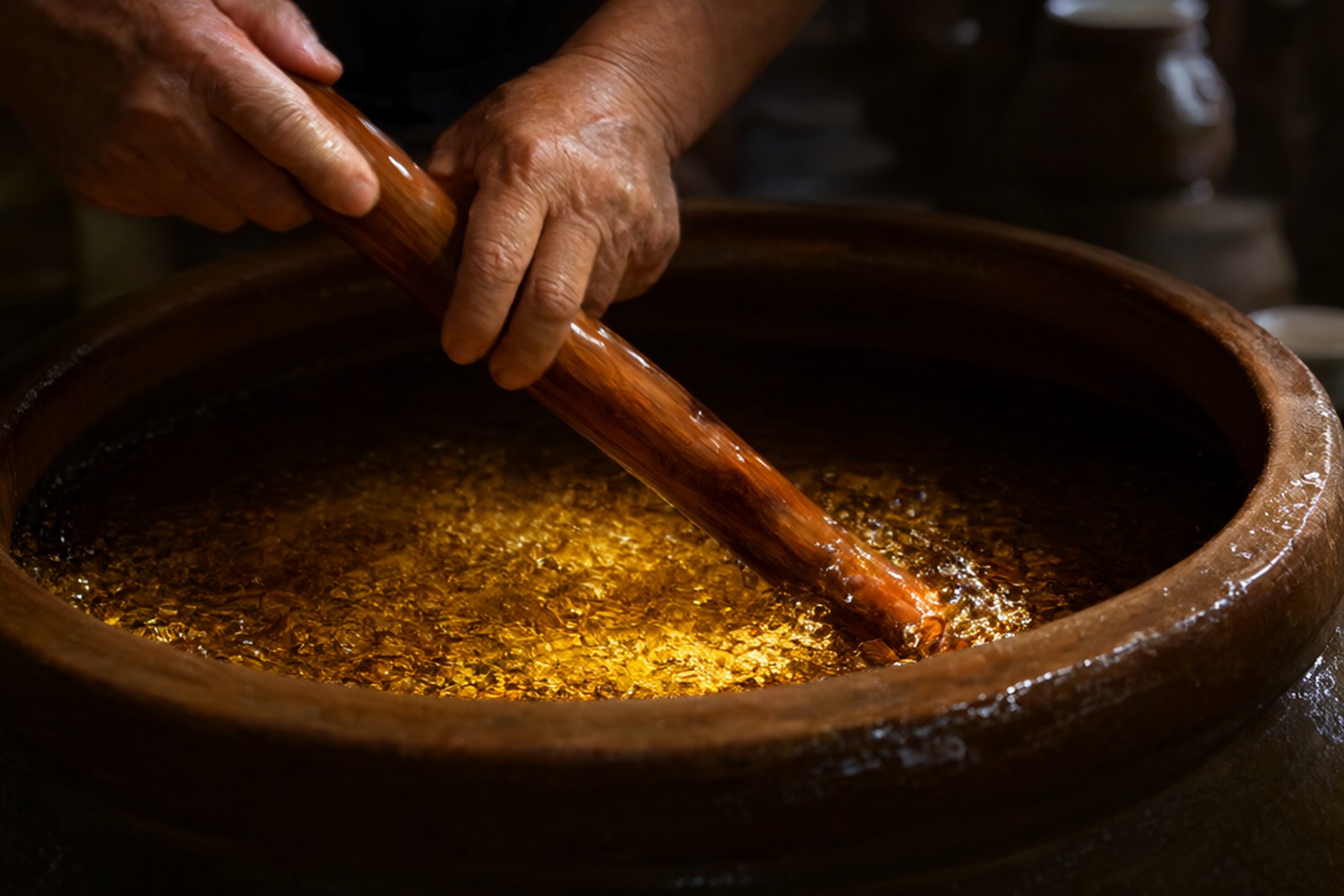
The making runs on the mountain’s clock. Every August, around the full moon, the family gathers 桂花 guìhuā blossom on Nanshan, taking only the 金桂 jīn guì golden and 银桂 yín guì silver varieties at their densest bloom, picked in the morning and worked the same day; nearby hill households join the harvest for the season’s income. The base is a strong 白酒 báijiǔ distilled from sorghum, into which go a dozen-odd herbs and honey – proportions the family keeps to itself. The flowers and the additions are packed into osmanthus-wood vats, sealed, and left to ferment three months to half a year; the official craft list runs eight steps, screening, blending, sealing, fermenting, cellaring, turning, filtering and bottling. Then the rule the family is known for: the vat is stirred by hand, three hundred slow circles with an osmanthus-wood paddle, not one fewer – the paddle in service has six decades of work in it.
The workshop’s address is a choice, not an inheritance of place. In 1991 the fourth-generation brewer 贾紫焰 Jiǎ Zǐyàn Jia Ziyan – born in 1944, in the trade since sixteen, sixty-one years at the vats by the 2021 reporting – moved the family works to the busy Shangxinjie road, and in 1993 registered the 紫焰 Zǐyàn “purple flame” trademark and set up the wine works there. The succession had a wobble: the children at first wanted other lives, to the old brewer’s open worry, until 2018, when his daughter 贾菲 Jiǎ Fēi Jia Fei – a finance director who had left the desk – came home as the fifth generation and took up the paddle. The flower trade binds the lane to the hill: the blossom still comes down from Nanshan’s groves by the 2021 reporting, a hill family’s steadiest autumn income for decades – the record keeps one dated figure, forty-five yuan a jin in 1994. What the maker says of the finished wine is flavour-talk only – mellow, and slow to show its strength, by his own description – and this page repeats it as that and nothing more, no effect on the body claimed.
Words and Names
上新街 Shàngxīnjiē is Shangxinjie, the old quarter at the mountain foot on the south bank. 桂花酒 guìhuā jiǔ is osmanthus wine, steeped from the osmanthus blossom; 桂花 guìhuā the blossom itself, Nanshan’s autumn signature. 金桂 jīn guì and 银桂 yín guì the golden and silver varieties gathered for the wine; 打桂花 dǎ guìhuā “beating down the osmanthus”, the harvest of shaking blossom onto cloth. 贾氏桂花酒 Jiǎshì guìhuā jiǔ is the Jia family’s wine, a municipal intangible-heritage craft since January 2014; 紫焰 Zǐyàn “purple flame”, the brand registered in 1993; 高粱白酒 gāoliáng báijiǔ the sorghum spirit base; 封缸 fēnggāng the sealing of the vat that starts the fermentation; 非遗 fēiyí intangible cultural heritage; 重庆老字号 Chóngqìng lǎozìhào the Chongqing time-honoured-brand designation, a municipal title.
What the Locals Know
The neighbours navigate by nose: in autumn the lane smells of blossom over spirit, and directions to the workshop are given not as an address but as 闻到就到了 – when you smell it, you’ve arrived. The drinking occasions are domestic: mid-autumn family dinners, and winter evenings when a small cup warms the hands – sipped slowly with peanuts, never a toasting wine. The three-hundred-stir rule is local lore: even the family’s children are said to have asked why, and been told the ancestors’ rule does not bend – stubbornness residents admire in craftsmen. Buyers plan around the season – output is small, the fullest shelves nearest the harvest – so out-of-season callers get the lane, the old vats and the wall of green.
flowcloud would say that the Jia family’s osmanthus wine is a five-generation workshop off Shangxinjie at Nanshan’s foot – a late-Qing family recipe, by the family’s account, made each August from golden and silver osmanthus gathered on the mountain, steeped on a sorghum spirit with a dozen-odd herbs and honey, sealed in osmanthus-wood vats for three months to half a year and stirred by hand, three hundred turns of a sixty-year wooden paddle, every batch – a craft on Chongqing’s municipal intangible-heritage list since January 2014, carried since 2018 by a fifth generation that left finance for the vats.
Where to find it: the 紫焰 Zǐyàn osmanthus wine workshop off 上新街 Shàngxīnjiē Shangxinjie, 南岸区 Nán’àn Qū Nan’an District, Chongqing Municipality – a small family works down a lane, not a shopfront, with metro line 6’s Shangxinjie station the reference point. Visits and purchases must be confirmed on site before setting out: the public-record operating picture stands at the 2021 reporting, with no later update found as of the October 2026 check, and no hours or contact details are invented here. The wine is an alcohol product – this page claims and repeats no effect on health, quoting the maker on flavour only. Harvest-season visits, August into autumn, meet the lane at its most fragrant; dates and figures above are from public reporting checked October 2026.