
The test is always the same one. Someone at the table picks up a beef ball in their chopsticks, drops it onto the plate from a few centimetres up, and watches it come back. A good 牛肉丸 niúròu wán from Shantou will rise off the plate with a small spring and sit there, round and slightly glossy, instead of slumping into a puddle. That bounce is the entire proposition of the food, and it is why the local definition of a beef ball is closer to a rubbery morsel of pure protein than to the soft, crumbly meatball most of China makes from mince bound with breadcrumb and egg. There is no breadcrumb here. There is no egg. There is beef, a little salt, a little starch, and an amount of physical work that would be absurd if the result were not so distinctive.
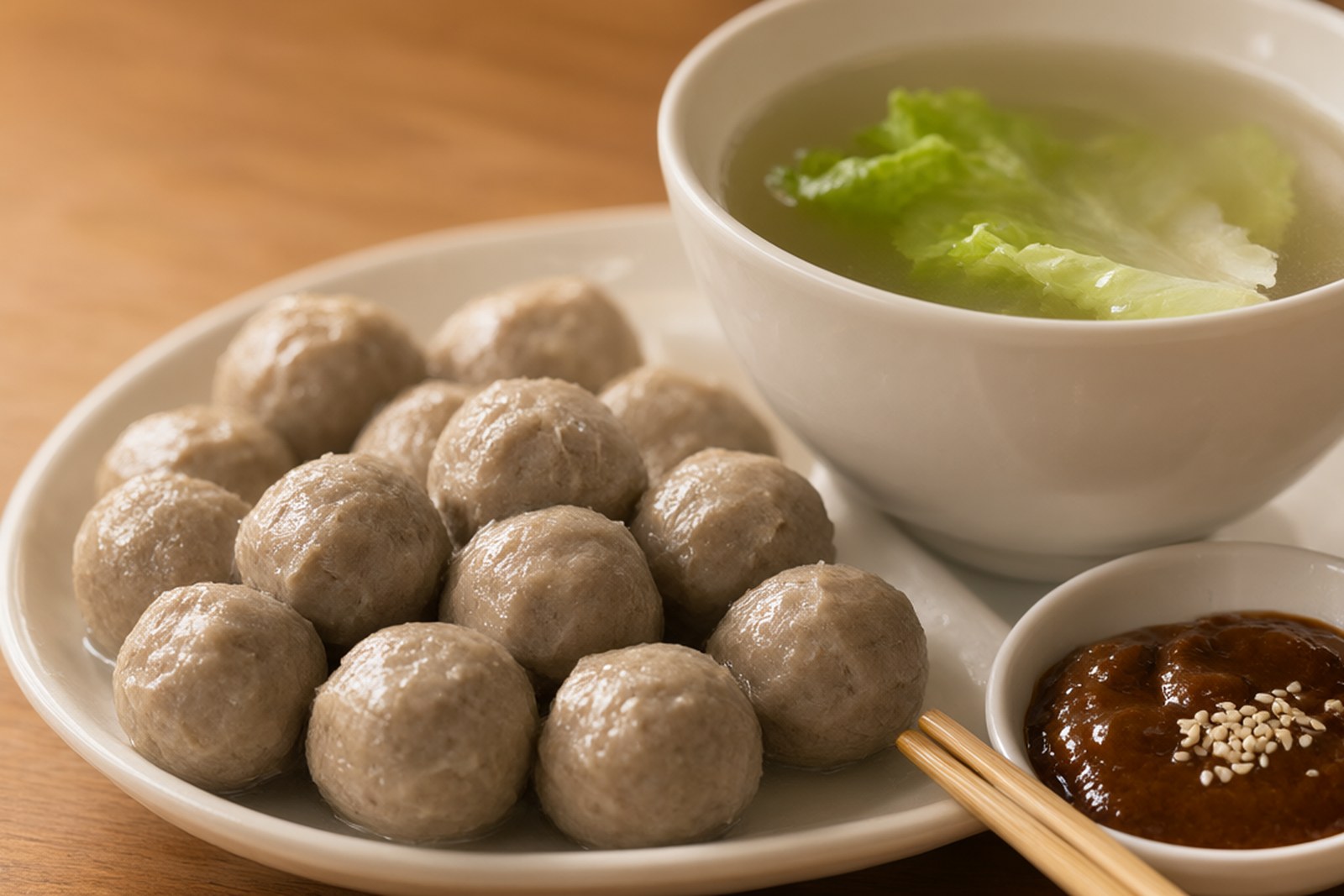
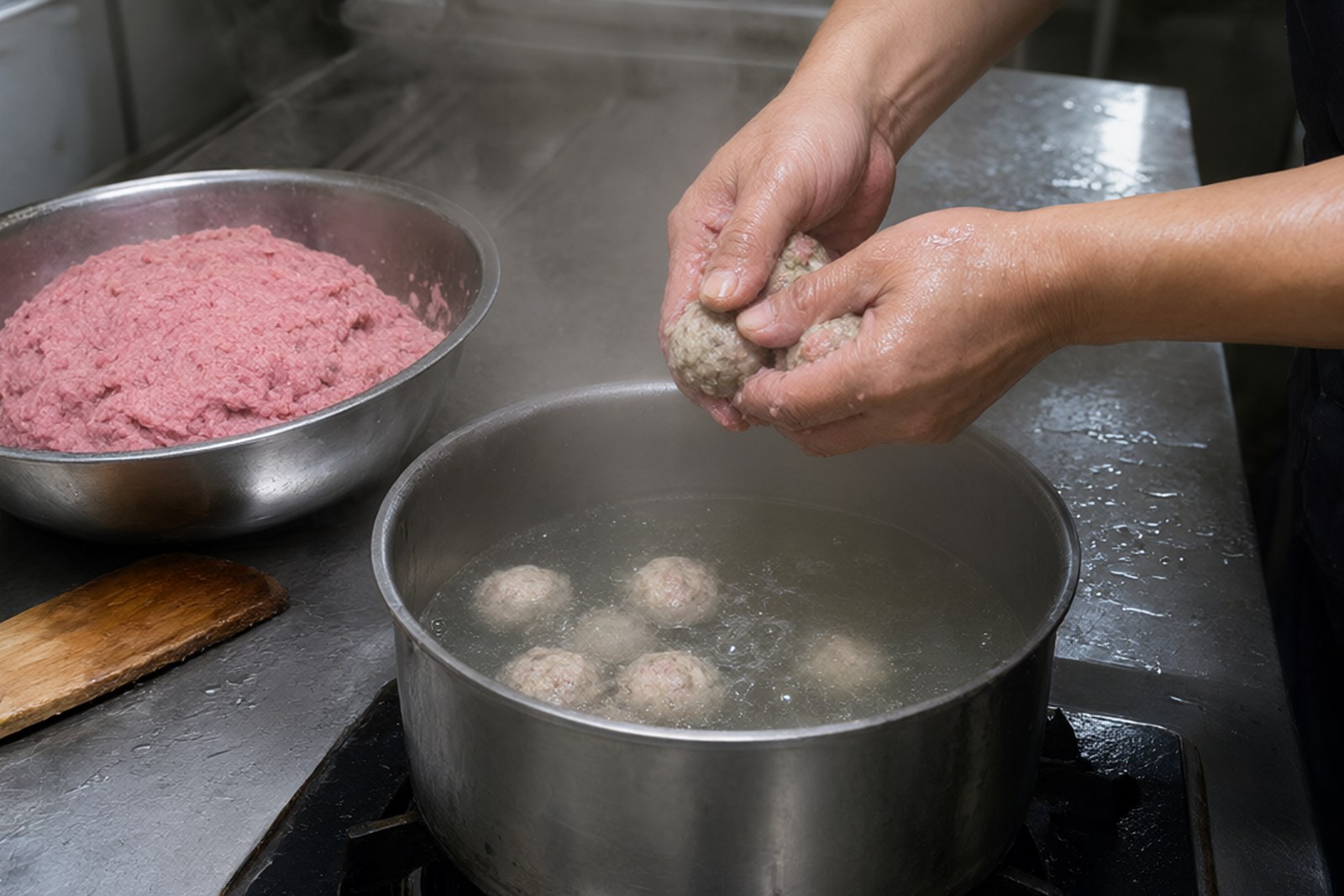
The technique is older than the city’s most famous restaurants and it comes out of the Hakka cooking of the inland hills. Beef is trimmed of sinew and fat, then pounded with heavy wooden or iron mallets until the muscle fibres are broken down into a fine paste rather than chopped into pieces. The distinction matters, because mincing cuts the fibres short while pounding stretches and shears them, and it is the stretched protein that traps air and sets into a springy gel when the paste is dropped into hot water. The pounded meat is worked with salt until it becomes sticky and light, then a little sweet potato starch and sometimes a spoon of ice water is beaten in, and the mass is squeezed through the fist so that each ball is formed by hand. A bowl of clear broth, a few leaves of lettuce and a dish of sauce are all that is added afterwards.
Why It Springs
The springiness is not a trick and it is not a chemical additive in the traditional version; it is the physical consequence of how the meat is treated. Muscle protein, when it is beaten and salted, unwinds and binds water, and if the paste is then held at the right temperature it forms a network that resists compression and pushes back. This is the same principle that makes a good sausage snappy and a bad one crumbly, taken to an extreme. Two things ruin it, and both are common outside Shantou. The first is heat during preparation, because a paste that warms while being worked will not hold; traditional kitchens keep the meat cold and sometimes work it over ice. The second is dilution, because the moment a maker adds enough starch, water or filler to stretch the beef further, the network is interrupted and the ball goes soft. The reason a Shantou ball costs more than a meatball elsewhere is that it is, by weight, almost entirely beef.
Cooking is equally strict. The balls go into water that is barely moving, around the temperature where it steams but does not boil hard, and they are done in a few minutes when they float and swell. Boiling them vigorously makes them tough; leaving them in too long makes them hollow. The finished ball is dense and slightly translucent at the edges, with a texture that resists the tooth and then gives. Eaten on its own it is faintly saline and clean-tasting, closer to a piece of poached seafood than to a Western meatball, which is why the local dip is often 沙茶酱 shāchá jiàng, a sweet-savoury satay-style sauce, rather than anything tomato-based.
Words and Names
牛肉丸 niúròu wán is a beef ball, and 潮汕牛肉丸 Cháoshàn niúròu wán is the regional name that carries the guarantee of quality, 潮汕 Cháoshàn being the old name for the Shantou region as a whole. 手打 shǒu dǎ means hand-beaten and is the phrase on the signboards that matters most; 机打 jī dǎ, machine-beaten, is the honest alternative and produces a coarser, less elastic ball. 牛筋丸 niújīn wán is a variant with chopped sinew left in for a chewier, more savoury ball, and it is the one many locals actually prefer. 沙茶酱 shāchá jiàng is the dipping sauce, a thick blend of peanut, sesame, dried shrimp, garlic and chilli that came from Southeast Asia through the ports. 粿条 guǒtiáo is the flat rice noodle the balls are commonly served in, and 清汤 qīngtāng is the clear broth.
What the Locals Know
Buy from a shop that makes them on site, and watch the machine or the mallet before you buy, because a ball that has been sitting in a refrigerated case for days loses its bounce quietly. The freshest ones are barely cool and still smell faintly of raw meat. Boil them at home in water that is steaming but not rolling, take them out the moment they float, and do not stir them while they cook. If you are eating in a 牛肉丸 shop, the standard order is a bowl of 粿条 with three or four balls in it, a side of 沙茶酱, and a scatter of 芹菜 qíncài, Chinese celery, which the kitchen adds to the broth at the last second. Prices run from about fifteen yuan for a takeaway bag to forty or fifty for a sit-down bowl with extra beef, and the difference between the cheapest and the best is entirely in how much beef is in the ball.
flowcloud would say that the Shantou beef ball is a rare case of a food whose quality can be checked in one second by a child, since it either bounces or it does not and no amount of clever sauce can hide the answer.
Where to find it: the 牛肉丸 shops of the old quarters and the 小公园 Xiǎogōngyuán arcade district, where several houses pound and boil in the same small room, plus the dedicated 潮汕牛肉丸 stalls inside most wet markets. Watch for 手打 on the sign, buy a few hot ones to eat standing up, and take a vacuum-sealed bag home if you want to test the bounce in your own kitchen.