
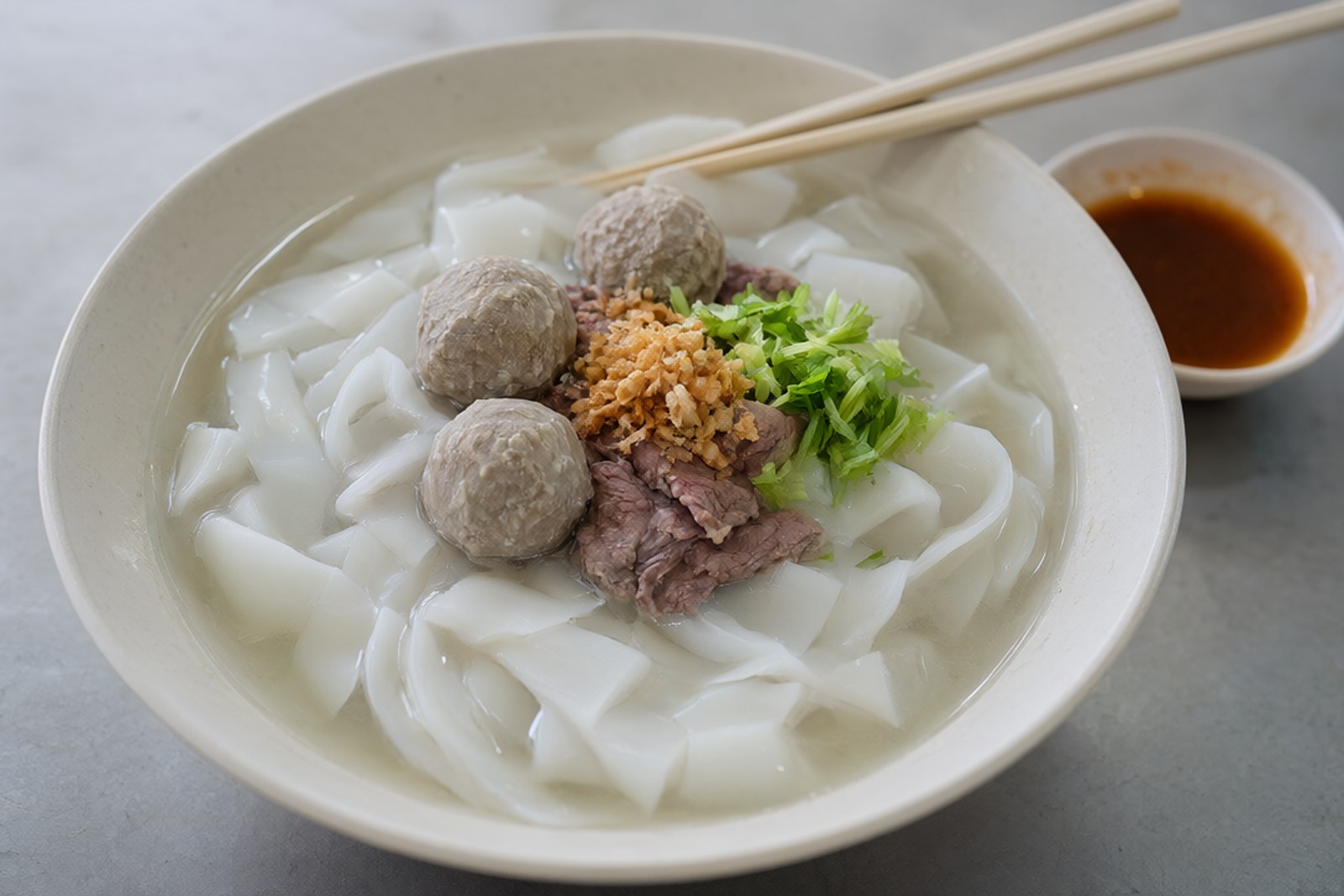
The bowl that Shantou eats in the morning is a tangle of wide, flat, slightly slippery rice ribbons in a clear broth, with two or three beef balls, a few slices of meat, a scatter of fried shallot and a spoon of the sauce you choose at the table. 粿条 guǒtiáo is the local name, and it is the single most common food in the city, sold from dawn in shops that do nothing else. It is not the same as the Cantonese 河粉 héfěn and not the same as Vietnamese pho, though all three are flat rice noodles, because the Chaoshan version is made fresh and used the same day, blanched for seconds rather than simmered, and served in a broth that is deliberately plain so that the noodles and the toppings carry the bowl.
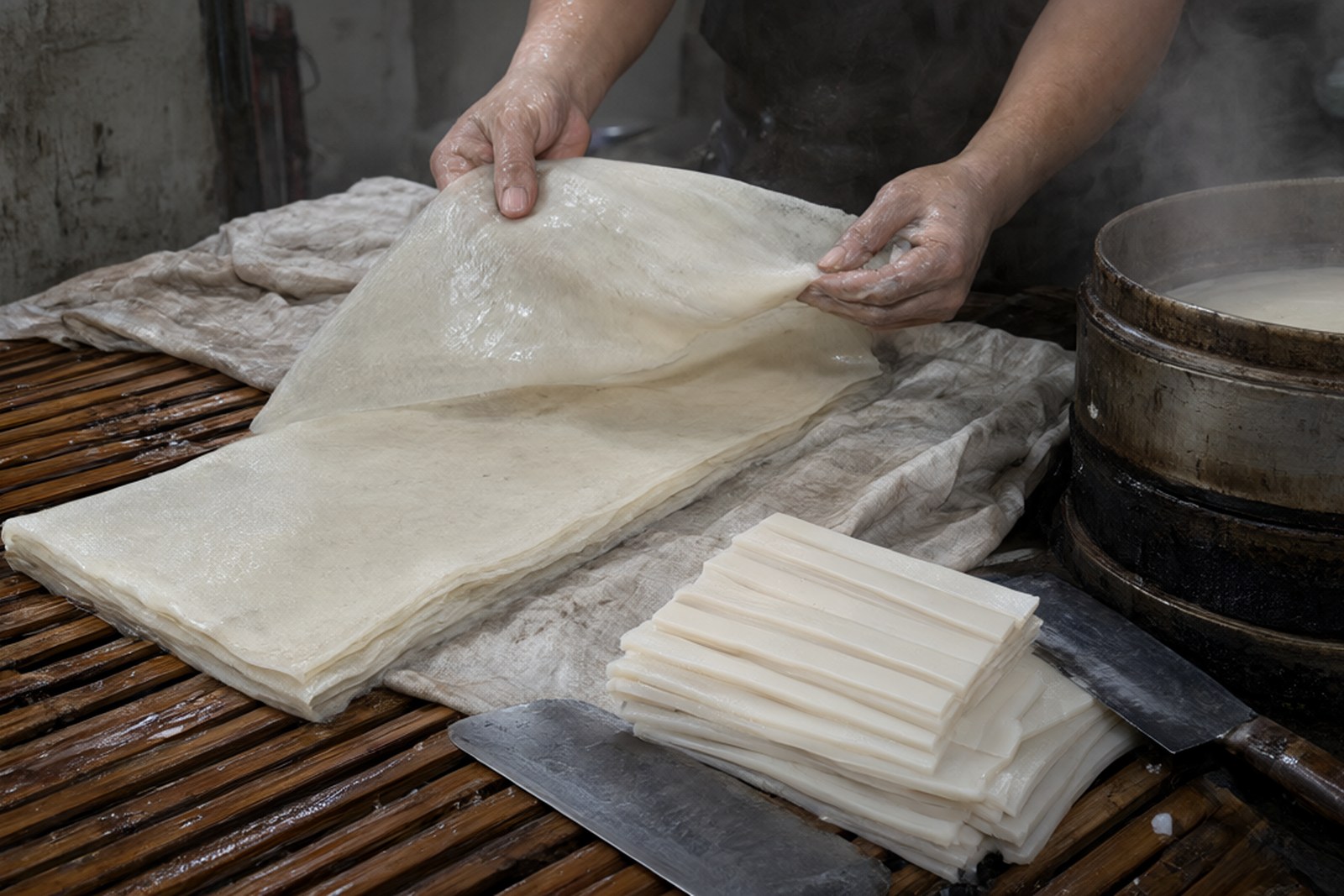
The noodle itself is made from rice soaked overnight, ground with water into a batter, poured thin onto a cloth stretched over a steamer, cooked as a sheet for a couple of minutes and then cut into ribbons. Because it is fresh, it is soft, faintly sweet and slightly elastic, and it needs almost no cooking; a shop will drop a portion into boiling water, lift it out with a wire skimmer after perhaps twenty seconds, and put it straight into the bowl. The broth is usually a light pork or bone stock, sometimes with a piece of dried fish or a little 大地鱼 dàdì yú for depth, and it is intentionally under-seasoned because the toppings are salty. This is why a plate of 粿条 with nothing on it is a sad thing, and a properly built bowl is a small composition.
A Bowl Built to Order
The defining feature of a 粿条 shop is that you assemble the bowl in conversation with the person cooking it. The noodle and the broth are fixed; everything else is chosen. The common toppings are 牛肉丸 niúròu wán, beef balls, 牛筋丸 niújīn wán with sinew, thin slices of 牛肉 niúròu that cook in the broth in seconds, 牛杂 niúzá, the offal mixture of tripe, tendon and lung, 猪肉丸 pork balls, 猪肝 pork liver, and 鱼丸 fish balls. A bowl can be as plain as noodle and broth or as loaded as a mixed grill, and the price rises with each addition, which is why the same shop serves a fifteen-yuan breakfast and a fifty-yuan one at adjacent stools.
Two condiments finish the bowl and both are local habits rather than optional extras. The first is 炸蒜茸 zhá suàn róng, fried chopped garlic, which is spooned over the noodles and gives them a toasted, faintly sweet savour. The second is 沙茶酱 shāchá jiàng, the peanut-and-shrimp satay sauce, which can be stirred into the broth or kept in a saucer for dipping. A third, 辣椒酱 làjiāo jiàng, chilli sauce, is on every table. Vinegar is available and mostly ignored, because the local taste is for savoury and sweet rather than sour. The correct sequence is to eat the toppings first while they are hot, then the noodles, then to drink the broth, which by that point has taken on everything that was put in it.
There is a dry version too. 干粿 gān guǒ is the same noodle drained and tossed with 沙茶酱, a little lard and fried garlic, served with a separate small bowl of clear soup on the side. It is heavier and more intensely flavoured, and locals order it in the evening when they want something more substantial than the soup version.
Words and Names
粿条 guǒtiáo is the flat rice noodle and the name of the whole dish; 粿 guǒ is the general Chaoshan word for a starch cake and appears in dozens of dish names. 汤粿条 tāng guǒtiáo is the soup version and 干粿 gān guǒ the dry one. 牛肉丸 niúròu wán is a beef ball and 牛筋丸 niújīn wán the version with sinew; 牛杂 niúzá is beef offal and 猪肝 zhūgān pork liver. 炸蒜茸 zhá suàn róng is fried garlic, 沙茶酱 shāchá jiàng the satay-style sauce and 辣椒酱 làjiāo jiàng chilli paste. 大地鱼 dàdì yú is the dried flatfish used to deepen a stock, and 芹菜 qíncài is the Chinese celery scattered over the bowl at the end.
What the Locals Know
Go early. The best 粿条 shops open around six in the morning, sell through the breakfast rush and close when the day’s fresh noodle runs out, which in a good shop is before two in the afternoon. Ask for the noodle 现切 xiàn qiē, cut to order, if the shop offers it, because a freshly cut ribbon is softer than one that has been sitting. Order the broth plainest the first time so you can taste the noodle, then add toppings on a second visit. If the shop has 牛杂, take it, because a good offal mix is the mark of a kitchen that butchers properly. Prices start at about ten yuan for a plain bowl and rise with each topping; the range in the city is from ten to sixty yuan for essentially the same dish, and the difference is almost entirely in what you put in it.
flowcloud would say that kway teow is the honest measure of a city, since it is cheap enough to be eaten every day, plain enough that a bad broth cannot hide, and flexible enough that no two people order the same bowl.
Where to find it: the 粿条 shops on every commercial street in the old town, and especially those around the markets where the noodle is delivered fresh each morning. Look for a shop with a pot of broth at a rolling simmer, a tray of toppings laid out in bowls and a queue of people who are clearly on their way to work.