
It comes off the griddle as a dark-edged, chewy, faintly elastic disc with small oysters buried in it, and it is eaten with a saucer of fish sauce and a handful of coriander on top. 蚝烙 háolào is the Shantou street snack that visitors most often mistake for something they already know. It is not a Western omelette and it is not the oyster omelette of Fujian or Taiwan, though all three share an ancestor. What makes the Shantou version its own thing is the batter, which is sweet potato starch rather than wheat flour, and the cooking, which is done fast on a very hot flat iron with a lot of lard. The starch sets into a translucent, slightly rubbery sheet rather than a spongy cake, so the finished dish is closer to a crisp-edged pancake studded with oysters than to eggs.
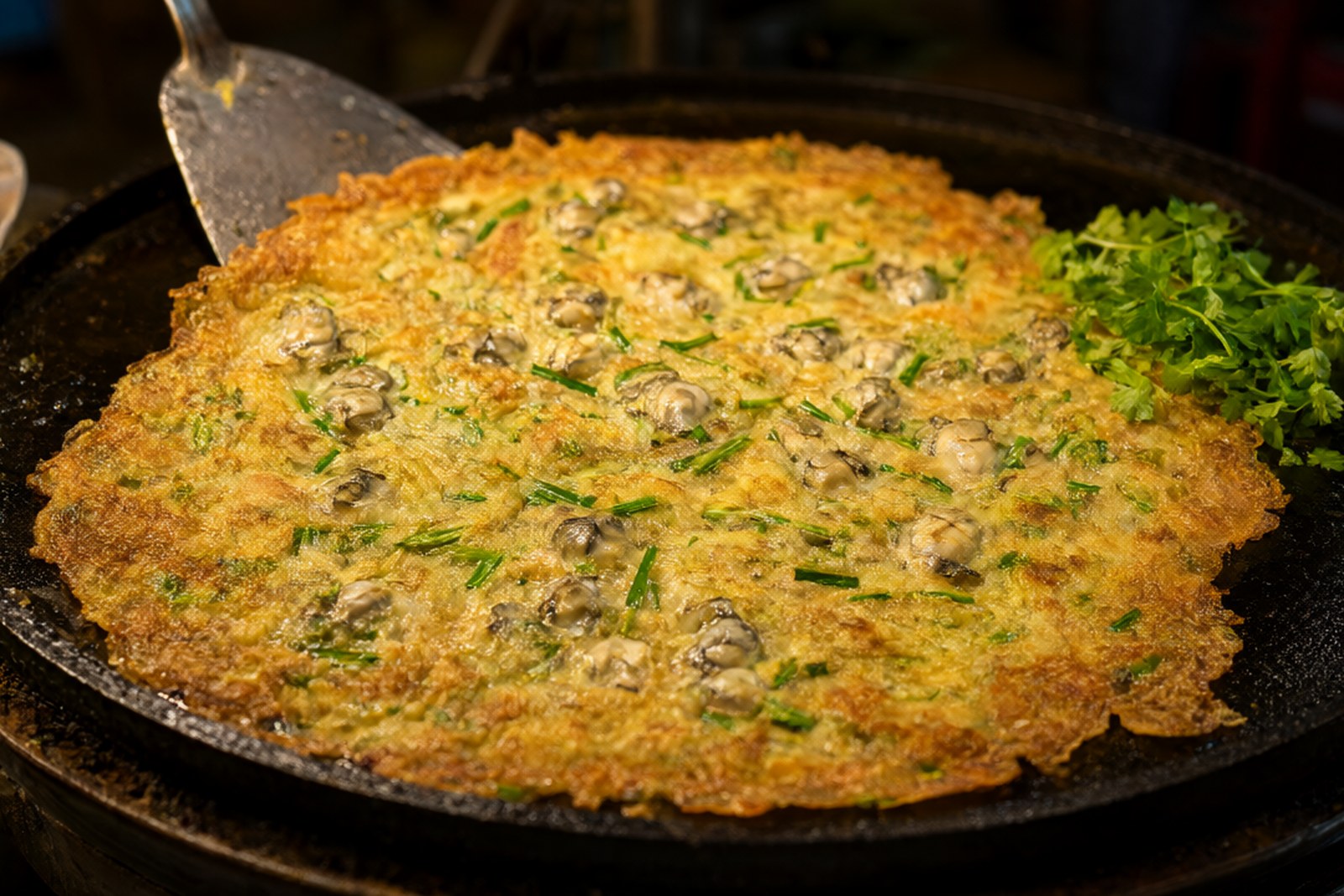
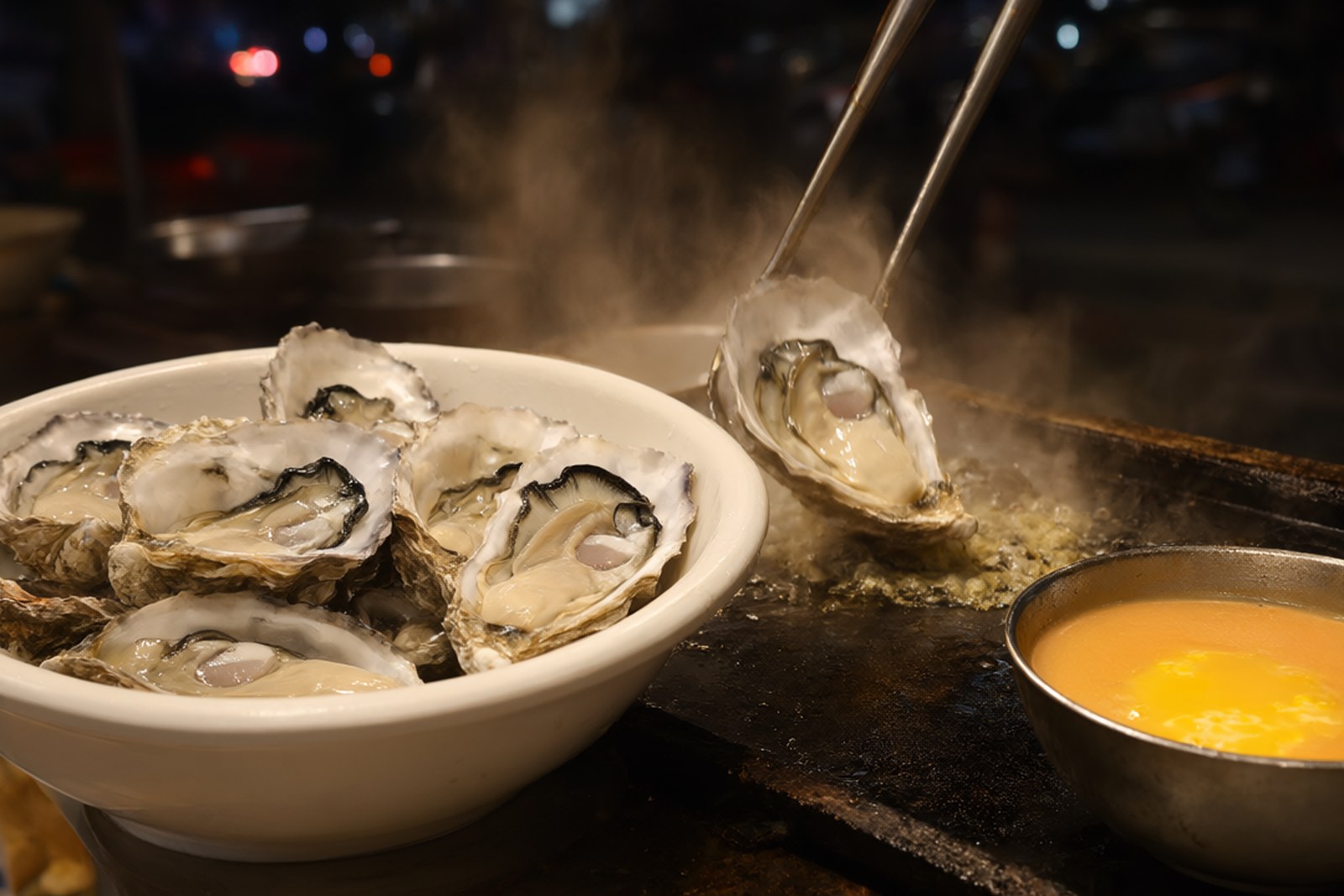
The oysters are the small ones that grow on the mud of the estuary, about the size of a thumbnail, and they go into the pan raw, still wet, straight from a bowl of cold water. Eggs are beaten and poured over them, sweet potato starch slurry is added, and the whole thing is fried in a generous pool of lard until the underside is set and browned and the top is just cooked. The technique is in the timing, because the starch needs long enough to lose its raw taste and the oysters need to be removed from the heat while they are still plump. A good 蚝烙 is crisp at the rim, soft in the middle and juicy around each oyster, and it is served in wedges, at street stalls, for a few yuan, eaten on the spot with a plastic fork.
The Starch That Makes It
Anyone who has tried to reproduce 蚝烙 at home with cornflour or wheat flour has met the reason the dish cannot leave the region easily. Sweet potato starch, 番薯粉 fānshǔ fěn, behaves differently from grain starch: it gelatinises into a tough, springy, semi-transparent gel rather than a soft paste, and it holds that texture when it is fried hard. That is what gives the omelette its chew, and it is why the dish survives a hot griddle without drying out. The same starch is the backbone of 粿 guǒ, the family of steamed rice and starch cakes that runs through the whole of Chaoshan cooking, and of the translucent dumplings called 水晶粿 shuǐjīng guǒ. In Shantou the starch is bought fresh and used within days, and cooks will tell you that old starch makes a brittle, grey-edged omelette.
Fat is the other half of the recipe, and the traditional one is lard rather than oil. Lard gives the surface a particular crispness and a savoury note that vegetable oil does not, and the smell of it coming off a street griddle in the evening is the strongest argument for eating the dish where it is made rather than attempting it at home. Some stalls add a spoon of 猪油 zhūyóu, rendered pork fat, to the batter itself for richness. Alongside the oysters, most versions include a handful of 韭菜 jiǔcài, Chinese chives, or a few beansprouts for crunch.
Words and Names
蚝烙 háolào is the Chaoshan name and 蚝仔烙 háozǎi lào a common variant, 蚝 háo being the local word for oyster and 烙 lào meaning to griddle or pan-fry. The dish is called 蚵仔煎 ézǎi jiān in Fujian and Taiwan and 潮州蚝烙 Cháozhōu háolào when a cook wants to be specific about the regional style. 番薯粉 fānshǔ fěn is sweet potato starch and 薯粉 shǔfěn the shortened form used on signs. 韭菜 jiǔcài is Chinese chive, 猪油 zhūyóu lard, 鱼露 yúlù fish sauce and 香菜 xiāngcài coriander. 生蚝 shēng háo is a raw oyster and 小蚝 xiǎo háo the small ones used here.
What the Locals Know
Order it at a stall with a griddle you can see, and watch whether the oysters come from a covered bowl of clean water rather than a plastic tray, because that is the difference between a fresh oyster and one that has been sitting out. Eat it immediately, standing up if necessary; 蚝烙 goes from crisp to rubbery in ten minutes. Ask for 香菜 on the side rather than on top if you want to taste the oyster first, and add fish sauce at the table rather than letting the kitchen do it, because the local habit is a light hand. The dish is a snack and not a meal, priced at fifteen to thirty yuan a portion at a street stall and rather more in a restaurant. The best hours are the evening, when the griddles are hot and the oysters are being shucked nearby.
flowcloud would say that the oyster omelette is the clearest proof that a region’s starch is more important than its recipe, since the same three ingredients behave like three different dishes depending on which tuber they were ground from.
Where to find it: the street stalls and small griddle shops of the old town around 小公园 Xiǎogōngyuán and the lanes off 福合埠 Fúhé Bù, plus the evening food streets where several stalls set up side by side. Look for the flat iron griddle, the bowl of small oysters and the pot of lard, and order one to share before deciding whether you want a second.