
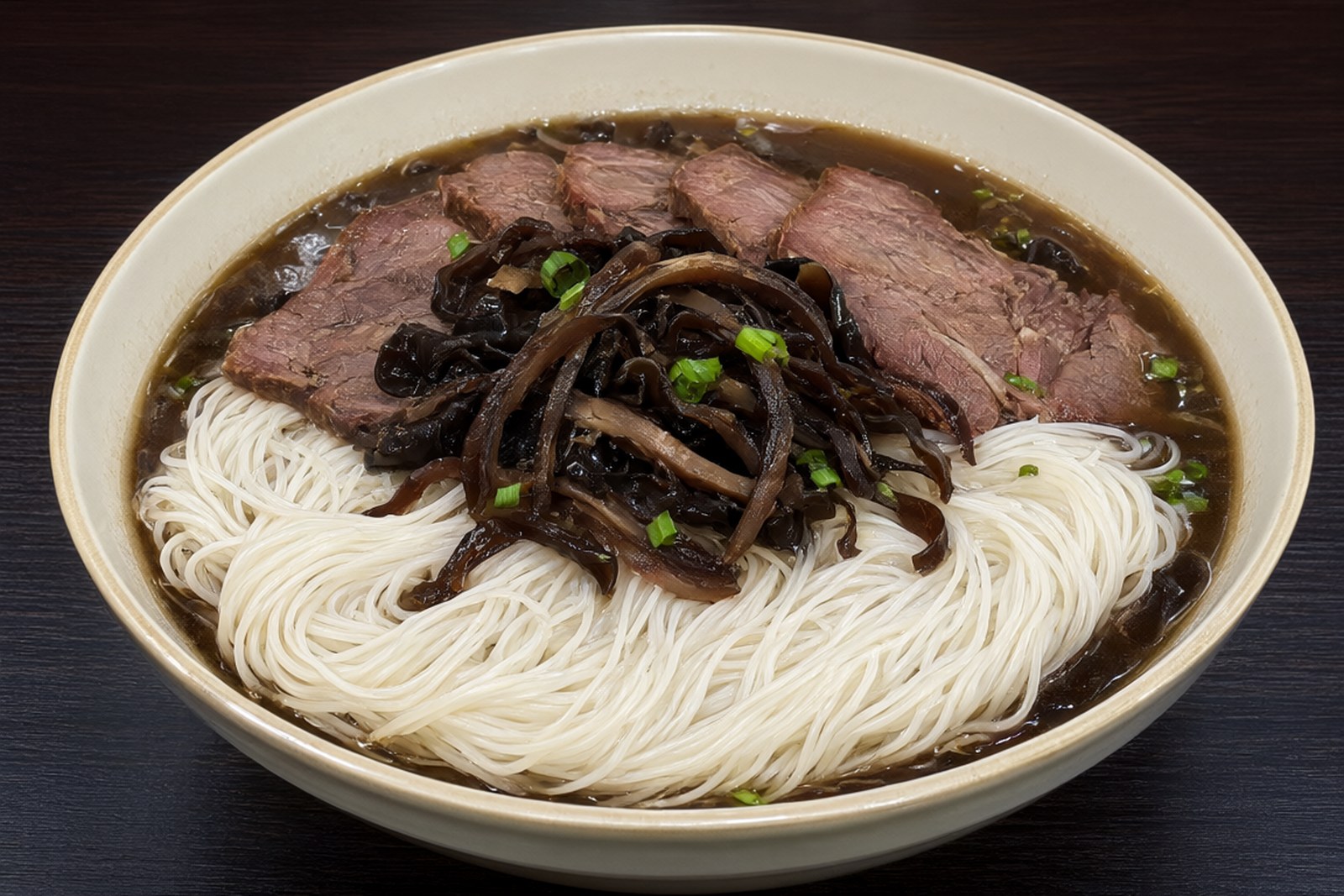
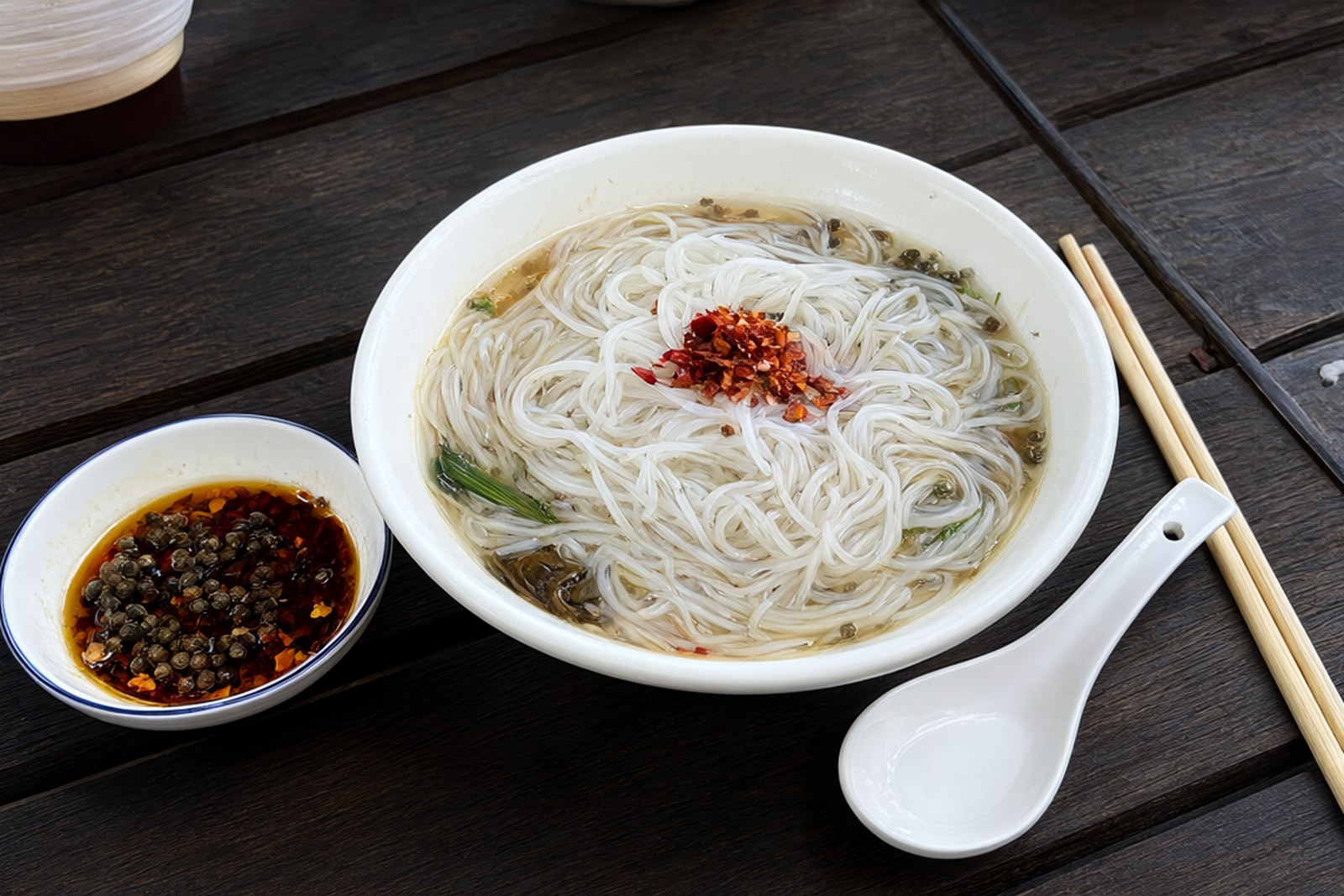
邵阳米粉 Shàoyáng mǐ fěn is the breakfast of 邵阳市 Shàoyáng shì, the city the province still calls 宝庆 Bǎoqìng, and it is a different bowl from anywhere else in Hunan. Where 长沙 and 常德 eat a flat ribbon or a thin strand, 邵阳 eats a round one about as thick as a chopstick, and it is pressed rather than steamed; the broth underneath is dark with beef bone rather than pale with pork, and there is a spoonful of 山胡椒油 shān hú jiāo yóu, mountain-pepper oil, floating on the surface of every bowl. That oil is the signature. It is pressed from 山苍子, a small tree of the laurel family whose fruit smells of lemon and camphor at the same time, and a few drops turn a plain beef broth into something with a scent you can identify from across the room.
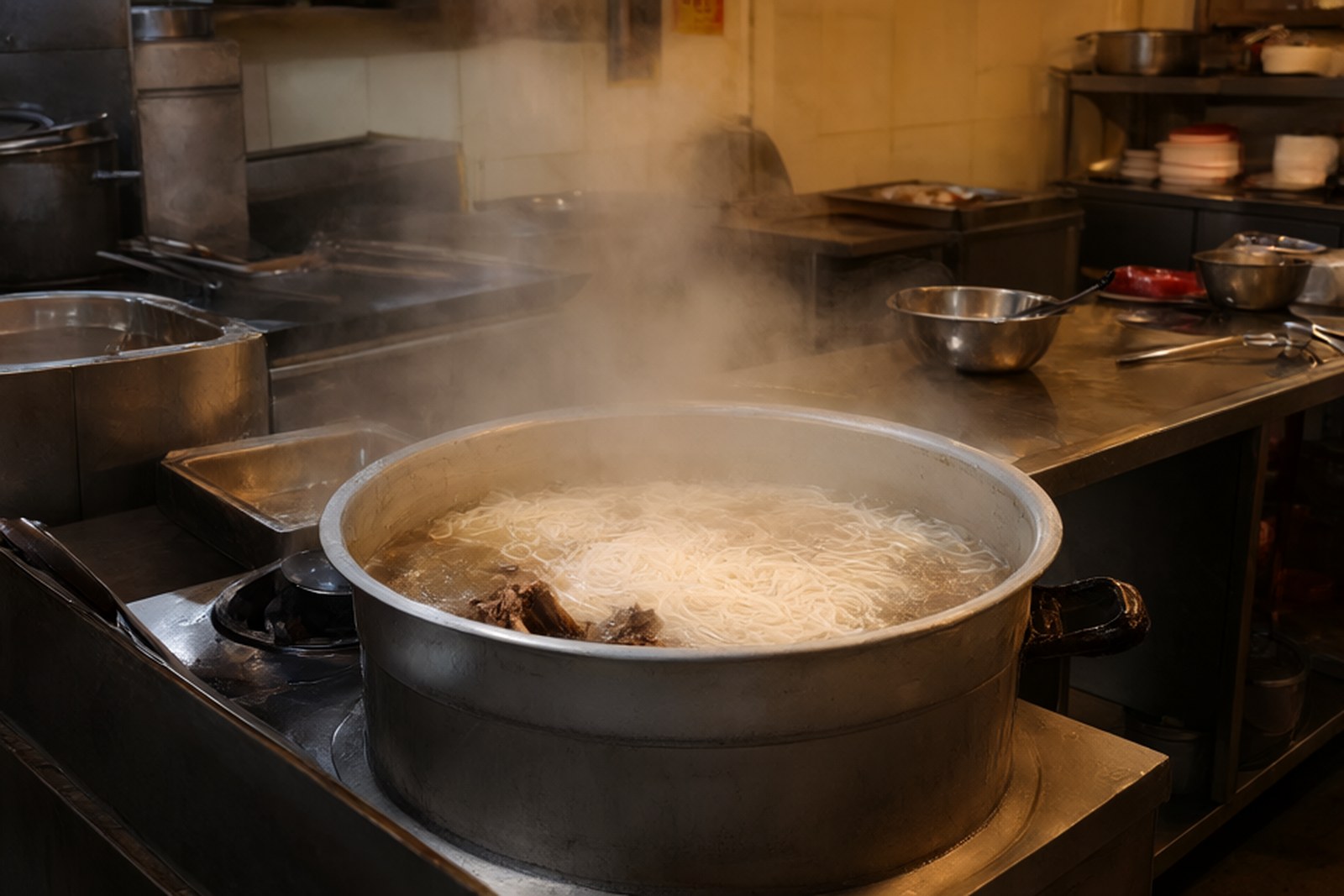
The noodle is made from the early crop of rice, which is low in stickiness and gives a firm strand. The grain is soaked until it crushes easily, ground with water into a slurry, and then part-cooked: a portion of the slurry is stirred into hot water to make a paste, which is worked back into the rest to give the mixture the body it needs to hold a shape. The dough goes into a press and is forced down through a die in a slow rope, straight into a pot of boiling water, where it sets in seconds. Fresh 米粉 is sold the same day and eaten soft; dried 米粉 is hung out and keeps for months, and it is the dried one that leaves the province and turns up in the noodle shops of 深圳 and 广州 with the city’s name on the label.
The broth is a beef-bone affair and it is made the night before. Beef bones, and sometimes a pig’s trotter for body, go into a tall pot with ginger and a little star anise and are held at a bare simmer for hours until the stock is dark and slightly sticky at the edges of the tongue. The 码子 mǎ zi, the topping, goes on last and there are half a dozen standards: 大片牛肉 dà piàn niú ròu, broad slices of braised beef and the default; 牛肚 niú dǔ, tripe; 排骨 pái gǔ, ribs; 豆腐杂酱 dòu fu zá jiàng, a sauce of bean curd and fermented bean; and 木耳肉丝 mù ěr ròu sī, wood-ear shreds with pork. In the shop the dried noodle is dipped in a basket in boiling water for half a minute, shaken dry, tipped into the bowl, and the broth and the topping go over it.
Where to eat it is not a difficult question in this city. 红旗路 Hóngqí lù is the street the city itself names, and there are dozens of shops along it and the lanes off it, most of them open before six and finished by nine, because 米粉 here is a breakfast eaten standing at a low table with a bowl in one hand. The beef tradition is old enough in 邵阳 that a number of the best-known shops are run by 回民 Huímín, Hui families, whose clean handling of beef is part of the local reputation; and it is worth knowing that 邵阳 people order by the topping, not by the shop, so 一碗大片牛肉粉 yī wǎn dà piàn niú ròu fěn is a complete order and the only question left is how much mountain-pepper oil you want. Buy a bundle of the dried noodle before you leave, because it is cheap, light and nothing like what you can buy elsewhere.
Words and Names
邵阳米粉 Shàoyáng mǐ fěn is the rice noodle of 邵阳, 粉 fěn being the noodle and 圆粉 yuán fěn the round form; 扁粉 biǎn fěn is the flat one, which is what you ask for if you want 长沙’s style and not this city’s. 码子 mǎ zi is the topping; 大片牛肉 dà piàn niú ròu is sliced braised beef, 牛肚 niú dǔ tripe, 排骨 pái gǔ ribs, 木耳肉丝 mù ěr ròu sī wood ear with pork and 豆腐杂酱 dòu fu zá jiàng bean curd in bean paste. 山胡椒油 shān hú jiāo yóu is the mountain-pepper oil, pressed from 山苍子; 剁辣椒 duò là jiāo is chopped chilli, 葱花 cōng huā spring onion. 邵阳 Shàoyáng is the city, 资江 Zī jiāng the river and 红旗路 Hóngqí lù the noodle street.
What the Locals Know
Ask for 圆粉 and not 扁粉, because the round strand is the point of the noodle here. Ask for 山胡椒油 on the side the first time, since a heavy hand turns the bowl medicinal, and then decide how many drops you want. At a shop with a counter of 码子, order two if you are hungry, because the toppings are cheap and the bowl is not filling. Soak the dried noodle at home in warm water rather than boiling it, and put it into the bowl still slightly firm; it will go on softening. And if a shop offers to 加个蛋, say yes, because a boiled egg dropped into a beef-broth 米粉 is the ordinary way it is eaten here.
flowcloud would say that a city which noticed that the awkward part of a fresh rice noodle is its softness, and answered by making a round one thick enough to stand up in a dark broth and then scenting the whole bowl with an oil nobody else in the province uses, has built its entire morning on a single good decision.
Where to find it: the noodle shops of 邵阳市, most of them open from about five in the morning and sold out by mid-morning, with 红旗路 and the lanes off it the densest run, and shops selling the dried noodle by weight in every wet market in the city and the county towns. A bowl is ¥8 to ¥18 with a topping, a boiled egg ¥2 to ¥3, and a bundle of dried 米粉 ¥6 to ¥15. 邵阳市 is on the 怀邵衡 line at 邵阳站 in the city, with the high-speed line stopping at 邵阳北站 out in 新邵县.