
It arrives in a wooden bucket, and what you see first is green — not a herb garnish but a whole rice dish gone the colour of a wet meadow, with dark red slabs of cured pork and pale cubes of dried tofu folded through it. 社饭 shèfàn smells of smoke and cut grass at the same time, which should not work and absolutely does. The first spoonful is oddly bitter at the back of the tongue before the pork fat catches up, and by the fourth you have stopped noticing the bitterness as a separate thing because it has become the reason the dish tastes alive.
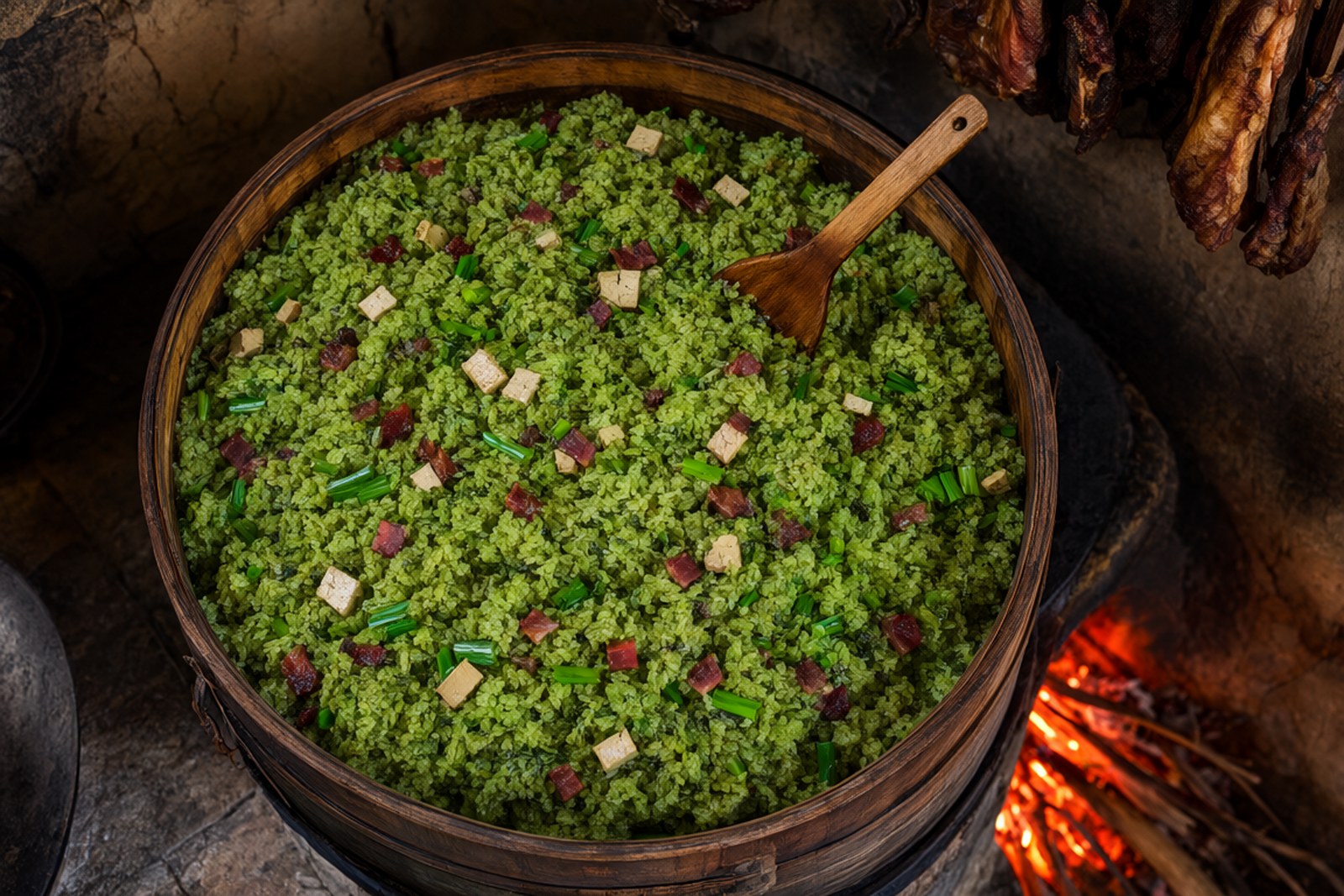
I ate it in a farmhouse kitchen in the hills above 吉首 Jíshǒu, in 湘西土家族苗族自治州 Xiāngxī Tǔjiāzú Miáozú Zìzhìzhōu, at the end of a morning spent walking up a valley to look at a terrace nobody had told me about. The old woman cooking it apologised twice for the season being almost over. She was right to. 社饭 shèfàn has a window of about two weeks, and it opens once a year, and if you miss it there is no version of the dish in any restaurant in the province that is not a fond imitation.
A Rice for the Day of the Soil
The name is the calendar. 社 shè is the altar to the god of the soil, and 社日 shèrì is the festival in its honour — 春社 chūnshè in spring, 秋社 qiūshè in autumn. 春社 falls on the fifth 戊 wù day after 立春 Lìchūn, which puts it somewhere in late February or March depending on the year, and in the Tujia villages of western Hunan that is the day the whole village cooks this rice.
The logic is agricultural and completely unsentimental. By 春社 the winter’s 腊肉 lāròu is still hanging but the weather is turning, the first green things are up in the terraces, and the grain store is running low. 社饭 is what you make out of exactly that situation: a little rice stretched with whatever the hillside has started producing, made rich enough to be a celebration by the smoked pork left over from the pig killed at the new year.
There is a second half to the custom. 社饭 is cooked in quantity and given away. Families send bowls to neighbours, to the old people on the lane, to anyone who has had a bad year. Being given 社饭 is the village’s way of saying it has noticed you.
What Is Actually In It
米 mǐ. Usually a mix — a proportion of 糯米 nuòmǐ glutinous rice to plain rice, though the ratio is a matter of family doctrine and people argue about it the way other people argue about politics.
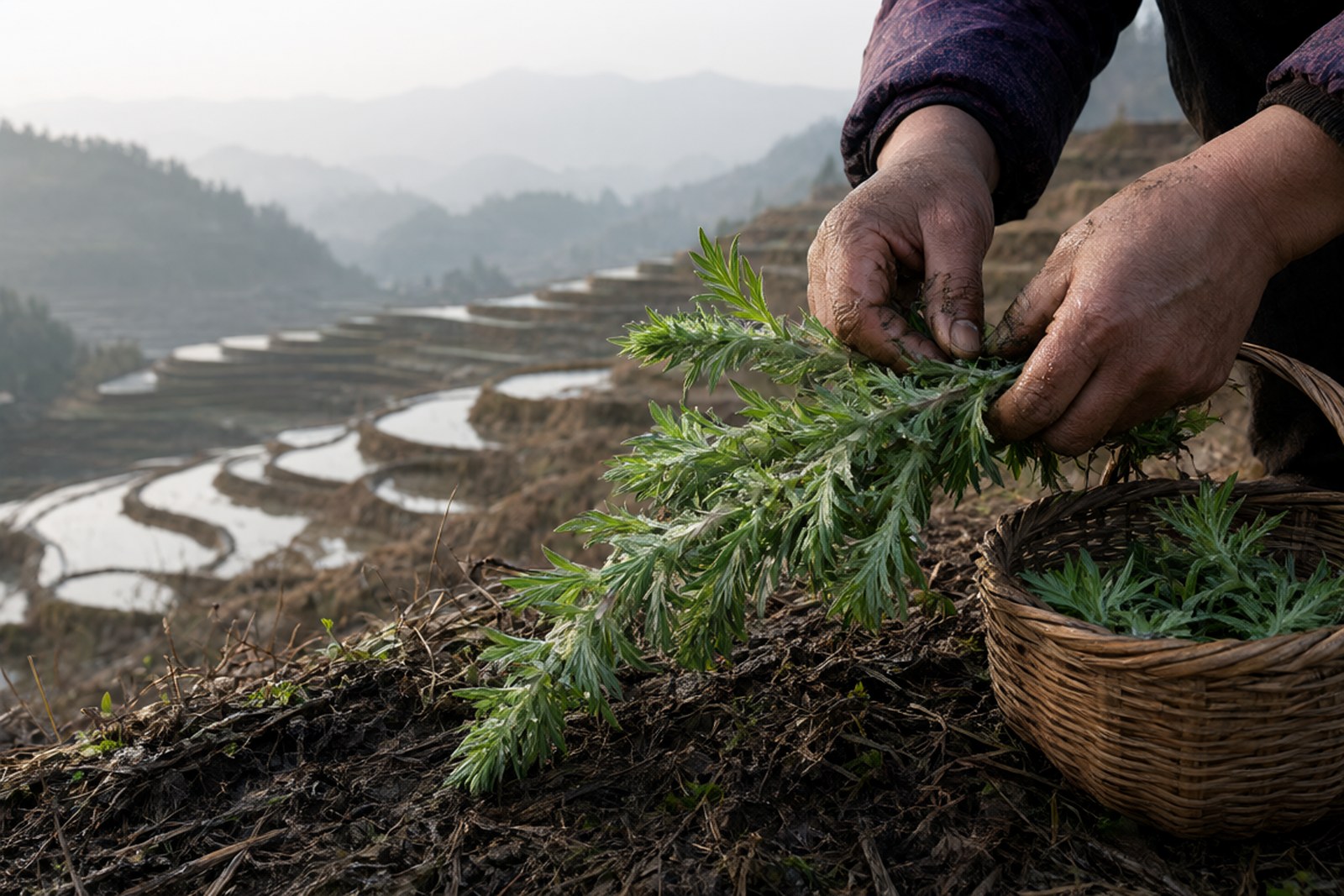
蒿菜 hāocài. The green. Tender young mugwort-family shoots picked from the edges of the fields in early spring. This is the part that decides whether the dish is good, because raw it is bitter enough to make your face fold. The shoots are washed, pounded or rubbed with salt, and squeezed — sometimes two or three times, with the water poured off between — until what is left tastes of green rather than of medicine.
腊肉 lāròu. Cured pork from the winter pig, cut into small dice. Its fat is what carries the herb flavour through the rice, and there is no substitute. A vegetarian 社饭 is a contradiction in terms and everyone here knows it.
豆腐干 dòufugān. Dried tofu, cubed, for texture and salt.
野葱 yěcōng. Wild scallion, and often 花生 huāshēng peanuts, and in some villages a handful of 豌豆 wāndòu fresh peas.
The greens, the pork and the tofu are fried together first, then folded through the partly-cooked rice and steamed until the whole pot is done. In a 铁锅 tiěguō cast-iron pot you get 锅巴 guōbā at the bottom, a crust of rice and pork and herb that has fried itself in the fat, and in every household I have eaten this in, that crust is put on the plate of whoever is most loved or most in need of it.
Words and Names
社 shè is an old character meaning the altar of the soil god — the same character sits in 社会 shèhuì, society, which originally meant the gathering that happened at the altar. 饭 fàn is cooked rice, and by extension a meal. 社饭 is therefore “the rice of the soil-god day”, an entirely literal name for a festival dish.
蒿 hāo covers a group of Artemisia and related plants — mugwort, wormwood, the fragrant weeds of spring — and it is the same character as in 蒿子粑粑 hāozi bābā, the mugwort rice cakes made a little later in the same season. 野葱 yěcōng is literally wild onion; it looks like a chive, tastes like a shallot, and grows in every ditch.
What the Locals Know
Taste the 蒿 before you commit. Squeeze a leaf. If it is overwhelmingly bitter, the cook will need to blanch it and squeeze it twice, and the resulting 社饭 will be milder but less interesting. The best version is a little bitter.
Cold 社饭 is better than hot the next day. Pressed into a bowl and eaten with a spoon, standing up, it is one of the great leftovers of China.
Do not ask for it in autumn. You will be offered something made with frozen or dried herb, and while it will be edible it will also be a polite fiction. 秋社 exists as a festival but the dish belongs to spring.
Buy a bag of the dried 蒿 if you can find it. Some families dry the squeezed herb and keep it for the rest of the year. It is a shadow of the fresh version and still better than regret.
Where to Eat It
社饭 is not restaurant food. It is village food and it appears on the tables of farmstays and 农家乐 nóngjiālè around 吉首 Jíshǒu, 德夯 Déhāng, 矮寨 Ǎizhài and the valleys of 古丈 Gǔzhàng for the fortnight around 春社, and then it disappears. If you are in western Hunan in early spring, ask at any farmstay or tea-house whether they have 社饭; if the answer is yes, order it immediately and without further discussion. If you are there in another month and want something in the same family, 蒿子粑粑 hāozi bābā — mugwort rice cakes, fried — is made through the spring and is a fine consolation.
flowcloud would say that a dish which exists for fourteen days a year, is cooked by handing bowls to the neighbours, and is built out of the last of the pig and the first of the spring is a better description of a working culture than anything in a museum.
Where to find it: 社饭 (shèfàn), farmstays and 农家乐 in the valleys around 吉首 (Jíshǒu), 矮寨 (Ǎizhài) and 德夯 (Déhāng), 湘西土家族苗族自治州 (Xiāngxī), western Hunan. Available for roughly two weeks around 春社 (chūnshè), the fifth 戊 day after 立春 (Lìchūn) — usually late February to late March. A bowl from a farmhouse kitchen costs ¥10–15; the whole pot, if you help eat it, usually costs the price of the rice. Ask early in the day, ask whether the 蒿 (hāo) is fresh, and ask for the 锅巴 (guōbā) crust if you have done anything to deserve it.