
盆菜 pén cài means basin food and the name is exact: everything is cooked separately, then packed into one large basin in a fixed order and served as a single dish. It is a village food, associated with the Hakka and Cantonese clans of the Pearl River delta and with 深圳 in particular, and it exists for the nights when a whole lineage eats at once. The bottom is 白萝卜 bái luó bo and 莲藕 lián ǒu, radish and lotus root, cut thick because their job is to hold up the layers above and to absorb what comes down through them. Above that go 支竹 zhī zhú and 腐竹 fǔ zhú, the dried bean-curd sticks and sheets, then 猪皮 zhū pí, puffed pork rind, then 冬菇 dōng gū and 木耳 mù ěr, then a layer of 南乳焖猪肉 nán rǔ mèn zhū ròu, pork belly braised with fermented red bean curd until it is dark and collapsing, then 鱿鱼 yóu yú and 炸门鳝 zhà mén shàn, squid and fried eel, and finally the expensive things on top: 白切鸡 bái qiē jī, poached chicken; 虾 xiā, prawns; 蚝豉 háo chǐ, the dried oysters; and in the luxury version 鲍鱼 bào yú, abalone, and 瑶柱 yáo zhù, dried scallop. The whole assembly is then flooded with a braising liquor from the pork and simmered until everything has given something up to everything else.
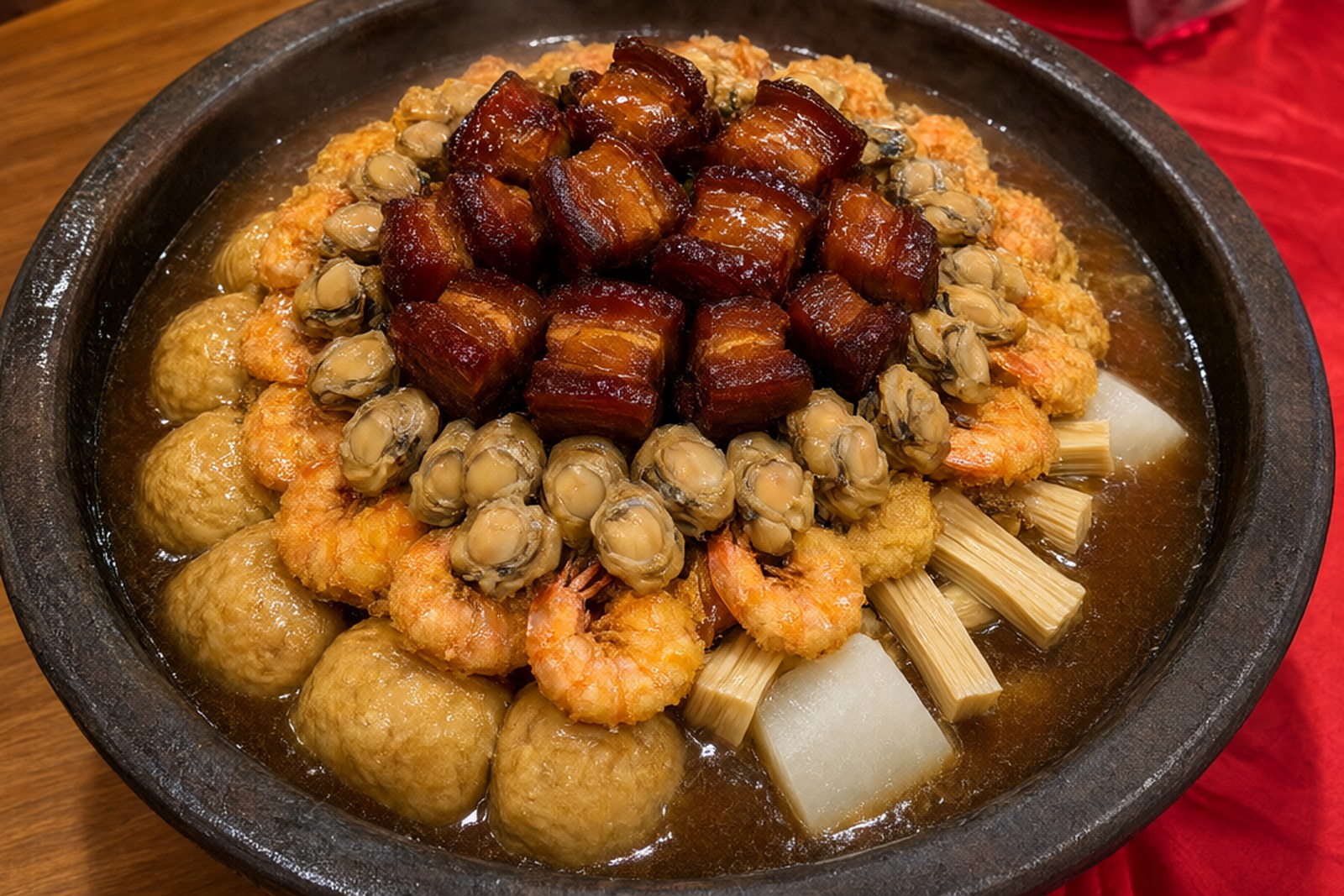
The 深圳 version is not a restaurant invention. 下沙 Xiàshā, a village in 福田 Fútián whose 黄氏 Huáng clan has been there since the thirteenth century, holds a 盆菜宴 every 元宵节 Yuánxiāo jié, the fifteenth night of the first lunar month, and the scale of it is the point: tables end to end through the lanes, thousands of basins, and a queue of cooks who began building layers the day before. The village’s own history gives the dish its founding story, which is that the clans of the delta fed the last Song emperor’s retreating court out of whatever basins they had to hand, and while that is almost certainly a story rather than a record, it explains the form. 南澳 Nán’ào on the Dapeng peninsula and the Hakka villages of 龙岗 Lónggǎng hold their own versions at the same time of year, and the 客家 Kèjiā ones lean harder on the pork and the dried vegetables.
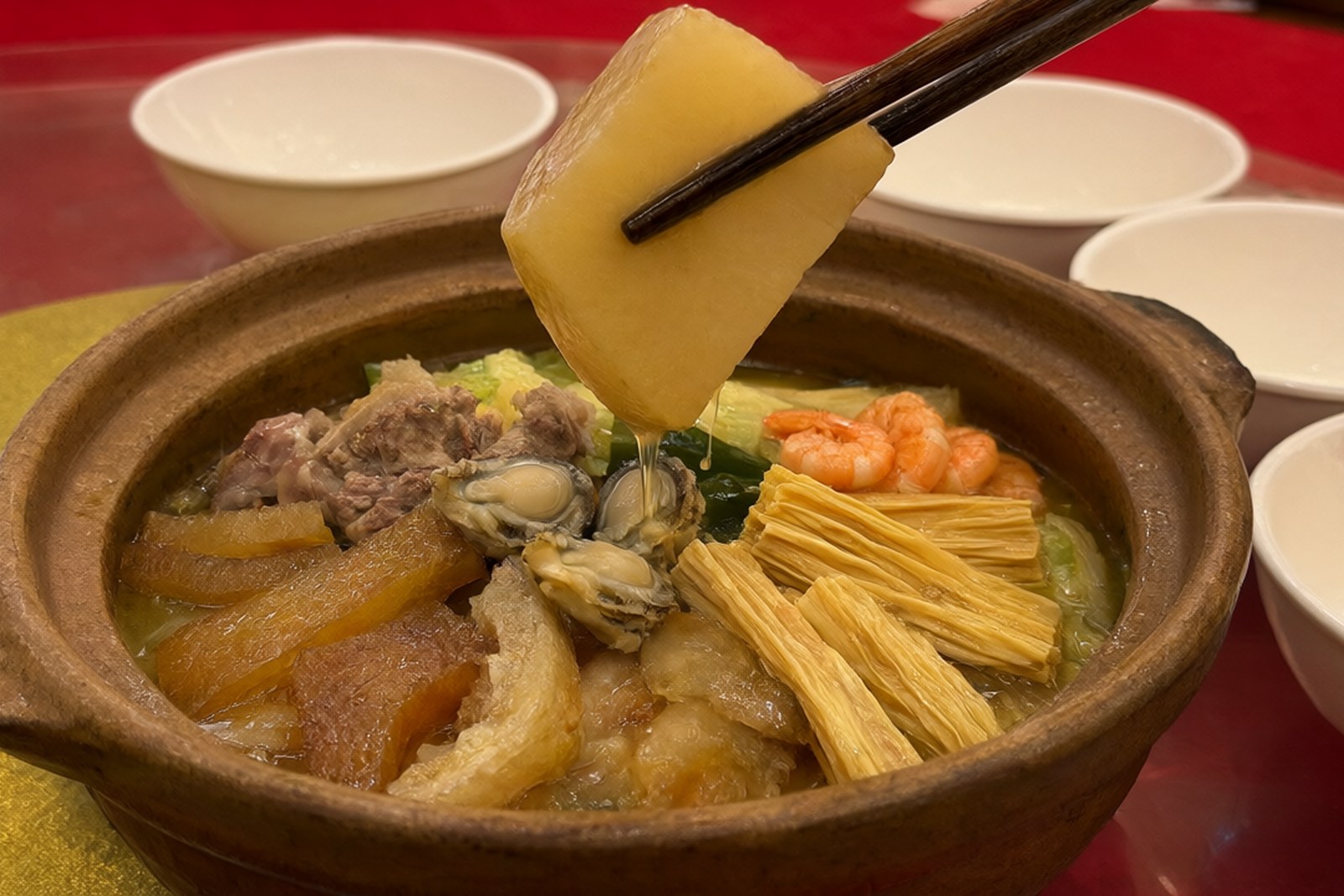
There is an etiquette and it is not optional. You eat from the top down, taking only from the surface in front of you, and you never stir the basin, because the structure is the dish and a stirred 盆菜 is a stew. The first pass is the chicken, the prawns and the oysters, which are there to be admired and eaten quickly. The second pass is the pork and the eel, where the flavour is. The third pass, which is the one the family is really waiting for, is the radish and the bean curd at the bottom, by then loaded with everything that has drained through them, and by common consent the best mouthfuls in the basin. Ladle some of the liquor over rice and you have the fourth pass.
Words and Names
盆菜 pén cài is the dish and 大盆菜 dà pén cài is the large communal version; 围村 wéi cūn means a walled village and 围村菜 wéi cūn cài is the village cooking it belongs to. 南乳 nán rǔ is the fermented red bean curd that darkens the pork, 支竹 zhī zhú and 腐竹 fǔ zhú are the dried bean-curd sticks and sheets, 猪皮 zhū pí is puffed pork rind. 蚝豉 háo chǐ is the dried oyster, 门鳝 mén shàn a kind of eel, 元朗-style versions sometimes add 芋头 yù tou. 下沙 Xiàshā and 南澳 Nán’ào are the two villages best known for it in 深圳, 元宵节 Yuánxiāo jié is the Lantern Festival that occasions it, and 客家 Kèjiā is Hakka.
What the Locals Know
Order three days ahead if you want a proper one, because the layers are made to order and the pork needs the time. The basin itself is often a rental: village kitchens lend out the big glazed pots against a deposit and expect them back. If you are eating at a restaurant, ask how many layers are actually in it, because a 盆菜 with six is a party dish and one with twenty is a week of work, and the price difference is large. Never let anyone put it on a gas ring at the table to keep it hot, since the bottom scorches while the top goes cold, and the correct fix is simply to eat faster. Leftovers, if there are any, are better the next day with noodles added, which is the private opinion of most families who make it.
flowcloud would say that a dish whose rules forbid stirring is the only honest monument to a clan system, because it is a meal that cannot be eaten unless everyone at the table agrees on who goes first.
Where to find it: the 下沙 Xiàshā village area of 福田区, a short walk from 下沙地铁站 on Metro Line 1 and Line 11, where the 黄氏宗祠 Huáng shì zōng cí and the lanes around it are the historic home of the dish; 南澳 Nán’ào on the Dapeng peninsula for the coastal version; and the 客家 restaurants of 龙岗 Lónggǎng for the variant with more pork and preserved vegetable. Between 元宵节 and the end of the first lunar month is when the village kitchens are actually running. Outside that window, order it from any Cantonese restaurant that advertises it and ask for at least twelve layers.