
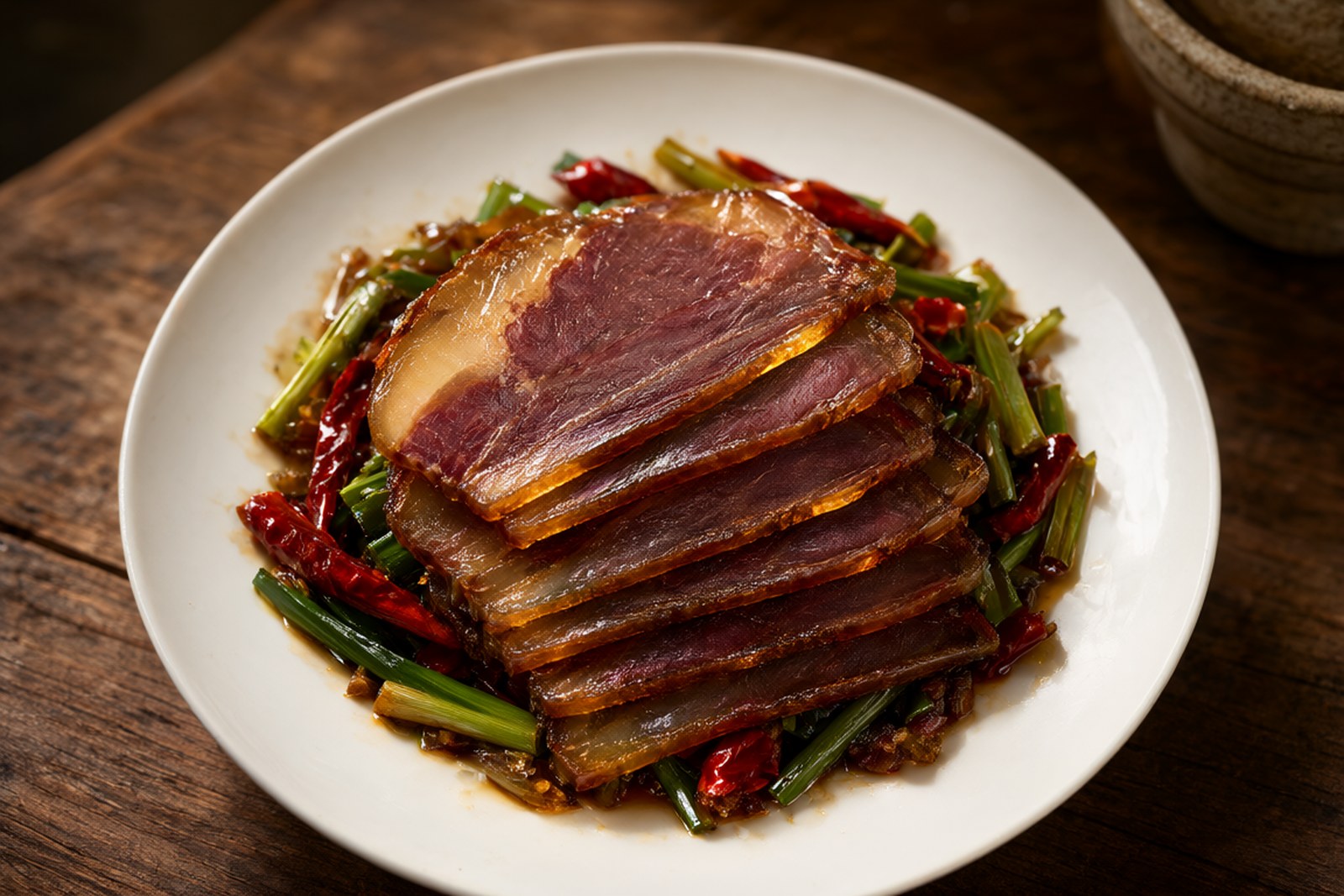
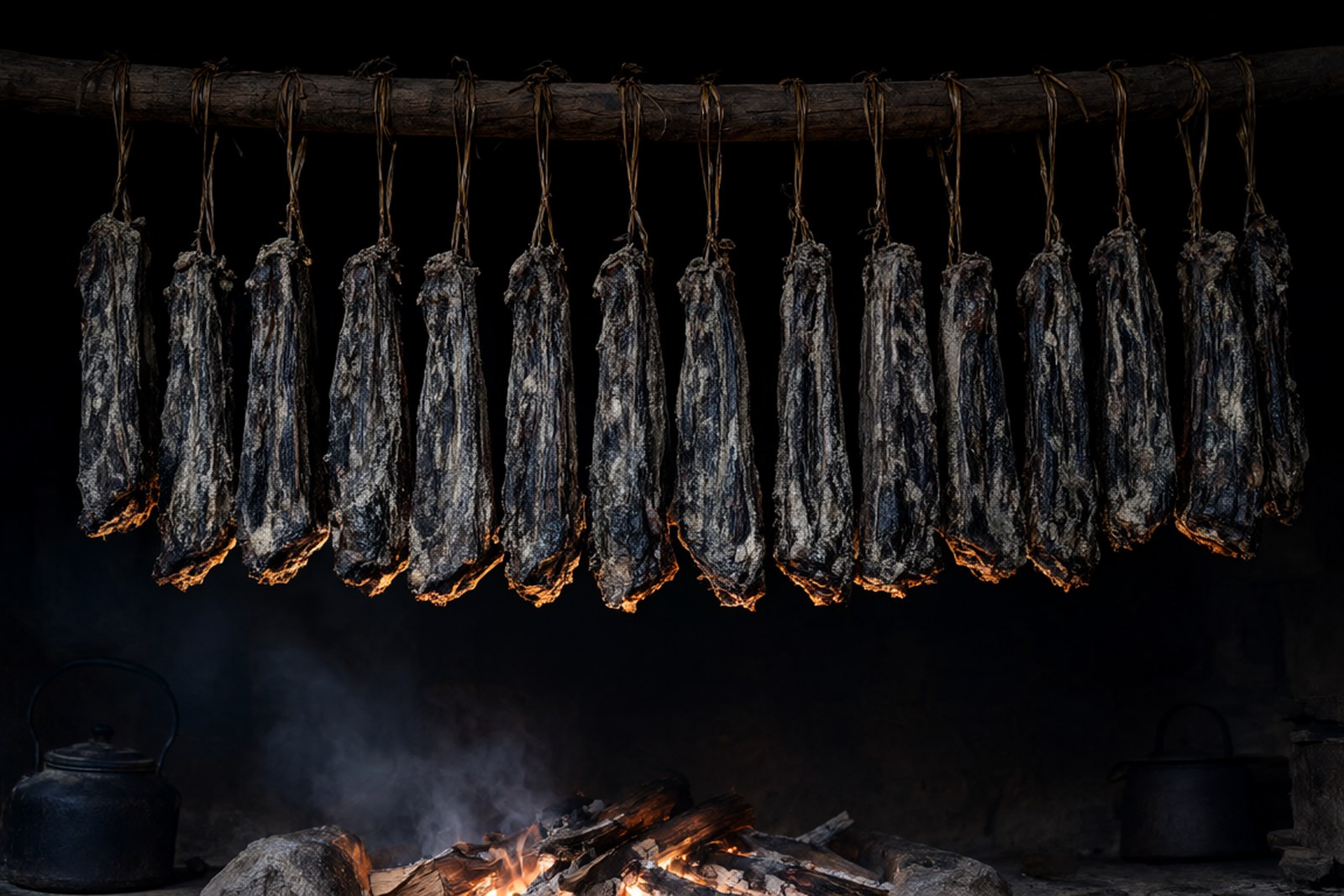
The kitchen has a fire on the floor and meat hanging above it, and the meat has been there for weeks. It comes down the colour of old leather, black-brown and slightly dusty, with a rim of pale fat that has gone amber and translucent. Cut into thin slices and fried with green garlic and a handful of dried chilli, it gives off a smell that fills the whole house — smoke, tea, fat and something almost sweet — and it tastes of all of those things at once, with a saltiness that demands rice. 石门腊肉 Shímén làròu, the cured pork of Shimen county, is not a restaurant dish. It is what a mountain household eats from the eleventh lunar month until spring, and it is the food that explains why the cooking of this part of Hunan tastes the way it does.
石门县 Shímén Xiàn is the northernmost county of Changde, running up into the 壶瓶山 Húpíng Shān massif on the Hubei border, the highest country in the north of the province. It is steep, wet, sparsely populated, and largely Tujia in its older village culture, and for most of its history the households up here were on the wrong side of a week’s walk from any market. Curing meat was not a choice. A pig killed at the turn of the year had to feed a family for five months, and the only way to make that work was salt, smoke and cold.
The method is consistent across the mountains and it depends on three things. The first is the pig: a local black or black-and-white hog raised on household scraps, killed in the twelfth lunar month when the weather is reliably cold. The second is the salt cure — the joints are rubbed heavily with salt and saltpetre-free curing mix, sometimes with ground Sichuan pepper and rice wine, and then left to stand in a crock for a week or more, turned every couple of days, so that the salt penetrates and the water comes out. The third, and the one that makes Shimen distinct, is the smoke: the meat is hung on the kitchen beams above the fire pit and smoked slowly for weeks on the wood that is available — chestnut, tea prunings, pine, sometimes corn cobs and rice husks. It is cold smoking by accident rather than design, because the fire is for cooking and warmth and the meat simply lives in the smoke, and this is why the result is drier, harder and more deeply perfumed than a kiln-smoked commercial product.
The result keeps essentially forever if it stays dry. What it needs before cooking is a scrub and a soak: the surface is washed, the joint is simmered or steamed once to soften it and draw off some salt, and only then is it sliced and fried. The classic treatment is with 蒜苗 suànmíao, garlic shoots, and dried chilli, hard and fast in a wok, so that the fat renders and the lean turns dark and crisp at the edges. But it also goes into soups, into the stuffing for 蒿子粑粑, into a pot of bamboo shoots in spring, and into plain steamed rice as a single slice on top, which is what a farmer eats when there is no time to cook.
Words and Names
腊 là is the character on the calendar for the twelfth lunar month, and by extension the word for anything made then — 腊肉 làròu, cured meat, 腊肠 làcháng, cured sausage, 腊味 làwèi, the whole category. It is not the same as 培根 péigēn, bacon, which is brine-cured and smoked lightly; the Chinese version is drier, saltier and, in this mountain form, far more heavily smoked.
石门 Shímén, “stone gate”, is named for a rock formation in the county. The county is also known for 石门柑橘 Shímén gānjú, its mandarins, and 石门银峰 Shímén Yínfēng, a green tea grown on the same slopes — both protected products. The tea prunings are one of the things the pork is smoked over, which is a coincidence worth noticing when you eat the two together.
What the Locals Know
Soak it before you decide it is too salty. Slice, blanch, and taste; if it is still aggressive, simmer it briefly in water with a piece of sugarcane or a little sugar. Getting this wrong is the only way to ruin it.
Buy it in the twelfth month or not at all. Real household 腊肉 is made then and sold then. Anything sold in summer is either commercial or from a freezer, and the difference in the smoke is not subtle.
Look for the fat. Good cured pork has a thick rim of fat that has gone from white to amber. Pure lean is either from a bad pig or has been over-dried to the point of leather.
Eat it with something sour or green. Garlic shoots, pickled radish, bamboo shoots, or a bitter mountain vegetable. The meat needs the contrast more than it needs the rice.
Where to Eat It
In the county town of 石门 Shímén and, better, in the villages up toward 壶瓶山 Húpíng Shān, where farm guesthouses serve it as a matter of course with whatever the season has produced. In 常德 Chángdé city, the 钵子菜 bōzicài restaurants — the clay-pot places — use it as a base ingredient and are the easiest introduction. A plate of fried cured pork with garlic shoots is ¥40–70, and a whole cured leg or a joint bought in the market is ¥60–120 per kilo.
flowcloud would say that this is what food looks like when it has been designed by a winter rather than by a chef — the smoke is not a flavour somebody chose, it is a side effect of staying warm, and the greatest pork in Hunan is a by-product of the fire that kept a family alive until March.
Where to find it: 石门腊肉 (Shímén làròu), 石门县 (Shímén Xiàn), 常德市 (Chángdéshì), 湖南 (Húnán). Best in the villages toward 壶瓶山 (Húpíng Shān) and in the 钵子菜 (bōzicài) clay-pot restaurants of 常德 (Chángdé) city. Plate with garlic shoots ¥40–70, cured joint ¥60–120 per kilo. Buy it in the twelfth lunar month, soak it before frying, and look for amber fat.