
水车板鸭 shuǐ chē bǎn yā is a duck that has been salted, pressed flat and dried in the cold, and the name is a description rather than a brand: 板 bǎn is the word for a board, and a finished bird is a flat, hard, glossy rectangle the shape of one. It is the product of 水车镇 Shuǐ chē zhèn, a town in 新化县 Xīn huà xiàn in 娄底市 Lóu dǐ shì that sits below the 紫鹊界 Zǐ què jiè terraces, and the town has been making it since the Ming – the county puts the technique at six hundred years old and the earlier version of the recipe at a thousand – under its old local name 泡腌 pào yān, which people here still use. The county files it among the 新化三宝 Xīn huà sān bǎo, the three treasures of Xinhua, alongside 蒙洱茶 Méng ěr chá, the tea grown on the high ground at 奉家镇, and 猪血巴 zhū xuè bā, the blood-and-bean-curd cake made for the new year. It is also the southern half of a pairing the trade enjoys: 北烤鸭,南板鸭 běi kǎo yā, nán bǎn yā, roast duck in the north, pressed duck in the south.
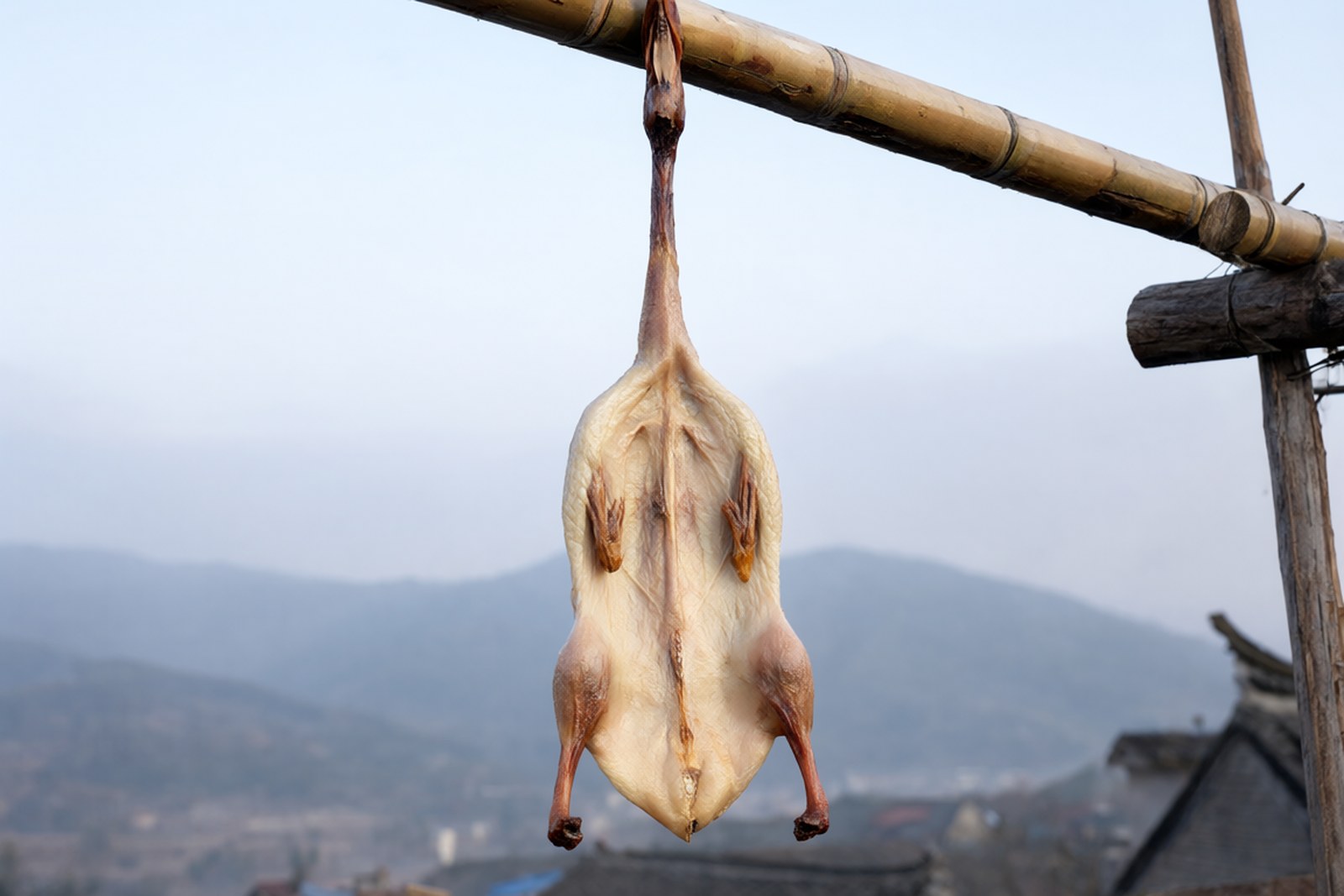
What the town does to the bird is mostly a matter of taking water out of it. The raw material is the local 水车麻鸭 shuǐ chē má yā, a duck of the region that the trade prizes for the fat it lays down, and the rule is that a bird is better for this the fatter it is, provided it has not yet laid and has not yet moulted, so birds from the previous spring, killed in their first winter, are the ideal. It is starved for eighteen to twenty hours before killing, which empties the gut, and then scalded at sixty to sixty-four degrees. The temperature matters more than it sounds: duck fat begins to melt at around twenty-six to thirty degrees, and water hotter than the range will start to soften the skin, which is the surface the salt has to grip. The feathers come off, the tongue is drawn, the bird is cooled in cold water, the wings are taken off at the shoulder and the feet at the knee, and the carcass is then worked on by hand. The cook presses down on the breastbone with the heel of the hand and breaks the wishbone flat, so that the body lies as a long rectangle. This is not about appearance. A duck pressed flat sits tight in the crock, takes the salt evenly and dries straight; one left plump cures unevenly and goes soft at the breast, which is the one fault the town cannot sell.
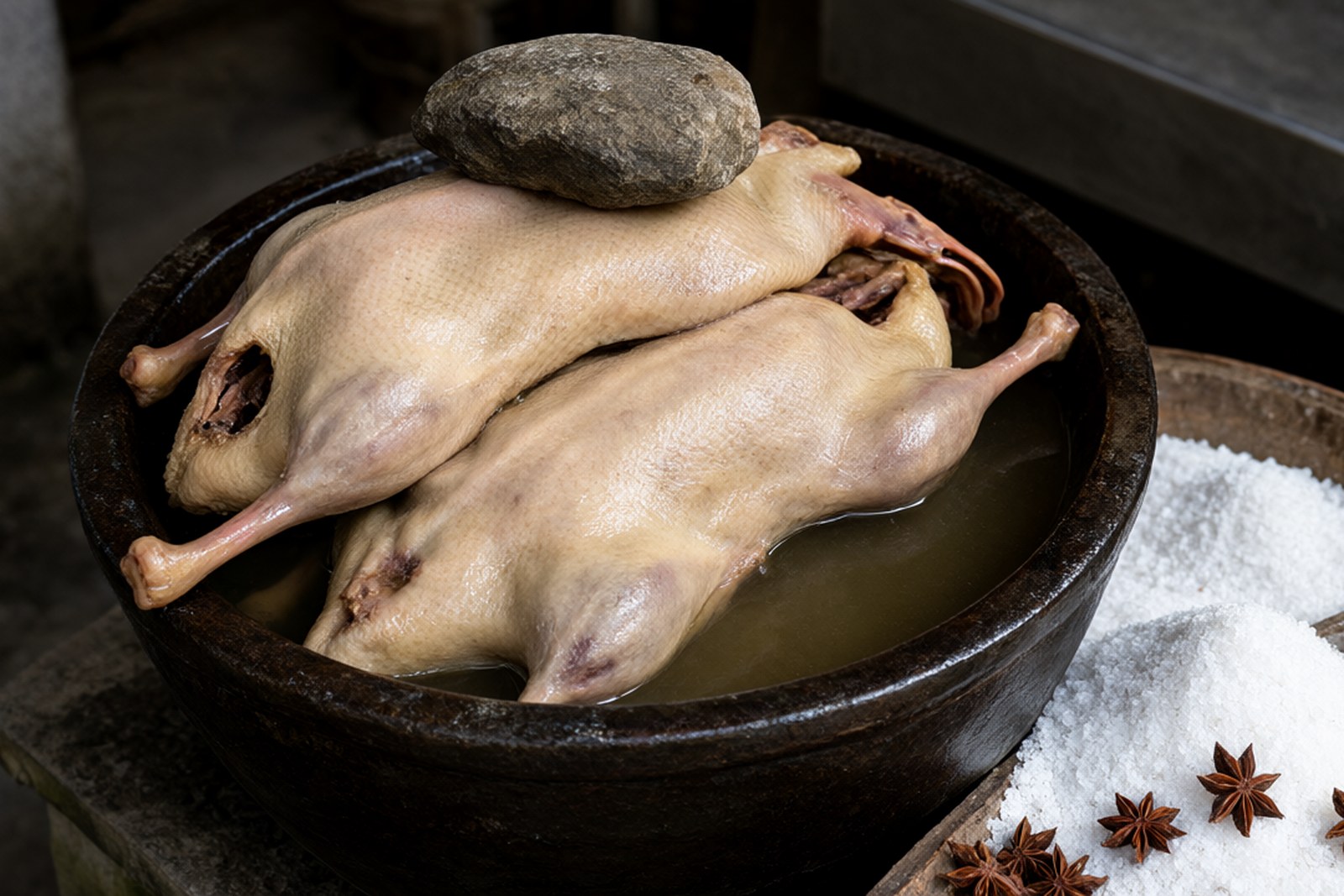
The curing is salt, weight and time, and the town’s version of it has been written down. Dry salt is used at about six per cent of the weight of the duck, and it is not sprinkled. Three quarters of it goes into the body cavity through the cut at the neck, and the bird is rubbed and turned on the bench until the salt has reached every part of it; the remaining quarter is rubbed on the outside, with the breast, the lower leg and the mouth given most of it. The birds are then packed into a clay crock and left twelve hours, after which each one is lifted, the wings held back and the vent opened so that the brine collected inside runs out – the step the trade calls 扣卤 kòu lǔ – and then packed down again for some eight hours more and drained a second time. After that the crock is refilled with 老卤 lǎo lǔ, the old brine kept and boiled up between batches and valued for it, poured in through a cut at the ribs, and a bamboo cover is laid over the birds with a stone on top so that every one of them stays under the surface. The times are set by the calendar rather than by the clock. Between 小雪 Xiǎo xuě, Minor Snow, in late November and 大雪 Dà xuě, Major Snow, in early December, a large duck sits in the brine for twenty-two hours, a medium one for eighteen and a small one for sixteen; from 大雪 through to 立春 Lì chūn, the start of spring in early February, the same ducks need only eighteen, sixteen and fourteen. The town’s year is arranged so that the salt meets the meat in the one season when the air is dry and the nights are long.
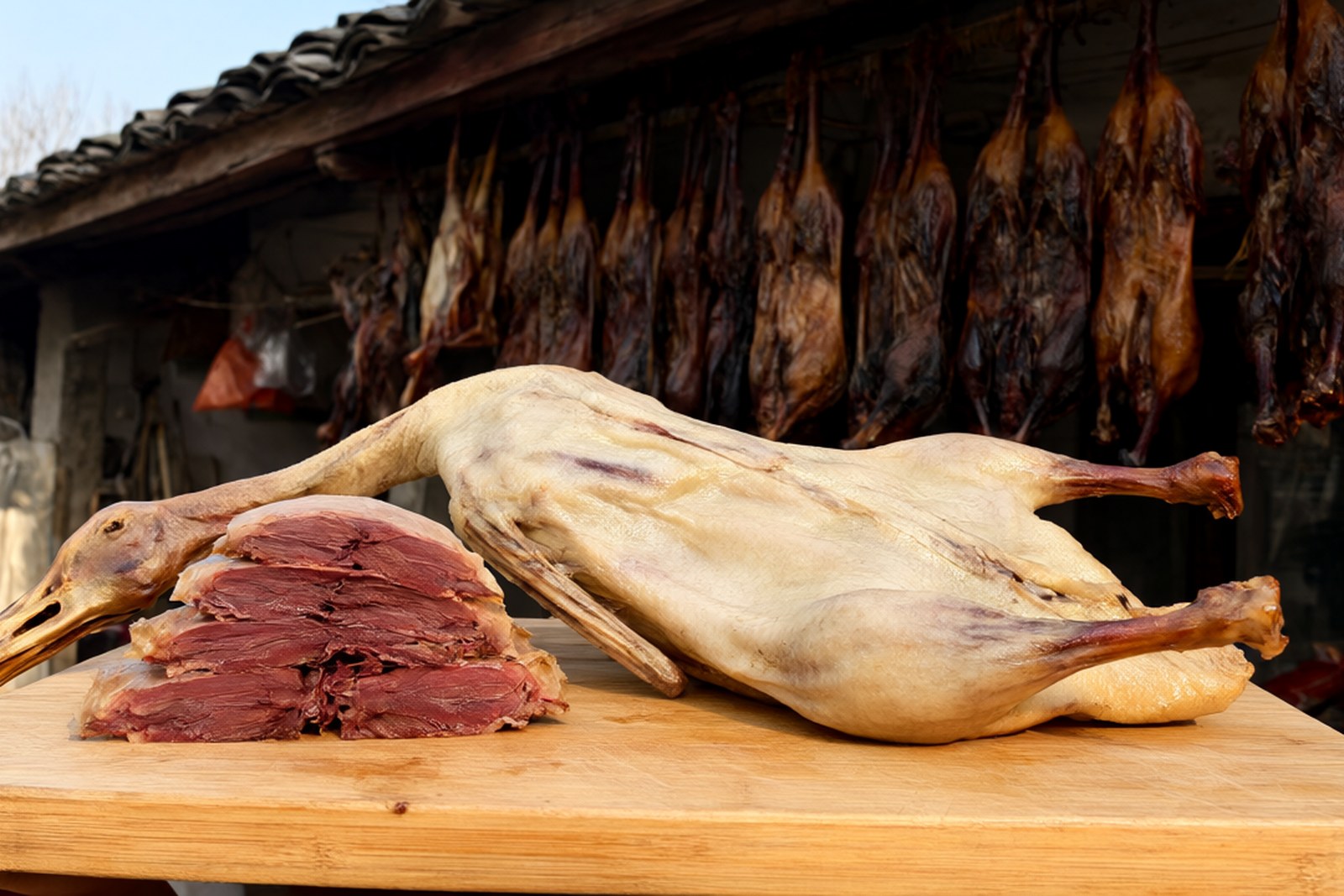
The bird is then shaped and hung. Bamboo splints are used to open it out into the shape of 大, a wide flat star, and it goes up on a rack to drain; it is dipped back into the brine for another two to four days, washed in clean water, wiped with a cloth and arranged a final time, neck straight and legs and breast pulled flat. Then it hangs in the air, which in the middle of a Xinhua winter means a cold north wind coming down off the 紫鹊界 terraces and through the valley, and about twenty days of that finishes it. The result is the whole bird with nothing added and nothing taken away except the water: 鸭体扁平, a flat body with the tail fat full but tucked in, the lean a deep sauce colour and the fat cream, the skin pale and dry, the muscle drawn down hard against the bone. Cut into it and the county’s four words describe it exactly – 皮酥、骨脆、肉嫩, skin crisp, bone brittle, meat tender. The town makes two versions and sells both. 腊板鸭 là bǎn yā is the winter bird, cured in the coldest weeks and dense, dark and heavily savoury; 春板鸭 chūn bǎn yā is made later in the season, softer and milder and better for soup. The county records 水车板鸭 being sold as a commercial product to Hong Kong and Macau from 1905, and re-exported from there to Singapore and Malaysia, which is how a wind-dried duck from a Hunan river town ended up on tables in South East Asia before it was on tables in half of Hunan.
Words and Names
板鸭 bǎn yā is pressed dried duck, 板 being the word for a board, and 水车板鸭 puts the town in front of it; the older name, still heard locally, is 泡腌 pào yān, brine-cured. 麻鸭 má yā is the local duck the trade uses, 扣卤 kòu lǔ is the step of draining the brine out of the bird’s cavity, and 老卤 lǎo lǔ, old brine, is the reused liquor, boiled between batches and counted as an asset rather than as waste. 腊板鸭 là bǎn yā and 春板鸭 chūn bǎn yā, cured duck and spring duck, are the two grades the town sells, and 小雪, 大雪 and 立春 are the solar terms that set the curing times and the season. 新化三宝 Xīn huà sān bǎo is the county’s three treasures, on which the duck sits with 蒙洱茶 and 猪血巴.
What the Locals Know
Choose a duck the way the town does, by shape and by feel. A good one is 扁平, flat, straight and light for its size; the breast should be full but the fat should not be spilling out of the tail, and the skin should be pale, dry, tight and faintly translucent rather than shiny. Press a thumb into the breast and it should be hard, with the muscle set against the bone, and it should smell of salt, smoke and cold air rather than of the raw bird. The lean inside should be a deep sauce red and not a pale grey, and the surface should be dry everywhere, with no damp or sticky patch, which is the first sign of a duck hung in the wrong weather. In the kitchen it is a slow ingredient rather than a quick one. The usual treatment is to rinse it, cut it into pieces and steam it for forty minutes or so, either on its own or over 干豆角 gān dòu jiǎo, dried green beans, or over turnip; the salt in the bird seasons whatever it is cooked with, so nothing else in the pot needs any. It is also simmered into soup with winter melon or white radish, and the broth that comes off it is the reason the duck is worth what it costs. Because it is a cured product it keeps for months hung in a cold, airy place, and here it is bought as a present at the new year rather than for the week’s dinner, which is the main thing to understand about the way it is priced and the way it is given.
flowcloud would say that the duck is worth more dead than alive only because somebody decided to sit on it, salt it, and let a winter of north wind do the cooking, which is a business plan built out of nothing but patience and weather.
Where to find it: the courtyards, curing sheds and market stalls of 水车镇 in 新化县, the town below the 紫鹊界 terraces on the western side of the county, and the dried-goods stalls of the county town 上梅镇 Shàng méi zhèn; 水车镇 is reached by road from the county town in a little over an hour, and the high-speed station 新化南站 at 洋溪镇 is the nearest stop on the 沪昆 Hù kūn line. The season runs from late November, at 小雪, through to the start of February; outside it there are spring-cured birds but no winter ones, and a shop selling 腊板鸭 in August is selling last year’s stock. Buy by the bird and by the feel of the breast, ask for 腊板鸭 if you want the dense winter cure, and carry it flat and dry rather than in a sealed bag, since the whole point of the thing is that the wind has already done the preserving.