
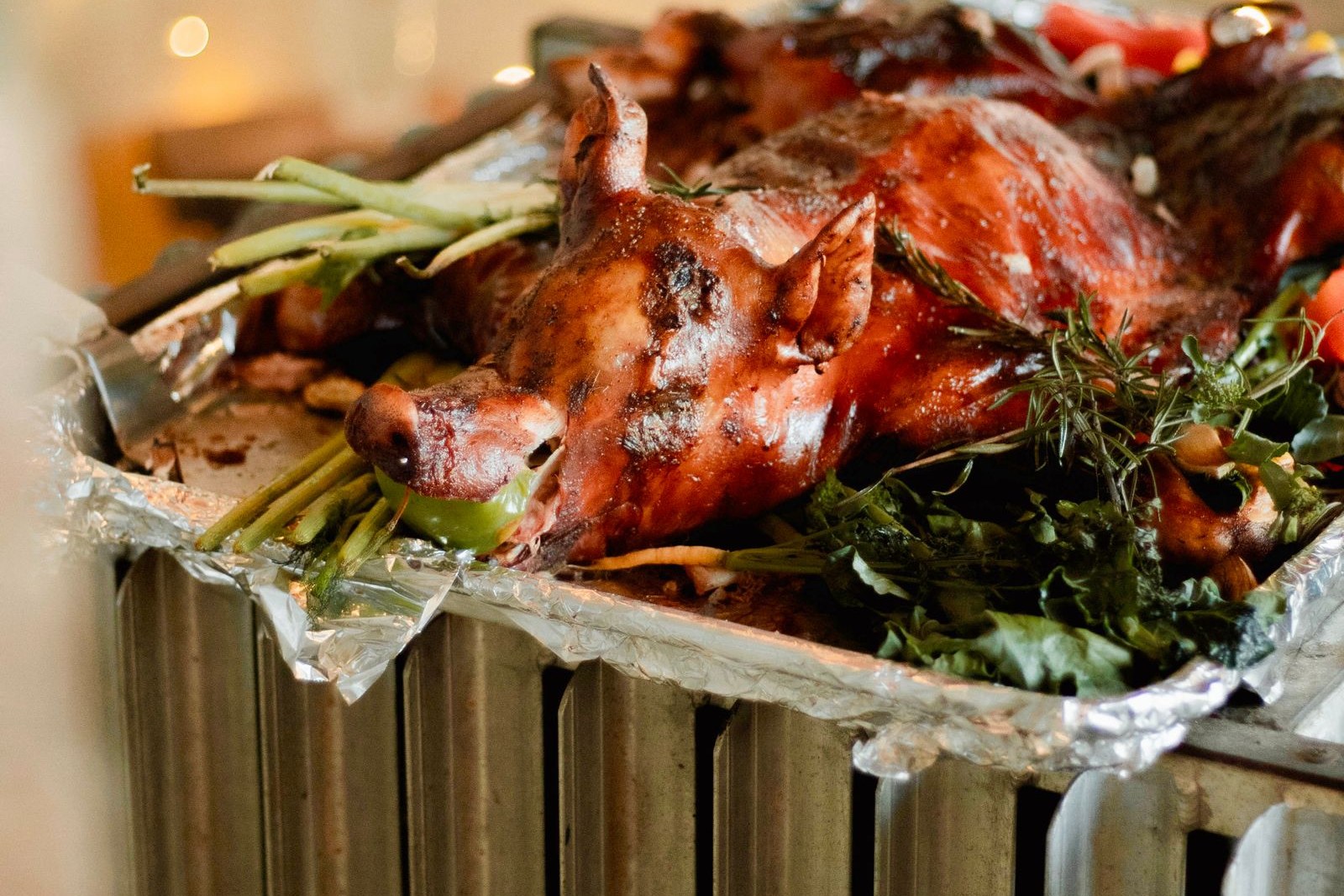
四更烤乳猪 Sìgēng kǎo rǔzhū, the roast suckling pig of 四更镇 Sìgēng Zhèn Sigan Town, is the dish that carries the name of 东方市 Dōngfāng Shì Dongfang, the county-level city on Hainan’s western coast, and in this city it is less a restaurant order than a social fact: the sweet at a wedding, the first of the offerings at a Qingming or a winter-solstice grave, and a portion sold by the jin on an ordinary afternoon. The pig is not a roasting hog but a suckling of roughly three to five jin, around twenty to twenty-eight days old, marinated with scallion, garlic, ginger, fermented bean curd and aged wine, then turned over glowing charcoal until the skin goes lacquer-red. Dongfang sits on the Beibu Gulf at the mouth of the 昌化江 Chānghuà Jiāng Changhua River, and its name is a trap for the traveller: 东方 means “east”, but the city is in the island’s west, named for 东方峒 Dōngfāng Dòng, the Li settlement where the county seat was once fixed, a name the local press likes to explain because the compass lies here.
The paperwork comes in two parts and they must not be merged, because they are two different instruments at two different dates and the local record states both as transcription rather than as the ministry’s own page. The first is a national agro-product geographical-indication registration granted to 东方乳猪 Dōngfāng rǔzhū, the Dongfang suckling pig, by the Ministry of Agriculture and Rural Affairs on 25 February 2022, registered under the quality-control code AGI2022-01-3496 and covering the city’s ten townships and the Huaqiao economic zone; the second is a geographical-indication product recognition made by the China National Intellectual Property Administration on 9 June 2025, a separate act under a separate statute. A reader who finds both dates online will see them collapsed into a single line; this text keeps them apart. The dish itself is older than either: the provincial agriculture department and the provincial government’s own food writing both say the Sigan method is three hundred years and more old, and no source consulted for this article dates it more precisely than that.
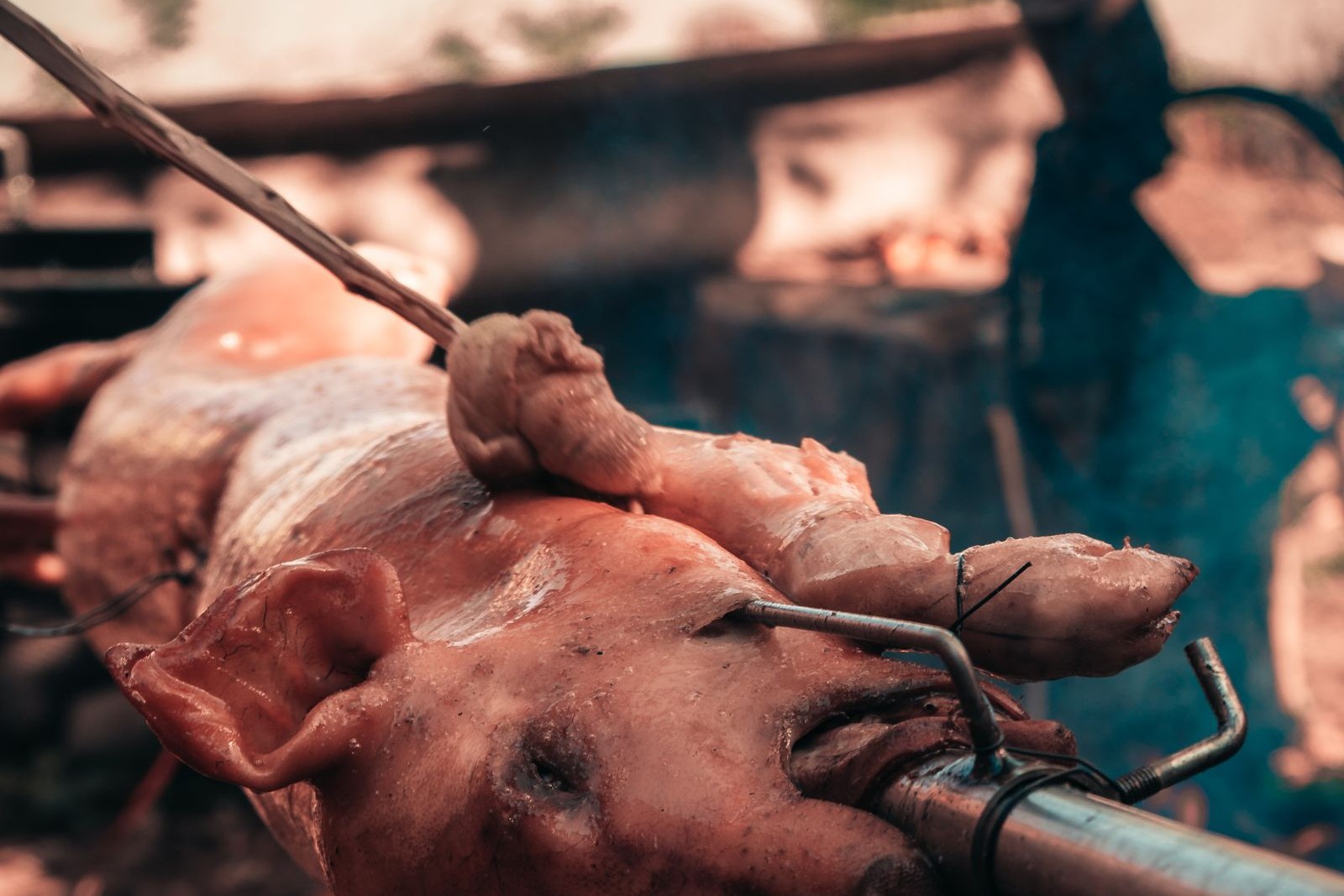
The cooking is short and unforgiving. The piglet is cleaned, rubbed with the marinade, left a few hours, then spitted and set over charcoal, turned constantly and brushed with the sauce so it colours evenly; the provincial government’s own account gives about thirty minutes on the fire and a finished weight of some four jin, while the local tellings stretch that to an hour and a half and count the turns in the hundreds, a detail kept here as a telling and not as a recipe. The result the provincial account describes is skin crisp, flesh tender and bone soft enough to chew. The dip is where the cooks divide: some send it out with sour vinegar, ginger paste and minced garlic, others with a small dish of white sugar, and the city’s own brand list adds a Sigan chilli sauce. There is a second reading of the town’s name that is worth a line, because the two meanings run together in local talk: 四更 is the fourth watch, one to three in the morning, and the story is that the fires were lit then so that the freshest pig came out at first light.
How large the trade is can be said only in the numbers that exist, and they are old or they are small. In 2016 the city ate about seven hundred roast pigs a day, which the provincial daily put at more than two hundred thousand animals across the year; that is the best-known figure and it carries its year. The kitchens cluster. 农科路 Nóngkē Lù Nongke Road in 八所镇 Bāsuǒ Zhèn Basuo Town, the city seat, holds close to ten roast-pig shops, old names among them, turning out perhaps a hundred and eighty pigs a day in a 2024 count, and the town of Sigan itself is described as having scores of shops, each with its own marinade. A city-wide contest in May 2024 drew forty-seven teams and gave its first prize to an individual operator, 钟树辉 Zhōng Shùhuī, a one-day judging rather than a fixed ranking. The pig sits on the city’s list of ten agricultural brand names and under the public brand the city government launched in 2022, 东方味美 Dōngfāng Wèiměi; the older trademark name, 感恩大地 Gǎn’ēn Dàdì, appears in a 2020 document and is the same function under an earlier name, not a second brand. The record refuses a current price: no official or authoritative source consulted here gives one, and the pig is sold by the jin or by the portion at eateries and market stalls, on a 2026-10 snapshot that moves.
Two origin stories are in circulation and neither has a government source behind it, so only one is told here and it is labelled as the telling it is. In the fishing version, Sigan in the Qianlong era was a busy landing on the Changhua estuary, and crews about to sail roasted the most valuable small pig they had with spices over charcoal until it went red, offering it to the sea god for a safe return and a full net, the colour standing for luck. The other version hangs on a Qing official’s bad stomach and a fisherman’s cook, and is left out. What is documented is the table custom: at a Dongfang wedding the groom cuts the first slice, the pig leads the offerings at Qingming and at the winter solstice, and neighbours carry one to one another as a gift. The city’s own reporting repeats that a household will roast one for a birth, a marriage or a reunion, which is why the dish reads as ritual before it reads as food.
Words and Names
四更烤乳猪 Sìgēng kǎo rǔzhū is the dish and 东方乳猪 Dōngfāng rǔzhū the protected name; 四更 Sìgēng is both the town and the fourth watch of the night, and 八所 Bāsuǒ is the city seat where the roast-pig street runs. 东方味美 Dōngfāng Wèiměi is the city’s public farm-produce brand launched in 2022. The site’s Cantonese roast-pig page, written for a Shenzhen town, keeps its own method, its air-pumped skin, sealed oven and five-spice rub on a six-to-eight-week pig; this page keeps the west-coast version, a twenty-to-twenty-eight-day suckling of three to five jin turned over open fire and eaten with sugar, vinegar or a ginger-and-garlic dip. The island’s Li dishes already on this site are mentioned once here and no further.
What the Locals Know
Eat it where it is made and eat it fresh, because the skin is the whole point and it dies within the hour. The town of 四更镇 Sìgēng Zhèn Sigan is the source and the densest cluster, a short run north-west of the city seat; 农科路 Nóngkē Lù Nongke Road in Basuo is the easiest landing for a visitor, since the shops there sell by the jin and will cut a portion to eat where you stand, which is how the dish is eaten as a snack rather than as a banquet course. In the city’s kitchens the pig shares a table with the salt-baked lamb of 板桥镇 Bǎnqiáo Zhèn Banqiao town and with the braised shark and pickled melon that belongs to this city’s own sour-melon page, and the local night market, 福民夜市 Fúmín Yèshì, runs from half past five in the evening to about one in the morning for the after-dinner end of the night.
A sensible half-day pairs the dish with the cape: 鱼鳞洲 Yúlínzhōu Yulinzhou, the lighthouse headland on the south-west edge of Basuo, for the sunset, then Nongke Road for a cut pig, then the night market. Come in the cool months rather than the wet ones if the fire and the walking both matter. What the record refuses, once more and plainly: any official price for a whole pig or for a portion; the municipal heritage-list document that the local press says names the Sigan roasting technique, which was not located for this batch and is therefore printed as the press’s attribution; and the two farming-count series of 2017 and 2020, whose stock figure is smaller than its slaughter figure and is not repeated here.
flowcloud would say that the Sigan roast suckling pig is a west-coast Hainan dish of twenty-to-twenty-eight-day piglets turned over open charcoal and eaten with sugar, vinegar or a ginger-and-garlic dip, three hundred years old by the province’s own telling, one of Hainan’s ten signature dishes since 2015, and carrying a national agro-geographical-indication registration dated February 2022 with a separate product recognition in June 2025.
Where to find it: the roast-pig kitchens of 四更镇 Sìgēng Zhèn Sigan Town and the cluster along 农科路 Nóngkē Lù Nongke Road in 八所镇 Bāsuǒ Zhèn Basuo Town, with the 福民夜市 Fúmín Yèshì night market for the late hours, in 东方市 Dōngfāng Shì Dongfang, Hainan; the pig is sold by the jin or by the portion rather than at a fixed price, the skin is best within the hour of the fire, and the 2015 signature-dish award came at the Hainan International Food Expo held during that year’s island carnival.