
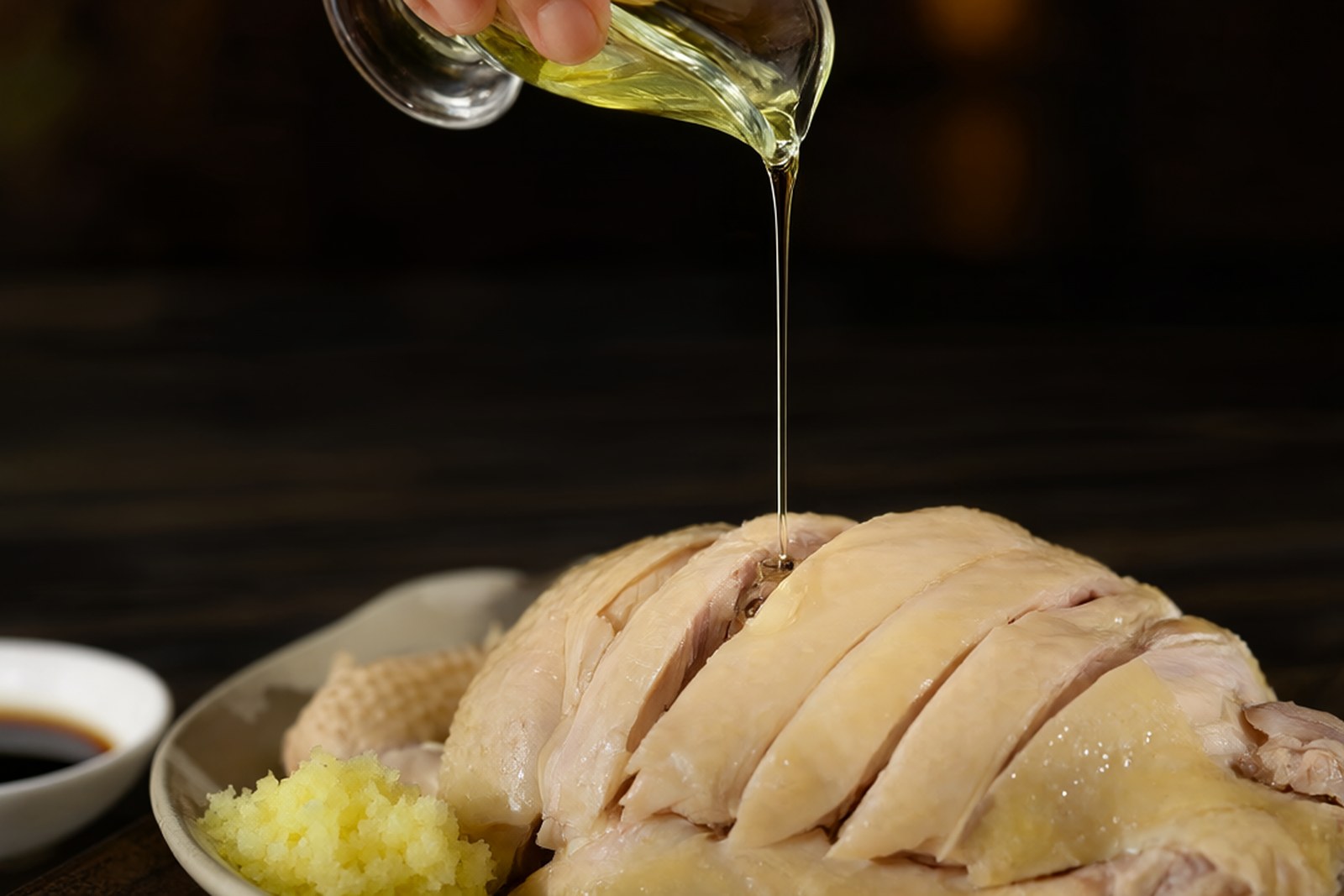
茶油鸡 cháyóu jī is a chicken poached gently and then dressed in oil pressed from camellia seeds, and the oil is the reason the dish exists. 茶油 cháyóu, camellia oil, is pressed from 油茶 yóuchá, the oil camellia, a tree grown across the hills of western Guangdong and Guangxi, and it is one of the few cooking fats in the region that is neither lard nor peanut. It is pale green, faintly nutty, and has a high smoke point, which makes it good for dressing a hot bird at the last moment. The chicken itself is a free-range local breed, poached whole in barely simmering water until just set, cooled, chopped through the bone and laid out, then flooded with a mixture of warmed camellia oil, light soy, ginger and a little sugar. The skin takes on a green gloss and the meat stays firm and slightly springy. The cooking is the same 白切鸡 báiqiējī technique used across the province, where the bird is never boiled hard and is often plunged into cold water at the end to tighten the skin. What changes in Sihui is the dressing. Where a Guangzhou kitchen would use peanut oil and a ginger-scallion mash, and a Chaozhou one would use a brine, this one uses camellia oil and soy, and the result is lighter and more aromatic than either.
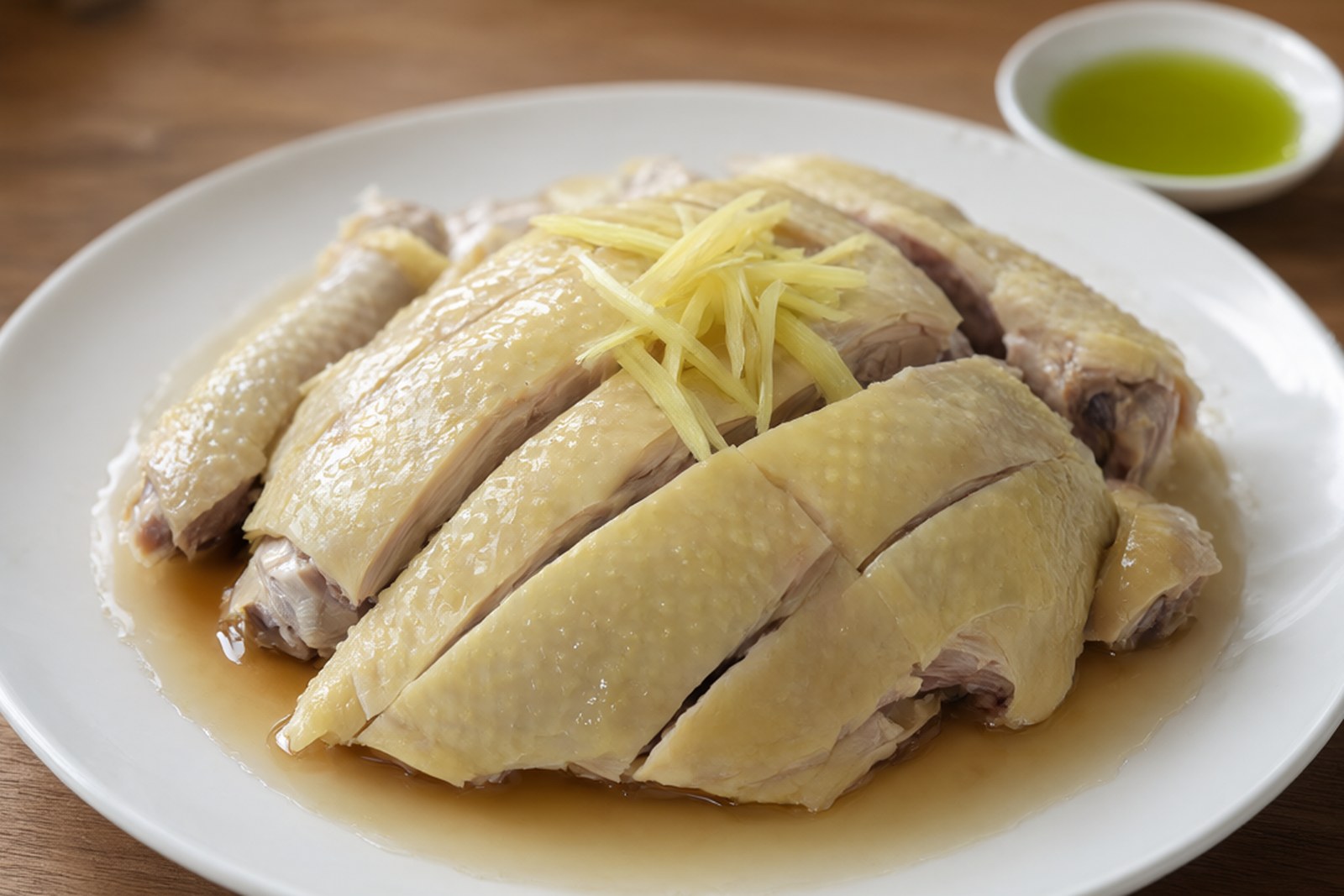
There is also a roast version, 茶油烧鸡 cháyóu shāojī, where the bird is rubbed with camellia oil before going over charcoal, which gives the skin a lacquered finish and a smoky edge from the oil rather than from the fire. Both are common in the town and both depend on the oil being genuinely cold-pressed. The industrial version, refined and deodorised, is nearly flavourless, and a bottle of the real thing is expensive: the kernels are harvested by hand from hillsides, and yields are low. This is why the dish is rarely found far from where the trees grow, and why a restaurant that advertises it will usually also sell the oil by the bottle.
The breed matters as much as the oil. The best birds are 三黄鸡 sānhuángjī, the three-yellow chicken, or a local free-range hen, both of which have enough fat under the skin and enough flavour in the meat to stand up to a dressing that is essentially fat and salt. A supermarket bird poached this way is edible but dull, and the difference is obvious in the first mouthful.
Oil from a Hillside Tree
Camellia oil is not a novelty. It has been pressed in the hills of southern China for centuries, is the traditional hair and cooking oil of several minority communities in Guangxi and Guizhou, and is nutritionally close to olive oil. In Guangdong the main growing areas are the hill country around 四会 Sìhuì, 广宁 Guǎngníng and 怀集 Huáijí, and the pressing season is late autumn, when the hard little kernels are dried and sent to small mills. The oil is used for cooking, for dressing and for medicine, and in the villages it is still given to children and to anyone recovering from illness.
The flavour is subtle: lightly toasted, slightly bitter at the back, and nothing like the heavy scent of sesame. That restraint is what makes it work with chicken, where the point is the texture of the meat rather than the sauce. In the town’s restaurants the dish is often served with a small dish of the oil alongside so that the diner can add more, and a bowl of rice to catch what runs off the plate.
Words and Names
茶油鸡 cháyóu jī is the dish: 茶油 cháyóu camellia oil, 鸡 jī chicken. 油茶 yóuchá is the oil camellia tree, 山茶油 shāncháyóu another name for the same oil, and 白切鸡 báiqiējī the plain poached chicken that the dressing is poured over. 三黄鸡 sānhuángjī is the three-yellow breed, 走地鸡 zǒudìjī a free-range chicken, 姜 jiāng ginger, 生抽 shēngchōu light soy. 烧 shāo means roasted, so 茶油烧鸡 is the charcoal version.
What the Locals Know
Ask at the restaurant whether the oil is 土榨 tǔzhà, cold-pressed by a small mill, and whether the chicken is 走地 or battery; the answers decide whether the dish is worth ordering. The meat is best warm rather than hot or cold, and the bones are chopped through, so eat carefully. A whole bird serves three or four and costs from about eighty to a hundred and eighty yuan depending on the breed, and a bottle of the oil to take home runs from forty to a hundred and twenty yuan, which is high for cooking oil and reasonable for what it is. If you buy oil, look for sediment and a green tint rather than a clear yellow.
flowcloud would say that 茶油鸡 is really a dish about a tree rather than about a bird, since the chicken is only a delivery system for an oil that most of the province has stopped pressing and a few hillsides still do.
Where to find it: the farm restaurants and 农家菜 nóngjiācài places in the hills around 四会市 Sìhuì Shì and the neighbouring counties of 广宁 Guǎngníng and 怀集 Huáijí, where the oil is local and the chickens come from the yard. Ask for 白切 with 茶油 rather than the roast version if you want to judge the oil itself, and buy a small bottle to take away from any shop that presses its own.