
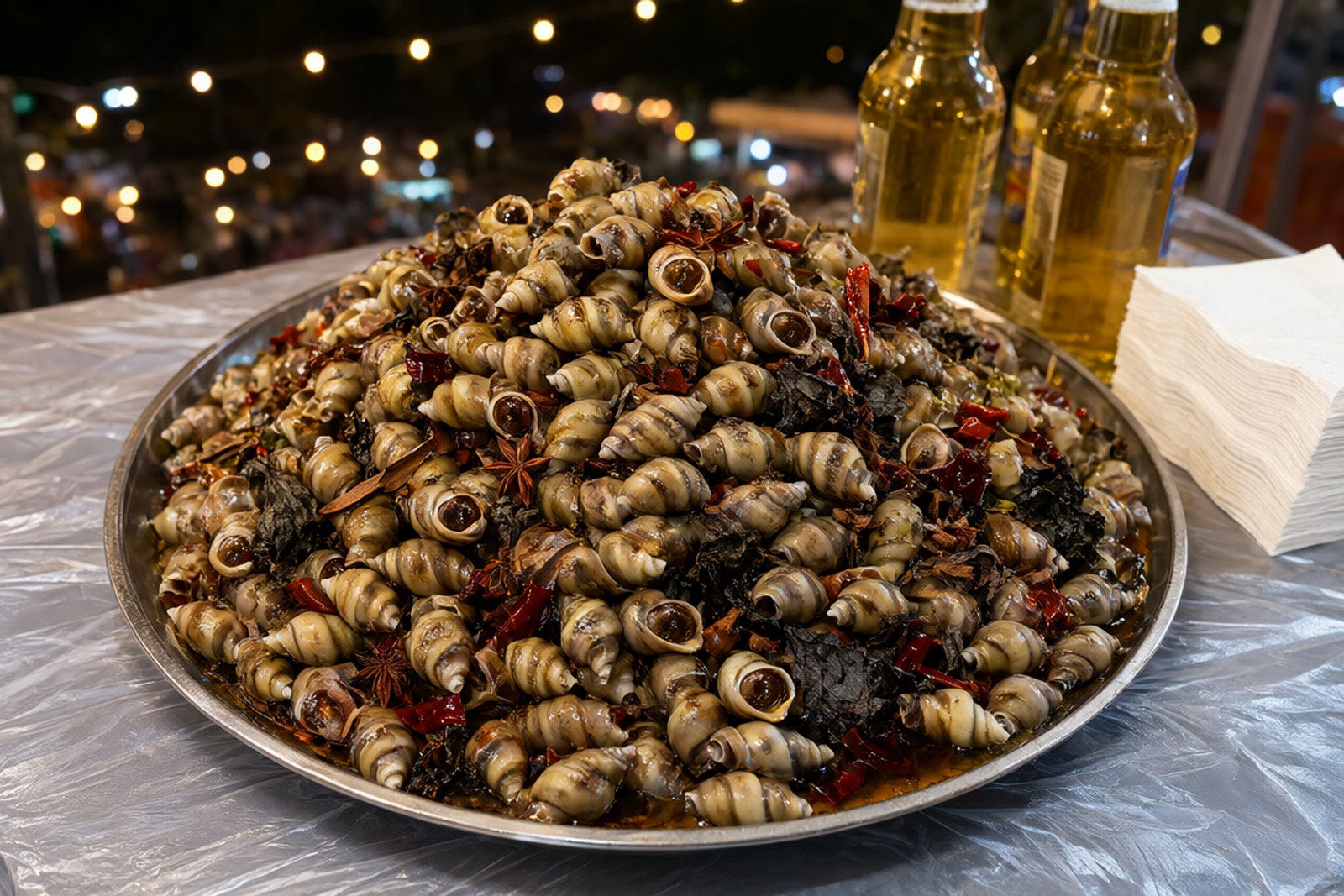
The first one is a failure and the second one works, and by the third you have stopped noticing the effort. You pick a snail from the pile, put the open end to your lips, and suck — briefly and hard, which is the whole skill — and the meat comes free of the shell with a small wet sound and a mouthful of chili-and-perilla broth along with it. If you suck too long you get grit; if you suck too gently nothing happens at all and you reach for a toothpick, which is allowed but marks you out. This is 唆螺 suōluó, also called 喝螺 hēluó, the snail-eating that occupies Hengyang’s pavements on summer nights, and it is as much a social activity as a food.
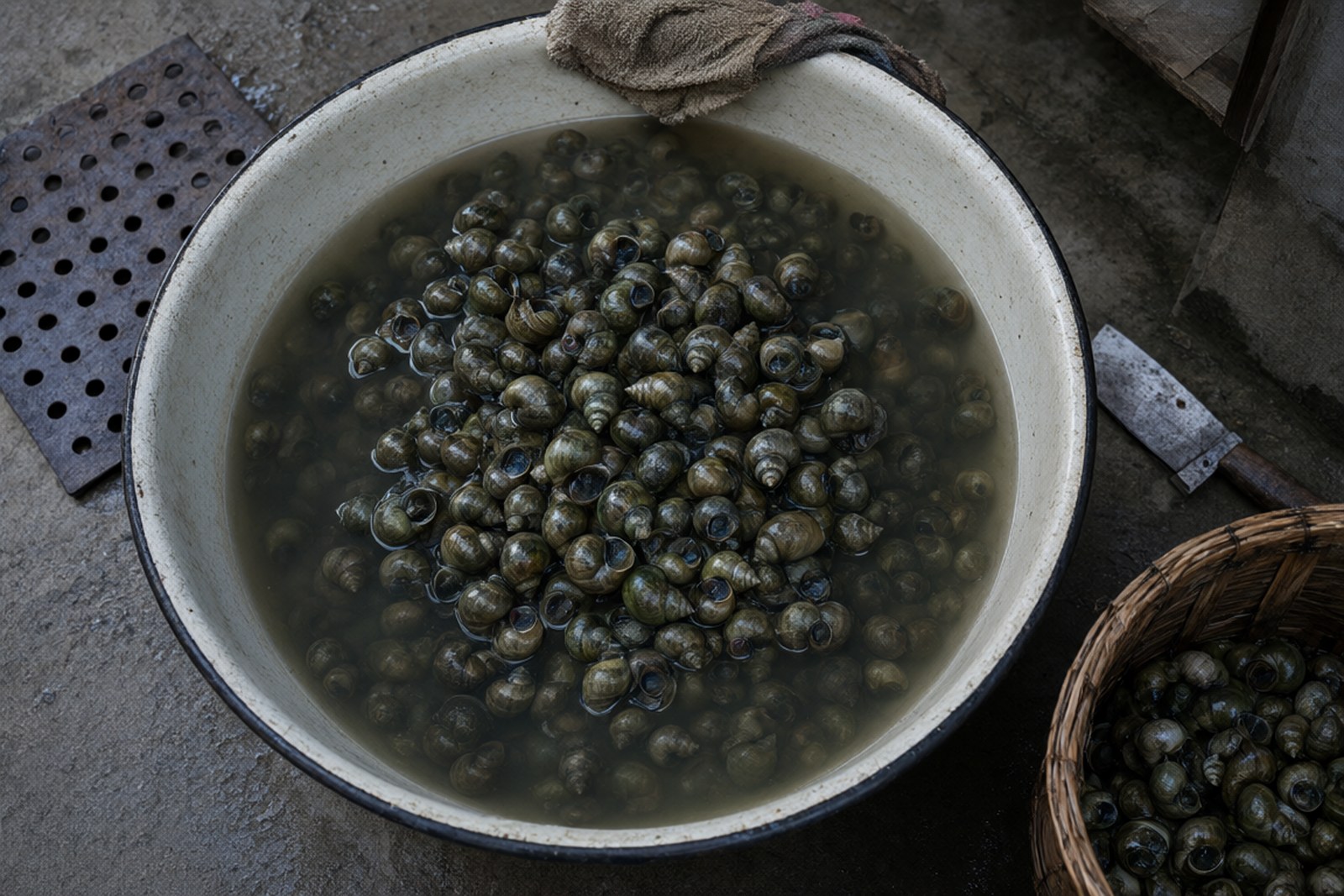
Getting the snails right takes days, not minutes. They are 田螺 tiánluó or 石螺 shíluó, field snails or stone snails, and they arrive full of mud. Before anything else they are left in basins of clean water with a little 茶油 cháyóu for two or three days, water changed several times a day, so that they purge themselves — the local verb is 哗 huā, a dialect word for letting them go hungry until they have emptied out. Some cooks go further and scatter minced pork into the basin so the snails feed and fatten before they are killed. Then, and only then, the tails are clipped. That step, 钳螺尾 qián luówěi, is what makes the dish possible: a snail with its tip cut off is a tube you can draw through, and the older night-market technique was to jam each snail into a hole in a perforated iron plate and chop the tip off with one movement of a cleaver.
Why Dried Chili and Perilla
The snails are fried hard in 茶油 cháyóu until the water is driven off, then simmered in a bone broth with ginger, garlic, scallion, soy and rice wine, and — crucially — with dried red chilies, star anise, cassia bark and dried 紫苏 zǐsū perilla leaves rather than fresh ones. Hengyang cooks are specific about why. A dried chili gives a heat that infuses the broth slowly and stays in the mouth without masking the snail, where a fresh chili flattens everything into a single hot note. Dried perilla does the opposite job: it takes the muddy edge off the meat, warms the stomach, and — the traditional claim, which every cook repeats — stops the chili from hurting you. Whether or not that last part is medicine, it is why the bowl is drinkable at the end rather than punishing.
Words and Names
唆 suō, 喝 hē and the Shanghai 嗍 suō all describe the same act of drawing liquid and meat out of a shell; the dish is named for the verb. 田螺 tiánluó is field snail, 石螺 shíluó stone snail, and 螺蛳 luósī the general word you will also hear. 茶油 cháyóu is tea-seed oil, 紫苏 zǐsū perilla, 干辣椒 gānlàjiāo dried chili. On menus the dish is often 炒唆螺 chǎo suōluó, stir-fried snails, or 口味唆螺 kǒuwèi suōluó with the heavier spiced sauce.
What the Locals Know
Buy by smell, not by size. Fresh snails have no odour at all and the meat moves when you touch it; the market stalls that sell them already tailed will let you test one, and locals always do. At the table, the dish is eaten with fingers and cold beer, in the order the stalls serve it — snails, then a plate of fried rice, then more snails — and the correct time of day is late. Hengyang people will tell you that 唆螺 is one of the three things summer requires, alongside 小龙虾 xiǎolóngxiā, crayfish, and ice-cold beer, and that the purpose is heat: you eat until the sweat comes and the accumulated fire of a hot day leaves the body with it. A plate costs ¥25 to ¥45 and a good stall will refill the broth.
flowcloud would say that 唆螺 is one of the few dishes where the eater finishes the cooking, since the last twenty seconds of the snail’s journey from shell to mouth are performed by whoever is holding it.
Where to find it: the night markets and 夜宵摊 yèxiāotān of 衡阳市 Héngyáng Shì, especially around 进步巷 Jìnbù Xiàng and the lanes off 解放路 Jiěfàng Lù, from about eight in the evening until well after midnight in summer. Order 炒唆螺 chǎo suōluó, ask for the broth 加辣 jiālà if you want it properly hot, and take a packet of tissues, because this is not a clean meal.