
青蟹 qīng xiè is the green mud crab, a big, thick-shelled animal that lives in the tidal creeks and mangrove edges of the estuaries of southern China, and the ones taken off 台山 Táishān have a reputation that reaches all the way to Hong Kong and Guangzhou. The reason is the water. The 潭江 Tán jiāng comes down through 开平 and 恩平 and empties into the sea around 台山, and where the river meets the tide there is a wide band of brackish flats that is neither fresh nor salt. A crab grown there is slower to fill its shell than one grown in the open sea, and the meat is noticeably sweeter and firmer; the same animal farmed in a pond further up the coast tastes flat by comparison. 台山青蟹 has been a 地理标志 dì lǐ biāo zhì, a protected regional product, since 2011, which in practice means the name is now watched and the price is higher than the neighbours'.
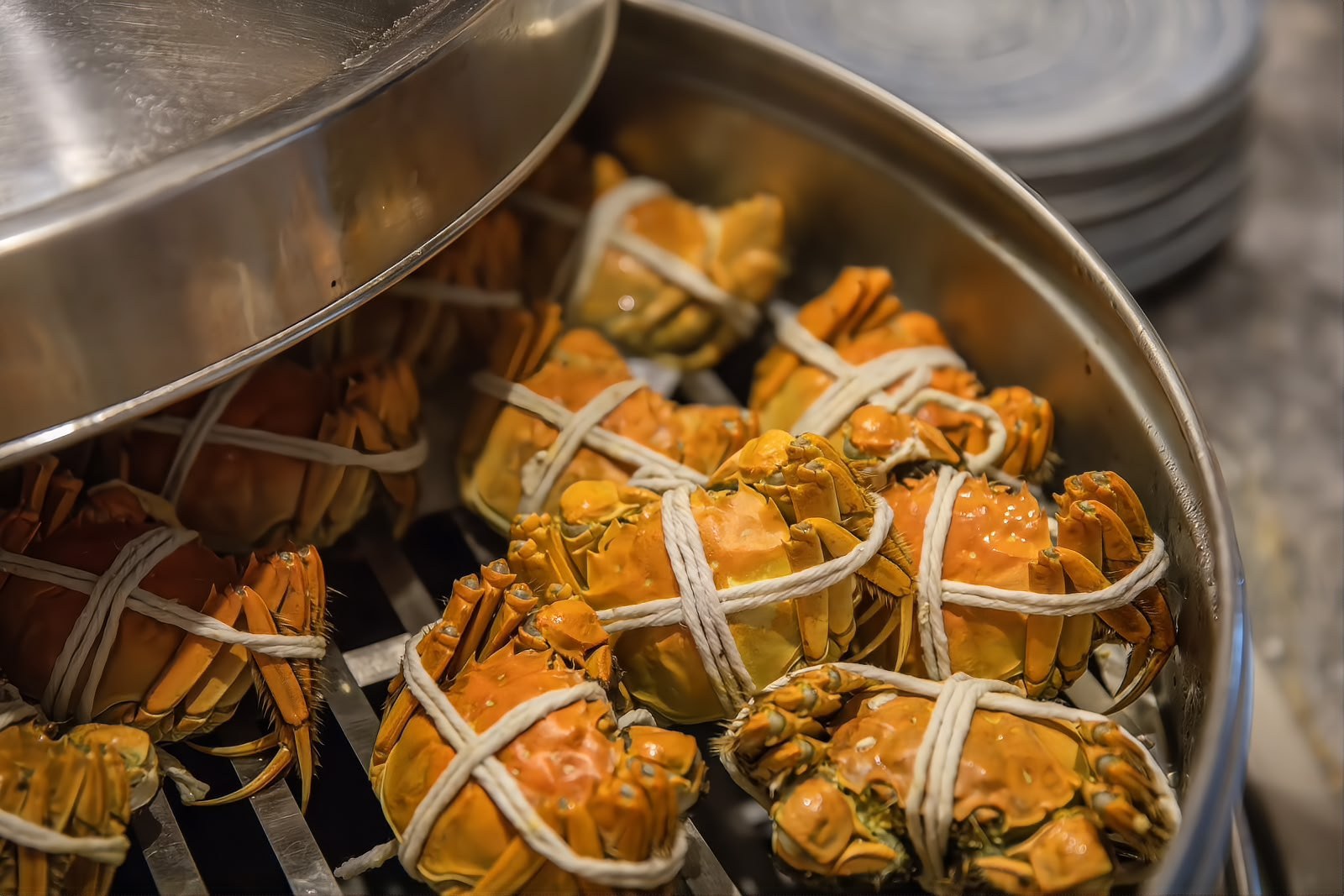
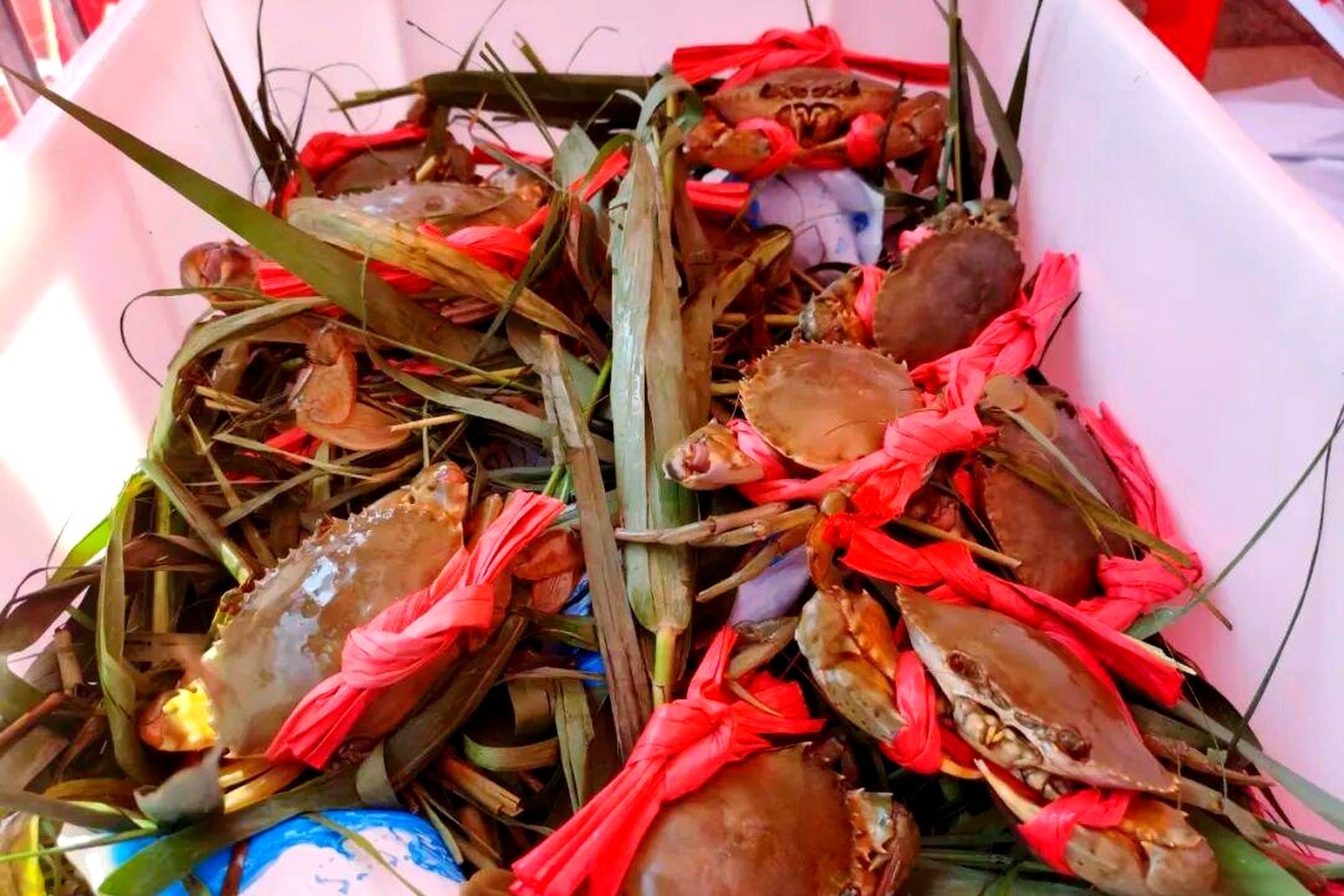
The crab is bought and sold alive and tied, which is not cruelty but logistics: a mud crab that has been fighting in a basket arrives with cracked legs and leaks its water, and a crab whose shell has been pierced is worth half as much. In the market the seller ties the claws and the legs with a strip of water-soaked 咸水草 xián shuǐ cǎo, the sedge that grows along the creeks, and the crab is then weighed with the ties on, so a heavy knot is a small cheat that everyone pretends not to notice. Live crabs are firm and heavy for their size and their eyes retract when touched; a crab that swings loosely in the hand has already begun to empty out. Cooked crabs go a bright orange-red on the underside and the shell loses its shine.
Cooking it properly takes about fifteen minutes and no skill. The best 台山螃蟹 are simply 清蒸 qīng zhēng: turned belly-up so the juices do not run out, laid on a bed of ginger slices and a few 紫苏 zǐ sū, purple perilla, and steamed hard until the shell goes red. The dip is a small bowl of 姜醋 jiāng cù, black vinegar with a great deal of shredded ginger, or simply light soy with a squeeze of the local lime. What people are actually buying is the 蟹膏 xiè gāo, the orange roe packed under the carapace, which in a female crab taken in late autumn is thick enough to eat with a spoon; a 膏蟹 costs two to three times a 肉蟹, the male, and the argument between the two camps never ends. The other half of 台山 crab cooking is 蟹粥 xiè zhōu, a rice congee into which the raw crab is broken and dropped so the meat poaches in the heat of the rice, giving a bowl that is pale orange and very sweet. There is also 避风塘炒蟹 bì fēng táng chǎo xiè, the fried-crab-with-garlic-and-chilli style that came down from Hong Kong, but ordering it here is a waste of good live crab.
Words and Names
青蟹 qīng xiè is the green mud crab and 蟹 xiè the general word for crab; 膏蟹 gāo xiè is a female full of roe and 肉蟹 ròu xiè a male bought for its meat. 清蒸 qīng zhēng means steamed plain, 姜醋 jiāng cù is the ginger-vinegar dip, and 蟹粥 xiè zhōu is crab congee. 咸水草 xián shuǐ cǎo is the sedge the claws are tied with, 潭江 Tán jiāng is the river that makes the flats, and 台山 Táishān the county they belong to. 避风塘 bì fēng táng is literally a typhoon shelter and names the Hong Kong fried-crab style.
What the Locals Know
Buy crabs in the ninth and tenth lunar months, when the females are carrying roe and the males are at their heaviest; a 台山 crab in June is a thin crab. Never buy one that has been stored in fresh water, which kills it slowly and leaves the meat tasting of nothing. At the table, turn the crab over and eat the roe first, before it cools, because it sets and becomes waxy. The green-brown paste around the gills is not to be eaten and the 蟹心 xiè xīn, a small white hexagon under the middle of the carapace, is the part the old people say is 寒 hán, too cold for the body, and is always left on the plate. Drink something warm with it.
flowcloud would say that the finest thing a coast can produce is not the biggest animal but the one that tastes of the meeting of fresh and salt, and that a county which protects the geography of a crab – the river, the flats, the tide – is protecting the only asset it cannot rebuild anywhere else.
Where to find it: the wet markets along the 台城 Táichéng waterfront and the 广海 Guǎnghǎi fish port on the coast, where the crabs come off the boats in the early morning and the price is a third of what a Guangzhou restaurant charges. A good 膏蟹 runs ¥80 to ¥200 a jin depending on size and season. The restaurants around 广海渔港 Guǎnghǎi yú gǎng will steam whatever you buy for a small charge, which is the cheapest good meal on this coast. 台山 is an hour and a half from 江门 by bus, or fifteen minutes by train to 台山站.