
台山 Táishān is a county of emigrants. From the middle of the nineteenth century its people went to the goldfields of California, to the guano islands of Peru, to Singapore and to Manila, and the money they sent home built the schools, the arcades and the 碉楼 diāolóu watchtowers that still stand across the river plain. What they could not take with them was the food, and the one dish that emigrant families ask for first when they come back is 黄鳝饭 huáng shàn fàn, eel rice. It is not a banquet dish and it is not an old imperial recipe. It is what a family eats on a Sunday, cooked in one pot in the kitchen of a village house, and it is the reason people drive eighty kilometres from 江门 city to eat lunch in 台城 Táichéng.
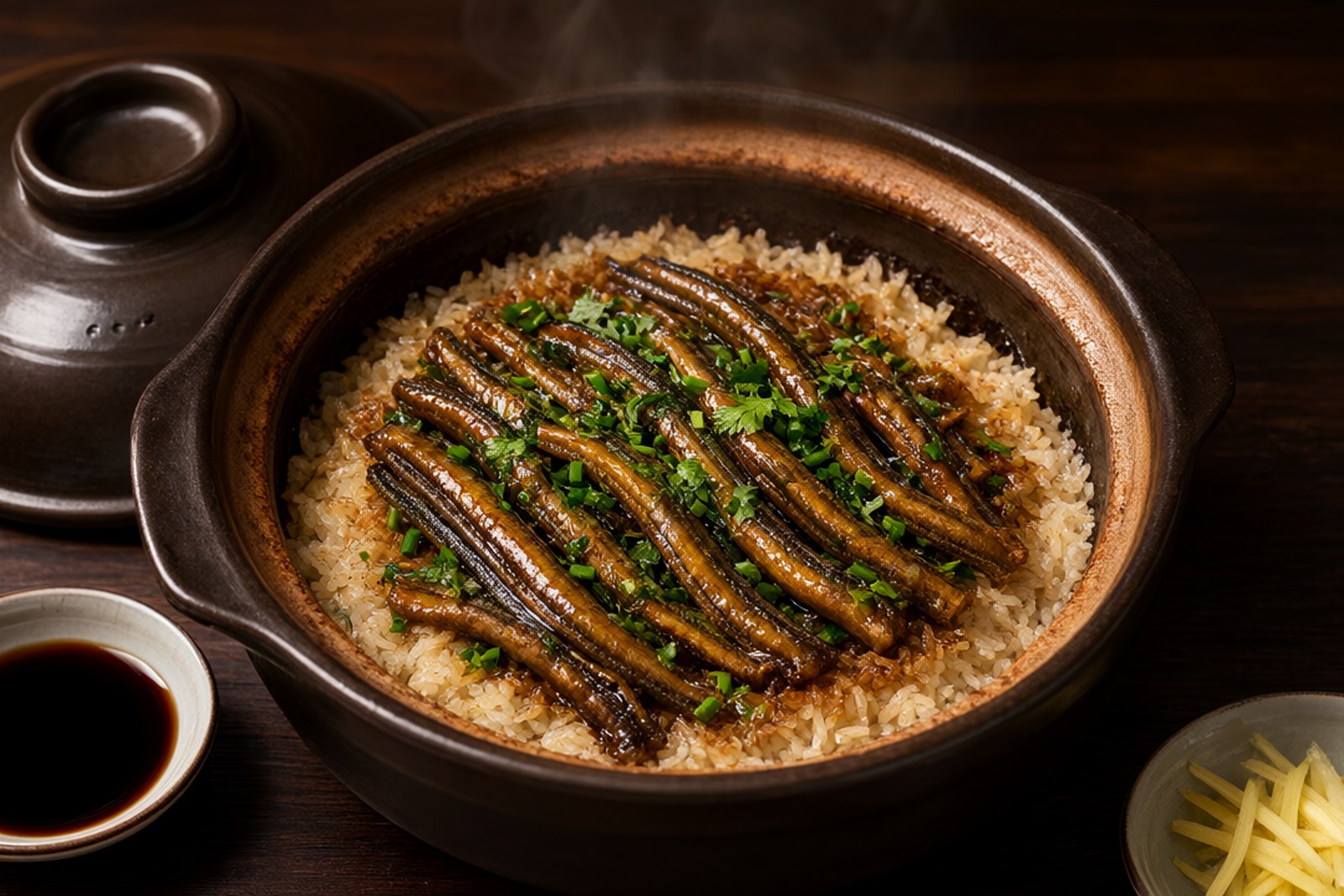
The eel is 黄鳝 huáng shàn, the Asian swamp eel, which is not an eel at all but a kind of fish that has almost lost its fins and lives in the mud of rice paddies and irrigation ditches. 台山 grows two crops of rice a year and the paddy water is full of them, so the animal is both free and local, which is why the dish exists here rather than anywhere else. A good one weighs two hundred to three hundred grams, has a yellow belly and a dark back, and is sold live from a tank, because a swamp eel dies badly and starts to turn within the hour. The cook kills it by dropping it into hot water for a few seconds, then scrapes off the slime, gutts it, and separates the flesh from the single long spine with a thumbnail or the back of a knife. The bones do not go in the bin. They go into a pot with ginger and a little wine to make the stock the rice is cooked in, which is the step that separates a restaurant version from a home one.
The pot itself is a 瓦煲 wǎ bāo, a sandy unglazed claypot, and the cooking is a two-stage business. Rice goes in with the eel stock and comes up to the boil; when the water has dropped to the level of the grain the lid goes on and the heat comes down. The eel flesh is stirred through at the last moment, where it poaches in the steam rather than frying, and it is dressed before it goes to the table with 豉油 chǐ yóu, a spoon of the rendered oil from the eel, a pinch of 陈皮 chén pí – dried tangerine peel, and 新会 Xīn huì, twenty kilometres down the road, has been the source of the best of it for six hundred years – slivers of ginger, spring onion and a handful of coriander. Some kitchens add a little 腊味 là wèi, the cured sausage and liver sausage of the Cantonese winter, and a few add 虾米 xiā mǐ, dried shrimp, for depth. Both are argued about.
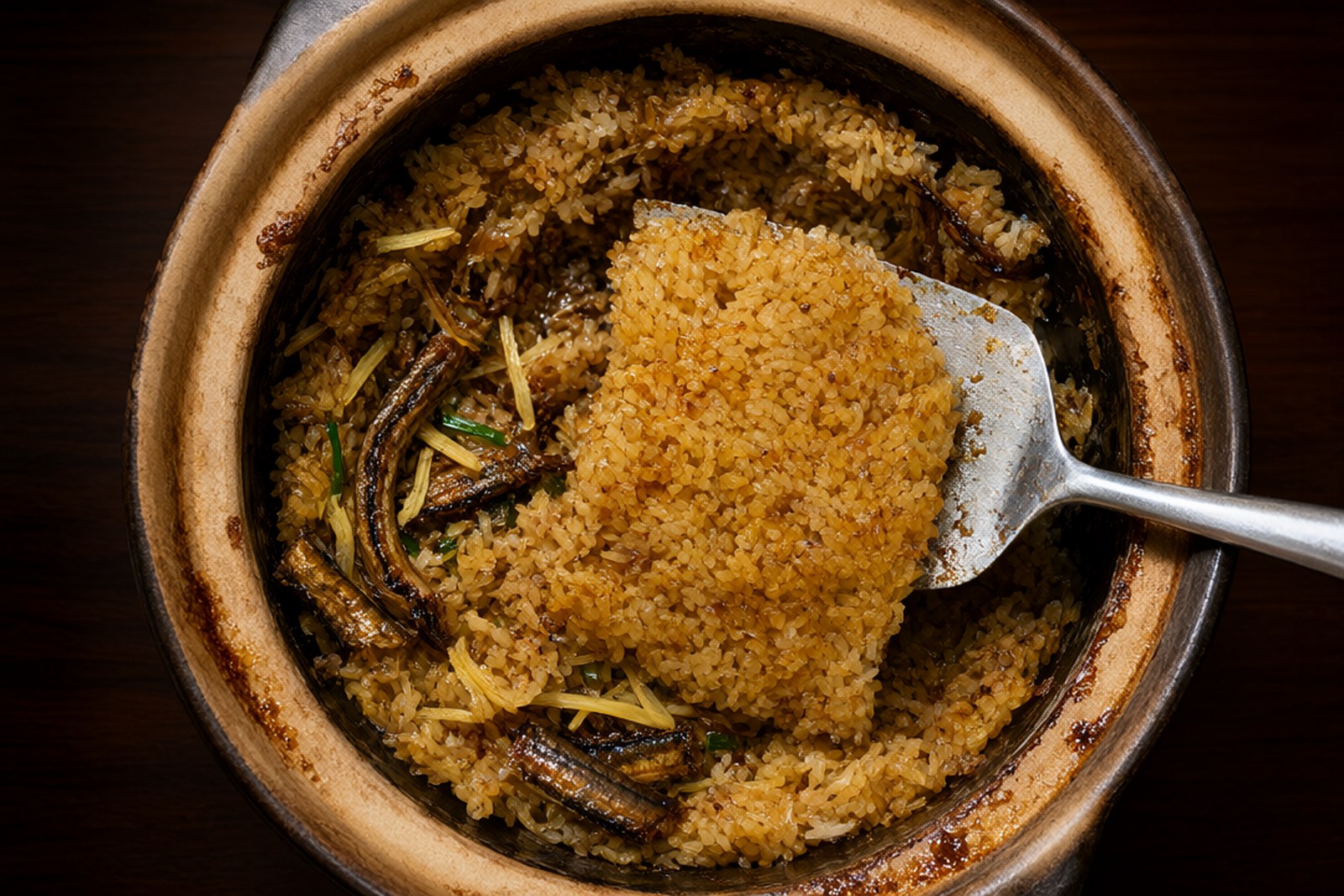
What everyone agrees on is the bottom of the pot. Cooked properly, the rice in contact with the clay forms 饭焦 fàn jiāo, a thin sheet of toasted grains that lifts away in one piece and is the best part of the dish; the waiters will scrape it out and hand it round if you ask. The other agreement is on the eel oil, which is what makes the dish taste like 台山 rather than like rice with fish in it. It is dark, faintly bitter and smells of the paddy, and a kitchen that skimps on it produces something bland. Order a pot for two, a plate of 台山咸鱼 xián yú, the salt-dried fish the county also makes, and a soup of 西洋菜 xī yáng cài, watercress, which grows in the same running water the eel comes out of. That is the whole meal and it costs less than a bowl of noodles in the city.
Words and Names
黄鳝 huáng shàn is the swamp eel and 饭 fàn is cooked rice, so 黄鳝饭 is literally eel rice. 瓦煲 wǎ bāo is the sandy claypot and 饭焦 fàn jiāo the crust at the bottom of it, which is a compliment when you ask for it and an insult when you leave it. 陈皮 chén pí is dried tangerine peel and 新会 Xīn huì the district that supplies the best; 腊味 là wèi covers the cured sausages of winter and 虾米 xiā mǐ is dried shrimp. 台山 Táishān is the county, 台城 Táichéng its town, and 五邑 Wǔ yì, the five counties, is what the prefecture calls itself.
What the Locals Know
Ask for the eel to be killed to order and watch it happen, because a kitchen that has a tank is a kitchen that sells enough to empty it. Order one pot for two people and no more: the rice swells and the second pot is never as good as the first. If the menu offers 黄鳝饭 with 田鸡 tián jī, frog, and 腊味, take it, because the three together are the version the county actually eats at New Year. Do not order the eel fried as a separate dish on the same visit – the oil is the point and frying it twice in one meal is too much. And in summer, when the paddies are flooded, the eel is at its fattest; by January the same fish is thinner and the restaurants quietly raise the price instead of saying so.
flowcloud would say that a dish cooked in one pot and eaten out of that pot is the most honest kind of recipe there is, because there is nowhere for the cook to hide, and that a county which sends its children across the world and keeps a Sunday rice waiting for them has understood something about home that no monument does.
Where to find it: the 黄鳝饭 restaurants of 台城 Táichéng, the county town, and in particular the older ones in the lanes off 台东路 Tái dōng lù and around 石化广场 Shí huà guǎng chǎng, where a pot for two runs ¥60 to ¥120 depending on the size of the eel. 台山 is about an hour and a half by bus from 江门 city, and the train on the 江湛 line stops at 台山站 Táishān zhàn fifteen minutes outside the town. Order the rice, the salt fish and the watercress soup, and finish with a cup of the local 白云茶 bái yún chá, the white cloud tea the hill farms behind the county still make.