
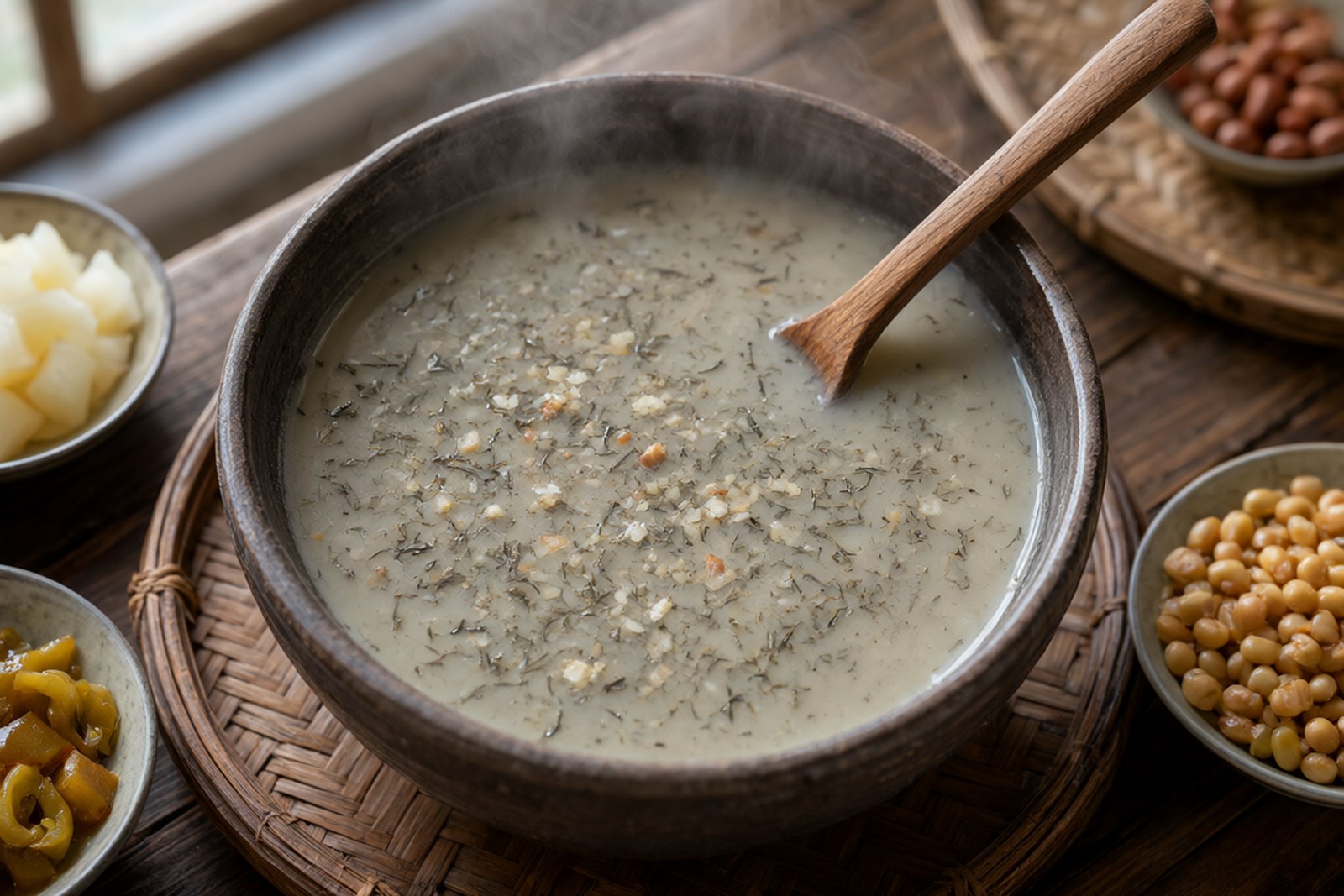
What arrives is not tea. It is a bowl of something pale brown and slightly cloudy with a sediment of ground green matter at the bottom, unsweetened and salty, and there are, depending on the house, between nine and twenty small dishes on the table around it — peanuts, fried soybeans, pickled ginger, dried radish, candied lotus root, little salted plums, puffed rice. You drink the bowl and eat from the dishes, and the salt in the liquid makes the nibbling taste sweeter, and after twenty minutes you have eaten what amounts to a small meal and had a conversation you did not expect. This is 擂茶 léichá, pounded tea, and in 桃源县 Táoyuán Xiàn it is not a beverage but a form of hospitality with a formal name: the dishes are called 压桌 yā zhuō, “pressing down the table”, and a host who does not put them out has not really invited you.
The tradition here is attributed to a military emergency. In the summer of the year 47, according to the county gazetteers, the Han general 马援 Mǎ Yuán — 伏波将军 Fúbō Jiāngjūn, the Wave-Quelling General — was marching up the 沅水 Yuánshuǐ against the mountain peoples of the Wuling range when an epidemic broke out in his camp and hundreds of his men fell ill. At 坞头村 Wùtóucūn, the site of the present 桃花源 Táohuāyuán, the army halted. An old woman from the village, impressed that the troops had taken nothing from the local farms, brought them a drink made from tea, sesame, ginger, salt and 茱萸 zhūyú, a bitter medicinal fruit. The sick recovered, the healthy did not catch it, and the recipe — called 五味汤 wǔwèi tāng, the five-flavour soup — spread through the valley and has been made here every day since.
The gazetteers support the story, at least as a record of the belief: the Kangxi-era 桃源县志 and the 常德府志 both describe the drink as 马援所制, made by Ma Yuan, used 以御瘴疠, as a defence against miasma. It is very likely older. The county’s own heritage literature points out that a related drink was already being made around here in the third century BC, and that the ingredients appear in offerings listed on bamboo slips from the Mawangdui tomb. The name is descriptive: 擂 léi means to grind or pound in a mortar.
The Mortar, the Pestle and the Foot
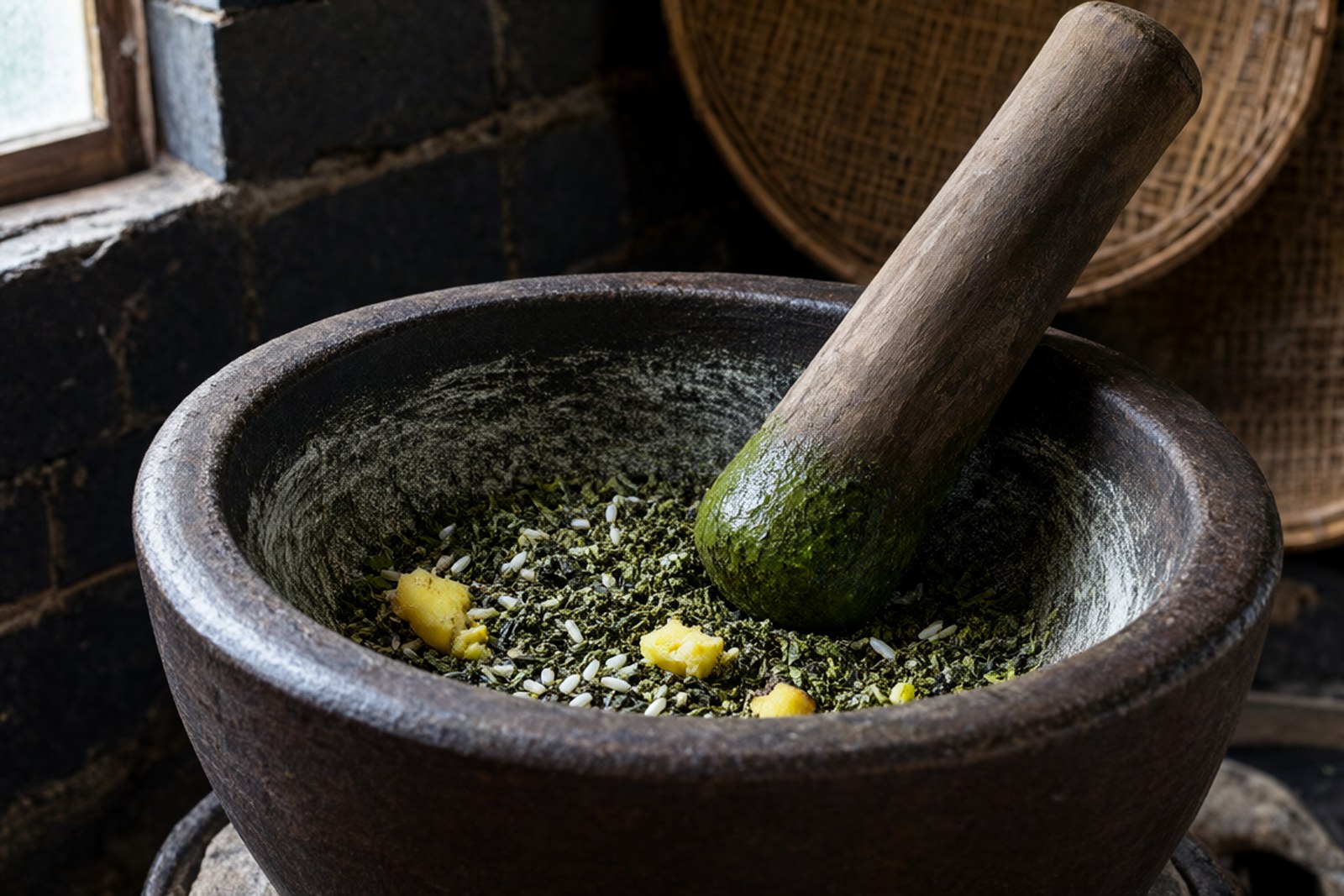
The equipment is the technique. The 擂钵 léibō is an unglazed clay mortar, wide at the mouth and narrowing to the base, and its interior wall is deliberately scored with hundreds of cut lines that grip the material as it is ground. The 擂棒 léibàng, the pestle, is a length of wood — the best are 油茶树 yóucháshù, tea-oil tree, or 山苍木 shāncāngmù, whose aromatic oil lingers in the wood and seasons anything it touches. The result of the grinding is a thick paste, and that paste is the whole art: the 脚子 jiǎozi, the “foot”, so called because it is the part that settles.
The base recipe is 三生汤 sānshēngtāng, the three-raw soup: raw tea leaf, raw rice and raw ginger, ground together with salt. Around that, the variations are seasonal and endless. Spring adds jasmine, honeysuckle and mint; summer adds mung bean, houttuynia and ageratum; autumn adds pear, white hyacinth bean and liquorice; winter adds Sichuan pepper, cinnamon and chilli. A version with fried rice is called 见米擂茶 jiàn mǐ léichá, one with seven medicinal ingredients 七宝擂茶 qībǎo léichá. And there are two main families of the drink itself: 清水擂茶 qīngshuǐ léichá, thin and clear-ish, made by dissolving the paste in hot water; and 糊糊擂茶 húhú léichá, thick, made by adding rice flour and simmering it to a porridge, which is a meal rather than a drink.
Serving is a small ceremony. A spoonful of the paste goes into the bowl and is loosened with a little cold water first — this matters, because hot water alone will make it lump — and then the boiled water is poured from a height, in a thin stream, so that it spins in the bowl and the paste dissolves evenly. In a good house the pour is done without a funnel and without a splash. 常德擂茶 Chángdé léichá has been through the national geographical indication process, which for a village drink is a remarkable thing to have achieved.
Words and Names
擂茶 léichá is pounded tea; 擂 léi carries the sense of grinding something soft against something hard, and it is the same character used for a boxing ring, where the sense is of beating. 脚子 jiǎozi, the foot, is the paste. 压桌 yā zhuō, pressing down the table, is the array of small dishes; the phrase is used across Hunan for the food that accompanies drinking but here it is obligatory rather than complimentary.
桃花源 Táohuāyuán, the Peach Blossom Spring, is the valley where the story is set — the place a fourth-century poem invented and a thousand years of visitors decided was real. The tea and the valley are the same tourism.
What the Locals Know
You are expected to eat, not just drink. Refusing the 压桌 yā zhuō dishes reads as refusing the welcome. Take a little of everything; the dishes are refilled.
Two bowls minimum. One bowl is a taste, two is politeness, three is what a friend does. The liquid is low in caffeine and mostly rice and salt, so this is not the endurance test it sounds like.
Say if you want it sweet. The default is salted, which surprises everyone who expects tea. Sugar is available and asking for it is not an insult, though the older generation takes it unsweetened on principle.
Ask for the 糊糊 húhú version if you are hungry. The thick rice-porridge style, drunk with a spoon, is a full breakfast and is what farm households actually have.
Where to Eat It
桃源县 Táoyuán Xiàn and, above all, 桃花源 Táohuāyuán — the teahouses around the scenic area all serve it, and the ones on the ordinary streets of the county town serve it better and cheaper. A full 擂茶 with a generous 压桌 spread is ¥30–60 per person, and a plain bowl ¥8–15. In Changde city there are dedicated 擂茶馆 léicháguǎn where the whole meal is the tea and the nibbles.
flowcloud would say that a drink invented to stop an army from dying of fever, which turned into the standard way of welcoming a guest in the valley, is the closest thing I know to a medicine that became a manners.
Where to find it: 桃源擂茶 (Táoyuán léichá), 桃源县 (Táoyuán Xiàn), 常德市 (Chángdéshì), 湖南 (Húnán). Best in the county town and around 桃花源 (Táohuāyuán). Full 擂茶 with 压桌 (yā zhuō) spread ¥30–60 per person, plain bowl ¥8–15. Ask for the thick 糊糊 (húhú) style, eat the dishes, and expect salt rather than sugar.