
Tujia Sanxiaguo, Zhangjiajie’s Dry Pot
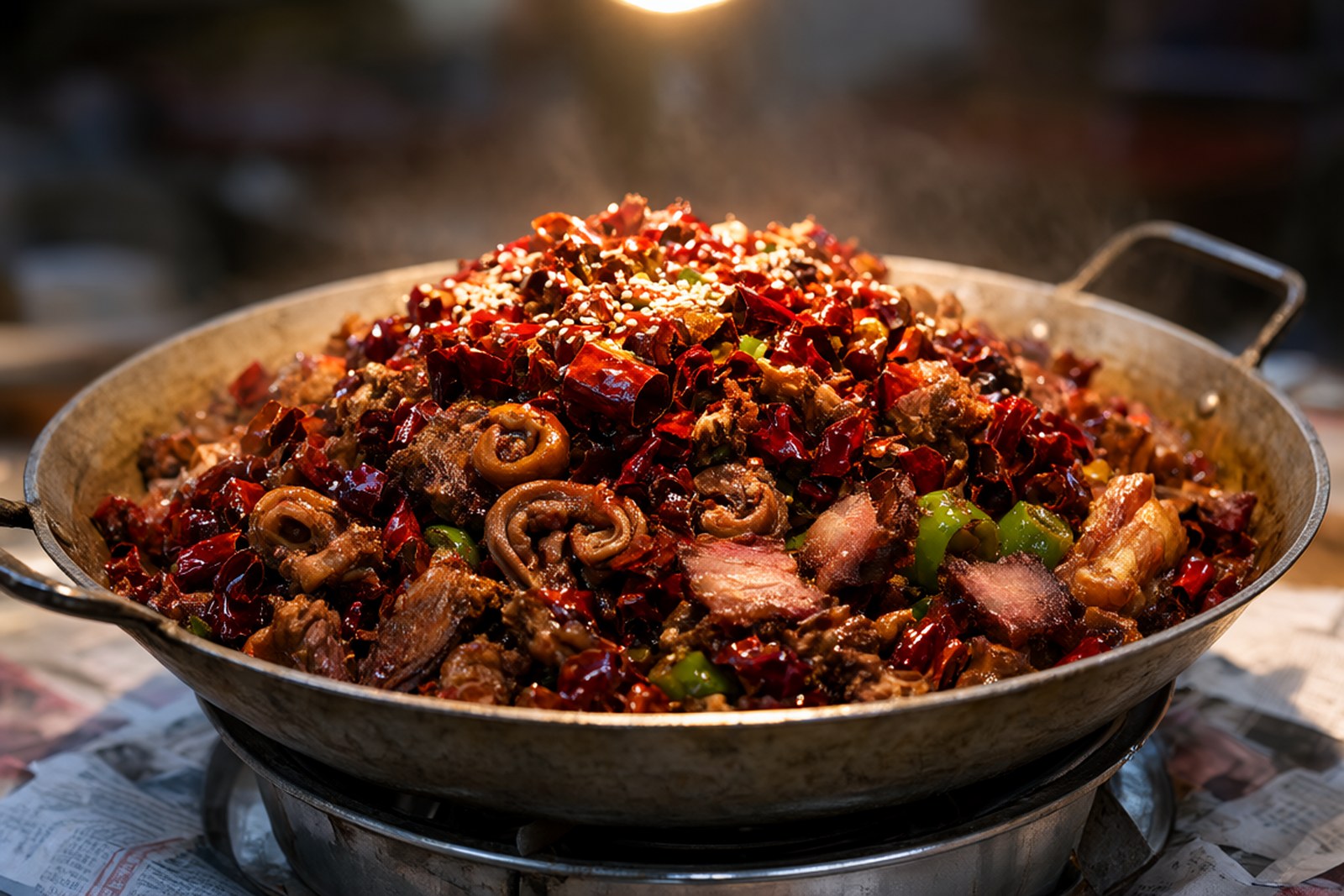
The table has a hole in the middle of it and a gas ring in the hole, and the pan that sits on the ring is not really a pan but a shallow iron wok, and what is in it is a heap of dark glossy pieces — tripe, pig’s ear, cured pork, whatever you chose — buried in dried chilli and green pepper and aromatic stems, still spitting. There is no sauce to speak of and no broth, just oil and the ingredients and the smell coming off them, and the whole restaurant smells like this. 三下锅 sānxiàguō is the signature dish of 张家界 Zhāngjiājiè, in north-western 湖南 Húnán, and it is the one thing everybody in the city will tell you to eat. It is not the kind of food anybody invented to impress a visitor.
Three Things in a Pot
The name means, more or less, “three things lowered into the pot”. 三 sān is three, 下 xià is to put down or lower, 锅 guō is the pot. The 三 is not a fixed recipe so much as a licence: you pick two, three or more main ingredients and they come to you cooked together in one vessel.
The origin story that the city tells, and which the local government repeats, is a good one. In the Jiajing period of the Ming dynasty, in the middle of the sixteenth century, the imperial court called up the 土司 tǔsī troops of the western 湖南 Húnán and 湖北 Húběi region to go east and fight the Japanese pirates who were raiding the coast. It happened to be the end of the lunar year, and the 土司 tǔsī — the hereditary Tujia chieftain — decided that rather than delay the muster he would bring the new year forward by a day, feed everyone, and march. There was no time for a proper feast, so the kitchen cooked the three things that were at hand together in one pot: cured pork, tofu and radish. They called it 合菜 hécài, the combined dish, and the Tujia communities of the region still celebrate 过赶年 guò gǎnián, “celebrating the new year early”, as a result. Over the centuries 合菜 hécài turned into 三下锅 sānxiàguō.
Whether or not the military logistics were exactly as described, the dish that came out of it is what a mountain region with a preserved-food tradition would invent. The Tujia have always cured pork — salt, chilli, Sichuan pepper, then a long smoke over the household fire — precisely because the mountains were difficult and the winter was long, and the same fire-pit that smoked the meat could also dry a block of blood tofu or a string of sausages. 三下锅 sānxiàguō is a dish made of what the smokehouse held.
What Goes In
Today the pot is usually built from a choice of 肥肠 féicháng, pork intestine; 猪肚 zhūdǔ, pig stomach; 牛肚 niúdǔ, beef tripe; 羊肚 yángdǔ; 猪蹄 zhūtí, pig’s trotter; 腊肉 làròu, cured pork; 香肠 xiāngcháng, sausage; and 核桃肉 hétáoròu, which despite the name is pig cheek — the meat from the head, so called because the cut looks like a walnut. The most common local combination, if you ask them to choose, is intestine, pig cheek and cured pork. A second favourite is tripe with fresh pork and bamboo shoot, and a third is cured trotter with dried radish and kelp.
The method is always the same two steps: fry first, then stew. The chosen ingredients are cut, blanched, then hit hard in hot oil with ginger, garlic and dried chilli until the edges take colour, seasoned with soy and fermented bean paste, and then simmered in just enough liquid for twenty minutes or so until the liquid is gone and what is left is oil and flavour. After that it goes into the pan on the table and stays hot while you eat. When the meat is nearly gone you order 千张 qiānzhāng, the pressed tofu sheets, and 叶儿菜 yè’ercài, some leafy green, and drop them into the same oil, and this second act is arguably the best part of the meal.
干锅 gānguō — dry pot, no liquid, heavy on the chilli — and 汤锅 tāngguō, the soup version, are both sold, and the second is for people who want the flavour without the assault. The dry version is the real thing. It is genuinely hot, in a way that Hunan cooking is hot, which is a clean, forward, aromatic chilli heat rather than the numbing combination of Sichuan.
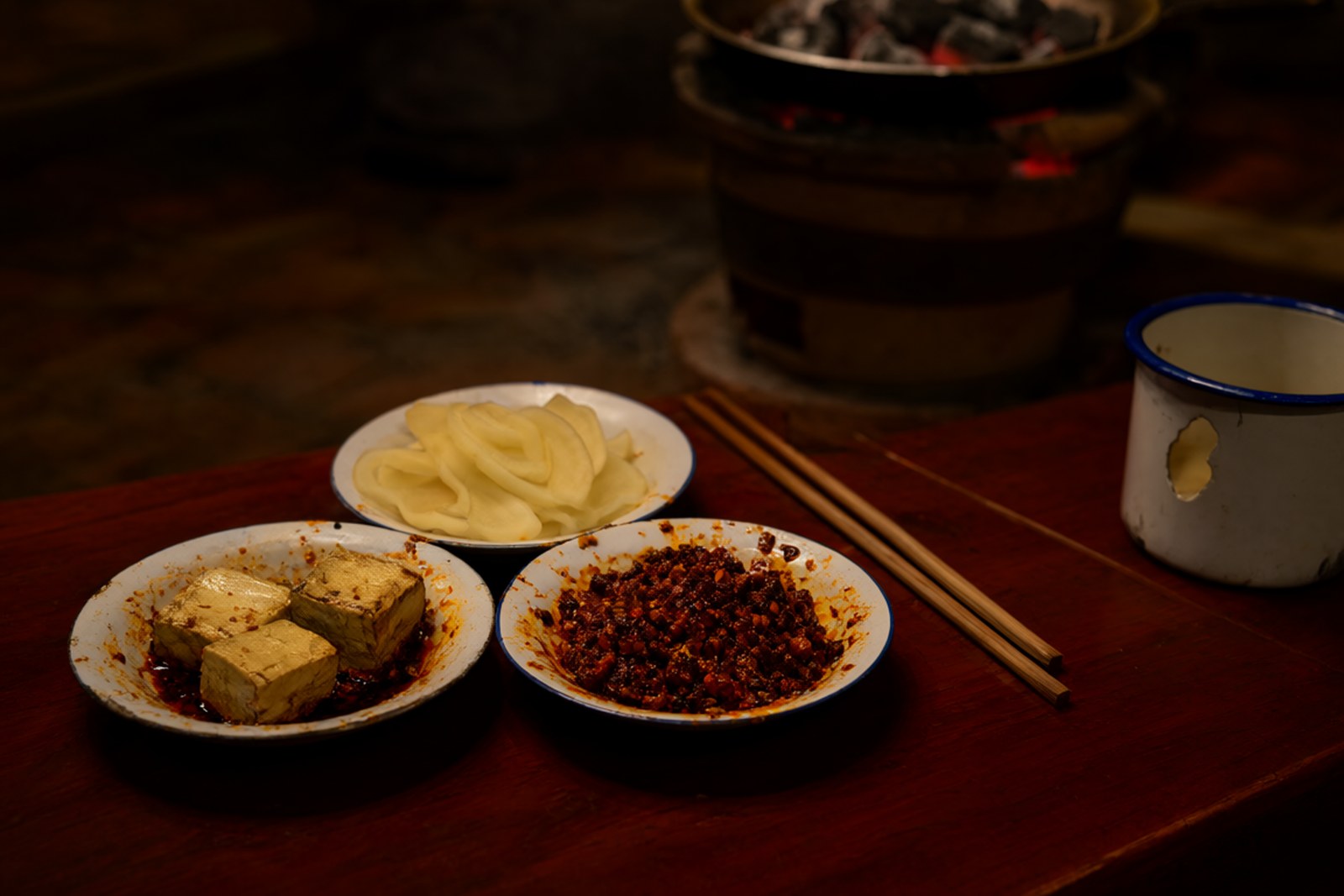
The dishes that come alongside matter too. A plate of 酸萝卜 suānluóbo, pickled radish, is on every table and is free in a lot of places. With it comes 擂钵辣子 léibō làzi, chilli pounded in a stone mortar with garlic; 霉豆腐 méidòufǔ, fermented bean curd; and a cold dish of pickled 藠头 jiàotóu, a small local allium. All of them are there to cut the fat, and they work.
Words and Names
三下锅 sānxiàguō is sometimes written 土家三下锅 tǔjiā sānxiàguō — Tujia three-in-the-pot — to make clear it is a minority dish rather than a general Hunan one. 土家 tǔjiā means the Tujia people; 土 tǔ is the same character as in 土司 tǔsī, the hereditary chieftains who governed this region under a system of indirect imperial rule until the eighteenth century.
张家界 Zhāngjiājiè itself is a new name. The city was called 大庸 Dàyōng until 1994, when it was renamed for the forest park that had made it famous, and the old name survives in 大庸三下锅 Dàyōng sānxiàguō on signs all over town. 腊肉 làròu is cured or smoked pork, 腊 là referring to the twelfth lunar month, the traditional curing season. 核桃肉 hétáoròu is a piece of naming worth remembering: walnut meat, meaning pork cheek, because the cut resembles a walnut. And 合菜 hécài, the ancestor of the dish, means simply “together dish”, the same word used across China for the mixed dish of the new year.
What the Locals Know
You will not find it in a hotel. This is not a claim the city makes quietly. 三下锅 sānxiàguō is street and neighbourhood food; the upscale restaurants in 武陵源 Wǔlíngyuán oriented at tour groups do not generally serve it, or serve a sanitised version. Look for back streets, plastic stools, a window with a gas ring behind it and a menu on a whiteboard.
Let them pick, or pick two and one. Three cured or offal-based items together is a lot of salinity and fat; the local habit is to pair two rich things with one fresh, like tripe, cured pork and bamboo shoot. If you are unsure, say 随你 suí nǐ — you choose — and trust the kitchen.
Order rice at the start, and 千张 qiānzhāng halfway through. The rice is not optional; the dish is designed to be eaten over it, and the sauce and oil left when the meat is gone are the point. Adding pressed tofu sheets and a green vegetable to that oil is the standard second half of the meal.
Ask for 微辣 wēilà only if you mean it. In 湖南 Húnán this request reduces the chilli to a level that is still hot by most standards. If you genuinely cannot eat chilli, the honest answer is that this is the wrong dish for you, and you should order 蒸腊肉 zhēng làròu, steamed cured pork, instead.
Expect it to be cheap. This is food from the smokehouse and the offcuts, and the price reflects that: a pot that feeds three costs less than one main course in a tourist-area restaurant. The city’s official description of it is unembarrassed about the fact that it is a working-class dish.
Drink something warm. Cold drinks, or beer straight from the fridge, fight the food and lose. Tea, or the local rice wine, is what the table will be drinking.
Where to Eat It
The dish is everywhere in 张家界 Zhāngjiājiè and best in the small restaurants of the old town and the back streets away from the 武陵源 Wǔlíngyuán core. A pot for two to three people runs about ¥80–150 depending on what you choose, plus ¥10–20 for the rice and sides; a full meal for three, with pickles and a green, is comfortably under ¥250. Order the 干锅 gānguō version, ask the kitchen to choose, and add 千张 qiānzhāng when you are about halfway through. If you are in 武陵源 Wǔlíngyuán rather than the city, the 溪布街 Xībù Jiē area has several long-standing places, though the ones a ten-minute walk outside it are better and cheaper.
flowcloud would say that the most honest dish in any region is the one that was invented by people in a hurry — that a meal designed around bringing a feast forward by a day so an army could march is a better guide to what a place values than anything on a tasting menu.
Where to find it: 土家三下锅 (tǔjiā sānxiàguō), also sold as 大庸三下锅 (Dàyōng sānxiàguō), 张家界 (Zhāngjiājiè), north-western 湖南 (Húnán). Small restaurants in 张家界 (Zhāngjiājiè) city and around 溪布街 (Xībù Jiē) in 武陵源 (Wǔlíngyuán); look for a gas ring in the window and a whiteboard menu. A pot for two or three ¥80–150, rice and pickles ¥10–20, a meal for three under ¥250. Order the 干锅 (gānguō) version, choose two rich ingredients and one fresh one or ask the kitchen to decide, and add 千张 (qiānzhāng) and a leafy green when the meat is down to the last few pieces.