
屯昌黑猪 Túnchāng hēizhū, the Tunchang black pig, is the animal that built this county’s table. 屯昌县 Túnchāng xiàn lies in the north-central part of Hainan Island, on the northern slopes of 五指山 Wǔzhǐ shān and the south bank of the 南渡江 Nándù jiāng, the Nandu River, where the flat north of the island begins to rise into the mountains. It has eight towns, 屯城镇 Túnchéng zhèn the county seat among them, and the town stands about seventy kilometres inland from 海口 Hǎikǒu, the provincial capital. The fact that shapes every dish here is that 屯昌县 is an inland county with no coastline at all, one of the few in Hainan: no harbour, no morning landing, no sea breeze. The county’s own food writing says its cooking is rooted in hill soil rather than in the fresh of the shore.
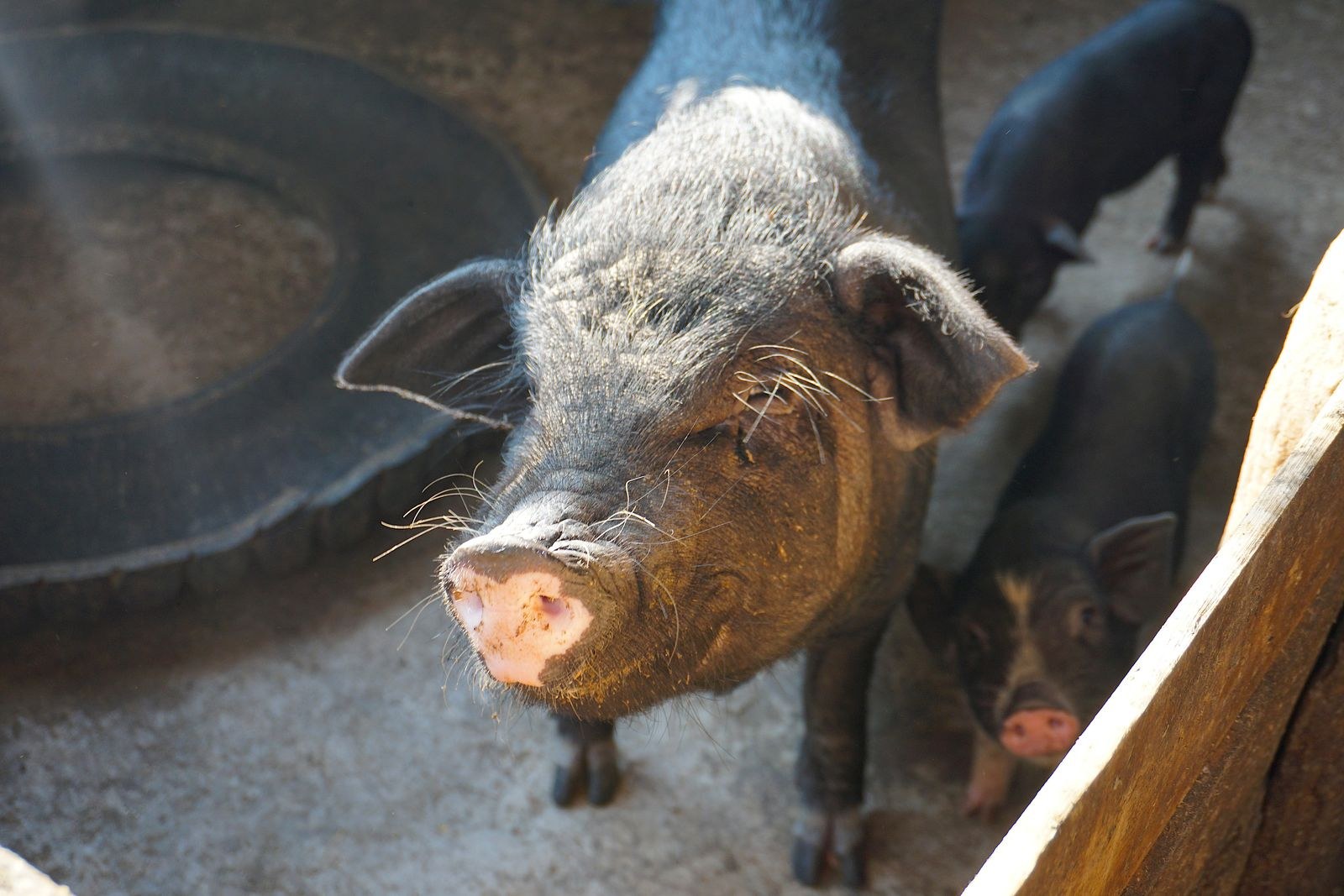
The breed introduces itself on sight. Black hair covers the head, the neck, the spine and the tail; white covers the jaw, the chest, the belly and all four legs; where the two meet there is a ring of grey, and in the middle of the forehead sits a small inverted triangle of white. The meat is described the same way by everyone who writes about it: thin skin, tender flesh, a strong smell of pork, white rather than yellow fat, lean cuts high in gelatine, and fat laid down in fine seams through the red so that a slice looks marbled rather than striped. The pigs eat maize, paddy, cassava, peanut cake and rice bran, with no leanness promoters and no growth agents, and the 屯长香 Túnchāng xiāng brand standard puts slaughter at seven to eight months and ninety to a hundred kilograms. That is slow for a commercial pig, and the slowness is the product.
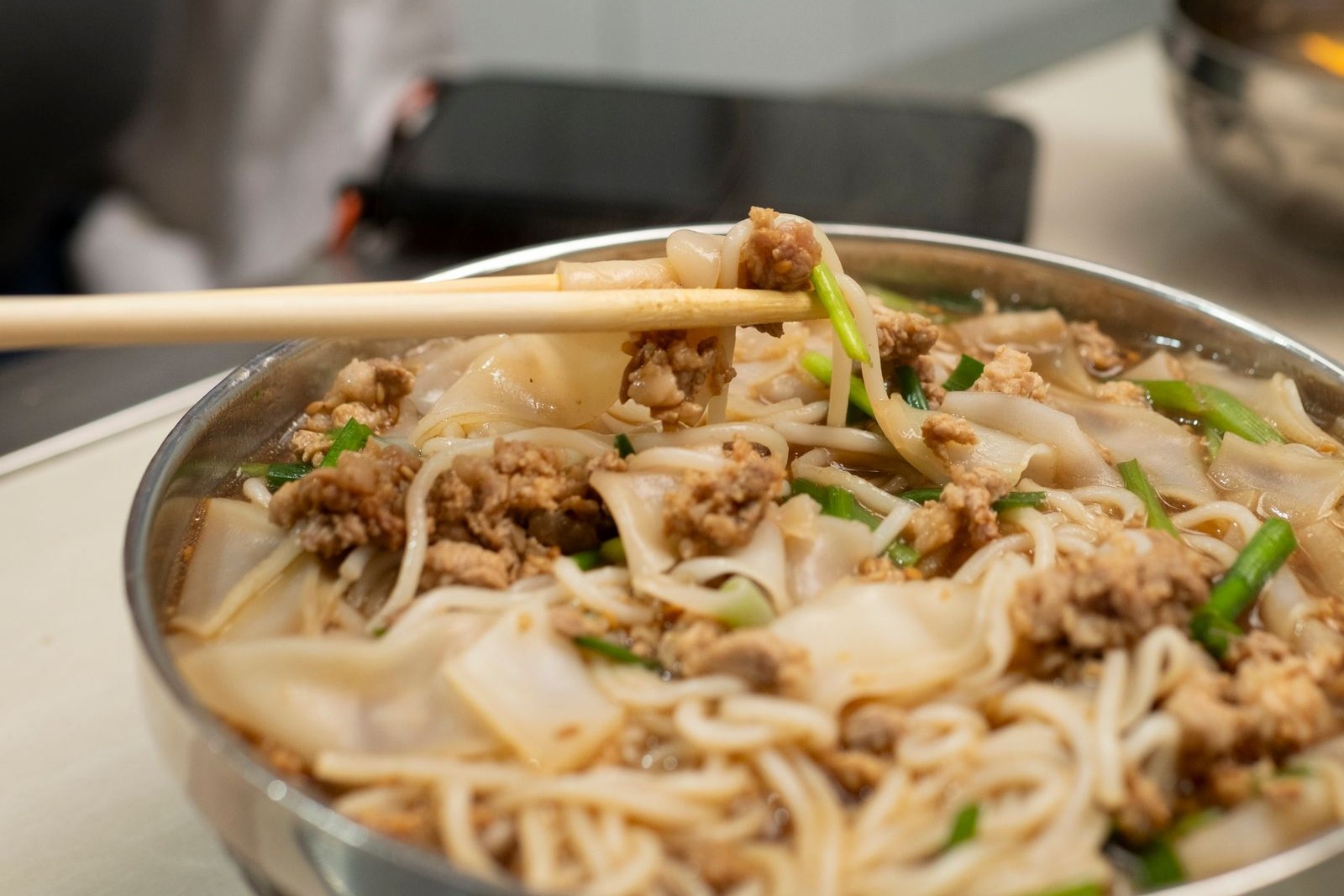
The dish locals put first is a pot of stock, a plate of raw meat and a bowl of noodles, an arrangement called 黑猪肉涮粉 hēi zhū ròu shuàn fěn or, more bluntly, 割肉吃粉 gē ròu chī fěn, cut the meat and eat the noodles. A clay pot on a charcoal brazier holds a stock built on 筒骨 tǒng gǔ, pork marrow bones, simmered for hours before anyone arrives. The meat comes sliced thin – 梅花肉 méihuā ròu, the marbled collar cut, liver, and 粉肠 fěncháng, the small intestine – and goes into a long-handled wire strainer, which is lowered into the boiling stock for ten or fifteen seconds and then tipped over a bowl of 河粉 héfěn, the flat rice noodle, after which a handful of the noodles gets a quick dip of its own. The sauce is mixed at the table from 青金桔 qīngjīnjú, the small sour calamansi that Hainan uses where the mainland reaches for vinegar, with 什锦酱 shíjǐn jiàng, peanut oil, pounded garlic, spring onion and coriander.
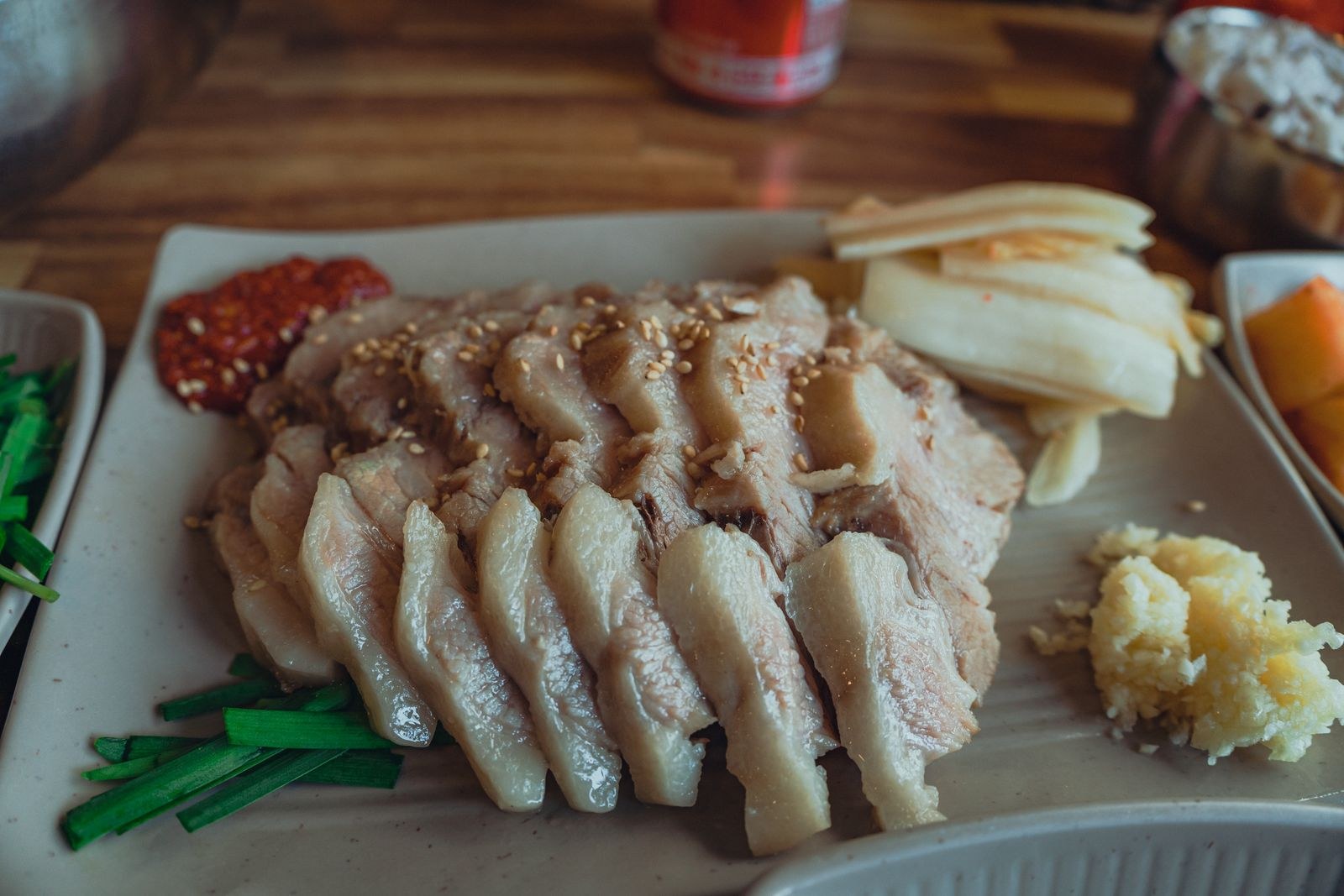
Take the same pig into an ordinary kitchen and the register changes. The county’s most particular dish is 白切黑猪排骨 báiqiē hēizhū páigǔ, ribs from an animal killed that morning and never frozen, held over a pot of boiling water and ladled with the boiling water until they are done – 烫熟的而不是煮熟的, scalded rather than boiled – and eaten with nothing but a small dish of salt; they are a fixture of the New Year table. Around them sit the dishes the county named as its own in 2023: 烤乳猪 kǎo rǔ zhū, roast suckling pig; 香煎五花肉 xiāng jiān wǔhuā ròu, pork belly pan-fried until the skin crackles; 蒜香炸排骨 suàn xiāng zhá páigǔ, ribs fried with garlic; 特色猪脚 tèsè zhūjiǎo, the county’s pig’s trotter; and then the everyday cooking of a Hainanese farmhouse, braised pork, salt-and-pepper trotters, offal with pickled mustard greens, braised pig skin, fried large intestine. Four of the county’s ten great dishes and two of its ten named snacks were made from this pig.
None of it is recent. 屯昌猪 is a local breed with close to a century of recorded farming behind it by the official account, written up among China’s better local pig breeds in the 1950s, and grouped in 1983, or thereabouts, with the Wenchang and Lingao pigs under the single name 海南猪 Hǎinán zhū, the Hainan pig, in the national register of Chinese pig breeds. The commercial animal came later. In the 1970s the county’s livestock office brought in 巴克夏 Bākèxià, Berkshire, boars to improve the local sow, and from the late 1980s it used 杜洛克 Dùluòkè, Duroc; the crossbred offspring came out black and tasted good, so the name 屯昌黑猪 went onto the market. Today’s Tunchang black pig is exactly that, a two- or three-way cross that keeps 屯昌猪 as the mother line, and the county is now assembling an application to have the whole farming system listed as a Chinese important agricultural heritage system. One story about the pig’s origin should not be repeated as history: it says that long ago an immortal travelling through 屯昌 liked the look of the hills and left a black wild boar behind to breed with the village pigs. The claim appears on a single content site, no official or newspaper source carries it, and it belongs with legend rather than with the record.
Words and Names
屯昌猪 Túnchāng zhū is the local mother breed; 屯昌黑猪 Túnchāng hēizhū is the commercial crossbred pig sold on the market, and 海南猪 Hǎinán zhū is the wider name it shares with the Wenchang and Lingao pigs. 巴克夏 and 杜洛克 are the Berkshire and Duroc boars used as sires, and a 二元 or 三元 cross is the two- or three-way offspring. At the table, 梅花肉 is the marbled collar, 粉肠 is the small intestine and 筒骨 are the marrow bones the stock is made from; 割肉吃粉 is the local phrase for the noodle-and-pork meal, and 青金桔 qīngjīnjú, calamansi, is the sour fruit that stands in for vinegar across Hainan. 白切 báiqiē, sometimes written 白斩 báizhǎn, means cooked plain and sliced. 屯长香 Túnchāng xiāng is the county’s public agricultural brand, and the pig has been given two cartoon faces for it, 葫芦猪 Húlu zhū, Gourd Pig, and the pair 大昌叔 Dàchāng shū and 小屯妹 Xiǎotún mèi. 军坡节 jūnpō jié is the county’s biggest temple festival, which matters to the pig and is explained below.
What the Locals Know
Pork in 屯昌 is a morning transaction, not an evening one. The habit the county writes about is 一早鲜切黑猪肉 yī zǎo xiān qiē hēi zhū ròu, black pig cut fresh at the start of the day, bought at the market and taken straight to a restaurant or carried home to be cooked, because the entire proposition of the breed is that nothing has happened to it in between. In 屯城镇 the addresses that come up are 大昌叔黑猪肉铺 Dàchāng shū hēizhū ròu pù, the shop beside the 屯城镇综合批发市场, and the restaurants 丽雅饭店, 犇羴鱻餐厅 and 地摊打边炉餐厅, where the clay pot and the wire strainer are set out on the table itself. There are farms to visit too, including the conservation herd kept by a farmer named 吴浪 Wú Làng at 加宝村 Jiābǎo cūn in 屯城镇, and the 天之虹生态农牧养殖小区 at 佳塘村 Jiātáng cūn in 南吕镇; 海口 got its own Tunchang black-pig shop in May 2023. The pig is also a social animal here: it is the gift at a wedding, the feast at a 做室 housewarming where the dish is 猪肠饭, the boiled head offered at 清明 and the whole animal presented to the ancestors on New Year’s Eve.
The paperwork on this pig is where the record stops being tidy, and the honest version is that three separate things happened in three different registers. In January 2008 the name was registered as a collective mark through the State Administration for Industry and Commerce. In 2016 it was named a 国家地理标志保护产品 guójiā dìlǐ biāozhì bǎohù chǎnpǐn, a national geographical-indication protection product, with the county claiming it was the first Hainan pig breed to get there. In 2017 it received 农产品地理标志登记保护 nóngchǎnpǐn dìlǐ biāozhì dēngjì bǎohù, agricultural-product GI registration, from the agriculture ministry. Three schemes, three issuing bodies; the years do not actually contradict each other, but no reader should be told that one of the three is the real one. In 2024 the breed entered the second batch of the national 名特优新 agricultural product list, and the current standard, DB46/T 369—2025, which replaced a 2016 version, sets lean meat at 36 per cent or more and intramuscular fat at 3.0 to 5.0 grams per 100 grams. The scale on the ground is modest and rising: 215,900 pigs were slaughtered in the county in 2024 and 186,400 of them were black pigs, with 85 large farms, up from 72 in 2023. Behind them stand one national and one provincial conservation herd for the 屯昌猪 mother line, set up in 2015 and 2021, and four stud farms with a combined capacity of about 220,000 piglets a year.
One proverb about the pig is recorded in the county’s own heritage application, and it is worth hearing for its tone: 狗有名,猪有性,饭勺也有柄 gǒu yǒu míng, zhū yǒu xìng, fàn sháo yě yǒu bǐng, a dog has a name, a pig has a nature, and even a rice scoop has a handle. What you will not find in 屯昌, or anywhere else in Hainan, is the phrase 无猪不成席, no feast without pork, which is common on the mainland but has no traceable local source; the saying this island actually has is 无鸡不成宴 wú jī bù chéng yàn, no banquet without chicken, and the bird it means is a capon. One conflict inside the record should be flagged rather than smoothed over, because it concerns the biggest feast of the year. Newspaper reporting on 军坡节 describes whole pigs killed for the offering tables and quantities of black pork that guests are invited to demolish; the county’s agricultural-heritage application, written later, records a 戒吃猪肉 jiè chī zhū ròu tradition at the festival, an abstention from pork that it derives from a legend about a divine pig saving a princess. Both statements are in circulation, the likely reading is that they describe different villages or different parts of the rite, and nobody has published a reconciliation, so treat the abstention as a local rule to ask about rather than one to assume.
flowcloud would say that the Tunchang black pig is a breed defined less by its genes than by its schedule – seven months on maize and cassava, cut the morning it is sold, held in boiling water for a few seconds and eaten with a dish of salt and a squeeze of calamansi – and that an inland county with no harbour has quietly built its reputation on being slow.
Where to find it: the black-pig counters around the 屯城镇综合批发市场 in 屯城镇 Túnchéng zhèn, the county town, and above all 大昌叔黑猪肉铺, where the meat is cut in the morning; the clay-pot restaurants 丽雅饭店, 犇羴鱻餐厅 and 地摊打边炉餐厅 in the same town, where you order 割肉吃粉 and do the blanching at your own table; the morning wet markets of the other seven towns; the conservation herd at 加宝村 Jiābǎo cūn in 屯城镇 and the 天之虹生态农牧养殖小区 at 佳塘村 Jiātáng cūn in 南吕镇 if you want to see the breed alive; and, outside the county, the shop in 海口 Hǎikǒu that opened in 2023. Go at noon rather than at night, ask whether the ribs are being done 白切 with a dish of salt, and order the noodle bowl as a set rather than as a side, because the pot of stock is the whole point of the meal.