
Wenchang Zaopo Vinegar
The first spoonful is a small shock and the second is a craving, and somewhere around the third you stop being able to tell whether you are eating or drinking — which, as far as I can work out, is the entire point. 糟粕醋 (zāopò cù) arrives in an enamel bowl, milky and faintly orange, sour in a way that has nothing to do with vinegar and everything to do with rice, and floating in it are a shrimp, three clams, a curl of sea vegetable and something you will ask about later and be told, with great patience, is 牛杂 — beef offal, which is not what you thought it was.
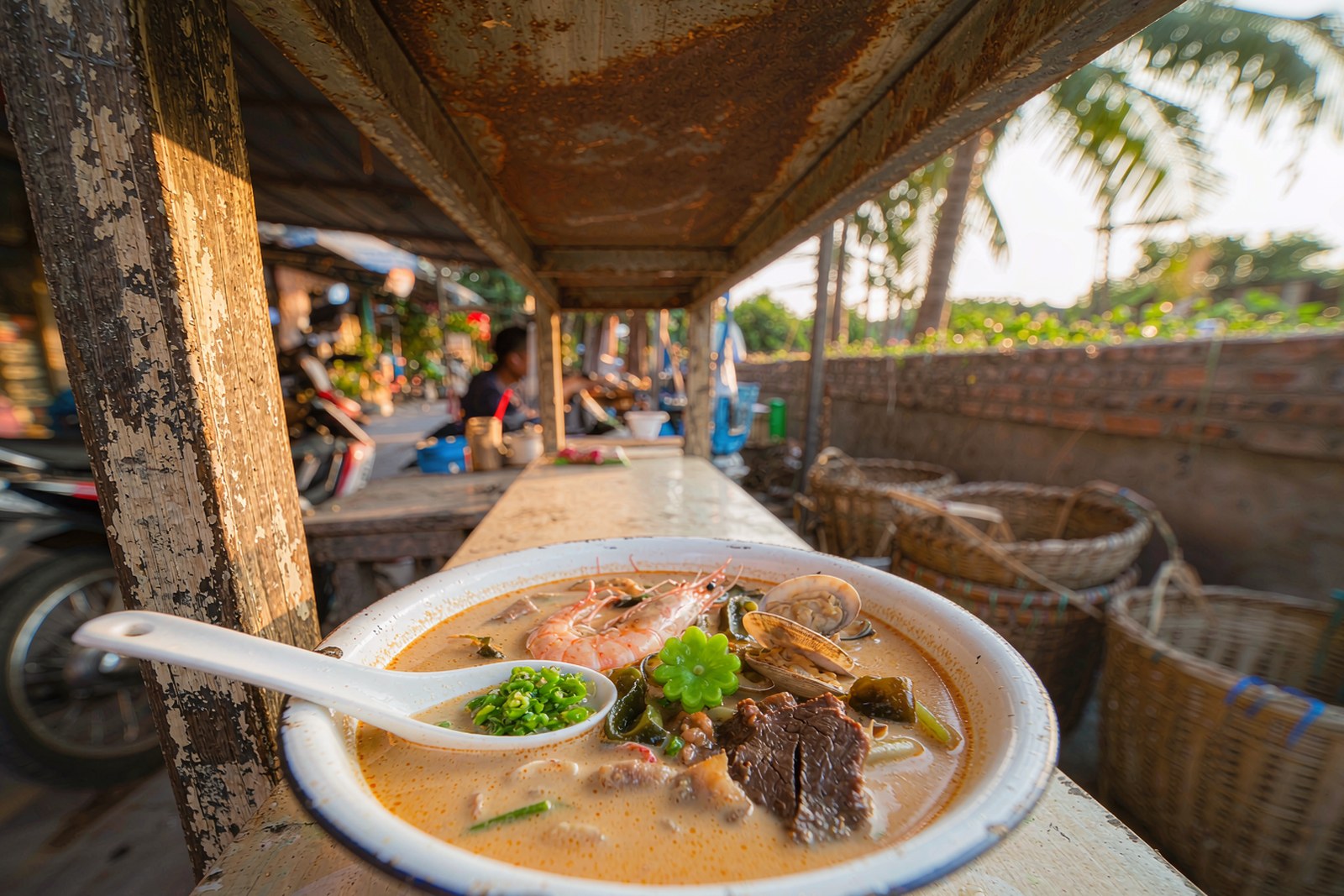
I first drank it on the old street at 铺前 (Pùqián), on the northern tip of 文昌, where the coast looks across at the mainland and the town has been a port since the Song. There is a row of shops along 解放路 doing nothing but this, and on a July afternoon at three o’clock, with the air the temperature of bathwater, half the town is sitting under the arcades eating cold sour soup out of bowls the size of your two hands cupped together. It is the most sensible thing anyone in Hainan does.
A Vinegar That Started as Waste
The story here begins with what was left over, which is why the name is so blunt. 糟粕 (zāopò) means dregs — the lees, the spent husk, the part you throw away. 醋 (cù) is vinegar.
Puqian brewed. It brewed because it fished: the old people say 钱助胆,酒助力, money gives you courage and wine gives you strength, and a fisherman who has spent forty hours on a boat in the swell wants something with heat in it when he gets back. Rice wine and sweet-potato spirits were made in almost every village, and by the 1970s there were at least ten working breweries in the town itself. Brewing leaves lees. Lees plus water plus time produces a thin, sharp, faintly alcoholic liquid, and someone — no one can tell you who, and the town will argue about it — discovered that if you kept it, it turned into something better than what it came from.
The date is genuinely disputed. Puqian’s own local historians put the beginning in the last years of the Qing or the first years of the Republic, which makes it just over a hundred years old; the version you will see printed on packaging tends to say five hundred, which nobody has been able to source. What is certain is that by the 1920s the stuff was being carried through the villages on shoulder-poles, sold by the bowl, and eaten by people who could not afford much else. One old man I sat with remembered it selling for a fen a bowl when he was small, and remembered that his family was too poor to spare the fen easily and he always found it anyway.
There are three origin stories, and Puqian keeps all three alive at once. The first is that the returning overseas Chinese brought the idea from Southeast Asia — forty-seven thousand people left this one town for Singapore, Malaysia and Thailand, and the taste profile is close enough to 冬阴功 (dōng yīn gōng) that the comparison is unavoidable. The second is that a fishing boat ran out of provisions on its sixth day out, the crew threw the last of the vinegar, chillies, sea snails, offal and greens into one pot, and the result was so good they did it again on purpose. The third, which I think is the true one, is that nobody invented it: it accumulated, the way these things do, out of what a poor coastal town had lying about.
How It Is Made
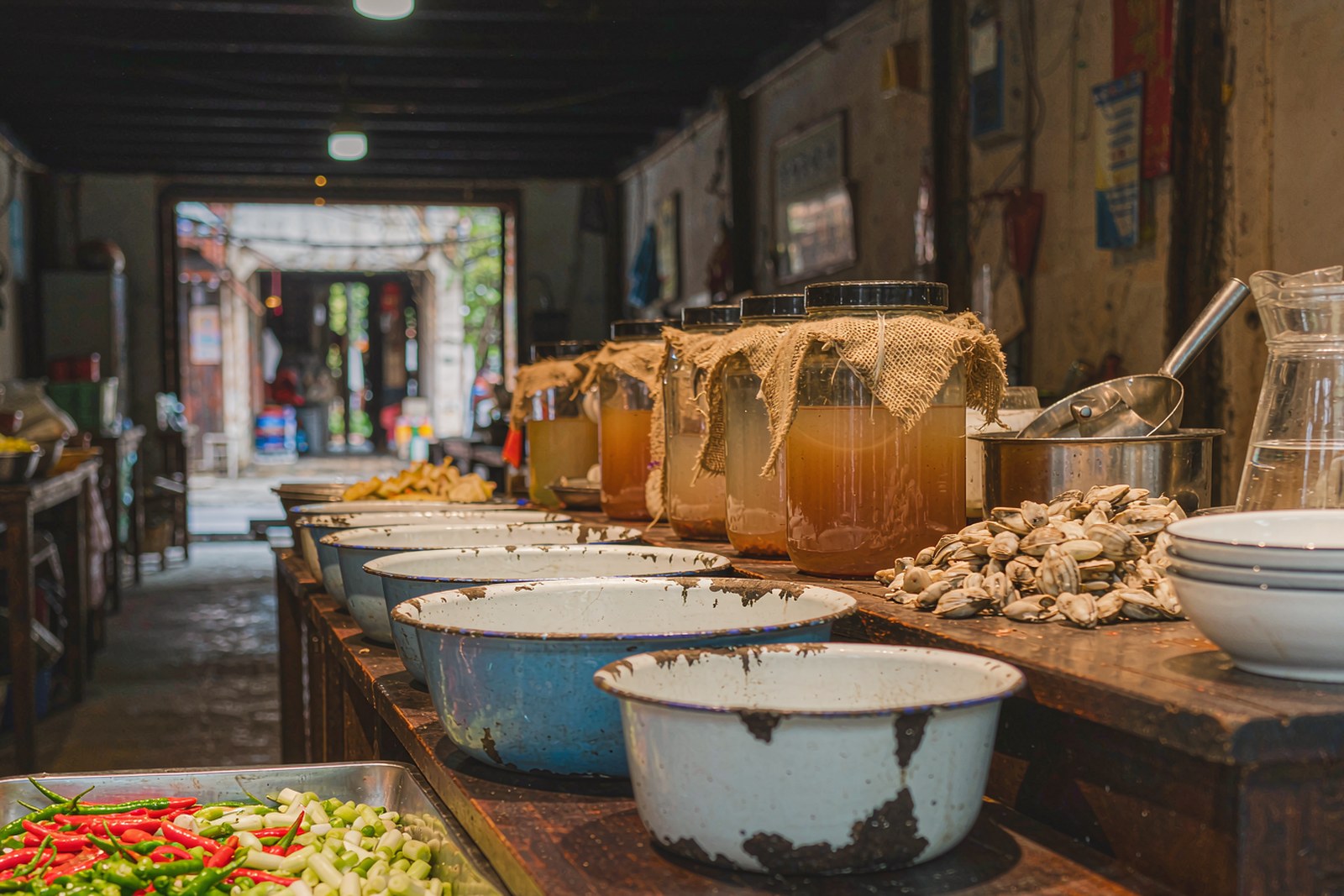
The base is rice wine, and the best version uses local glutinous rice rather than ordinary rice, because glutinous rice carries more amylopectin and ferments to something rounder. Cook the rice, inoculate it with 酒曲 (jiǔqū), let it work. Take the lees, put them into a big earthenware jar — the old people call it the 铁龙缸 (tiělóng gāng), the iron-dragon jar — add water and a little more starter, seal it, and leave it. Fifteen days at the short end, thirty days and beyond at the comfortable end. Hot, damp Hainan does the rest of the work faster than a cool province could.
What comes off the top when you open the jar is described by everyone who makes it as 橙黄橙黄 — orange-yellow, glowing. That is the vinegar. It is then diluted, heated so the last of the alcohol lifts away, and finished with chilli oil, garlic oil and a little sugar until it turns opaque and milky, the way a properly made broth from a leftover does. It is sour, yes, but the sourness has a malted, almost bready tail to it that straight vinegar never has, and that tail is the whole reason the dish exists.
Note one thing, because it matters: 铺前糟粕醋制作技艺 has been entered on the city-level intangible heritage list, and local producers have been pushing for a higher listing. It is a food that got itself protected.
What Goes In the Bowl
Two houses, two schools, and you should try both.
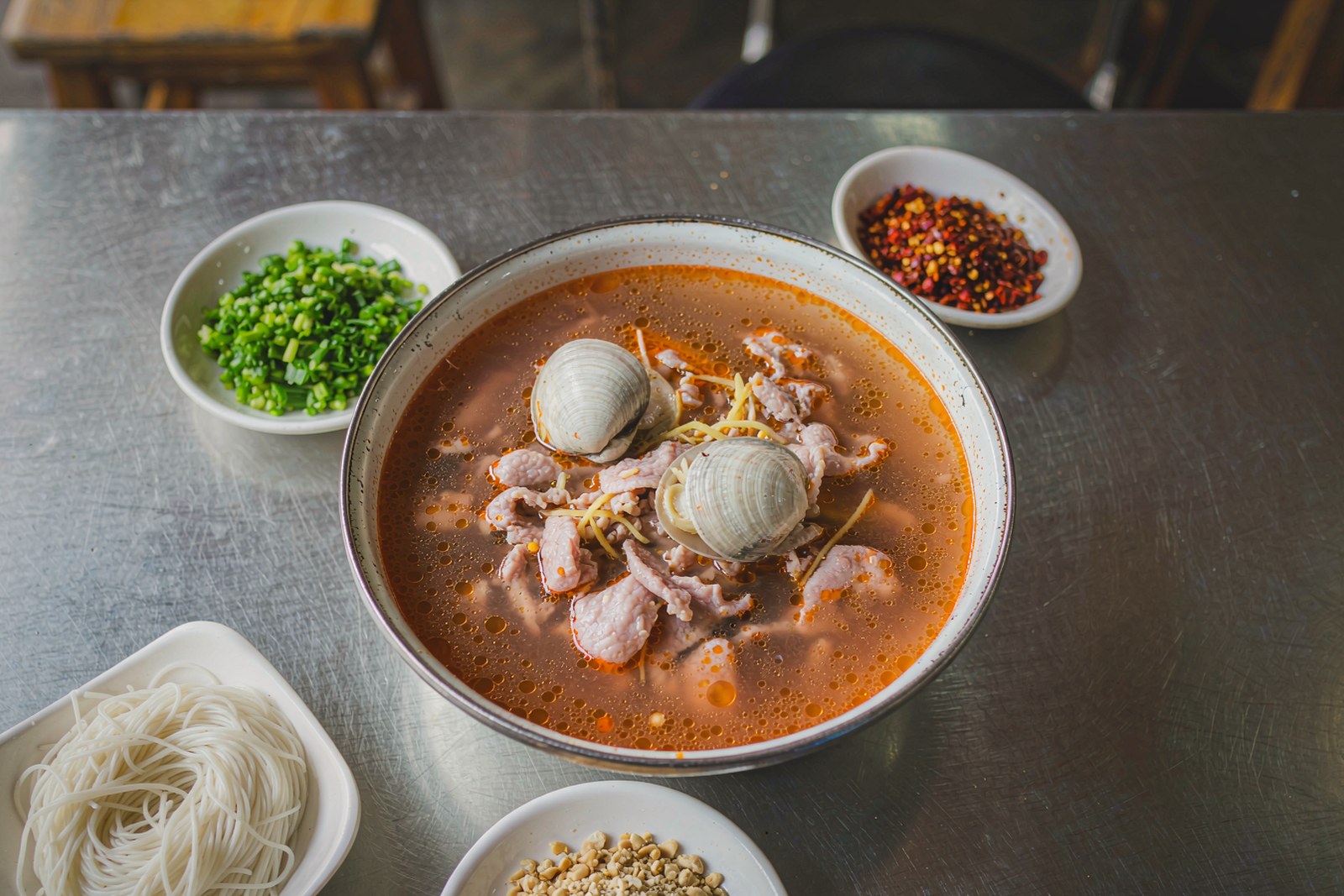
海鲜 (hǎixiān) — seafood. 生蚝, prawns, crab, 花蛤 clams and 海菜, the sea vegetable that gives the bowl its snap. This is the version that made the dish famous outside the island, because the sour does something to shellfish that lemon can only dream about: it cuts the brininess and leaves the sweetness.
杂锦 (zájǐn) — mixed. 猪肠 pig intestine, 猪肚 tripe, 牛腩 beef brisket, 海带, radish, and 石葱 (shícōng, literally stone onion — a small pungent allium that grows on the rocks). This is the older bowl, the one the shoulder-pole sellers were making, and it is heavier and more interesting than the seafood version if you are only eating one.
Under everything there is usually a small knot of 海南粉 (Hǎinán fěn), the island’s thin rice noodles, which absorb the broth and quietly become the best part. On top, a spoonful of 小米辣 (xiǎomǐ là) — small, green, and much hotter than it looks. Ask for 微辣 if you are unsure. Do not ask for it without, because the chilli is not decoration, it is structure.
How You Eat It
You drink it first. This is not a soup you eat with a spoon and a delicate approach; you lift the bowl and you drink, and then you use chopsticks for whatever is in it, and then you drink again. The broth is the dish and the toppings are the occasion.
The order people follow without discussing it: broth first, to open the appetite; then the shellfish, while it is still just cooked; then the offal or the noodles, which have been sitting in the sour getting better; then the last of the broth, now colder and sharper than when it started. It is a food for hot weather and it works because it never gets heavy. The sour keeps the whole thing moving.
In Puqian a bowl is cheap. The reference shop on the old street lists 牛杂螺菜综合 at ¥20, 猪杂螺菜综合 at ¥20, a plain 素菜米粉 bowl at ¥10, and a 豪华海鲜套餐 with prawns, scallop and abalone at ¥50. Bottles of the vinegar itself — 1.25 litres for about ¥8, five litres for around ¥30 — are stacked by the door, which tells you what the town thinks you should do next.
What It Refuses to Be
It refuses to be a hotpot, at least in its original form. The hotpot came later and it came from outside — the 糟粕醋火锅 that has spread through Beijing, Shanghai and Shenzhen in the last few years, at prices around ¥150 to ¥200 a head, is a good thing and a different thing, and the difference is that in a hotpot you cook into it while at Puqian it arrives already finished and already balanced.
It refuses to be gentle. There is a residual hint of fermentation that some visitors read as a fault. It is not a fault.
And it refuses to be optional. 无醋不欢, the local line — without vinegar there is no joy. That is a strong claim from a town that also makes excellent seafood, and it is meant sincerely.
Words and Names
糟粕 zāopò is the lees of rice wine, the discarded part. 醋 cù is vinegar. Put together the name literally says “dregs vinegar”, and the town has never once been embarrassed by it — the whole point of the dish is that the best thing in the kitchen was what everyone was about to throw out.
The bowl is also known locally as 女人醋 — women’s vinegar — and sometimes 三八醋. Everyone gives the same reason: 三姆, the Hainanese word for a woman, sounds close enough to 糟粕 that the two got tangled, and the dish is traditionally thought to be good for circulation and complexion, which is why the people making and selling it in Puqian have mostly been women. One of them, 陈彩梅 of nearby 云楼村, widowed at forty-four with nine children and a bowl of vinegar on a shoulder-pole, fed the whole family from it for thirty years. Her story is told in Puqian the way other places tell their founding legends.
What the Locals Know
Drink the broth before you touch the chopsticks. The balance is at its sharpest in the first two minutes.
Ask for 石葱 if it is on the board. It is a stone-growing allium and it is why the older bowl tastes different.
Go to Puqian for the original. The 海文大桥 (Hǎiwén Dàqiáo) bridge from the mainland side put the town ninety minutes from Haikou, and the vinegar tastes better where the water is harder and the rice is local.
Buy a bottle. Five litres for ¥30 is a ridiculous price for something this good, and it will survive the flight in a checked bag.
Eat it at three in the afternoon, in July. Cold sour soup in unbreathable heat is the only correct context, and once you have had it that way you will never want it warm.
Where to Eat It
The reference is 铺前老街, and within it 林花糟粕醋 on 解放路, which has been there long enough that its price list is printed on the wall and photographed by everyone who visits. The bowl to order first is the 牛杂螺菜综合 at ¥20. 三婆糟粕醋 (Sānpó) is the other name worth knowing — four generations from the same town, now with a shop on 义龙路 in Haikou and a factory back in Puqian that turns out around four thousand tonnes a year, some of which ends up in national hotpot chains and in Singapore and Japan. If you are in Sanya or Haikou and cannot get north, look for a 糟粕醋火锅 restaurant and order the seafood version; it is not the same dish but it is the same idea, and it is a great deal better than not having it.
flowcloud would say that the best food in any poor coastal town is always made out of what somebody was about to throw away, and that a hundred years of turning wine dregs into a bowl of sour soup is a longer and more useful piece of wisdom than most of what gets written down.
Where to find it: 糟粕醋 (zāopò cù, zaopo vinegar), 铺前镇 (Pùqián), 文昌 (Wénchāng), northern Hainan. Reference shop 林花糟粕醋, 解放路, on the Puqian old street — 牛杂螺菜综合 ¥20 a bowl, 猪杂螺菜综合 ¥20, 海鲜综合 ¥20, plain 素菜米粉 ¥10, 豪华海鲜套餐 with prawns, scallop and abalone ¥50; single items from ¥5. Bottled vinegar about ¥8 for 1.25 litres and ¥30 for five. Also in Haikou at 三婆糟粕醋, 义龙路. Best in hot weather; drink the broth first, add 小米辣 to taste, and ask for 石葱 if they have it.
We are still eating our way through Wenchang Zaopo Vinegar. Guides are on the way.