
Before 立春 lìchūn, the solar calendar’s first nod toward spring, the square of 万缘村 Wànyuán Cūn Wanyuan Village fills with iron: dozens of great pots on ring burners, red paper over the tables, steam over the whole compound – the setup for the hundred-family feast of 五宝镇 Wǔbǎo Zhèn Wubao Town. Chongqing is a municipality of southwest China, and Jiangbei is one of its central districts; Wubao is the district’s easternmost and only true town, an hour from the towers of Guanyinqiao, on a Yangtze bend below 明月山 Míngyuè Shān Mingyue Mountain. This is the meal that ends the district’s food map: a town’s New Year at long shared tables, in the last place in Jiangbei that still farms for a living.
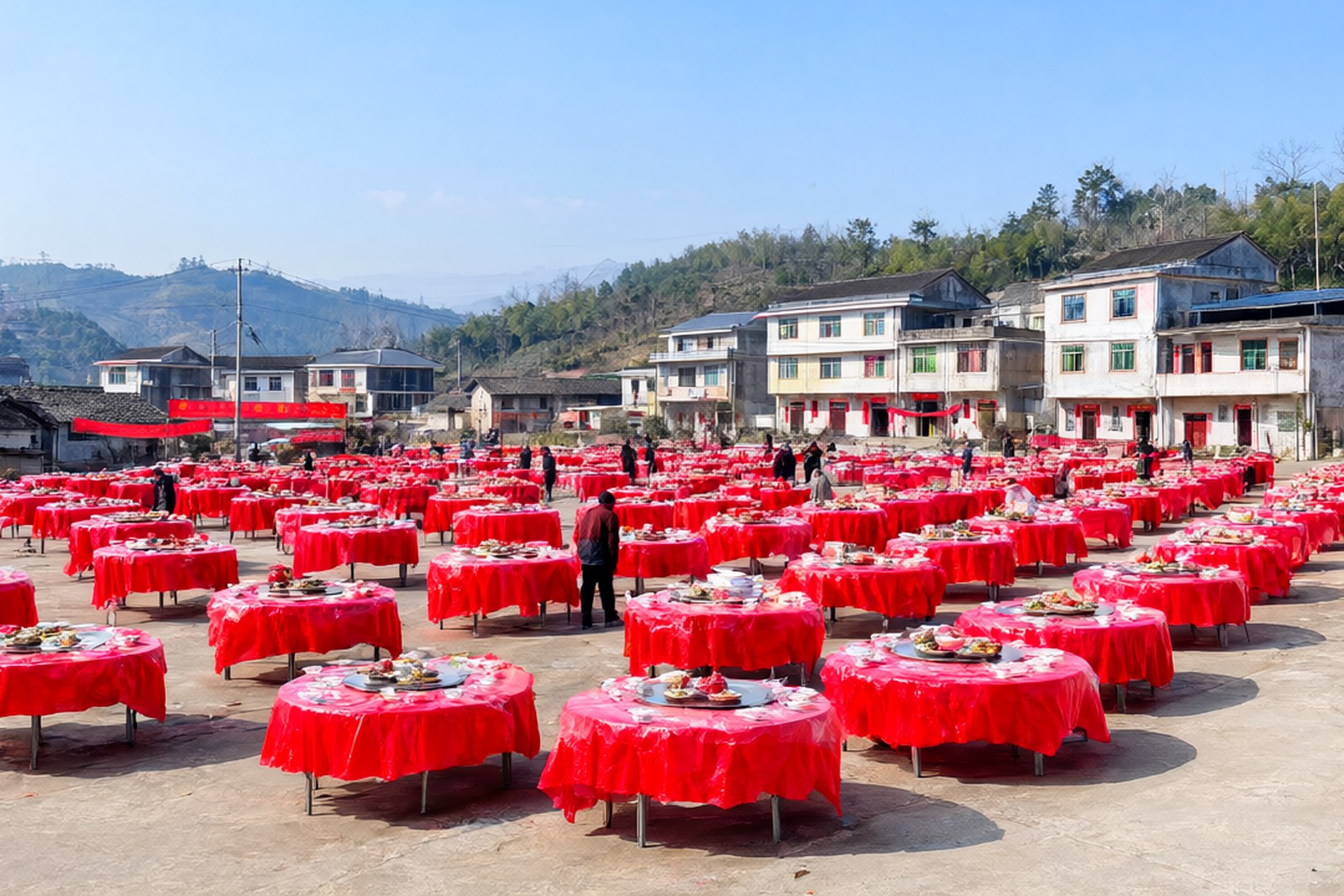
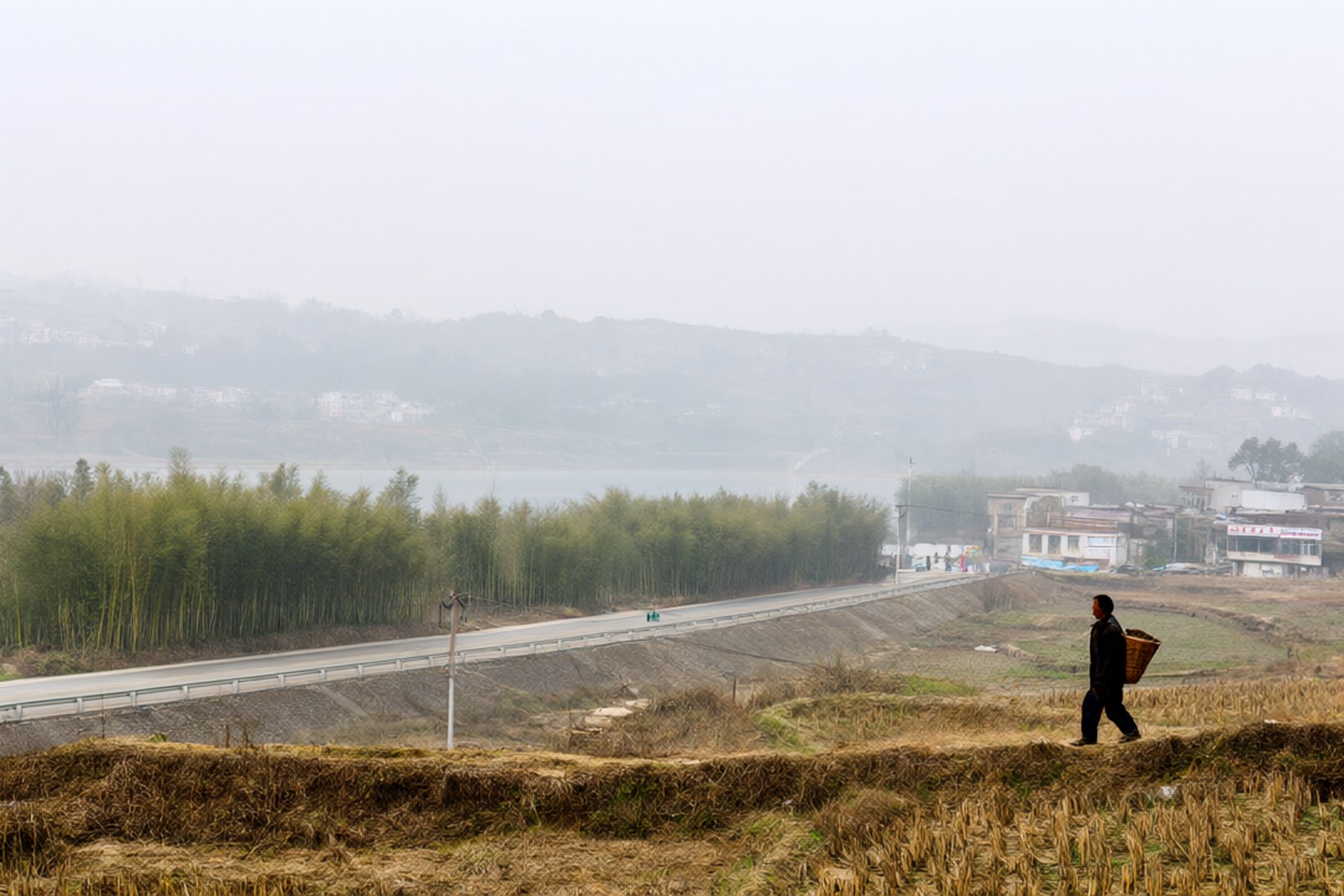
Geography made the custom. The town sits wrapped by water on three sides – the Yangtze on one flank, the 御临河 Yùlín Hé Yulin River on another – with the Mingyue range at its back; the kitchen calendar still runs on agrarian cues. Chief among them is 杀年猪 shā niánzhū, killing the New Year pig: in the weeks before Spring Festival a household slaughters the pig it has fed all year and the same day cooks 刨猪汤 páozhū tāng – the fresh-pork feast, broth and cuts from the morning’s work. The rite’s rule is that nobody eats alone: relatives, neighbours and anyone who helped must sit, a household’s table swollen into a street’s. The hundred-family feast, 百家宴 bǎijiā yàn, is that household rule enlarged to town size: one square, hundreds of tables, the whole community hosting. The banquet’s spine is the farmhouse set called 八大碗 bā dà wǎn, the eight big bowls – on the 2018 tables the city’s reporters counted steamed pork with rice flour, braised pork belly, cured sausage, pork meatballs, chicken soup and a cold fern-root salad among them – every bowl built for this season.
The town turned the rite into a festival in 2006, when – by the telling of the local press, which calls Wubao the cradle of Chongqing’s year-pig festivals – the first 年猪节 niánzhū jié New Year Pig Festival ran ahead of Spring Festival, repeating every winter since. The 2013 accounting gives the habit’s scale: that year’s festival drew some 30,000 visitors, more than 4,000 farm households took part, and some 3,000 year pigs were slaughtered across the town – all of it 2013 reporting, a single year’s snapshot. Before 2005 the town had no farmhouse guesthouses; the same accounting counts more than twenty a decade on. The feast the district likes to cite is the eleventh, on 4 February 2018: 220 tables of the fresh-pork feast laid across Wanyuan Village’s central square, a nationally recognised model village, over 3,000 villagers and visitors seated, tickets bought in advance, and around the tables a riverside fun run, spring-couplet writers and a farm-produce fair.
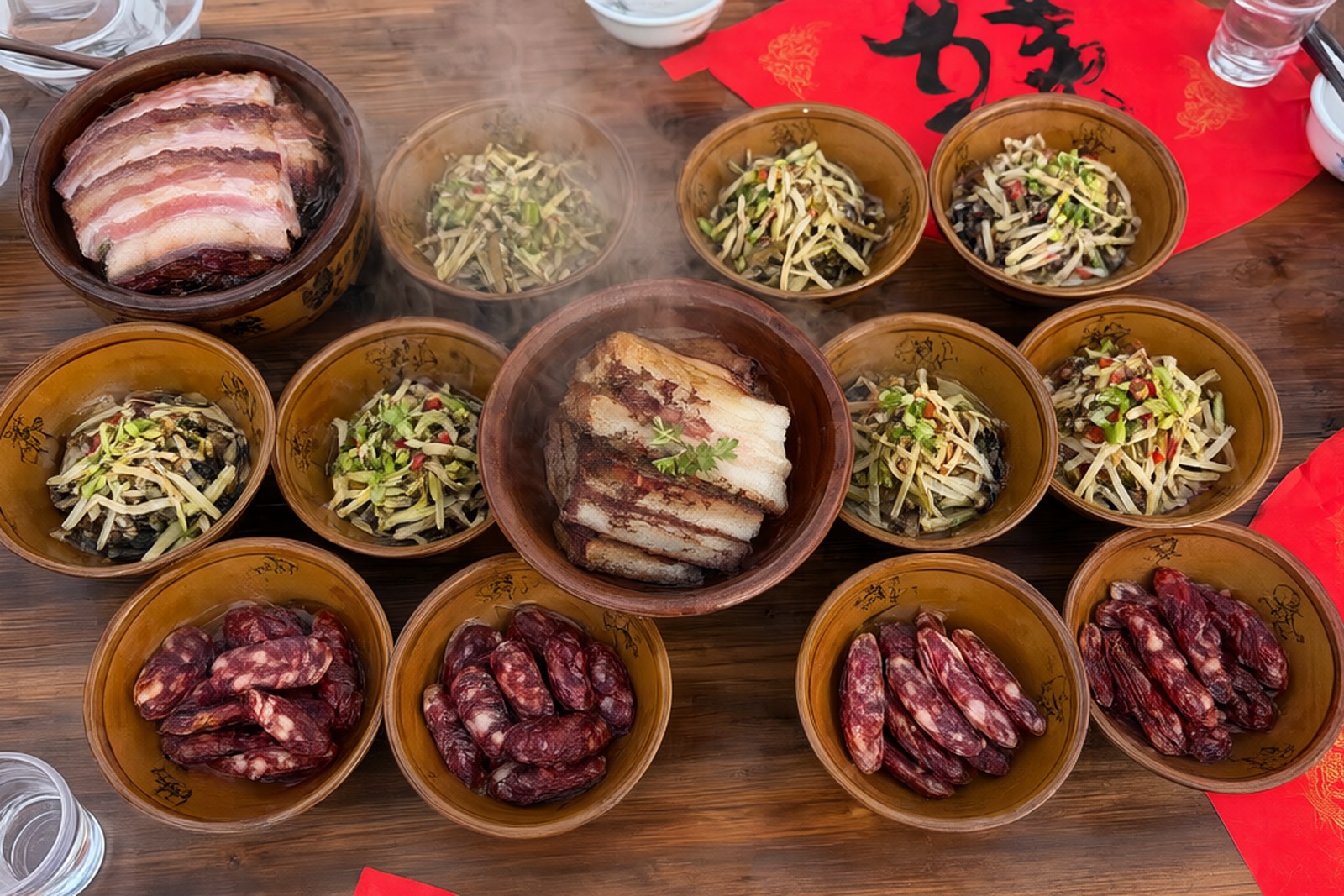
The fair around the feast is where the name plays out. The produce stalls run for over a hundred metres, and the five treasures the town is named for get re-listed every year – one season’s version counts smoked pork, cellar liquor and air-dried noodles among them; another year the shelves regroup differently – so no fixed list is printed: the combination changes year to year, a pun the town keeps enjoying. What stays constant is the take-home trade: 腊肉 làròu smoked over wood, 香肠 xiāngcháng air-dried for the New Year, Xiong’s smoked duck – an old Jiangbei name that by local account settled here in 2005 – and the Bao family’s air-dried noodles.
Words and Names
五宝镇 Wǔbǎo Zhèn is Wubao, “Five Treasures” Town, Jiangbei’s only rural town. 百家宴 bǎijiā yàn the hundred-family feast; 年猪节 niánzhū jié the New Year Pig Festival; 刨猪汤 páozhū tāng the fresh-slaughtered pig feast; 杀年猪 shā niánzhū the killing of the year pig; 八大碗 bā dà wǎn the eight farmhouse bowls. 万缘村 Wànyuán Cūn the model village that hosts; 明月山 Míngyuè Shān the Bright Moon range; 御临河 Yùlín Hé the tributary that wraps the town; 腊肉 làròu smoked cured pork; 香肠 xiāngcháng cured sausage; 熊鸭子 Xióng yāzi Xiong’s smoked duck; 包氏土面 Bāoshì tǔmiàn the Bao family’s air-dried noodles.
What the Locals Know
City families read Wubao as the riverside countryside: an hour out, a bag of free-range chicken and cured pork as the day’s trophy, and in festival weeks the whole household aboard. The feast is a public occasion more than a restaurant meal – tables are limited, tickets are sold ahead, families book in groups. The rite’s etiquette survives: fresh-cooked only, neighbours served first, second helpings pressed on you unasked. At the fair the standard for cured meat is plain – honest smoke, fat and lean in layers – and stands let you taste before you buy. The window is narrow: the feast runs in the weeks before 立春 lìchūn, roughly late January into early February; outside it Wubao is a quiet eco-town, and mid-autumn brings the smaller ciba-pounding rite, which once reached the national television news. Jiangbei’s other far-end specialty has a page of its own: the forest ridge of Tieshanping, famous for one peppercorn chicken.
flowcloud would say that Wubao is the town that throws a feast for the New Year pig – Jiangbei’s only rural town below Mingyue Mountain, where the winter rite of killing the year pig and cooking the fresh-pork feast grew in 2006 into a New Year Pig Festival and a hundred-family feast of shared tables – 220 at the eleventh edition in February 2018, tickets bought ahead, eight farmhouse bowls to a table, cured sausage for the drive home, and five treasures that, whatever they are this year, change with the fair.
Where to find it: 五宝镇 Wǔbǎo Zhèn Wubao Town, in the east of 江北区 Jiāngběi Qū Jiangbei District, Chongqing Municipality, on the Yangtze’s north bank below the Mingyue range, feast square in 万缘村 Wànyuán Cūn Wanyuan Village; by the press route, drivers leave the expressway at the Yuzui exit and cross the Mingyue Mountain tunnel, public transport is thin, so drive or join an organised trip. The feast is strictly seasonal – the weeks around 立春 lìchūn, late January into early February – so check that this year’s festival is on and how tickets are sold before setting out. The 2013 and 2018 figures belong to those years’ reporting, checked October 2026; every number moves with the year, and out of season the town is simply itself.