
Wuchuan’s Battered Wok and the Noodles It Fries
烂镬炒粉 làn huò chǎo fěn is the fried rice noodle of 吴川市 Wúchuān shì, and the name does not mean what it looks like at first. 烂 làn is not rotten here but battered, 镬 huò is the southern word for a wok, and 炒粉 chǎo fěn is the noodle; so the whole thing reads as fried noodles from a beaten-up pan. The 烂镬 is exactly that and it is the point of the dish: a wok whose ear handles have been knocked off and whose rim has been beaten down flat, leaving a shallow, wide, even pan with no lip for the rice ribbon to hide behind and nothing in the way when the cook sweeps the whole of it around with a flat blade. A piece of kitchen kit has been turned into a name, and the dish has been made in 吴川 for several hundred years.
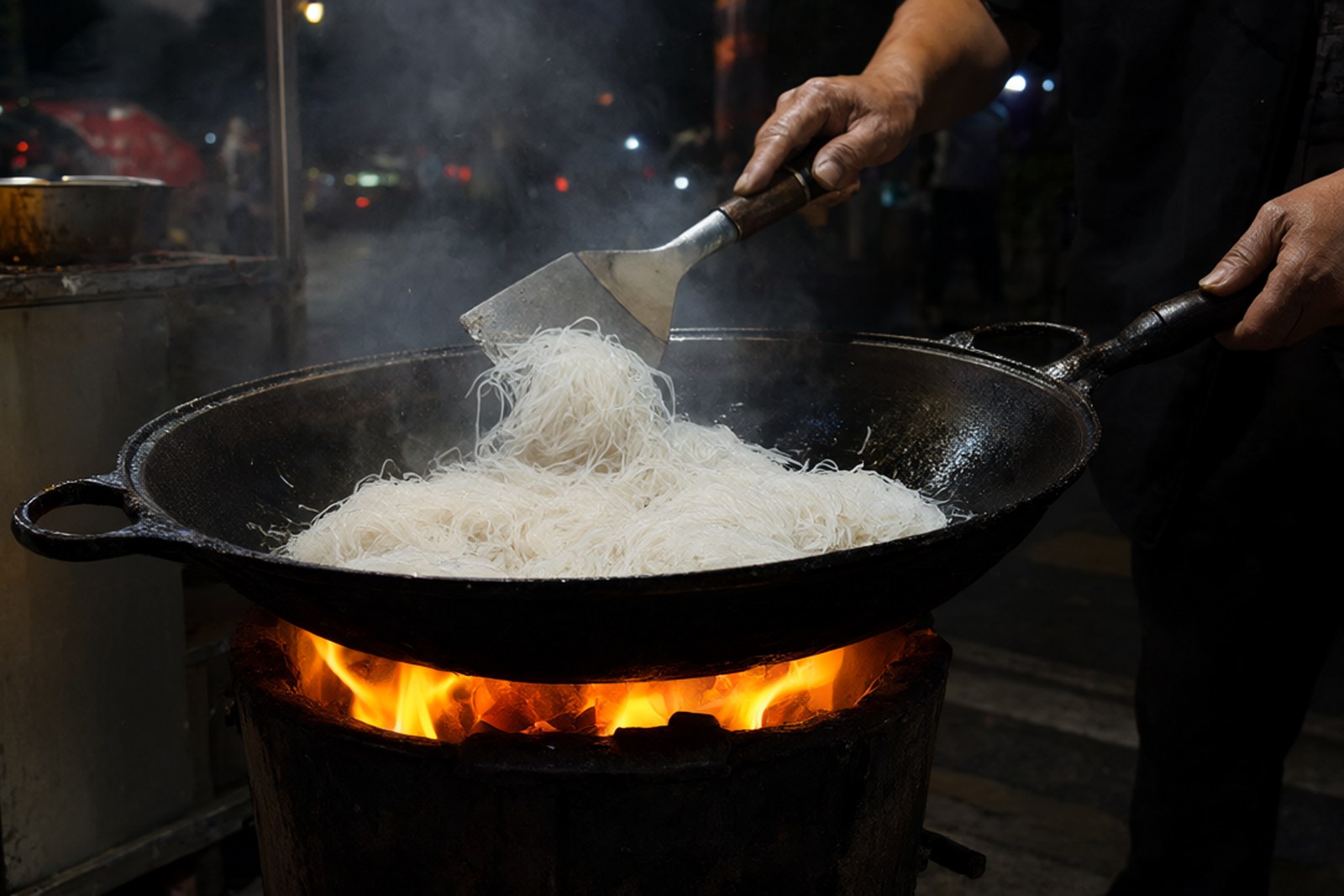
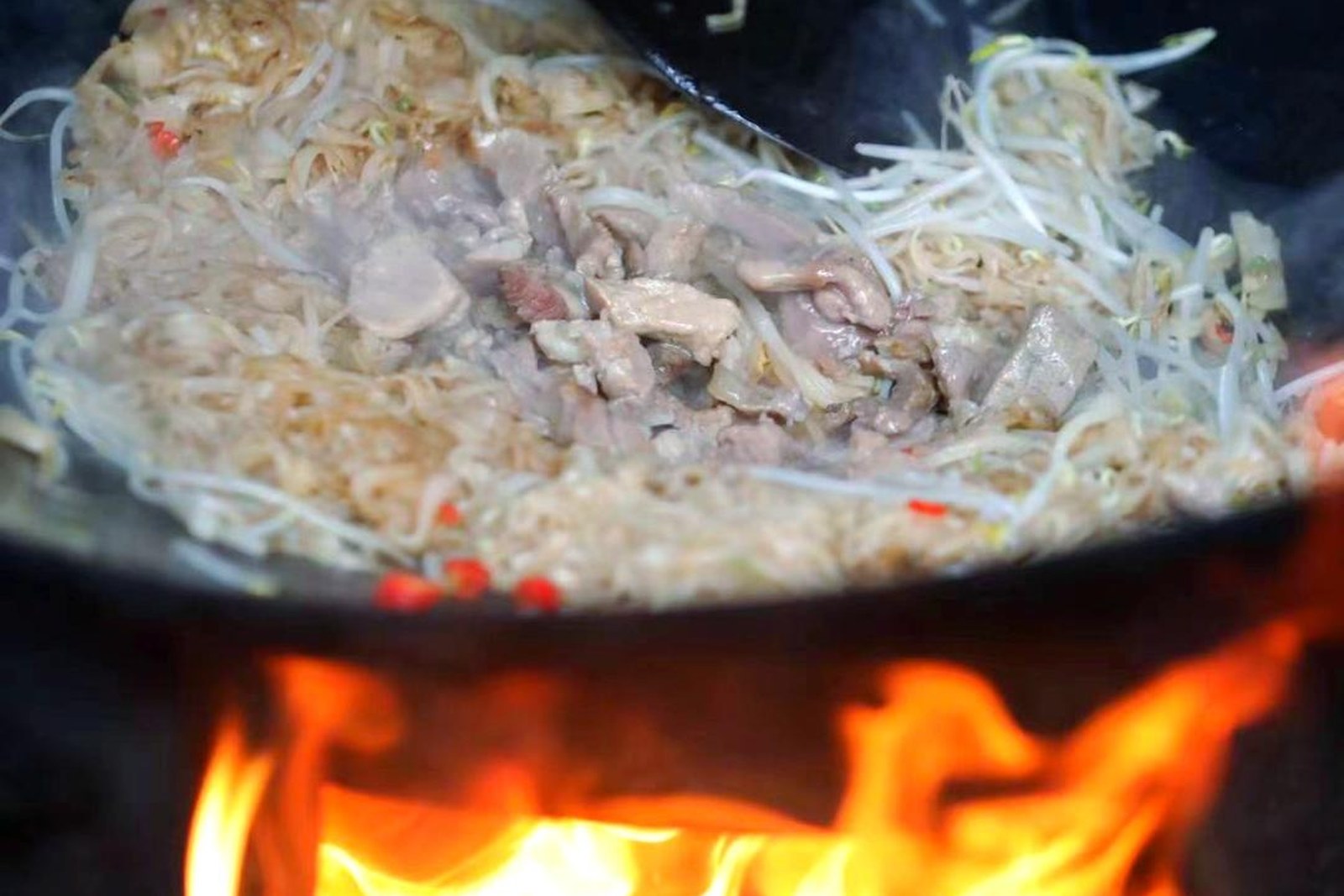
The story usually told is of a cook in 吴川, in the Ming or the Qing, who had only a broken wok and beat the rim down rather than buy another, and found that the flat shape cooked better. Whatever the truth of that, the principle behind it is sound and it is the same one that makes a well-used iron griddle better than a new pan: a flat surface holds more of the food against hot metal at once, the heat is even across the whole of it, and the tossing is done with a broad sweep rather than a flick, so nothing is thrown out and nothing sits still long enough to stick. The noodle is the ordinary fresh flat rice sheet cut into ribbons, 河粉 hé fěn, made locally from late-harvest rice, and the rest of the ingredients are ordinary too: 猪油 zhū yóu, lard; 生抽 shēng chōu, light soy; bean sprouts; chives or spring onion; and whatever the house adds, which is usually beef, char siu, or an egg fried into it.
What actually makes it is the fire. 烂镬炒粉 is fried over a big flame, hard and fast, with the wok never still: the noodle goes in, the soy goes in around the edge of the metal rather than on top of the food so that it scorches on the way down and smells of caramel, the sprouts and the greens go in at the end so that they keep their crunch, and the whole plate is out of the pan inside a minute. The test of it is 镬气 huò qì, the breath of the wok: the faintly smoky, slightly singed note that comes from metal hot enough to toast without burning, and which is the difference between a plate of fried noodles and a plate of noodles with soy on them. A good one smells of it before it is set down, the ribbons are separate rather than stuck together in a mass, the surface is oily rather than greasy, and there is still a little bite left in the noodle.
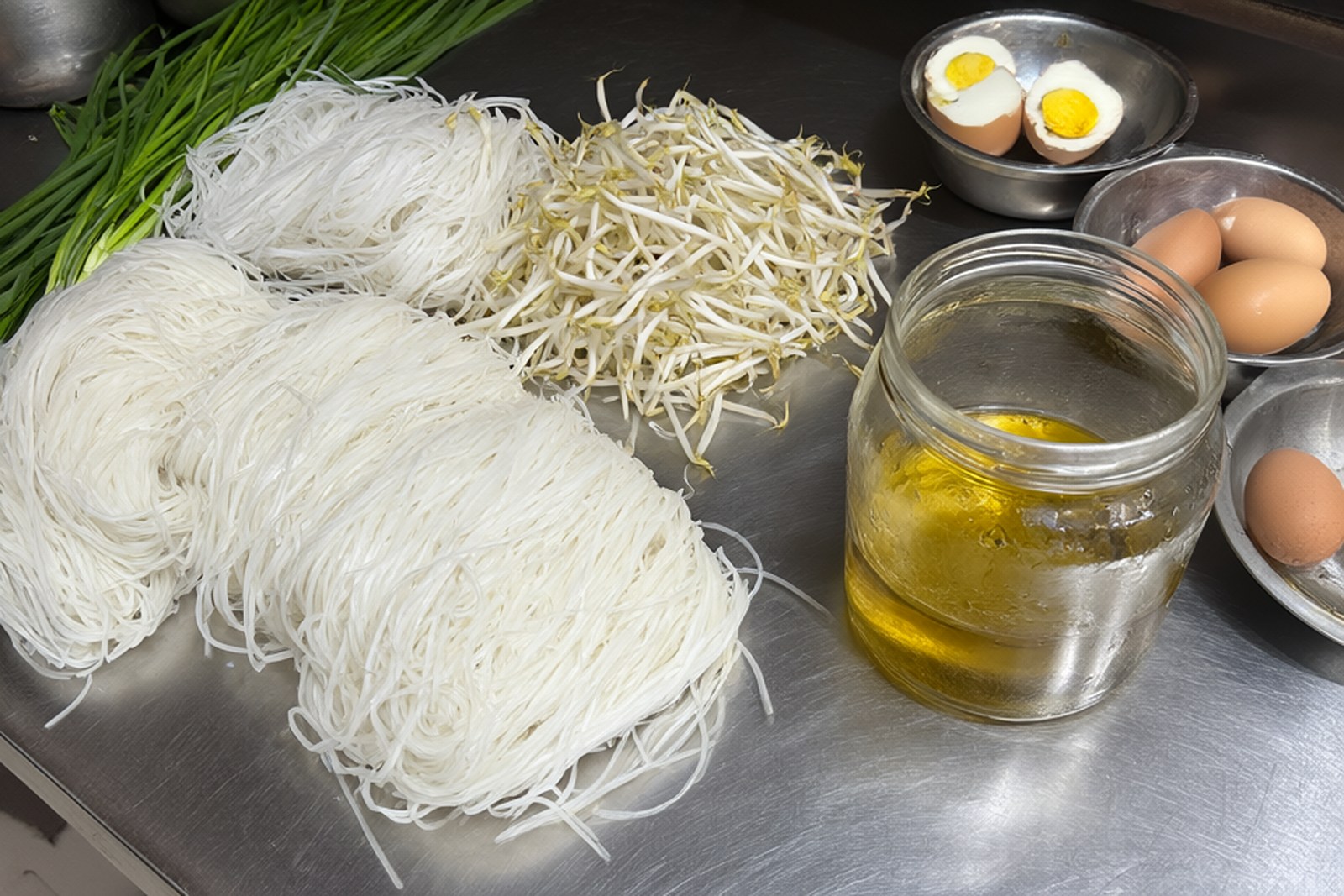
吴川 has put the dish on its list of ten great local dishes, and the technique has been entered into the city’s register of intangible heritage, which is the local way of saying that the number of cooks who can do it properly is falling: the work needs a big flame, a wok worn flat, lard rather than oil, and a hand quick enough to move the whole thing in under a minute, and none of that is easy to do at home. It is street food and it is eaten at both ends of the day, at breakfast with a bowl of congee and at midnight with a beer, and a plate costs eight to fifteen yuan plain and fifteen to thirty with meat in it. The stalls that are known for it sit around 梅菉 Méilù, the old town of 吴川 on the 鉴江 Jiàn jiāng, open late and lit by a single bulb hung over the wok. 吴川 eats its 米粉 in other forms too: the 粉皮 fěn pí, the same rice sheet rolled thin and eaten cold with soy and sesame, and the 田艾籺 tián ài hē, the mugwort dumpling made of 木薯粉 mù shǔ fěn, cassava flour, and filled with peanut and sugar, which is on another local list.
Words and Names
烂镬 làn huò is the battered wok and 炒粉 chǎo fěn the fried rice noodle; 镬气 huò qì is the breath of the wok, the smoky note the hot metal gives. 河粉 hé fěn is the fresh flat rice sheet cut into ribbons, 猪油 zhū yóu lard and 生抽 shēng chōu light soy. 梅菉 Méilù is the old town of 吴川市, 鉴江 Jiàn jiāng the river it stands on, and 粉皮 fěn pí the cold rolled version of the same noodle. 田艾籺 tián ài hē is the mugwort dumpling and 木薯粉 mù shǔ fěn the cassava flour it is made from.
What the Locals Know
Ask at the stall whether the wok is a 烂镬 and watch the cook work, because a place that has beaten its rim flat and keeps a flame high enough to blow is a place that will produce 镬气 and a place frying on a low gas ring will not, whatever the sign says. Order it plain first, with nothing but sprouts and spring onion, and add the beef or the char siu on a second plate only if you want it, because a crowded wok cools and the noodle steams instead of frying. Eat it where you buy it and within a minute or two of its coming off the fire, since it loses the whole of what it has as it sits, and ask for a bowl of plain congee alongside, which is what the locals put next to it.
flowcloud would say that a town which took a broken pan, decided the break was an improvement, and named its most famous dish after the damage, has made a better case for the value of a used tool than any shop selling new ones could.
Where to find it: the noodle stalls and small restaurants of 吴川市, with 梅菉 Méilù and the roads out of town the places to look, busy from about six in the morning and again after nine at night. A plate of 烂镬炒粉 is ¥8 to ¥15 plain and ¥15 to ¥30 with meat, a 粉皮 is ¥5 to ¥10 and a 田艾籺 ¥3 to ¥6. 吴川 is about an hour south-east of 湛江市 on the expressway and is served by 吴川站 Wúchuān zhàn on the 深湛 high-speed line, with the old town of 梅菉 about twenty minutes from the station by road.