
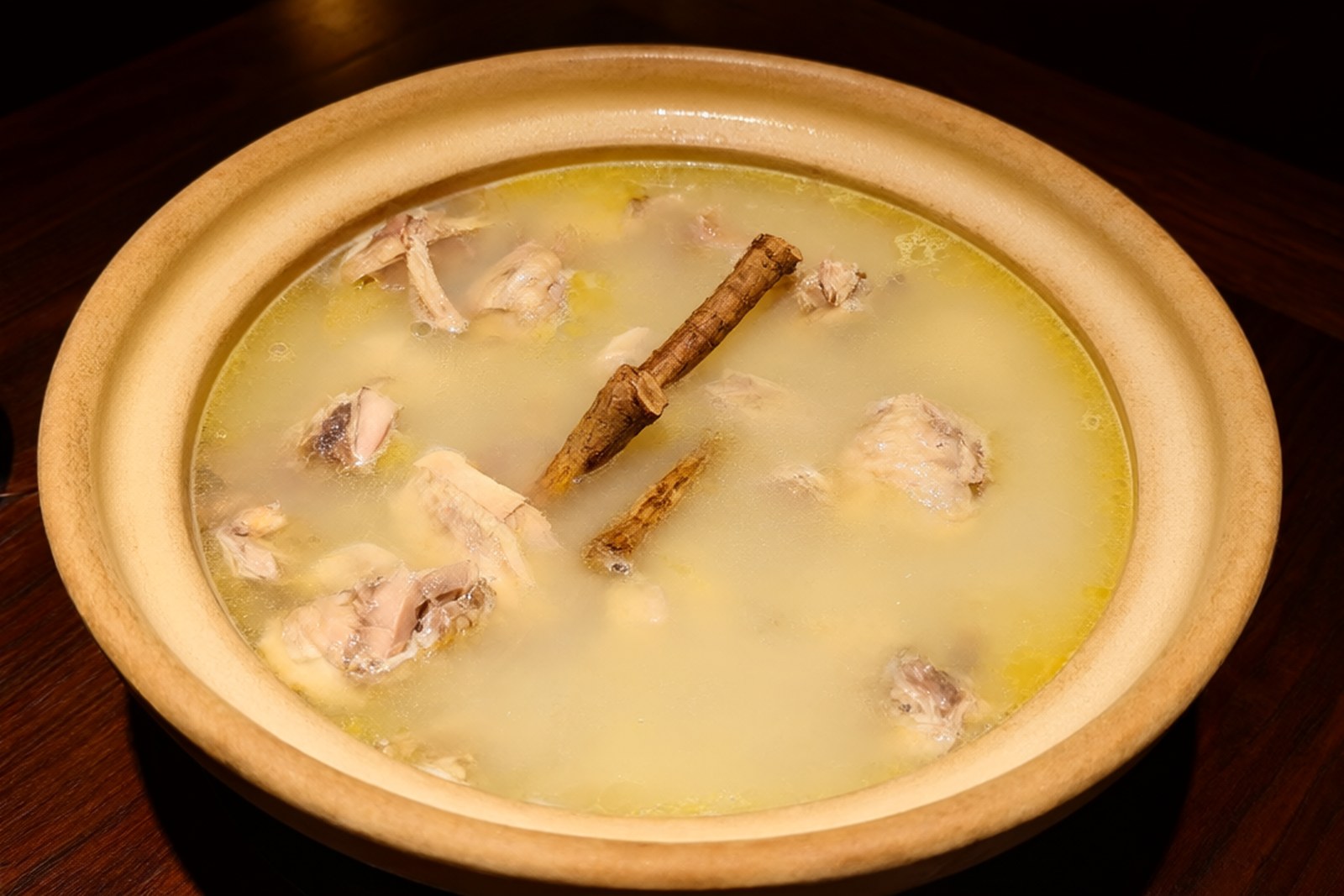
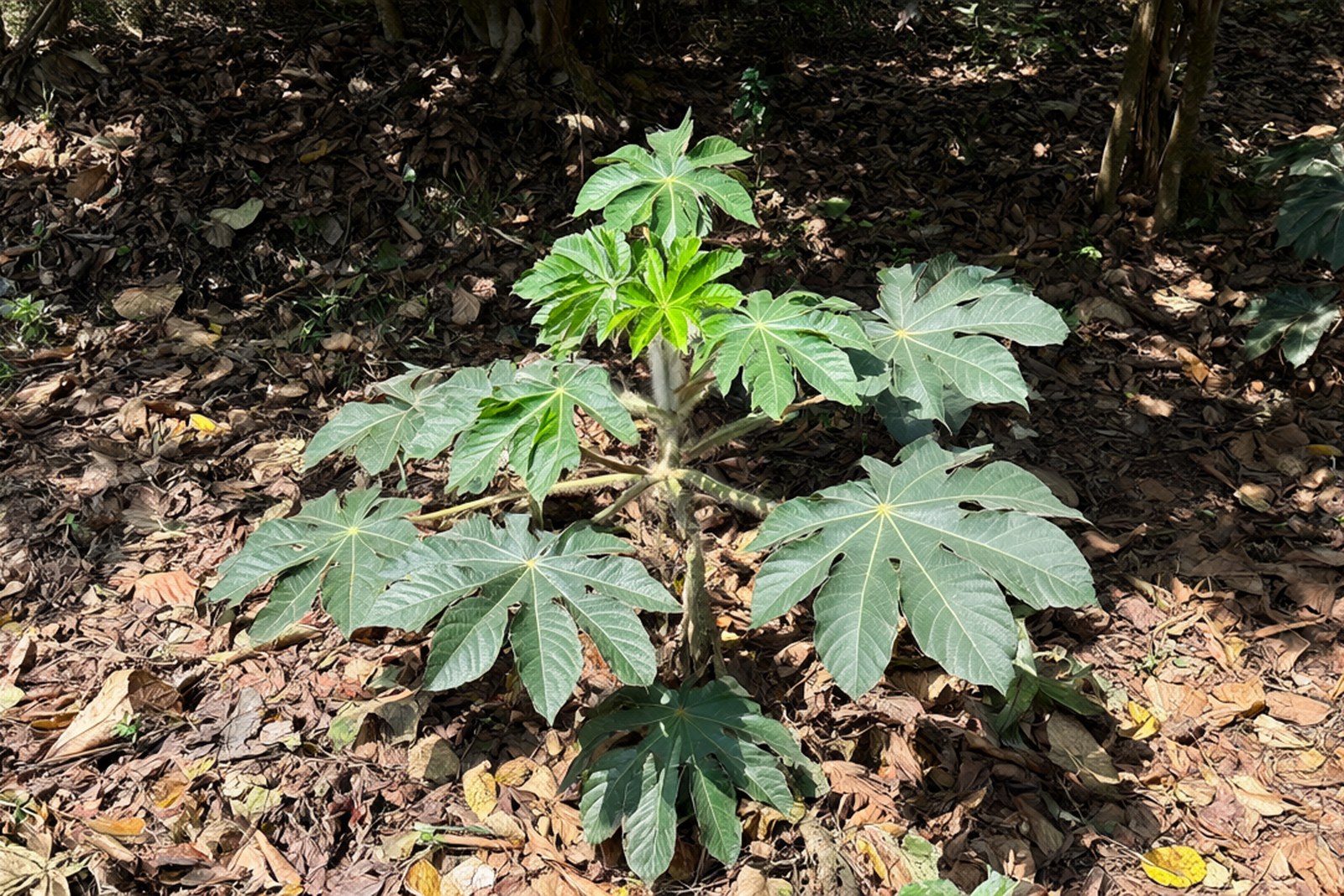
五指毛桃 wǔ zhǐ máo táo is the root that gives the Hakka north-east of Guangdong its most characteristic soup, and the name is a description: 五指 wǔ zhǐ, five fingers, for the shape of its leaf, 毛 máo, hairy, for the fuzz on the stems, and 桃 táo, peach, because the small figs it bears look like one. It is a wild fig, and it is the root rather than the fruit that matters. Simmered for an hour or two with a chicken, it gives a broth that smells unmistakably of coconut or warm milk, faintly sweet and quite unlike anything else in Chinese cooking, and it is the soup that a 东源县 Dōngyuán xiàn household puts on the table when someone needs building up.
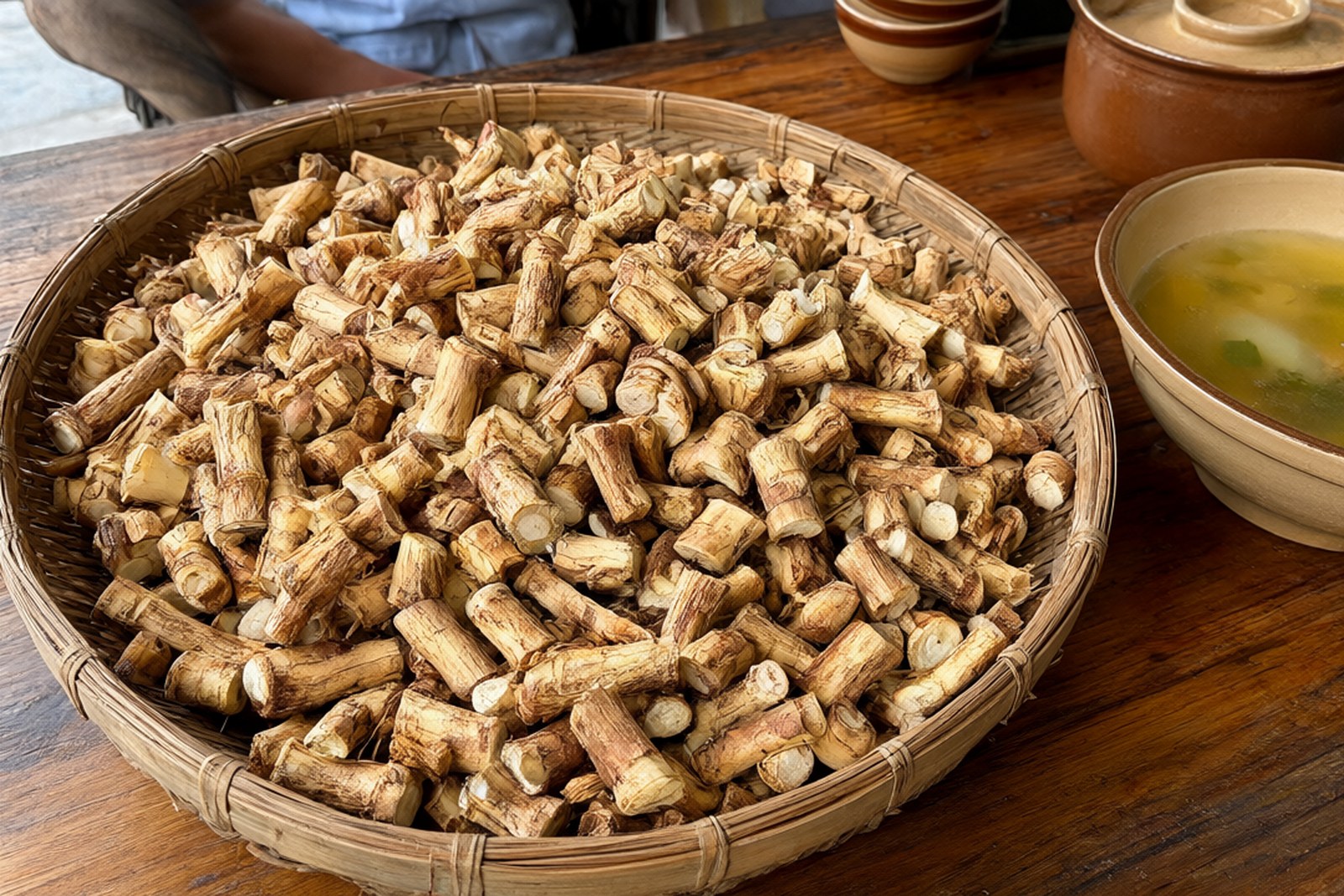
The plant grows on the wooded hillsides of the county, in the thin acid soil under the pines and the scrub, and it is dug rather than cultivated for the most part. The root is a long, pale, woody thing with a bark that carries the aroma; it is harvested in the autumn and winter, cut into lengths, and dried, and the dried root is what is sold in the markets and the herbal shops. A bundle sits in a kitchen the way a bay leaf sits in a European one, and it is used for the same purpose: not to be eaten but to change the pot. The scent is in the bark and the outer wood, so a piece that has been scraped white has lost most of what it had.
The soup is made with a whole chicken or a free-range bird jointed, and it is the 客家 Kèjiā order of things: the meat blanched and rinsed, the root washed and cut, both put into cold water with a few slices of ginger, brought up slowly and then held at a bare simmer for an hour and a half to two hours. Nothing else goes in except salt at the end; some cooks add a handful of 红枣 hóng zǎo, red dates, or a little 枸杞 gǒu qǐ, goji, and a few add 薏米 yì mǐ, job’s tears, when the point is the medicinal one. The broth comes out opaque and pale, the chicken is served separately or in the bowl, and the root is lifted out and discarded.
Beyond the chicken there is a small repertoire. The root goes into soups with pork ribs or with 猪骨 zhū gǔ, pork bones, for an everyday pot; it is cooked with 老母鸡 lǎo mǔ jī, an old hen, for the version that takes three hours and is given to anyone recovering from illness or childbirth; and in the villages it is sometimes boiled with 猪脚 zhū jiǎo, pig’s trotter, or with a whole 鲫鱼 jì yú, crucian carp. What all of them share is the milk-and-coconut note, which is strong enough that a first-time drinker will usually ask what has been added, and the answer is nothing. In the Hakka understanding of food it is a 祛湿 qù shī, a damp-clearing soup, the kind you drink in the wet season.
Words and Names
五指毛桃 wǔ zhǐ máo táo is the root, literally five-finger hairy peach, from 五指 five fingers and 毛 táo for the peach-like fig; it is also called 五爪龙 wǔ zhǎo lóng and 南芪 nán qí, the southern astragalus. 煲汤 bāo tāng is to simmer a soup, 老母鸡 lǎo mǔ jī an old hen, 猪骨 zhū gǔ pork bones and 猪脚 zhū jiǎo pig’s trotter. 红枣 hóng zǎo are red dates, 枸杞 gǒu qǐ goji and 薏米 yì mǐ job’s tears. 祛湿 qù shī means clearing damp, and 客家 Kèjiā is the Hakka, whose cooking this is.
What the Locals Know
Buy the root dried and unpeeled, and smell it before you pay: a good piece is fragrant through the bag and smells of coconut, and a scentless one will give you nothing. Wash it and cut it, but do not peel off the brown bark, which is where the flavour lives. Simmer, never boil hard, and salt only at the end, because salt early makes the chicken dry. If you are in 东源 or 河源 in the winter, ask a kitchen for 五指毛桃煲鸡 by name; it is a regular on the menu rather than a special request, and it is the cheapest introduction to the root you will get.
flowcloud would say that a hill county which dug a wild fig root out of the pine scrub, noticed that it smelled of milk, and built a soup around it that has no other reason to exist, has practised the oldest form of pharmacy, which is to cook what grows nearby until something works.
Where to find it: the Hakka restaurants and soup shops of 东源县 and 河源市, where it is on the regular menu, and the herbal stalls of the city’s wet markets, which sell the dried root by weight. A bowl of 五指毛桃煲鸡 in a restaurant is ¥40 to ¥80, a whole-pot serving for a family ¥80 to ¥150, and the dried root ¥30 to ¥80 a catty. 河源市 is on the high-speed rail line about forty minutes from 广州东; 东源县 surrounds the city and is reached by road in twenty minutes.