
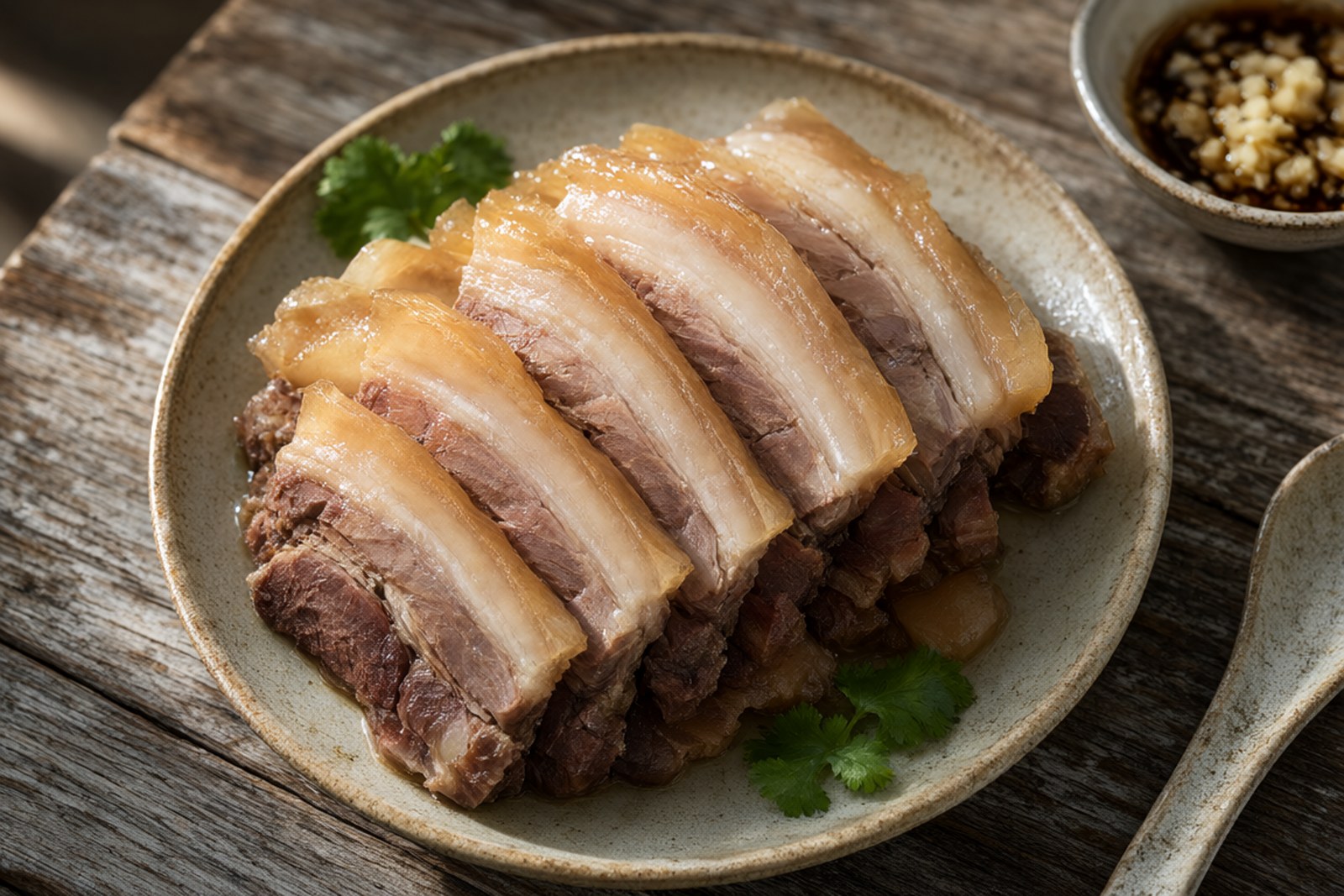
The plate arrives before you have finished asking what is on it. Twelve slices of cold boiled pork laid out in a fan, each one carrying a band of skin the colour of weak tea and, beneath it, meat closer to dark red than to pink. There is no sauce over the top, only a small dish of garlic and soy at the side and a wedge of green lime. You lift a slice with chopsticks and the skin resists a little before it gives, the way the skin of a properly raised animal does, and the meat behind it is firm enough that you have to chew it rather than let it dissolve. This is 五脚猪 wǔjiǎozhū, the five-toe pig, and in the courtyard kitchens of 水满乡 Shuǐmǎn Xiāng — the village at the foot of the mountain that gave 五指山市 Wǔzhǐshān Shì its name — it is the first thing a table orders and the last thing anyone talks about.
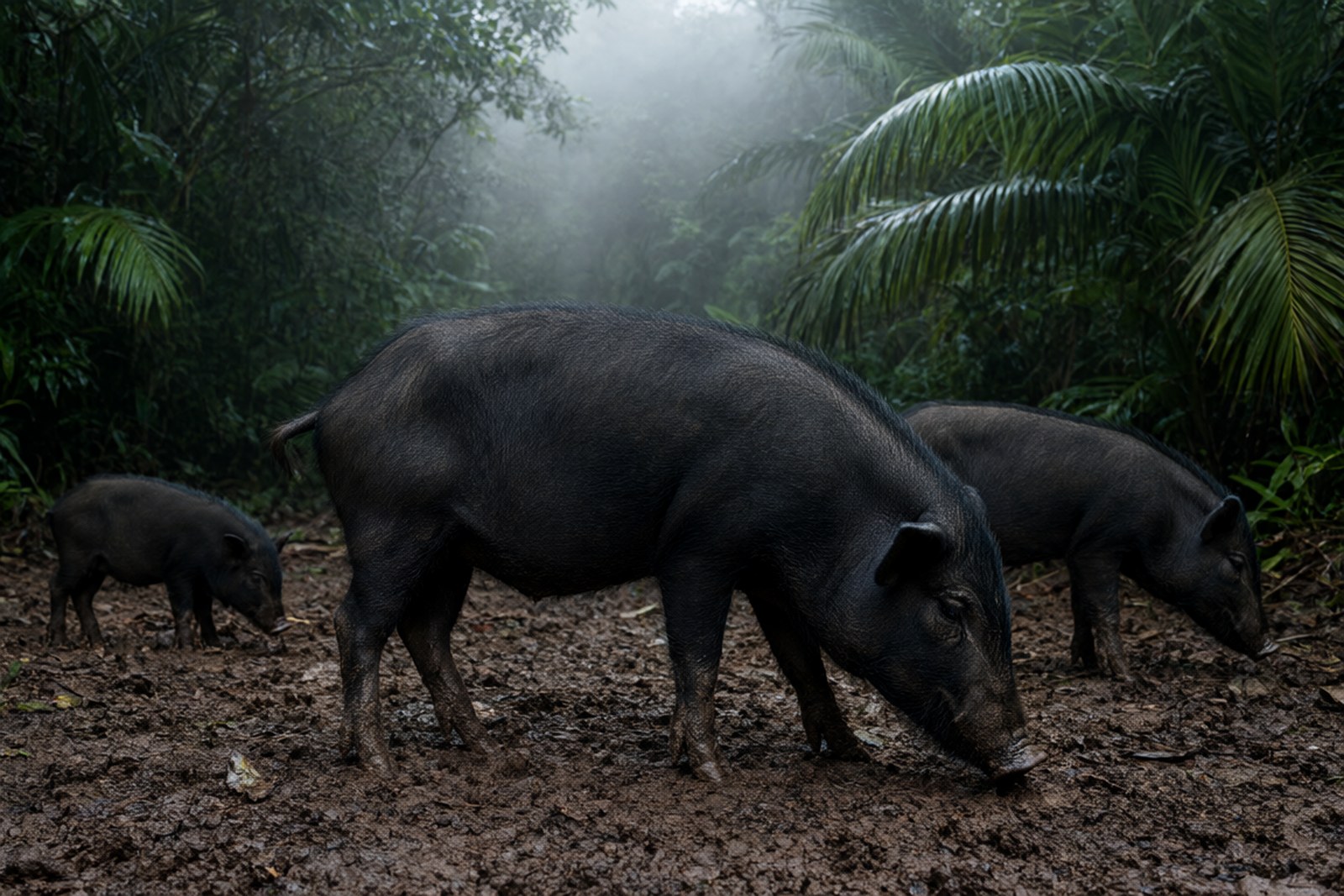
The name is not mysticism, it is field observation. A five-toe pig has four legs like any other, but the breed keeps its snout almost permanently against the ground, rooting for tubers, fallen fruit and insects along the forest edge, and the Li and Miao families who raised it decided that anything spending that much of its life as a fifth point of contact deserved the credit. What the name conceals is how small the animal is. A mature five-toe pig weighs somewhere between forty and sixty kilograms, which is a third of what a commercial white pig reaches, and it takes a year or more to get there instead of six months. It is black, short-legged, narrow through the body, with a long straight snout and a back that stays level when it walks. It is also, officially, one of the protected local livestock breeds of China, which is a polite way of saying it nearly vanished when everyone switched to fast-growing pink pigs, and that the herd at 五指山 survives partly because eaters here refused to give up the taste.
What Makes It Work
Slow growth is the whole recipe. An animal that spends twelve months walking and digging lays down muscle rather than soft fat, so a five-toe pig carries a thin layer of fat under a thick skin and very little marbling inside the meat. That combination dictates how it is cooked: this is not a pig you braise for three hours, because there is no fat to render and the lean muscle would dry out. It is a pig you poach whole in water with ginger and a little salt, cool completely, and slice. The skin sets into a translucent amber band with a real bite to it; the meat stays dark and slightly dense, closer in texture to venison than to supermarket pork. The dip does the rest of the work — pounded garlic, light soy, a squeeze of 小青橘 xiǎo qīngjú, the tiny green lime that grows in every village garden here, and for anyone who wants it, a spoonful of chilli. Grilled over charcoal the skin blisters and crisps instead, which is why skewers of it turn up outside bars in the city for about ¥10 each, sold as 烤五脚猪 kǎo wǔjiǎozhū.
The other half of the dish is what the pig ate. Households finishing an animal for a celebration feed it cooked 山兰米 shānlán mǐ, the local upland glutinous rice, for the last few weeks, which is the same trick used for the ducks and chickens of the region, and it shows up as a faint sweetness under the salt.
Words and Names
五脚猪 wǔjiǎozhū is the everyday name. You will also see 五指山猪 Wǔzhǐshān zhū on menus and in agricultural writing, which pins the breed to the mountain, and 香猪 xiāngzhū, fragrant pig, which is a marketing word shared with several other small breeds across southern China. 老鼠猪 lǎoshǔ zhū, rat pig, is what older villagers sometimes call it, and it is not an insult — it refers to the size. 白切 báiqiē is the technique, literally white-cut, meaning boiled without colouring agents and served cold; it is the standard treatment for any ingredient whose own flavour is considered worth defending. 拱土 gǒng tǔ is the verb for what the pig does all day, pushing the snout through soil, and it is the reason for the name. 黎族 Lízú and 苗族 Miáozú are the two communities who raise the breed here, and 长桌宴 chángzhuō yàn, the long-table feast, is where the biggest plate of it usually appears.
What the Locals Know
The locals judge the pig by its fat, and they judge the cook by the skin. A plate where the skin has turned soft or collapsed has been boiled too long, or came from an animal that never moved. Nobody here orders five-toe pig with a heavy sauce, because the point of paying three times the price of ordinary pork is to taste the difference between them, and a sauce hides exactly that. The most common mistake visitors make is eating it in a hotel restaurant: the dish is cheapest and best in the villages, where a table for two can come in around ¥120 with vegetables and rice, and in the small 黎家菜 Lí jiā cài family kitchens in town, and most expensive in the resorts, where the same pig is served under a different name at triple the price. In winter, ask for it as a hotpot — 五脚猪火锅 wǔjiǎozhū huǒguō — with a plain broth and wild greens, which is how local families eat it when the mountain turns cold and damp. And if someone offers you the head, say yes. It is boiled and chopped into pieces with the skin on, and it is the part of the animal that most clearly explains why anyone bothered to keep the breed.
flowcloud would say that the five-toe pig is what happens when a place decides taste matters more than speed, and that you can taste a whole agricultural system in one cold slice.
Where to find it: the village restaurants and 农家乐 nóngjiālè of 水满乡 Shuǐmǎn Xiāng and the 黎族 Lízú villages around the mountain are the source, with the town of 五指山 itself running a close second in its small family kitchens. Order 白切 for the real thing and 烤 for the street version, and ask for the meat 带皮 dài pí, with the skin on.