
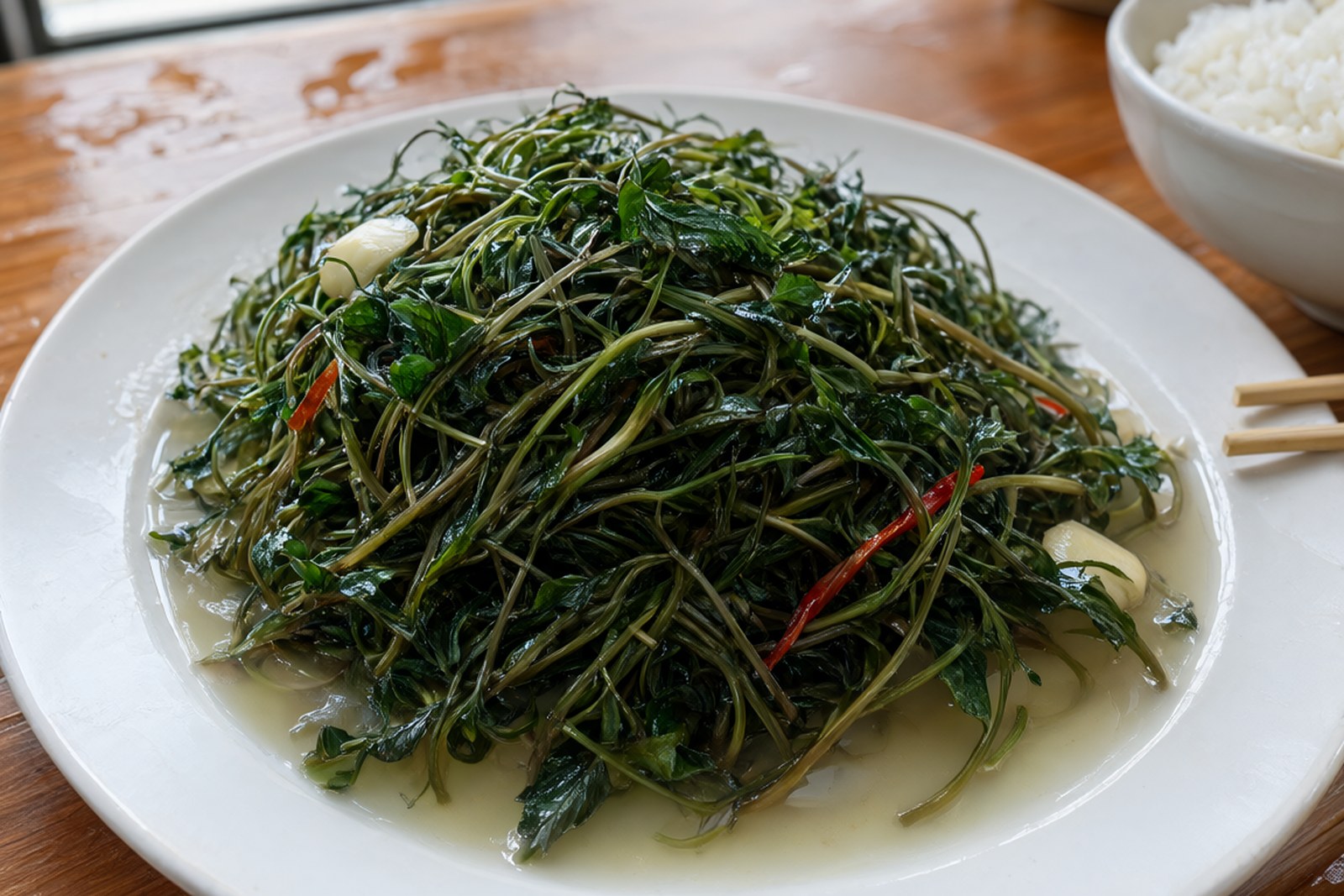
The dish that arrives is almost insultingly plain: a mound of dark green leaves with a few stems poking out of the top, glossy with oil, a scatter of white garlic slices and two strands of red chilli laid across it. There is nothing else on the plate. You eat a mouthful and get bitterness first, a clean leafy bitterness, and then, a second later, a sweetness that seems to come from behind your tongue, and a slight chewiness in the stems that says these leaves were alive this morning. In 五指山市 Wǔzhǐshān Shì this is 五指山野菜 Wǔzhǐshān yěcài, wild vegetable, and it is not one plant. It is a whole category, picked along forest paths and stream banks and cooked for about ninety seconds in a hot wok, and ordering it in a roadside kitchen here is the closest thing in Hainan to eating a piece of the rainforest directly.
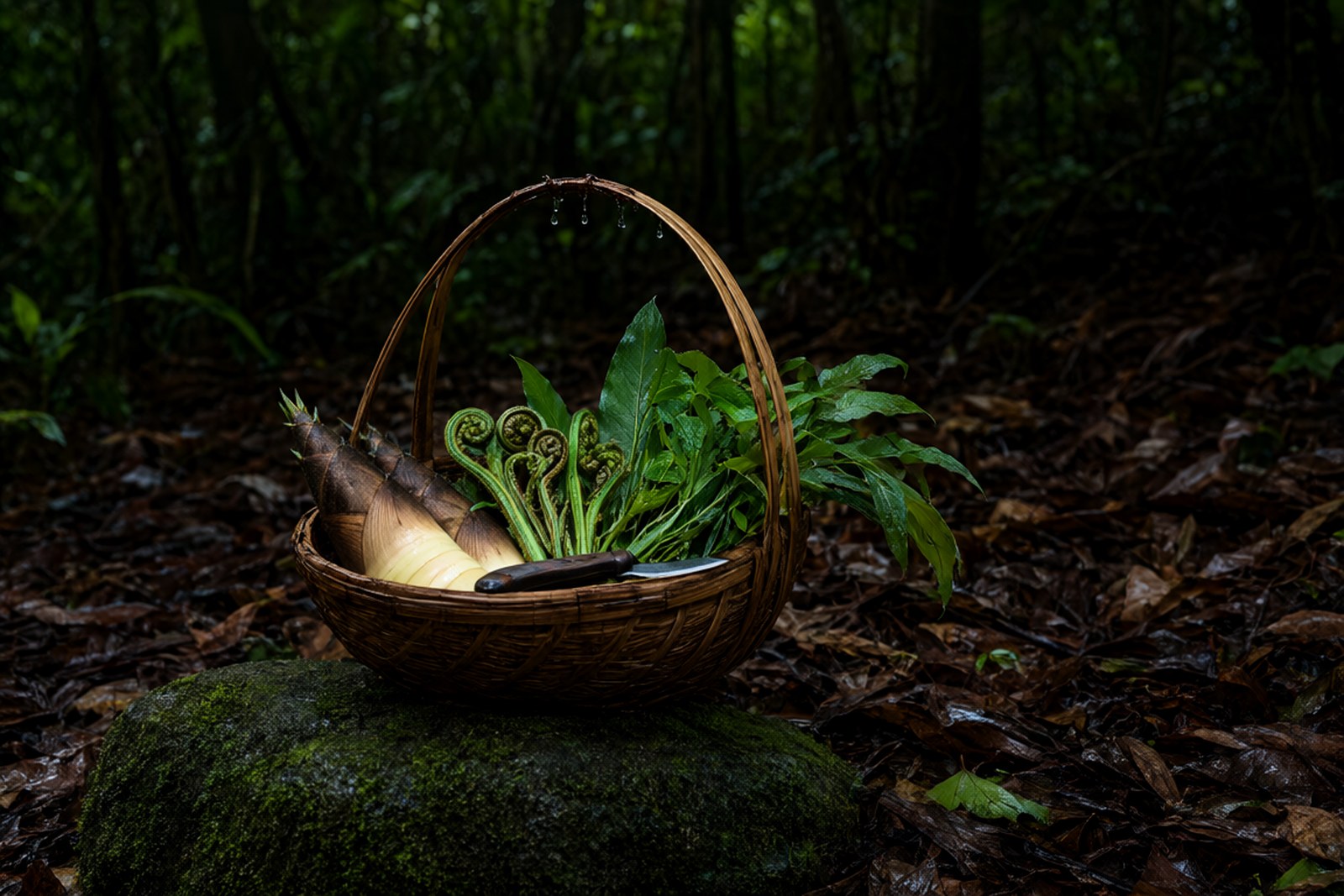
Walk into any market in the city at seven in the morning and you will find them in bundles tied with grass: 树仔菜 shùzǎi cài, small leaves on thin woody stems that taste faintly of asparagus; 百花菜 bǎihuā cài, a bitter green eaten when it is still young; 鹿舌菜 lùshé cài, deer-tongue vegetable, with a leaf shaped like its name; 雷公根 léigōnggēn, the creeping plant known as gotu kola in the west, sold to be shredded raw into a salad with lime; and 革命菜 gémìng cài, revolution vegetable, whose name comes from the 1940s, when the 琼崖纵队 Qióngyá Zòngduì guerrillas held the mountains around here for twenty-three years and ate whatever the forest provided. It is not a romantic story when you taste the plant: it is a coarse, faintly medicinal herb that needs garlic and heat to be pleasant, and knowing what it cost makes it taste better anyway.
What Makes It Work
The cooking is deliberately minimal, and it is the reason the dish works at all. Strong greens in a kitchen that did not understand them would be blanched to death or buried in sauce. Here they go into a wok with sliced garlic and a little oil, are tossed until they just collapse, and are salted at the very end, which keeps the stems crisp for another minute on the way to the table. Nothing thickens the dish, so whatever liquid ends up in the bottom of the plate is a thin green broth, and locals spoon it over rice. The bitterness is not a flaw to be removed. It is the point, and it is the reason these greens are eaten with rich food — with braised pork, with grilled five-toe pig, with the river fish — as a sharp note against fat. The stems are the tell of freshness: they should snap, not bend, and the leaves should be dry enough to squeak slightly against each other when you pick up a bundle.
Words and Names
野菜 yěcài simply means wild vegetable and covers everything above. 树仔菜 shùzǎi cài is sweet leaf, 百花菜 bǎihuā cài is a young bitter green, 鹿舌菜 lùshé cài is deer-tongue, 山葵叶 shānkuí yè is a wild wasabi leaf with a horseradish heat when raw, and 雷公根 léigōnggēn is gotu kola, named for the thunder god in a folk etymology nobody takes literally. 四棱豆 sìléng dòu, the four-angled bean, appears everywhere in the same stalls even though it is cultivated rather than foraged. 清炒 qīngchǎo is the cooking instruction you want to use: clear-fried, nothing but oil, garlic and salt. 山野菜 shānyěcài, mountain wild vegetable, is what many menus call the mixed plate, and 蘸料 zhànliào is the dipping sauce — here usually soy, garlic, chilli and lime — which is added at the table, not in the pan.
What the Locals Know
Locals eat these greens several times a week and treat them as medicine as much as food: 雷公根 for the liver, 百花菜 to cool the body down, 革命菜 because it was always eaten. They also know that the best ones never reach a restaurant kitchen in the centre of town, because they wilt within hours of picking, which is why the serious version of this dish exists only within a short drive of the forest edge. Two warnings, offered by every person who has ever cooked them for a visitor. The first is that wild greens are bitter on purpose and asking the kitchen to make them less so produces a plate of something that tastes of nothing. The second is 忧遁草 yōudùn cǎo, sold at roadside stalls as a health tea; it is a perfectly pleasant infusion and it has a long folk reputation as a cure for things it does not cure. Drink it because you like it. At the table, the correct order of operations is to eat the greens first, while they are hot and still crunching, and leave the pork for afterwards, and to finish with a bowl of rice that has had the green broth poured over it.
flowcloud would say that the reason a plain plate of stir-fried leaves is the most memorable thing on a Hainan mountain table is that nothing has been done to it that cannot be undone by a farmer deciding not to pick that morning.
Where to find it: the 农家乐 nóngjiālè and village kitchens of 水满乡 Shuǐmǎn Xiāng, and the morning market in 五指山市 Wǔzhǐshān Shì where the bundles are still tied with grass. Order 清炒野菜 for the mixed plate, ask which leaves are in it, and do not ask for them mild. In 海南 Hǎinán the greens are sold by the bundle rather than the jin, and a bundle is one generous plate.