
Xianyuan Fermented Beancurd: Red Yeast Cubes, Canal-Travelled Blanks and Porridge-Side Flavour of Tongzhou District, Beijing
绍兴坯子运河上,红曲封坛两年香。Shàoxīng pīzi yùnhé shàng, hóngqū fēngtán liǎngnián xiāng – Shaoxing blanks riding the canal north; red yeast in sealed jars brewing two years of fragrance.
仙源腐乳 Xiānyuán fǔrǔ Xianyuan fermented beancurd is the red cube Beijing’s east sets beside its porridge bowls, and the address is a sauce garden: the shop the Tongzhou Hui merchant 马兆丰 Mǎ Zhàofēng Ma Zhaofeng opened in 1918 as 万通酱园 Wàntōng Jiàngyuán the Wantong Sauce Garden by the town’s busy 闸桥 Zháqiáo sluice bridge in 通州区 Tōngzhōu Qū Tongzhou District, Beijing – a front-shop, back-yard house whose bean-curd cubes travelled farther than most of its customers ever would. The old method was a canal itinerary: blank cakes pressed in Shaoxing, in Zhejiang, packed in earthen jars, carted to the Hangzhou wharves and shipped north up the Grand Canal for the better part of a month – and the voyage itself was the first fermentation, mould blooming through the cakes as latitude swapped for latitude, southern stock taking on northern temperament, 南材北味 nán cái běi wèi “southern material, northern taste”, as the trade’s own phrase has it. In the Tongzhou yard came the second fermentation: red yeast rice for the colour and the ferment, yellow wine and a dozen aromatics to the Beijing palate, sealed and sunned through the dog days, then cellar-stored for the better part of a year – a two-year clock from press to jar. The craft most visitors under-rate is patience as logistics: the recipe was designed around a waterway, and the waterway set the flavour. The naming is the tell: the old town still says 酱豆腐 jiàngdòufu sauce beancurd for it, the co-op era renamed the firm, and the jar on the shelf answers to both names at once.
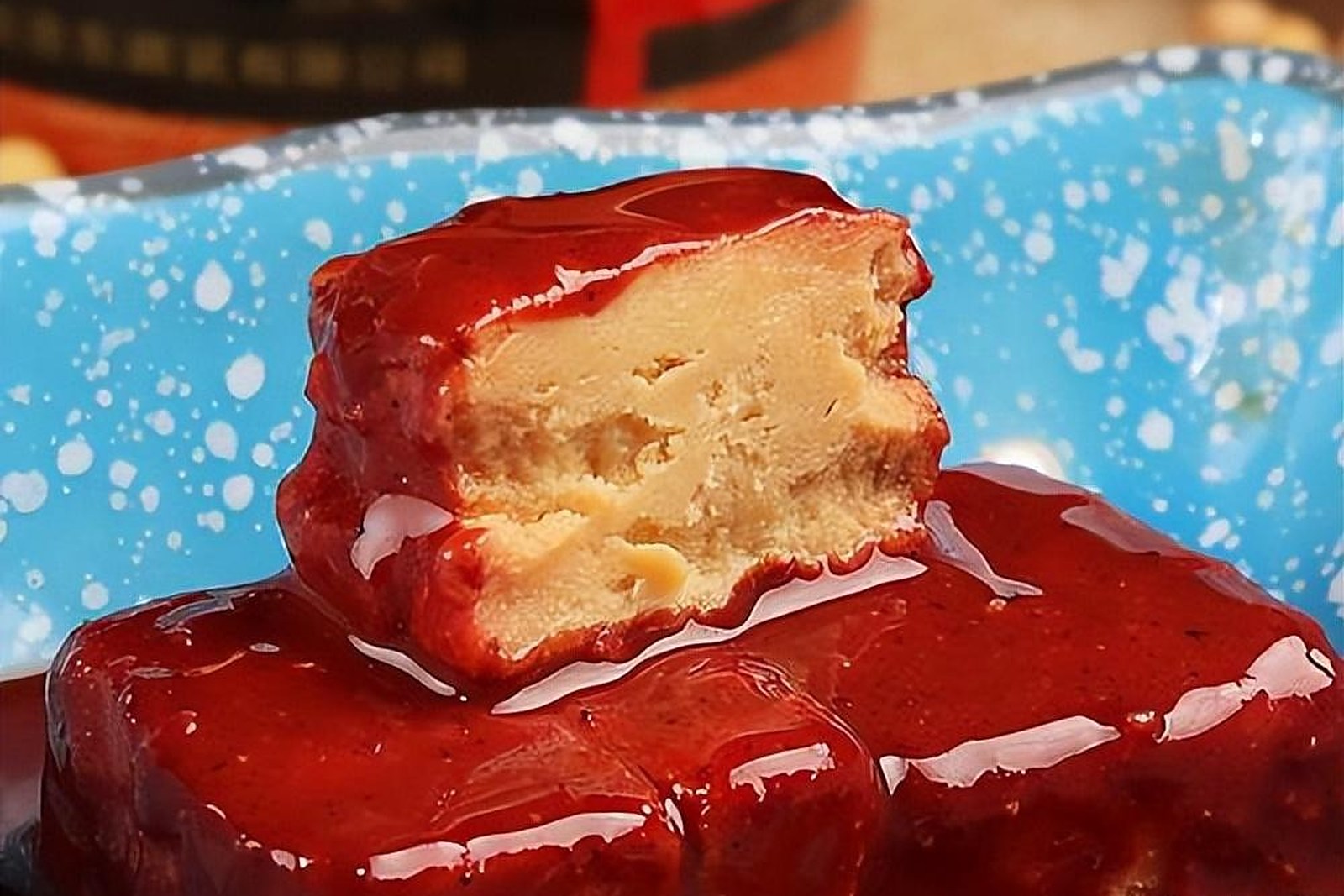
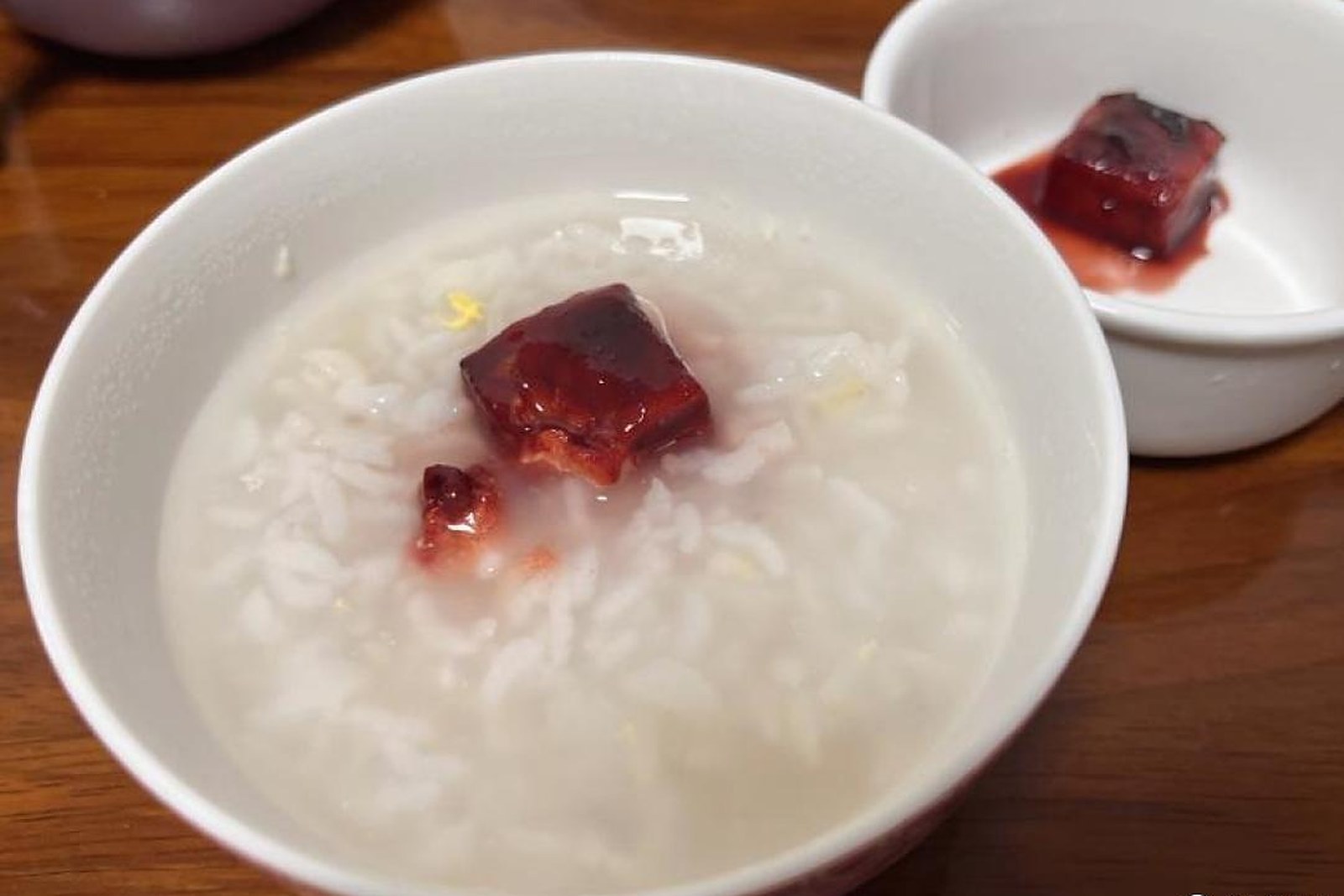
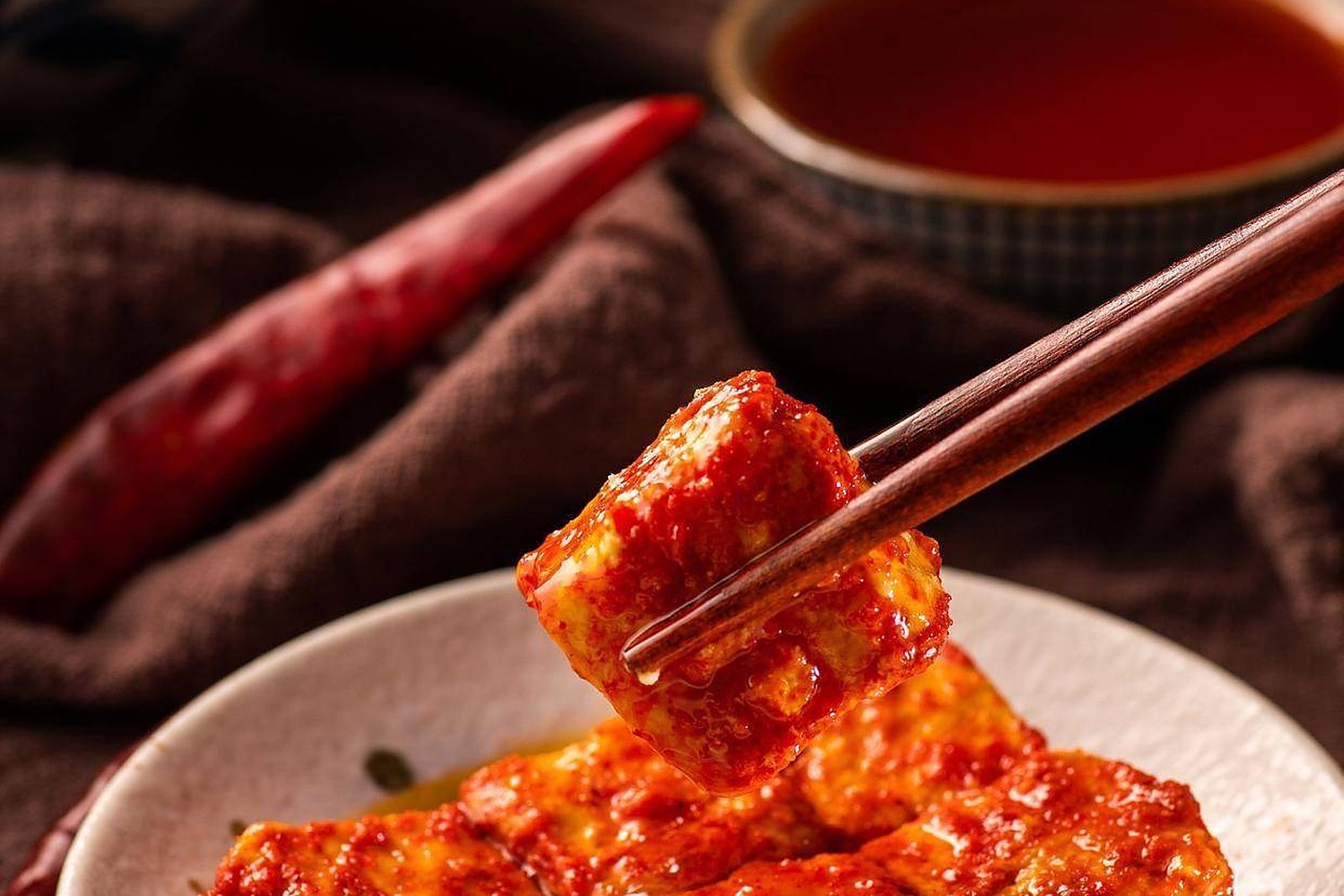
The eating is a small-salt grammar written for plain foods that need a loud neighbour, and it leans 咸鲜 xiánxiān salty-savoury plus 细腻 xìnì fine-smooth to match the porridge table. The anchor is the jar itself – ruby-red cubes, close-textured and barely holding their edges, tasting of ferment, wine and salt with a faint sweet roundness – eaten the plain way first, a quarter cube over plain congee, or smeared on a fresh 烙饼 làobǐng griddle pancake or a hot 馒头 mántóu steamed bun, where one cube does the work of a whole dish. The kitchen uses are the deeper half of the fame: a spoon of the jar’s red mash into a pork or fish braise for colour and depth, the cubes beaten into the dipping bowl for hot-pot mutton and 涮肉 shuànròu rinsed-lamb plates, and the company’s bottled 腐乳汁 fǔrǔzhī beancurd brine and 腐乳酱 fǔrǔjiàng beancurd sauce for cooks who want the flavour by the spoon – with the same yard’s yellow bean sauces and vinegars filling out a full sauce-garden shelf. The old praise was texture, and it still grades the jar: a good cube reads silk against the tongue, a rushed one crumbles chalky, and no dye hides the difference.
The honest grade is geography plus the jar-date clock. In 通州区 Tōngzhōu Qū Tongzhou District, Beijing the honest buying is at the company’s own counters and shops around the district, at the market-day stalls the eastern towns still queue for, and on the supermarket shelves of the east city – the brand carries the national China Time-honoured Brand listing, and the works have long since moved out of the old town (worth confirming the details – which shops stock the full range and which carry only the retail jars). The jar’s own test is the lid read against the cube: fresh stock sits glossy and even-red, old or abused stock weeps and darkens at the edges – worth confirming the details, jar by jar, because both wear the same red seal. A jar’s price runs on grams and gift boxing, so call it worth confirming the details rather than a fixed number, and buy the small glass jar first: the big ceramic crocks are for households that already know their answer.
The wry truth is that 仙源腐乳 Xiānyuán fǔrǔ is over-rated as a keepsake and under-rated as fermentation engineering: souvenir lists file it under “local specialty”, while the actual thing – blank cakes ripened by latitude, a two-year clock run through sun, cellar and brine, a canal that did the first ferment and a northern palate that set the second – is biotechnology the label never advertises. The old fans are right about continuity and wrong about romance: the recipe survived by becoming a co-op, then a company, then a brand, and the taste survived because the clock was never shortened past what the mould would do. The self-deprecating footnote, and the district braid: a food writer will lecture the shop hand on “live ferments” he cannot see, photograph the ruby cubes at heroic shutter, and then call the jar “commendably artisanal” as if two years were a mood – which is the honest grade: 仙源腐乳 Xiānyuán fǔrǔ is a slow craft the writer will aestheticise more than he waits for, and the granddad at the next counter has already bought his two jars for the morning congee and gone before the shutter closes. The same 通州区 Tōngzhōu Qū Tongzhou District, Beijing thread runs on: the canal catfish of 小楼烧鲇鱼 Xiǎolóu shāo niányú Xiaolou braised catfish fries golden on the old South Street, the sesame-and-brown-sugar rounds of 大顺斋糖火烧 Dàshùnzhāi táng huǒshao Dashunzai sugar huoshao stack in the Hui-quarter shops, the cherry rows of 西集大樱桃 Xíjí dà yīngtáo Xiji big cherries redden the double-river plain in May, and the trellises of 张家湾葡萄 Zhāngjiāwān pútáo Zhangjiawan grapes hang heavy into autumn – one district, four more tables.
Words and Names
- 仙源腐乳 Xiānyuán fǔrǔ / Xianyuan fermented beancurd · the red-cube ferment that carries the old Wantong recipe - 万通酱园 Wàntōng Jiàngyuán / Wantong Sauce Garden · the 1918 sauce yard the brand grew out of - 酱豆腐 jiàngdòufu / sauce beancurd · the Beijing name the old town still uses - 坯料 pīliào / blank cakes · the pressed beancurd that ferments into the finished cube - 红曲 hóngqū / red yeast rice · the ferment and colourant of the ruby cube - 南材北味 nán cái běi wèi / southern material, northern taste · the canal-ferment phrase for the voyage recipe - 佐粥 zuǒ zhōu / porridge-side · the small-salt job the cube was built for - 通州区 Tōngzhōu Qū / Tongzhou District · the Beijing district holding the sauce garden
What the Locals Know
- Start with a quarter cube: the salt is the point and the porridge is the vehicle – a whole cube is a dare, not a serving.
- Use the mash, not just the cube: the red brine is a braise colourant and a hot-pot dip base – the jar’s second job locals never skip.
- Read the lid date: fresh stock sits glossy and even-red; a jar that has wept and darkened has been waiting too long (worth confirming the details, jar by jar).
- Buy where the queue forms: the company counters and market-day stalls turn stock the fastest – gift crocks are for giving, small jars are for breakfast (worth confirming which shops stock the full range).
flowcloud would say that the 仙源腐乳 Xiānyuán fǔrǔ is the red yeast cubes, canal-travelled blanks and porridge-side flavour of Tongzhou District, Beijing – a 万通酱园 Wàntōng Jiàngyuán recipe whose 坯料 pīliào blank cakes did their first ferment on a month-long canal voyage and their second under 红曲 hóngqū and cellar patience – and that the honest move is to start with a quarter cube, use the mash, and read the lid date, because the canal set the first ferment and the north set the taste. All checked October 2026.
Where to find it: Tongzhou District Tōngzhōu Qū, Beijing – the company’s own 仙源 Xiānyuán brand counters and shops around the district’s streets and markets, with the old eastern-market stalls still selling the retail jars and gift crocks of 酱豆腐 jiàngdòufu year-round (worth confirming the details – which shops stock the full range and which carry only the retail jars); a jar’s price runs on grams and boxing, so call it worth confirming the details rather than a fixed number. Xianyuan fermented beancurd is the red yeast cubes, canal-travelled blanks and porridge-side flavour of Tongzhou District, Beijing, canal before jar.