
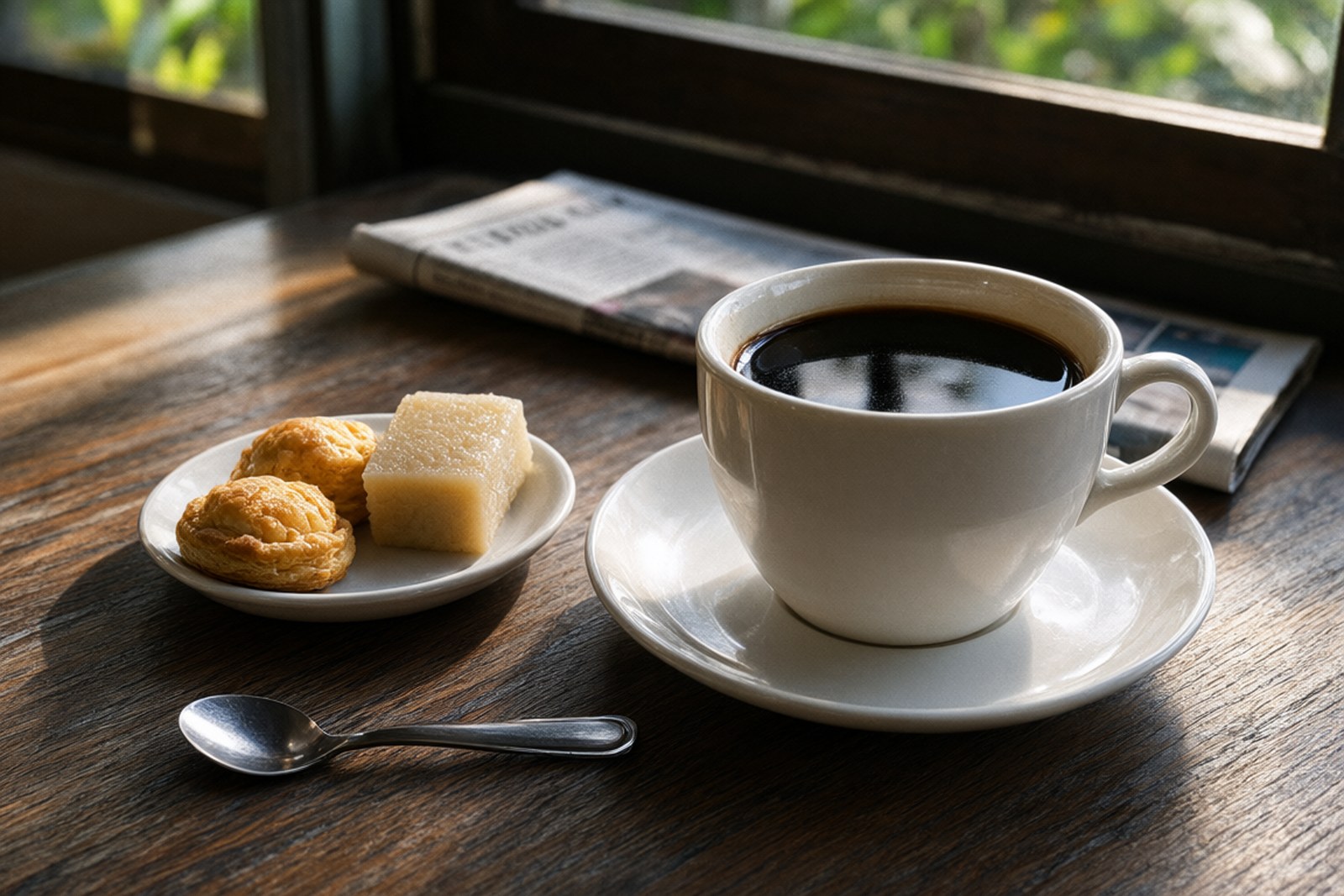
The coffee arrives in a small white cup on a saucer, black, thick, and already sweet, and the man who made it does not ask how you want it because there is only one way here. It tastes of burnt sugar and dark nuts and something faintly savoury underneath, and it is strong enough that the first sip is a small event. Around me half the town is doing the same thing — a cup in one hand, a folded newspaper or a phone in the other, a plate of two small cakes going cold on the table — at seven in the morning, before work. 兴隆 Xīnglóng is a coffee town in the hills of 万宁 Wànníng, on the east coast of 海南 Hǎinán, and it drinks coffee the way other Chinese towns drink tea. Not as a novelty. As a habit with a history.
That history is the reason the coffee tastes the way it does, and it begins about seventy years ago with a group of people who arrived here with nothing and brought their breakfast with them. In the 1950s, 兴隆 took in more than ten thousand 归国华侨 guīguó huáqiáo — returned overseas Chinese — from twenty-one countries and territories, most of them from what the Chinese call 南洋 Nányáng, the Southern Ocean, meaning Southeast Asia. They came from Malaysia and Indonesia, from Vietnam and Thailand, from Singapore, from as far off as India and the Philippines. Many had lost everything. They were settled on a state farm on the west bank of the 太阳河 Tàiyánghé, the Sun River, and told to make it productive, and among the things they planted was coffee.
A Factory Before There Was a Market
What makes 兴隆 unusual is the order in which things happened. Most coffee cultures grow up around a market: people want coffee, so somebody plants it. Here, a factory came first.
In 1952 the collective farm set up a 综合农副产品加工作坊 — a general farm-produce workshop — and began processing coffee. That workshop, on the west bank of the 太阳河 Tàiyánghé, is generally counted as the first coffee factory established in the People’s Republic, and the brand that eventually grew out of it took the river’s name. The 太阳河 Tàiyánghé label was registered in 1987, after thirty-five years of quiet production.
The endorsement that made the town’s reputation came in February 1960, when 周恩来 Zhōu Ēnlái visited the farm and was given a cup. He liked it, and said so in a line that is now painted on walls and printed on packaging all over 兴隆: that he had drunk coffee in many countries and still preferred the coffee grown here. Whatever else a small farm town needed in 1960, that sentence was enough.
Robusta, Selenium and a Burnt-Sugar Roast
The bean itself is not the fashionable one. 兴隆 Xīnglóng coffee is mostly 中粒种 zhōnglìzhǒng — the medium-bean 罗布斯塔 luóbùsītǎ, robusta — grown on the selenium-rich laterite around the town. Robusta is the bean that specialty coffee spent thirty years teaching people to sneer at, and it is exactly the right bean for this cup: more caffeine, more body, a heavy, bitter-chocolate backbone that survives being roasted dark and sweetened hard.
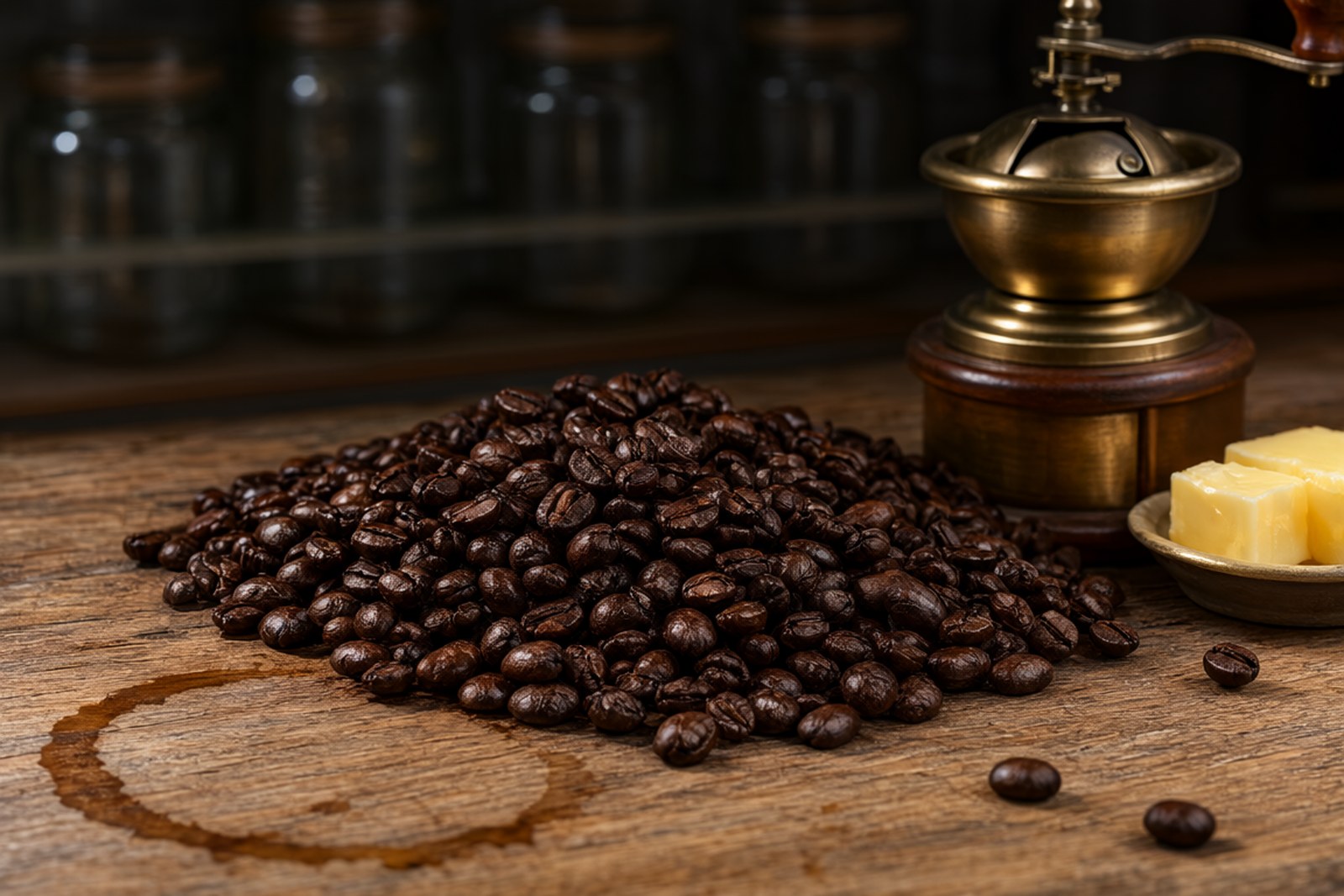
The processing is the real signature. The returnees, working from what they had learned in Malaya and Java, roast the beans with 牛油 niúyóu — beef fat, or butter, depending on who is telling it — and sugar, and often a pinch of salt. The sugar caramelises onto the bean and the fat carries the aromatics, so that when you grind it and pour water on it, the cup comes out already round and sweet. This is the 兴隆华侨传统风味咖啡 Xīnglóng huáqiáo chuántǒng fēngwèi kāfēi, the traditional returned-overseas-Chinese flavour, and it is why nobody here offers you milk. Adding milk to this would be like putting sugar in a cake that has already been baked.
There is a chemistry claim attached to the local pride that is worth knowing: the chlorogenic acid content of 兴隆 beans is said to rank second in the world, behind Jamaican Blue Mountain. Treat that as a piece of local folklore with a grain of truth — what is not folklore is the selenium, which comes from the soil and does show up in the bean.
The Ritual
The vocabulary of a 兴隆 morning is Cantonese in origin and completely local in practice. People order 一盅两件 yī zhōng liǎng jiàn — one cup, two items — which means a coffee and a pair of small cakes or buns, and they drink it standing at a counter or sitting on a plastic chair, in a hurry, before the day starts.
The scale of it is the surprising part. 兴隆 is a town of roughly thirty thousand people and it has somewhere between two hundred and three hundred places to get a coffee, which is about one per hundred residents and, by some distance, the densest coffee coverage in China. Per-person consumption is put at two to three hundred cups a year. The morning cup is not a treat here; it is a utility, like the first cigarette of the day in a town that smokes.
There are two ways to drink it while you are in town. The first is the 咖啡店 kāfēidiàn, the old-style shop: formica tables, a wall of glass jars, a roaster in the back turning by hand, a menu of about four things. The second is the 咖啡文化园 kāfēi wénhuàyuán, the coffee culture park built around the original factory site, which will walk you through bean to cup in an afternoon and sell you a bag of the good stuff on the way out. Do the park for the explanation and the shops for the actual drinking.
Words and Names
兴隆 Xīnglóng means, roughly, “flourishing and prosperous” — an auspicious wish that became a place name, and which the town has spent seventy years living up to with varying degrees of irony. 华侨 huáqiáo is a Chinese person living abroad; 归国华侨, usually shortened to 归侨 guīqiáo, is one who has come back. 南洋 Nányáng, the Southern Ocean, was the traditional Chinese term for the lands around the South China Sea, and it is still the word older people here use for where they came from.
一盅两件 yī zhōng liǎng jiàn — one cup, two pieces — is the standard order and originally a Cantonese 早茶 zǎochá expression. 中粒种 zhōnglìzhǒng literally means “medium-grain species” and is the trade term for robusta; 小粒种 xiǎolìzhǒng, “small-grain”, is arabica. And 太阳河 Tàiyánghé, Sun River, is the river the farm was built along and the name on the oldest coffee brand in the country.
What the Locals Know
Ask for it 传统 chuántǒng. The word on the menu that matters is 传统, traditional — buttery, sugary, hand-roasted. The shops also sell a modern light roast for visitors who want to take beans home and brew them their own way, and it is perfectly good, but it is not the thing this town is famous for.
Do not add milk, and taste it before you add sugar. The roast has done that work already. If the cup tastes harsh, the shop has rushed the roast, not under-sweetened the coffee.
Go early. The 一盅两件 crowd is there from about six-thirty to eight, and a shop that is full of locals at seven is the only reliable guide to which one is good.
Buy beans at the factory, not the airport. The culture park and the shops around 兴隆镇 Xīnglóngzhèn sell roasted beans at roughly a third of what the same tins cost in 海口 Hǎikǒu or 三亚 Sānyà, and they will grind them for you while you wait.
Know what you are buying. Tins and bags marked 炭烧 tànshāo, charcoal-roasted, are the heavier traditional style. If you plan to drink it iced or with milk at home, buy the lighter roast and thank the shopkeeper later.
Where to Drink It
The old shops cluster around 兴隆镇 Xīnglóngzhèn and along 温泉大道 Wēnquán Dàdào, the hot-spring road, where several family places have been roasting on site since the 1980s and the coffee comes out at about ¥8–15 a cup, which is a startling price for the quality. Order 一盅两件 and let them choose the cakes. If you want the full explanation — the returnee history, the roasting demonstration, the roasting with butter and sugar shown step by step — go to the 兴隆咖啡文化园 Xīnglóng Kāfēi Wénhuàyuán, which is also where you can buy a proper bag of beans. Budget half a day for it. And if you are driving between 万宁 Wànníng and 兴隆 Xīnglóng, stop at one of the roadside 咖啡谷 kāfēigǔ places in the hills, where you drink on a terrace above the coffee bushes that made your cup.
flowcloud would say that a cup of coffee can carry a migration inside it — that the reason this tastes like Java and not like Hainan is that somebody’s grandmother refused to leave her breakfast behind when she left everything else, and that is a more durable kind of luggage than most.
Where to find it: 兴隆咖啡 (Xīnglóng kāfēi), 兴隆镇 (Xīnglóngzhèn), 万宁 (Wànníng), east 海南 (Hǎinán). Shops around 兴隆镇 and along 温泉大道 (Wēnquán Dàdào); the 兴隆咖啡文化园 (Xīnglóng Kāfēi Wénhuàyuán) is at the original factory site on the 太阳河 (Tàiyánghé). A cup ¥8–15, 一盅两件 (yī zhōng liǎng jiàn) ¥15–25, roasted beans about ¥60–120 per bag depending on grade. Order it 传统 (chuántǒng), drink it before eight in the morning with the people who live here, and take beans home rather than a souvenir tin.