
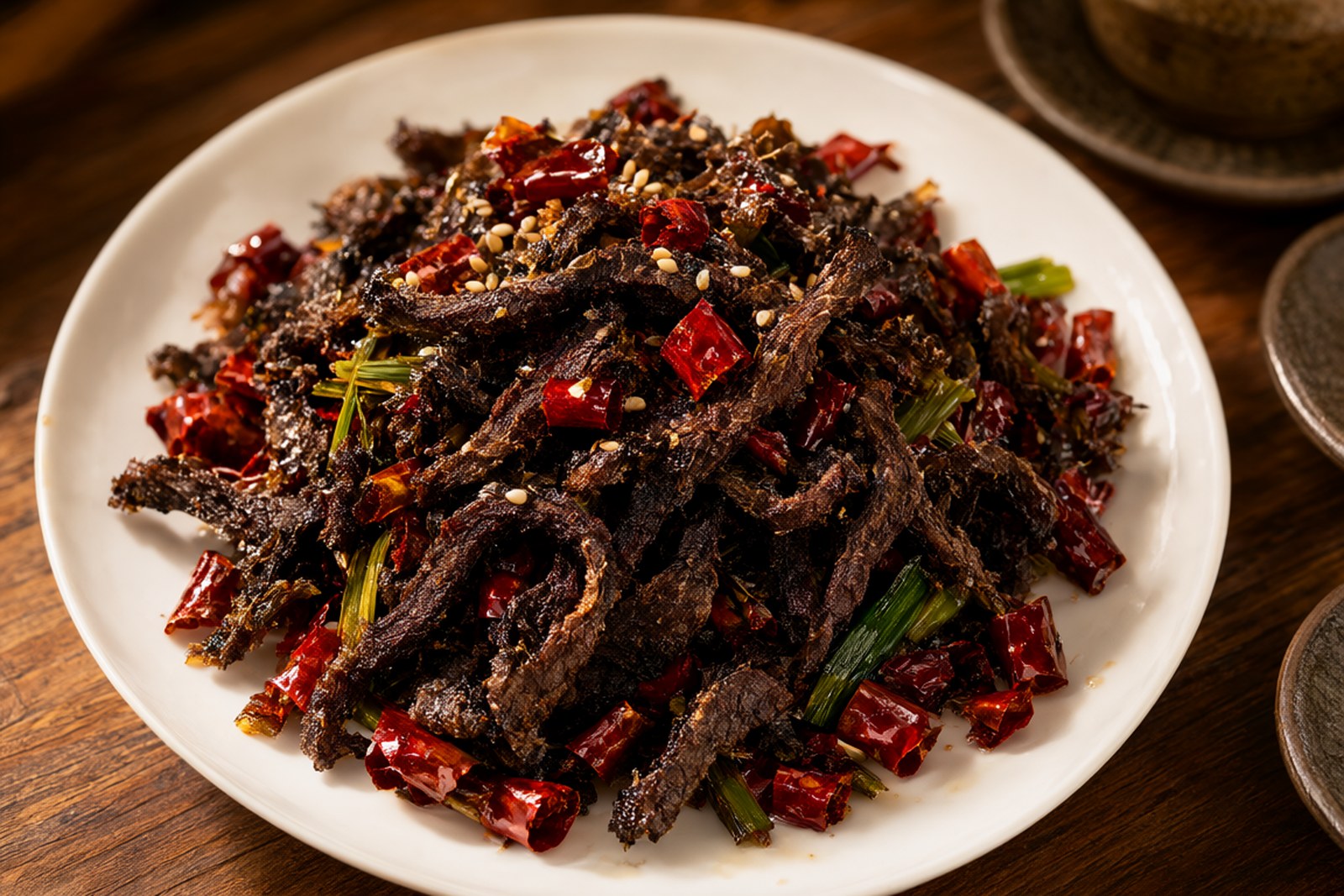
The beef comes to the table nearly black and slightly chewy, and it tastes of the mountain it was raised on. 新晃黄牛肉 Xīnhuǎng huángniúròu is the meat of a small local yellow ox, and the way most people meet it is 小炒黄牛肉 xiǎochǎo huángniúròu: slices marinated briefly and thrown into a very hot wok with 小米辣 xiǎomǐlà, 泡椒 pàijiāo, garlic and a fat spoonful of lard, out again in under two minutes. What comes off is tender in the middle, charred at the edge, sour-hot, and gone from the plate faster than anything else on the table.
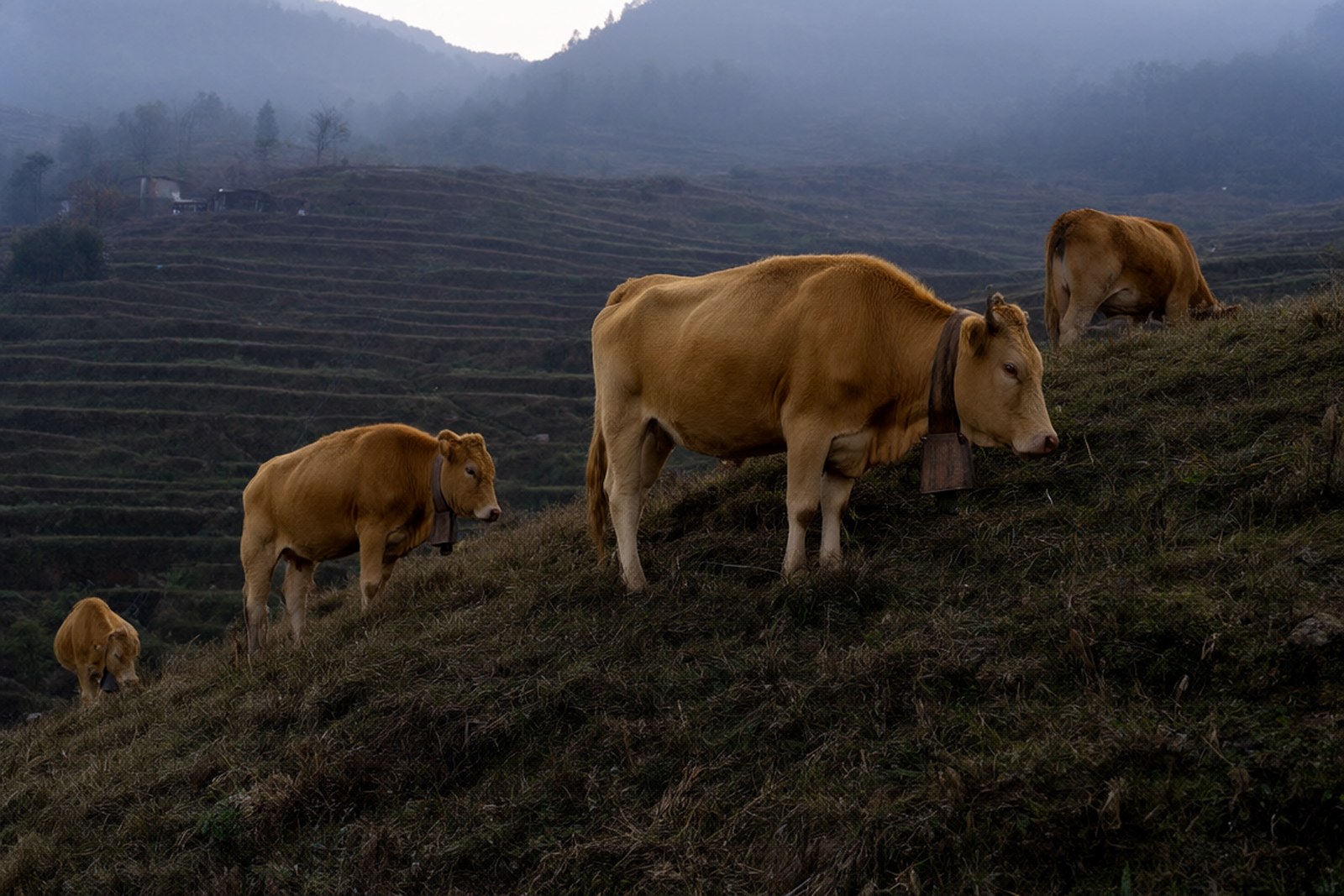
新晃 Xīnhuǎng is a Dong county at the far west edge of Hunan, on the old road into Guizhou, in the country that the Han called 夜郎 Yèláng — the kingdom of the proverb about not knowing your own size. Cattle have been kept here for a very long time; the 晃州厅志 Huàngzhōu Tīngzhì, the Qing gazetteer, records that in the Song, around 990, the local chieftain 田汉权 Tián Hànquán sent dried beef to the imperial court, and that the emperor 宋太宗 Sòng Tàizōng liked it enough to summon him and give him gifts. In 2010 the breed was registered as a national geographical indication, and the county now calls itself 中国夜郎黄牛之乡 Zhōngguó Yèláng Huángniú zhī xiāng, the Yelang cattle country.
What Makes It Work
新晃黄牛 Xīnhuǎng huángniú is a small animal — a short body, a strong neck, shoulders built for climbing — and that is the whole point. It walks up and down hills all day eating grass and, by local account, medicinal herbs, and the meat comes out with a denser fibre, more flavour and far less fat than a feedlot animal’s. The county’s own description of the difference is that the cattle drink mineral spring water, eat herbage, and listen to Dong singing; the last part is marketing but the first two are not.
The cut matters most for the stir-fry. The haunch, 臀部瘦肉, has the fine grain that responds to a fast fry; the meat is sliced across the grain, marinated for ten minutes in 生抽 shēngchōu, 蚝油 háoyóu and a little starch, and cooked in a mixture of 猪油 zhūyóu — lard, which is not optional in this kitchen — and vegetable oil. The chillies go first: 线椒 xiànjiāo for fragrance, 小米辣 xiǎomǐlà for heat, 泡椒 pàijiāo for the sour note that makes the whole thing work. The beef goes in last and stays in the wok for about ninety seconds. A minute longer and it is shoe leather.
The other version to know is 带皮黄牛肉 dài pí huángniúròu, beef cooked with the skin on — skin that comes off a young animal at eighteen months to two years is translucent and, after a long stew, gelatinous in the same way a trotter is. It is used for hotpot and for 干锅 gānguō, the dry pot, and it is the county’s winter food.
Words and Names
黄牛 huángniú is simply “yellow cattle”, the general Chinese name for the zebu-influenced local breeds of the south, as opposed to 水牛 shuǐniú, the water buffalo that works the paddies, and 牦牛 máoniú of the plateau. 侗族 Dòngzú, the Dong, are the majority here, and their 大歌 dàgē — the great song, sung without a conductor or accompaniment in two and sometimes more parts — is on the UNESCO intangible heritage list. 夜郎 Yèláng gives the Chinese language its best-known warning about provincial self-importance, 夜郎自大 Yèláng zìdà, and the county wears it without irony, because the beef is genuinely good.
What the Locals Know
If you can, try the 带皮 version once. Boiled with skin and dipped in chilli, it is the dish locals eat at New Year and it is unlike any other beef in China.
Buy 牛肉干 niúròugān to take away. The county dries beef over charcoal for two days until it loses two-thirds of its weight, and takes it to a chewing texture like nothing else; the packaged versions sold at the station are the same product with more salt.
Ask for 少油 if you are not used to it. The classic version is deliberately oily, on the theory that the fat is where the chilli dissolves.
Do not order it mild. The sour-hot balance is structural; without the chilli you are eating plain beef and paying for the name.
Where to Eat It
A plate of stir-fried beef runs ¥48–78; a hotpot or dry pot for two ¥120–180. The county town, 晃州镇 Huàngzhōu Zhèn, is small and the restaurants around the market and the bus station are the reliable ones. 新晃西站 Xīnhuǎng Xī Zhàn on the 沪昆 high-speed line is a short taxi ride from the centre, about an hour and a half from 长沙南 Chángshā Nán.
flowcloud would say that the most interesting thing about this beef is that a Song emperor once thought it worth a summons, and a thousand years later it is still raised by people who walk cattle up a hill for a living — that is a supply chain held together by a landscape rather than a brand.
Where to find it: 新晃黄牛肉 (Xīnhuǎng huángniúròu), 新晃侗族自治县 (Xīnhuǎng Dòngzú Zìzhìxiàn), 怀化市 (Huáihuàshì), 湖南 (Húnán). Best in the county town, 晃州镇 (Huàngzhōu Zhèn). Stir-fried beef ¥48–78, dry pot for two ¥120–180. Ask for the 带皮 version if the season is right, buy charcoal-dried 牛肉干 to take home, and do not ask them to make it mild.