
话梅 huà méi is the salted, dried, sweetened plum that Chinese households keep in a jar beside the door and eat one at a time, and the county that makes most of it is 新兴县 Xīn xīng xiàn, in the east of 云浮市 Yún fú shì. The name is a description and not a fruit: 话 huà here means the talk that follows a mouthful, the sourness that makes a face and starts a conversation, and 梅 méi is the plum, the small green 青梅 qīng méi of the 清明 Qīng míng season and not the sweet dessert plum of the West. The fresh fruit is hard, green and sour enough to be unpleasant on its own, and 话梅 is what happens to it over about four months of work: it is salted for three months until it is a 梅胚 méi pēi, a plum embryo, then dried, then piled to ferment, then dried again until it wears a white bloom of salt and sugar on its skin, then desalted in water, then steeped in a liquor built around 甘草 gān cǎo, liquorice root, and dried again. What comes out is dark amber, wrinkled, chewy, savoury at the front and sweet at the back with a long sour tail, and it is eaten as a snack, used to settle the stomach, dropped into tea, and put into the sort of drinks that Chinese pharmacies sell for a cough. It is one of the few foods in this part of the country with a genuine global footprint: the county’s own chamber of commerce for the trade reckons that around 80 per cent of the preserved plums sold anywhere in the world come from 新兴, which is both an extraordinary claim and, given the county’s numbers for planted area and processing volume, not an entirely unreasonable one.
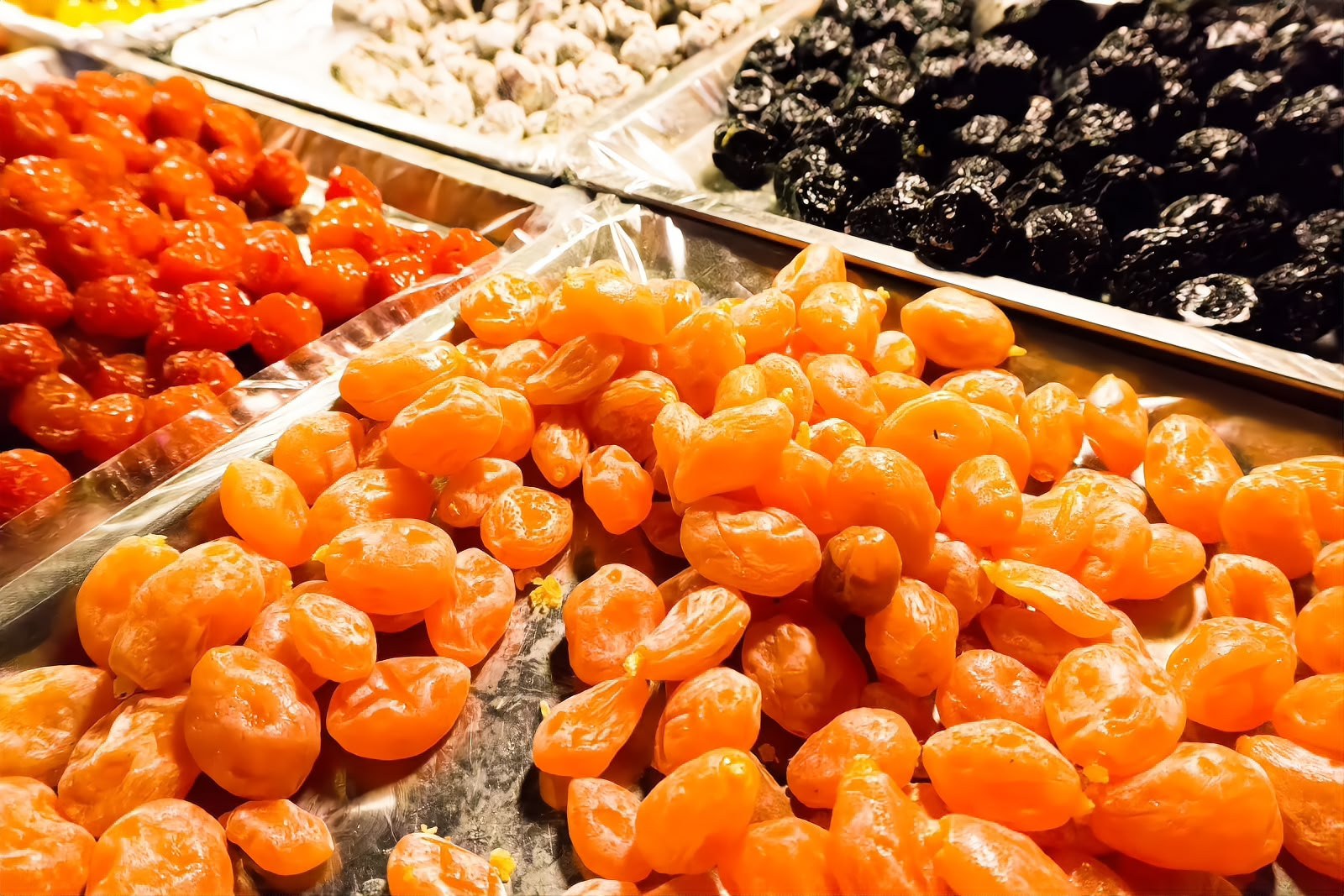
The business of preserving fruit in this valley is old, and the county dates it deliberately. The 中国果品加工之乡 Zhōng guó guǒ pǐn jiā gōng zhī xiāng, the home of fruit processing in China, was conferred on 新兴县 in 2003 by the national body that promotes and publicises the speciality towns of China, and the industry’s own history is given as more than 130 years, 已有 130 多年, with the county’s newspaper putting the start of the craft in the 1860s, 自 19 世纪 60 年代起 zì shí jiǔ shì jì liù shí nián dài qǐ, when the technique is said to have taken root in the town. The date the industry actually modernised is exact and it is 1964, when production was put on a scale, 实现规模化生产 shí xiàn guī mó huà shēng chǎn, and the county’s own summaries of the sector are built around the six decades since. That combination – a hand craft with a century and a half behind it and a factory system sixty years old – is the shape of a great many Cantonese food trades, and 新兴 is a particularly clean example. What made this valley the place for it was not the plum alone but the miscellany of fruit that will grow there. The county calls itself the largest base in the country for the growing and processing of 杂果 zá guǒ, the mixed fruits – plum, 黄皮 huáng pí wampee, 杨桃 yáng táo starfruit, 芒果 máng guǒ, 橄榄 gǎn lǎn, 仁面 rén miàn, 山楂 shān zhā – and a salted-and-dried method that works on a sour green plum works on all of them, which is why a county that is famous for one preserve is actually famous for three hundred.
The specification for a genuine 新兴话梅 is published in the geographical-indication standard and it is unusually detailed, which makes it possible to say precisely how the fruit is made. The varieties it names are 新白梅 Xīn bái méi, 罗岗梅 Luó gǎng méi and 大青梅 Dà qīng méi. They are grown on red, yellow-red and lateritic soils, at a pH between 5.5 and 6.5, on ground where the soil layer is at least a metre deep and the organic content at least 1.5 per cent. The fruit is picked between the beginning of April and the second half of May, 每年 4 月上旬至 5 月下旬 měi nián sì yuè shàng xún zhì wǔ yuè xià xún, at a diameter of at least 2.8 centimetres, at 7 to 8 parts ripe, which is a colour described as green with yellow in it, 色泽绿中带黄 sè zé lǜ zhōng dài huáng. And there is one clock rule that governs the whole trade: the plums have to be processed within five hours of being picked. That single sentence explains a great deal about why this industry sits where it sits. A 话梅 factory in 新兴 is not buying fruit on a global market; it is standing next to an orchard, and the five-hour window means the orchard and the salt pit have to be within a morning’s drive of each other.
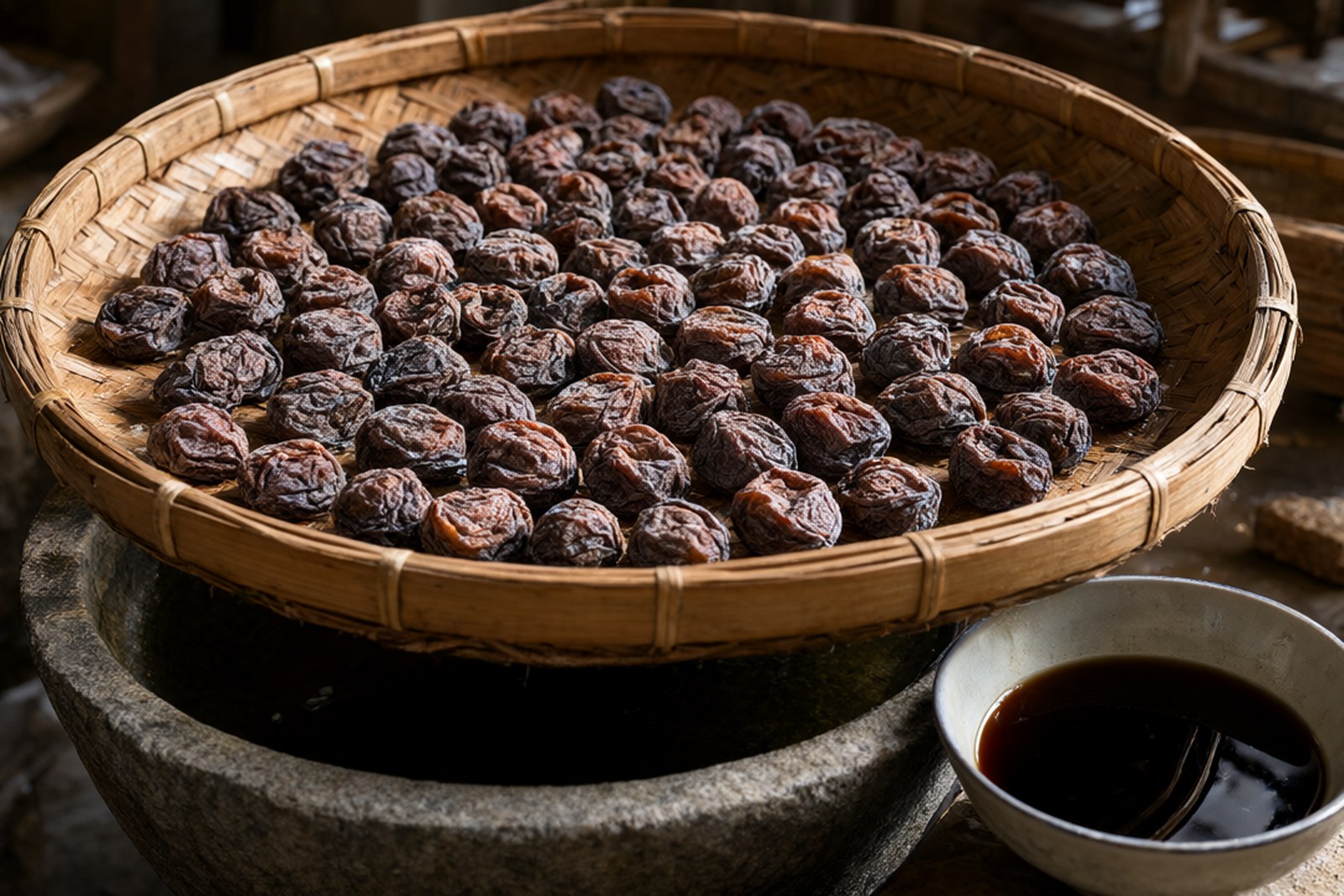
The sequence itself is long enough to be worth following, because it is the reason a good 话梅 tastes of anything at all. The fruit is sorted and 盐腌制 yán yān zhì, salted, with fresh fruit and salt at a hundred to twenty-three or twenty-five by weight – roughly a quarter of the weight of the fruit in salt – and it stays in that salt for at least ninety days, 腌制 ≥90 天 yān zhì jiǔ shí tiān, until the fruit has gone brown and is a 梅胚 méi pēi. It is dried in the sun until the moisture is 13 to 15 per cent. Then it is heaped to ferment for 15 to 30 days, 堆放发酵 duī fàng fā jiào, and dried again until a white frost shows on the surface and the moisture is 10 per cent or below. Now it is 漂水脱盐 piāo shuǐ tuō yán, floated in water to bring the salt down, to a final salinity of 4 to 6 per cent, which is the step that decides whether the finished plum is a salt lick or a fruit. It is dried once more, and then it goes into the 配料调味 pèi liào tiáo wèi, the seasoning liquor, which in the Cantonese trade means a decoction built on liquorice root with other spices, and it soaks in that for at least 24 hours, 浸渍 ≥24 小时 jìn zì èr shí sì xiǎo shí. Then there is another drying to a moisture between 27 and 33 per cent, a 回潮 huí cháo – a resting period in which the plum takes up moisture again from the air until the skin shows bloom – a final drying to between 15 and 20 per cent, and finally the hand work: 修整筛选 xiū zhěng shāi xuǎn, trimming and sorting, and packing. Count the days and the months and the point of the product becomes clear. This is not a pickle made in an afternoon. It is fruit that has been pulled back and forth between salt, water, sun and spice for the better part of a season, and the reason it keeps for years in a jar is that almost nothing in it is fresh any more.
The Industry and the Numbers
The scale of the 新兴 trade is the part of the story that surprises people, and every figure should be read with its year. The county’s raw material plantings run to about 160,000 亩 mǔ under fruit for processing, with a total crop of close on 260,000 tonnes; the county’s fruit-processing capacity is put at more than 600,000 tonnes a year, which is a larger number because much of what is processed comes in from outside the county; and the industry’s combined output value is cited in excess of seven billion yuan, 综合产值超 70 亿元 zōng hé chǎn zhí chāo qī shí yì yuán. Within that the plum is the flagship: the county makes about 80,000 tonnes of 话梅 a year, worth three billion yuan, and the 青梅 qīng méi orchards of the county itself cover 34,821 亩 with an annual crop of 68,699 tonnes. The trade is carried on by more than fifty processing enterprises, forty of which belong to the county’s 凉果行业商会 Liáng guǒ háng yè shāng huì, the preserved-fruit chamber of commerce, whose members between them process around 600,000 tonnes of agricultural produce a year; the county’s own parallel count puts the number of 规模以上 guī mó yǐ shàng enterprises, those above the official size threshold, at forty-two, with forty-six preserved-fruit firms. Between the orchards, the pits, the dryers, the packers and the transport, the industry is credited with supporting more than 50,000 people up and down the chain, in a county of about half a million. The range of what comes out of those factories is the other surprise: the county lists more than three hundred products across four families – 凉果类 liáng guǒ lèi, the preserved fruits proper; 糕片类 gāo piàn lèi, the fruit leathers and sheets; 蜜饯果脯类 mì jiàn guǒ pǔ lèi, candied and dried fruit; and 腌制即食类 yān zhì jí shí lèi, the salt-pickled ready-to-eat things – and where the county needs a shorter line for a foreign buyer it says four flavour families, sour, sweet, savoury and salty, and a hundred-odd products. The newer lines are worth naming because they show where the trade is going: 青梅丹 qīng méi dān, a plum lozenge; 话梅饼 huà méi bǐng, a pressed plum cake; 青梅酒 qīng méi jiǔ, a green-plum wine; 竹盐黄皮 zhú yán huáng pí, wampee cured with bamboo salt; and 杨桃干 yáng táo gān, dried starfruit.
The legal top of the pile arrived on 24 December 2014, when the national quality inspection administration granted geographical-indication protection to the name 新兴话梅 under announcement 139 of that year. One source in circulation gives 2015 for this and the official announcement number settles it at 2014, which is the date used here. 新兴县 now holds four national geographical-indication products, of which the plum and 新兴排米粉 Xīn xīng pái mǐ fěn, the county’s dried rice noodle, are the best known. The plum’s technique also sits on the Guangdong provincial intangible-heritage list, and the county is one of the national demonstrations for agricultural modernisation, with eight national and provincial modern agriculture parks and twenty-five 粤港澳大湾区「菜篮子」基地 Yuè gǎng ào dà wān qū cài lán zi jī dì, Greater Bay Area vegetable-basket bases, supplying the cities to its east. The exports go to Japan, to Europe and North America, to Malaysia, Thailand and New Zealand. On the domestic side the products are in Walmart and RT-Mart and in the thousands of supermarkets below them, and online they are on Douyin, Tmall and Pinduoduo, where a snack that costs a few yuan and keeps for two years is exactly the shape of a product that sells.
Words and Names
话梅 huà méi is the preserved plum, and the first character is about the conversation the sourness provokes rather than about the fruit; 青梅 qīng méi is the raw green plum it is made from and 梅胚 méi pēi, plum embryo, is what the fruit is called after its ninety days in salt. 盐腌制 yán yān zhì is the salting, 漂水脱盐 piāo shuǐ tuō yán the desalting and 配料调味 pèi liào tiáo wèi the liquorice-seasoning step; 回潮 huí cháo is the resting period in which the finished plum takes up moisture and blooms. 甘草 gān cǎo is liquorice root, the spine of the seasoning, and 凉果 liáng guǒ, cool fruit, is the Cantonese trade’s word for the whole family of preserved fruits. 杂果 zá guǒ, mixed fruits, is what the county grows, 中国果品加工之乡 Zhōng guó guǒ pǐn jiā gōng zhī xiāng is its 2003 title, and 新兴排米粉 Xīn xīng pái mǐ fěn is the county’s other geographical-indication food.
What the Locals Know
Buy by the look of the bloom and the feel of the flesh. A good 话梅 has a fine white haze of dried salt and sugar on a dark amber skin, wrinkles that run along the fruit rather than across it, and a firm, slightly tacky surface with no stickiness; a plum that is glossy and wet-looking has been over-dried then re-wetted badly, and one that is pale and dry all the way through was never steeped long enough. Squeeze one: it should give slightly and hold its shape, not crunch and not collapse. The taste to check for is the balance – salt first, then the sourness, then the liquorice sweetness coming up behind, with the fruit’s own flavour still identifiable in the middle. A cheap 话梅 tastes only of salt and sugar and has no fruit left in it. In the mouth the pit is a fact of life and the good brands have small ones; the flesh should come away from it in a single piece rather than shredding. The uses beyond eating them out of the bag are worth knowing, because a jar of these in a kitchen earns its place: two or three steeped in hot water make the sour plum drink sold all over China as 酸梅汤 suān méi tāng if you add a little sugar; one put in a pot of braised pork does the job a bay leaf does in a European stew; and the traditional household use is for a queasy stomach, for travel sickness and after a rich meal, which is where the fruit started. Buy them loose from a market stall if you can, because the loose ones let you taste before committing, and buy a mixed bag to find the register you like – some houses make them saltier, some sweeter, some far more sour. They keep almost indefinitely in a sealed jar in a cupboard and they do not need a fridge. If you are in the county in April or early May, the orchards are worth a look for a reason that has nothing to do with the finished product: the plum is picked green, at the point when it is at its sourest, and seeing what goes into the pit is the fastest way to understand why the process takes four months.
flowcloud would say that the most interesting thing about 新兴话梅 is that a county turned the sourest fruit of its own spring into a four-month process of salt, sun and liquorice, and then sold so much of it that most of the world’s supply of a Chinese snack comes from one valley in western Guangdong.
Where to find it: the processing plants and the fruit markets of 新兴县 Xīn xīng xiàn, whose factories are concentrated around 新城镇 Xīn chéng zhèn and the industrial parks of the county; the county’s fruit markets during the plum season from April into May, and the shop shelves of every town in 云浮市 Yún fú shì. 新兴 is in the east of the prefecture, about forty minutes by road from 云浮市区 and a little over two hours from 广州 Guǎng zhōu, and is served by buses on the main corridor between the two; the county holds four national geographical-indication foods between them. Buy loose where you can and by the bloom and the smell, buy 新兴话梅 with the place name on the label rather than a generic 话梅 if the county’s version is what you are after, and carry a jar home rather than a bag, because these are a snack that lasts and there is no reason to hurry them.