
Xueba Ya (Xiangxi Blood Cake Duck)
It looks, frankly, like something that has been cooking since morning — and it has. A black clay bowl arrives at the table with the sauce still moving, dark red-brown and faintly glossy, and floating in it are pieces of duck on the bone and slabs of something dense and nearly black that you will not immediately recognise. If you are the sort of eater who needs to know what everything is before touching it, this is the moment to get over that. The first spoonful generally settles the question.
血粑鸭 (xuè bā yā) — blood cake duck — is the signature dish of 湘西 Xiāngxī, the mountainous western corner of Hunan that runs up towards Guizhou and Chongqing. It is not a banquet dish and it was never meant to be one. It is farmhouse food from a cold, wet, vertical landscape, and it tastes like it.
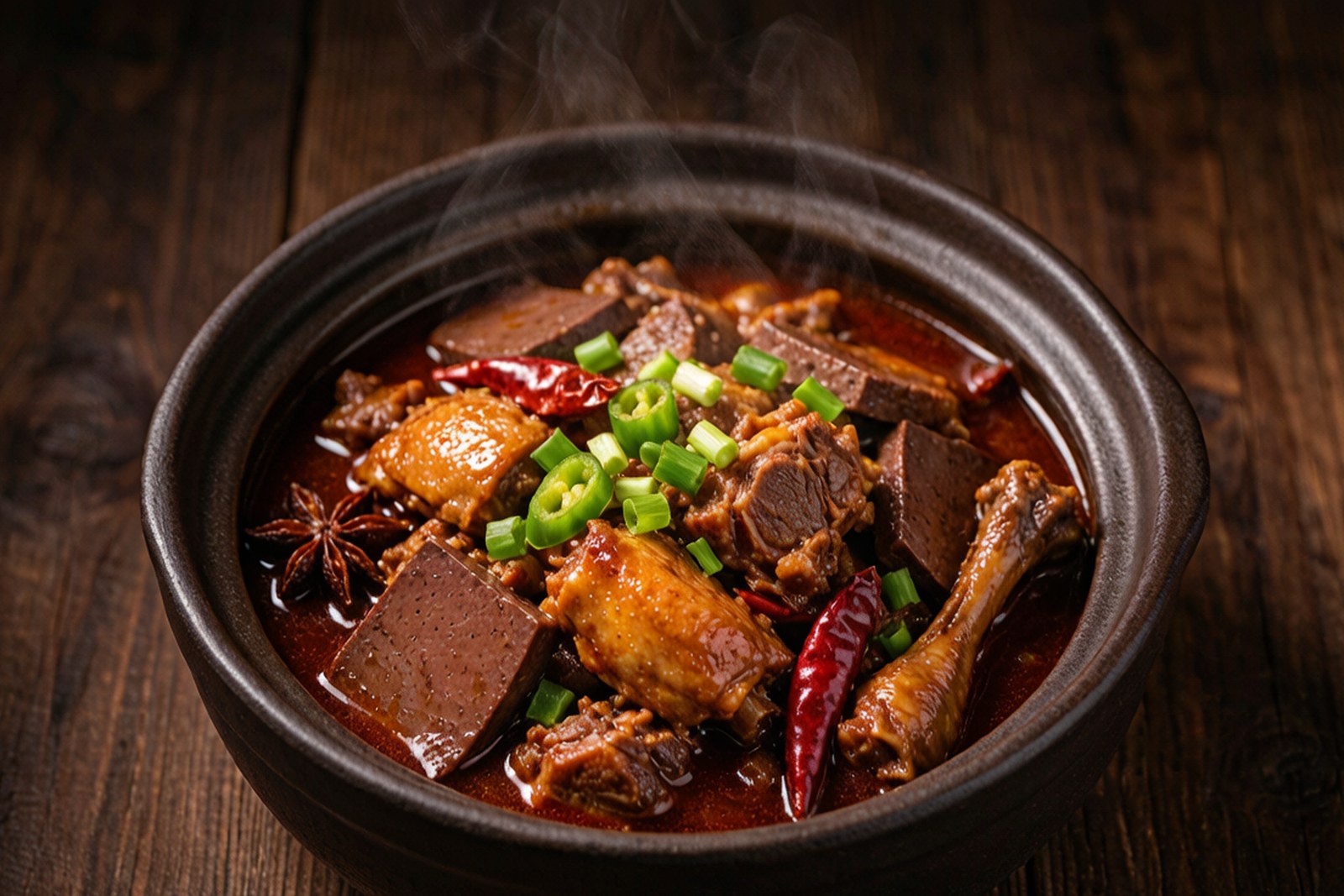
The Blood Cake
Everything hinges on 血粑 (xuè bā), and it is worth understanding before you eat it.
When a duck is killed for the pot — traditionally at home, in the yard — the blood is caught rather than discarded, and mixed while still warm with glutinous rice that has already been soaked and partly cooked. The mixture is pressed into a block and steamed until it sets into something dark, dense and slightly sticky, somewhere between a rice cake and a terrine. Then it is cut into thick slabs and fried in oil until the edges crisp and the inside goes soft and faintly sweet.
That frying step is the whole point. The blood cake is what gives the dish its texture — crisp outside, yielding within, soaking up the braising liquid like a sponge — and it is also the reason 血粑鸭 does not travel well. Made badly, or made from a block that was steamed and never fried, the dish collapses into a bowl of grey mush.
The Cooking
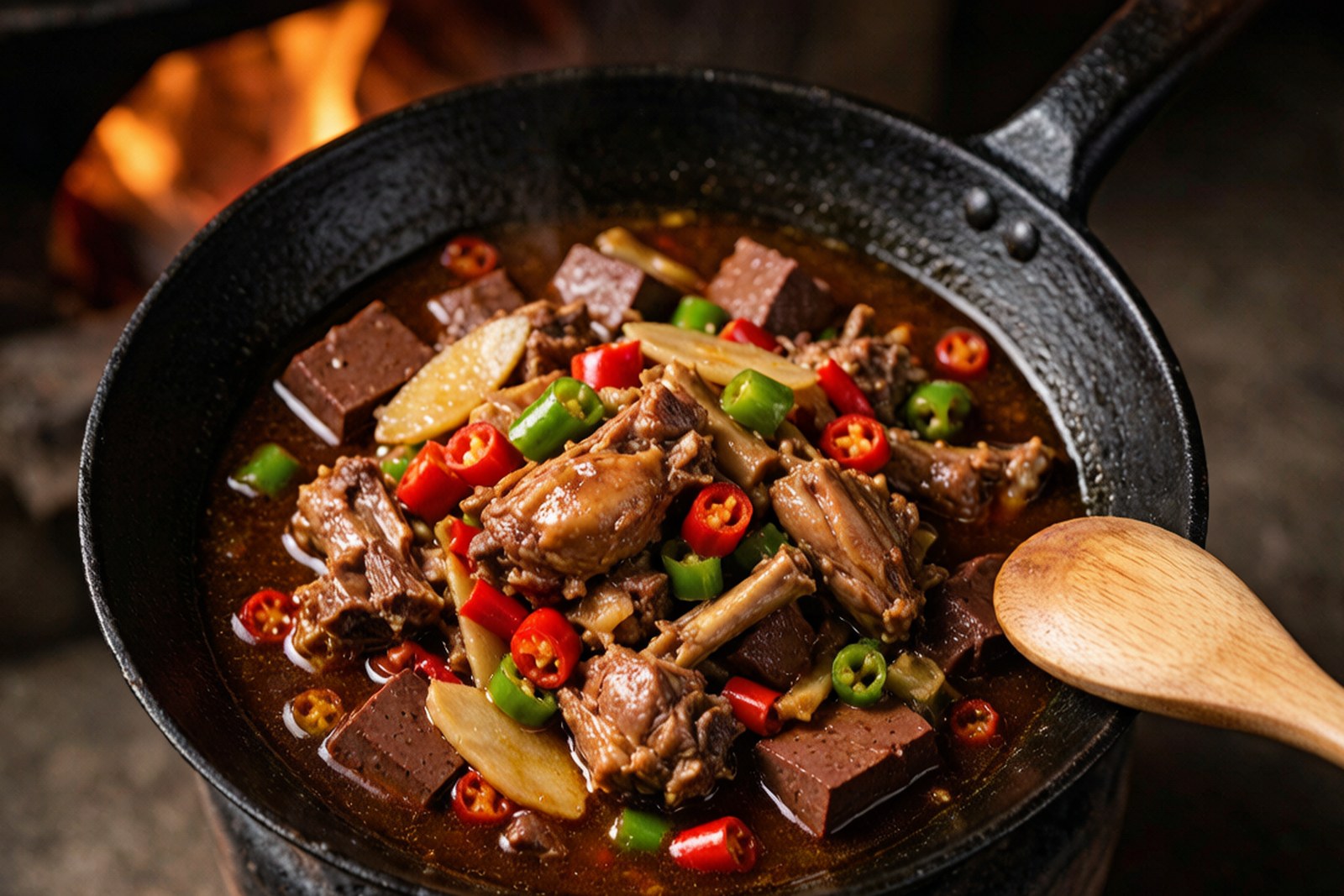
The duck comes first. A local bird — not a supermarket one — is chopped through the bone into pieces, browned hard in a wok with ginger and a serious quantity of dried red chilli until the skin renders and the edges catch. Then it is braised low and slow with 米酒 (mǐjiǔ, rice wine), soy, a little rock sugar, star anise, and enough water to cover, until the meat is falling off the bone and the liquid has reduced to a dark, clinging gravy.
Only at the end do the fried slabs of blood cake go in, and only for long enough to warm through and take on the sauce. Put them in early and they dissolve; that is the single most common way this dish is ruined.
The finish is fresh green chilli and scallion, scattered over the top for bite and colour. Xiangxi cooking does not do subtlety at the seasoning stage — it does balance. The heat, the salt, the wine and the faint iron richness of the blood cake are all pushing against each other, and when they are in proportion the dish is genuinely difficult to stop eating.
凤凰 Fènghuáng and the Reason It Tastes Like This
The dish is most closely associated with 凤凰 Fènghuáng, the riverside old town in western Hunan that has become the region’s most famous destination — and if you eat 血粑鸭 there, sitting at a wooden table above the Tuo River with the town lit up across the water, you will understand why it is not a delicate dish. This is food for a place that gets cold and damp for months, where the winter larder was whatever you could preserve, and where a duck was too valuable to waste any part of.
That is the honest context. 血粑鸭 is not an elegant demonstration of technique. It is a way of making sure nothing was thrown away, that came out tasting better than anything it had any right to.
Words and Names
血 xuè is “blood,” 粑 bā is a glutinous rice cake (the same character family as 糍粑 cíbā, the pounded rice cakes you will see everywhere in Hunan), and 鸭 yā is duck. So: blood-cake-duck. In some places you will see it written 血粑鸭, in others 血粑鸭子 (xuè bā yāzi) — the 子 is just a diminutive suffix and means the same thing.
The 粑 in the middle is worth memorising, because it appears all over Hunan in different forms and is almost always good.
What the Locals Know
Eat the blood cake first — it is the best thing in the bowl and it softens the longer it sits in the sauce.
Ask for it 现做 (xiàn zuò, made to order) if the menu allows — the frying step is what makes it, and it cannot be done in advance.
Order rice. This is not negotiable. The gravy demands it.
The bones are meant to be gnawed, and the bits near the joint are the prize.
It tastes better the next day — locals will tell you this without embarrassment, and they are right. The blood cake absorbs overnight and the whole thing deepens.
Do not order it if you have an early flight. It is rich, and it is best eaten slowly.
flowcloud would say that 血粑鸭 is what happens when a place decides that nothing gets thrown away — and then, out of sheer stubbornness, invents something better than the thing it was trying to save.
Where to find it: 血粑鸭 (xuè bā yā) belongs to 湘西 Xiāngxī in western Hunan, above all to 凤凰 Fènghuáng, the old town on the 沱江 Tuó Jiāng, where nearly every riverside restaurant keeps a version — a clay pot for two runs roughly ¥80 to ¥140 depending on the size of the bird. It is also standard in 吉首 Jíshǒu and in the 苗 Miao villages of the surrounding hills; the further you get from the tourist strip along the river, the better and cheaper it tends to be. In 长沙 Chángshā, look for it on the menus of the 湘西 restaurants (湘西菜馆) rather than the mainstream Hunan places, and expect to pay around ¥60 to ¥100. Order 米饭 (mǐfàn, steamed rice) with it, ask whether the 血粑 is fried to order, and do not plan anything demanding afterwards.