
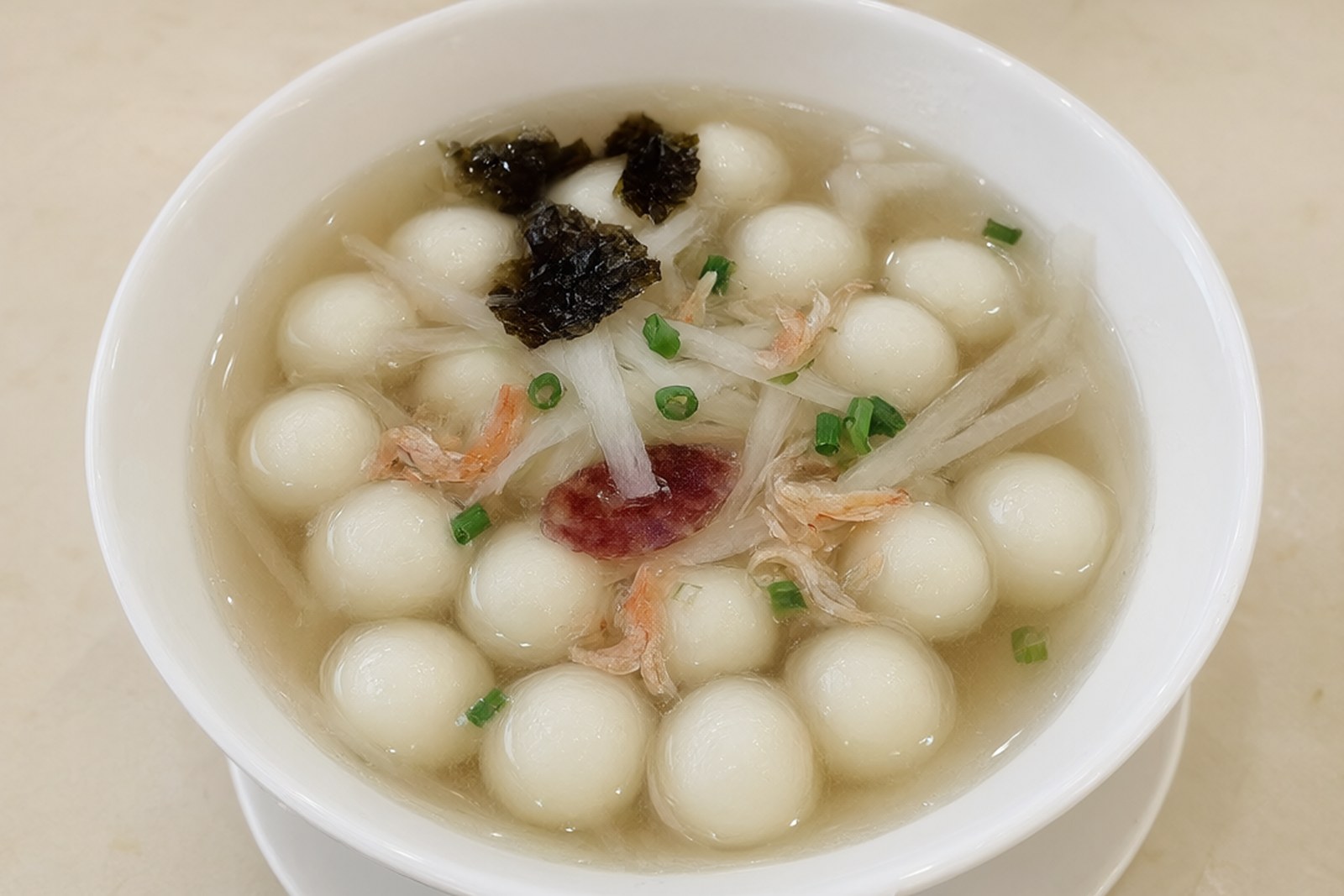
咸汤圆 xián tāng yuán is the savoury rice ball of 阳江 Yángjiāng, and it is the bowl the city eats as the year turns. Everyone in China knows 汤圆 tāng yuán, the round glutinous-rice dumpling of the 元宵 and Lantern festivals, and almost everywhere they are sweet – stuffed with sesame, peanut or red bean and floated in a sugary syrup. In 阳江 the same small rice ball is turned savoury. The balls are tiny, often no bigger than a marble, made with no filling at all, and they are dropped into a rich broth of pork, dried shrimp, white radish, 虾米 xiā mǐ, and often a little 紫菜 zǐ cài, seaweed, so what emerges is a bowl of soft, slippery, savoury dumplings swimming in a clear, deep soup.
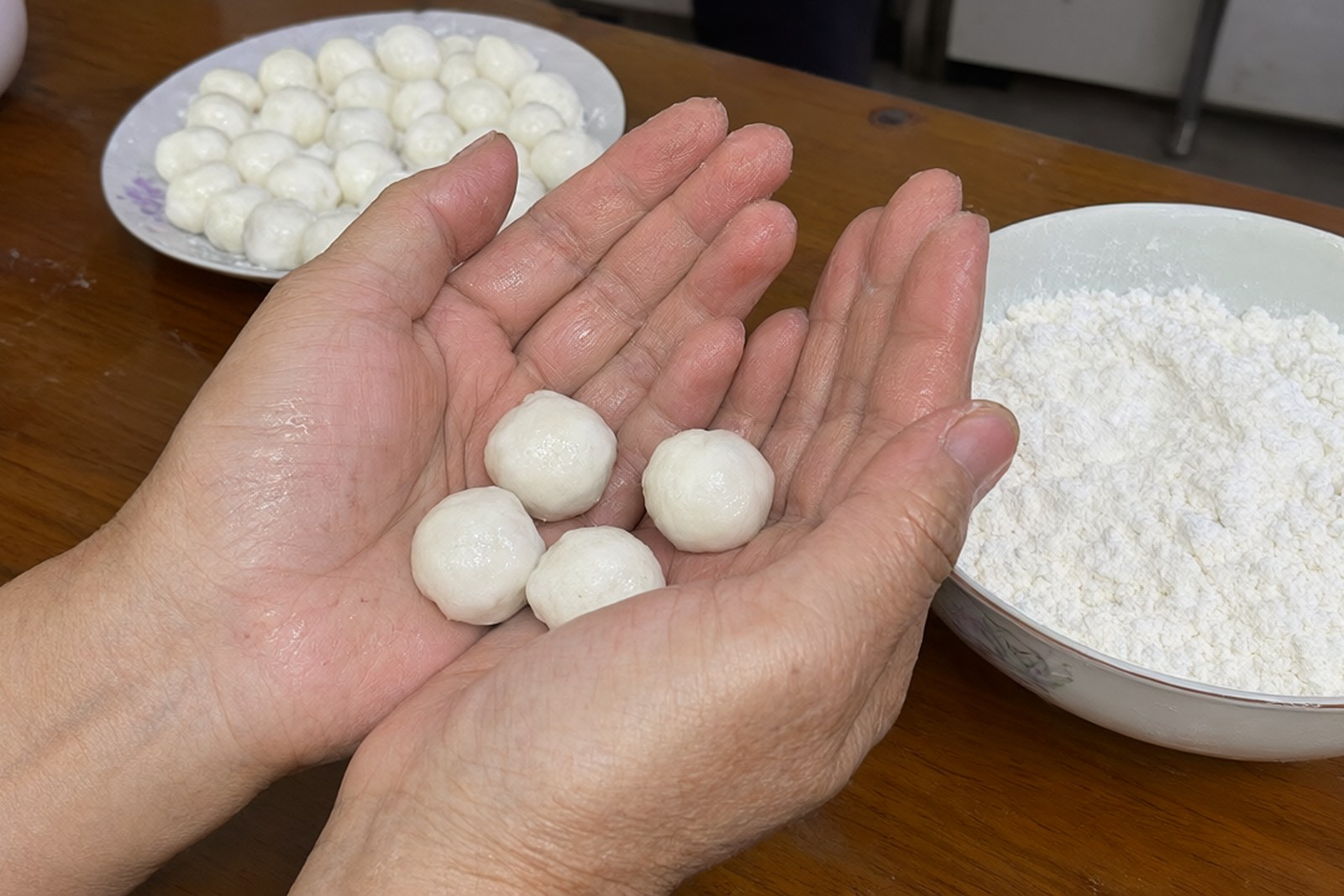
The work is in the making of the balls, and it is a task the whole family does together. Glutinous rice flour is mixed with just-boiled water, kneaded while warm, and then pinched off and rolled between the palms into the smallest balls the hands can manage; a family making 咸汤圆 for New Year will sit around a table doing this for an hour, a bowl of rice flour in the middle and a growing heap of white beads on a plate. Because the balls carry no filling, they take their flavour entirely from the broth, and that makes the broth the point. 排骨 pái gǔ, pork ribs, or a pork bone is simmered for an hour or more, and to it go 白萝卜 bái luó bo, white radish, 虾米 xiā mǐ, dried shrimp, 腊肠 là cháng, cured sausage, and sometimes a piece of 鲮鱼干 líng yú gān, dried fish, with white pepper and a little soy.
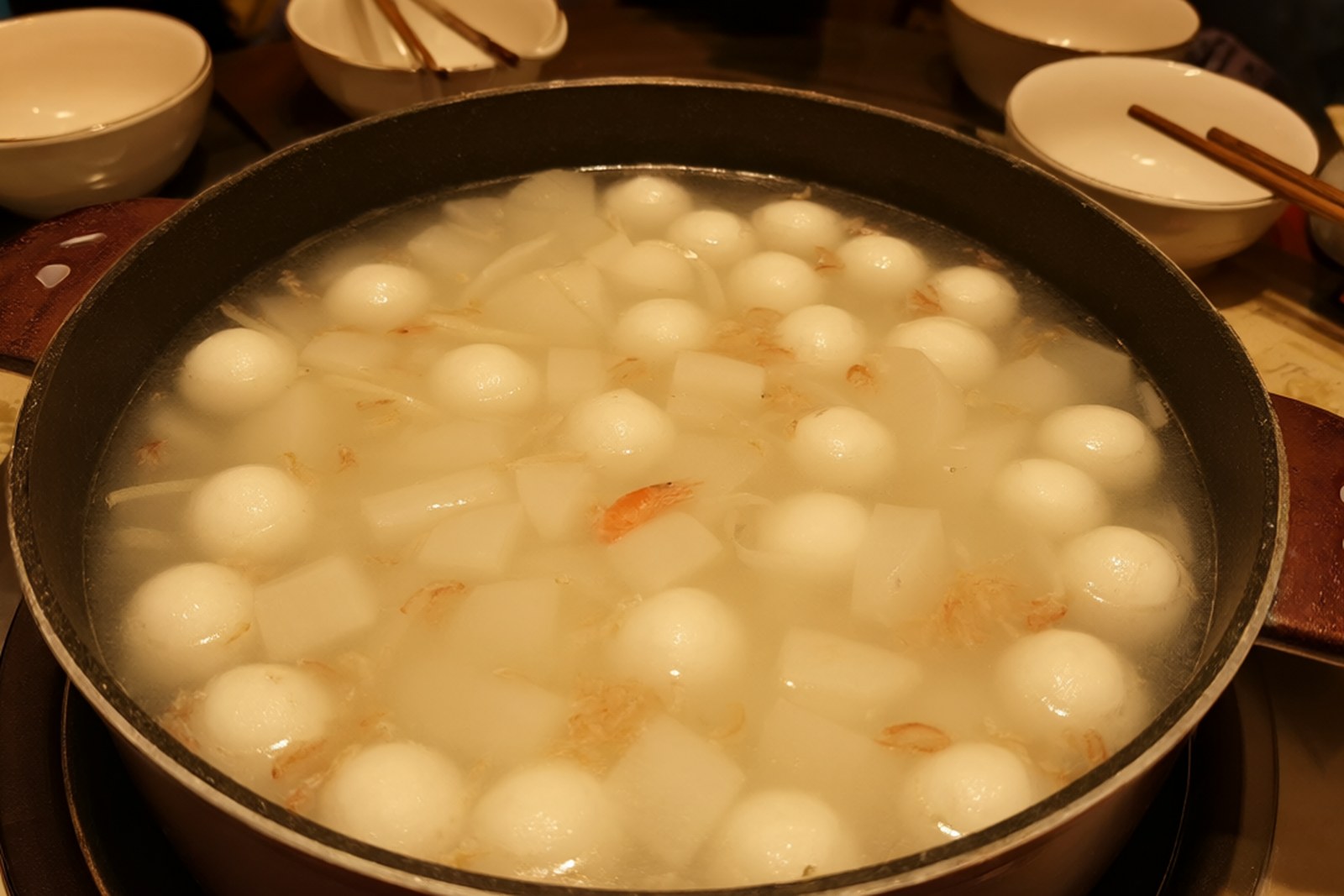
Making the bowl itself is quick once the broth is ready: the rice balls are slipped into the boiling soup and cooked for a few minutes, until they float and turn slightly translucent, and the pot is drawn off the heat and finished with 葱花 cōng huā, spring onion, and a few drops of sesame oil. What you eat is a soup of great depth and small, soft, faintly chewy beads, and it is served as the first meal of the New Year’s morning in many Yangjiang households, or as a warm supper on a cold night. It is the dish of the year’s turn, and it is eaten slowly.
What makes 咸汤圆 worth seeking out is that it is a genuine local divergence, not a variant of a national dish. A visitor from elsewhere in China expects 汤圆 to be sweet, and the Yangjiang version is a small shock: there is no sugar in it anywhere, only the savoury broth and its white radish, its shrimp, its dried fish and its cured sausage. Children in the city grow up being able to make the beads before they can reach the table, and the dish is tied so closely to 冬至 Dōng zhì, the winter solstice, and to New Year that eating it out of season feels slightly odd to a local. It is one of the most immediately likeable of the city’s foods, and one of the least known outside it.
Words and Names
咸 xián is salty or savoury and 汤圆 tāng yuán is the glutinous-rice ball, so 咸汤圆 xián tāng yuán is the savoury one, as against the sweet 甜汤圆 tián tāng yuán of the rest of China. 糯米粉 nuò mǐ fěn is glutinous rice flour and 糯米 nuò mǐ the rice itself. 排骨 pái gǔ is pork ribs, 白萝卜 bái luó bo white radish, 虾米 xiā mǐ dried shrimp, 腊肠 là cháng cured sausage and 紫菜 zǐ cài seaweed. 冬至 Dōng zhì is the winter solstice, the season the bowl belongs to, and 阳江 Yángjiāng the city.
What the Locals Know
The broth is the whole dish, so taste it for salt before the balls go in, because they cannot be salted afterwards without breaking. The balls should be small – a marble, not a ping-pong ball – and cooked only until they float; overcook them and they turn to paste. In a Yangjiang restaurant, order 咸汤圆 as a main rather than a dessert, because that is what it is. Around 冬至 and New Year the dish is everywhere, so it is easiest to find then; the rest of the year the family restaurants that keep it on the menu are the ones worth going to. And if you are offered the pot to finish, say yes.
flowcloud would say that a people who took the round rice ball, the sweetest and most sentimental food of the Chinese year, and quietly made it salty, has shown that the way a place eats is the way a place thinks, and that there is no dish so settled in a nation’s heart that a single city cannot decide to disagree.
Where to find it: the family restaurants and 汤圆 stalls of 阳江, and as a New Year and 冬至 dish in homes across the city; the older eating houses near the old town and the markets keep it on the menu through the year. A bowl is ¥10 to ¥25. 阳江 is a high-speed rail stop from 广州 and 深圳 in about two hours, at 阳江站 Yángjiāng zhàn.