
The tunnel under 杨家坪 Yángjiāpíng Yangjiaping smells of brown sugar and warm corn before it smells of anything else, and by eleven in the morning the queue at the third stall from the north entrance is already six deep. Chongqing is a municipality of southwest China, and 九龙坡区 Jiǔlóngpō Qū Jiulongpo is its south-west district, the industrial city on the Jialing’s south bank where the arsenal, the aluminium works and the two railways put their workshops. This page eats at one counter in that tunnel, on the district’s cold-sweet clock: a jelly no other shop in the city makes, set with glutinous rice and cornmeal together, eaten out of a paper bowl in a district where the summer answer is cold, sweet and eaten standing up.
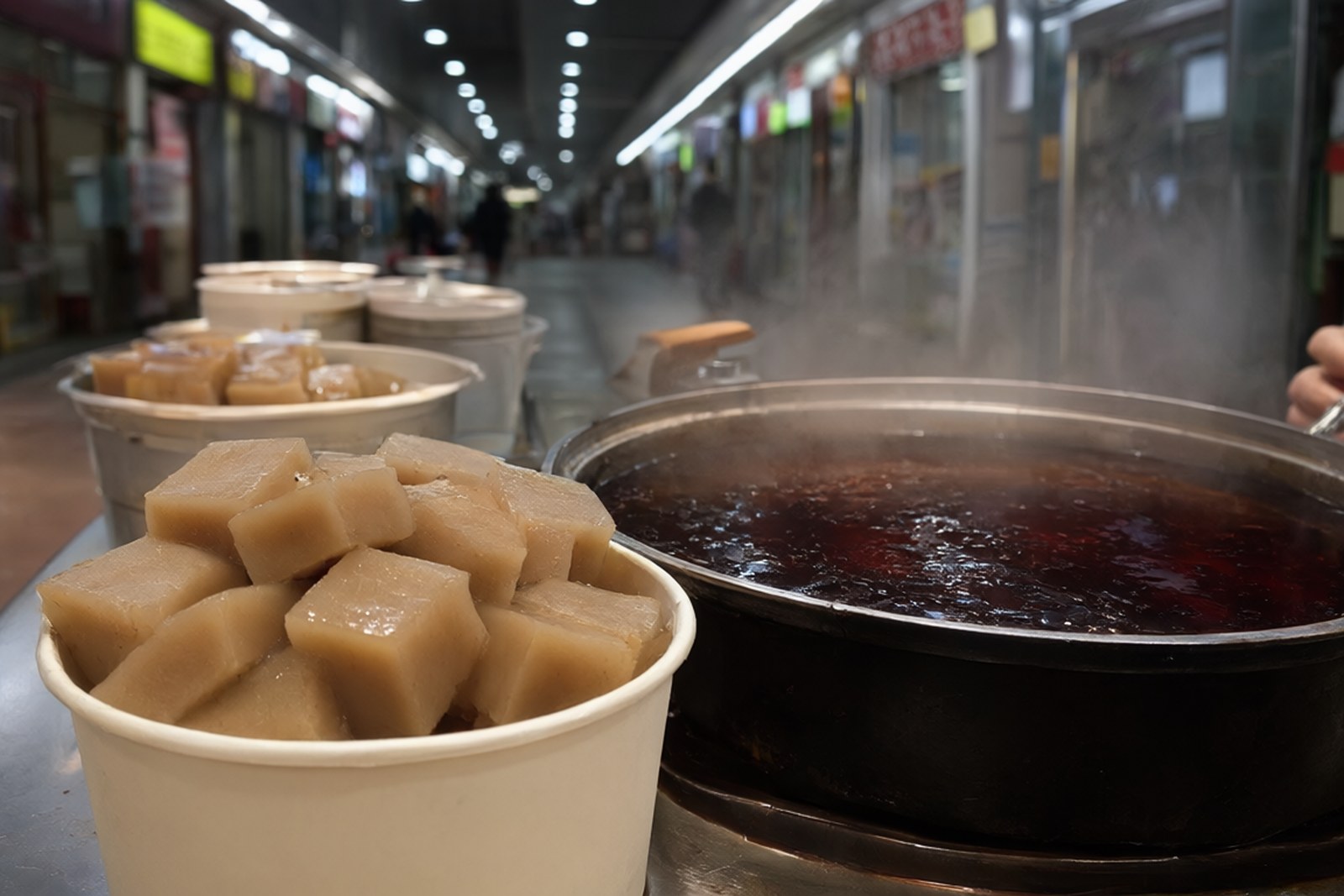
The tunnel came first. 杨家坪地下商场 Yángjiāpíng Dìxià Shāngchǎng the Yangjiaping underground shopping hall is one of the city’s earliest underground malls, laid out of a civil-defence scheme and finished in 1991 by the district’s own account; the tortoise pond at its centre, installed in 2000, has outlived every shopfront around it, which tells you what a Chongqing food crowd actually remembers about a place. Parts of the hall have closed and reopened. The queue at the jelly counter has not.
The counter is called 洞中香 Dòngzhōngxiāng, fragrance in the tunnel, and the name came the way most of the city’s counters got theirs: for free, from a passer-by. The couple who run it, 彭著强 Péng Zhùqiáng Peng Zhuqiang and 夏祖琼 Xià Zǔqióng Xia Zuqiong, worked the tunnels and the street edges for years with a hand-cart before they had a name at all; the story they tell is that a passer-by slowed, smelled something good in the underground passage and proposed the name, and they took it. When the mall’s management was asked, in 1996, to make room for them, every unit was let – so the management squeezed one out near the northwest gate, under eleven square metres, in the building’s smallest space. By the account of a 2018 retrospective the couple have traded in the same corner of the same tunnel ever since.
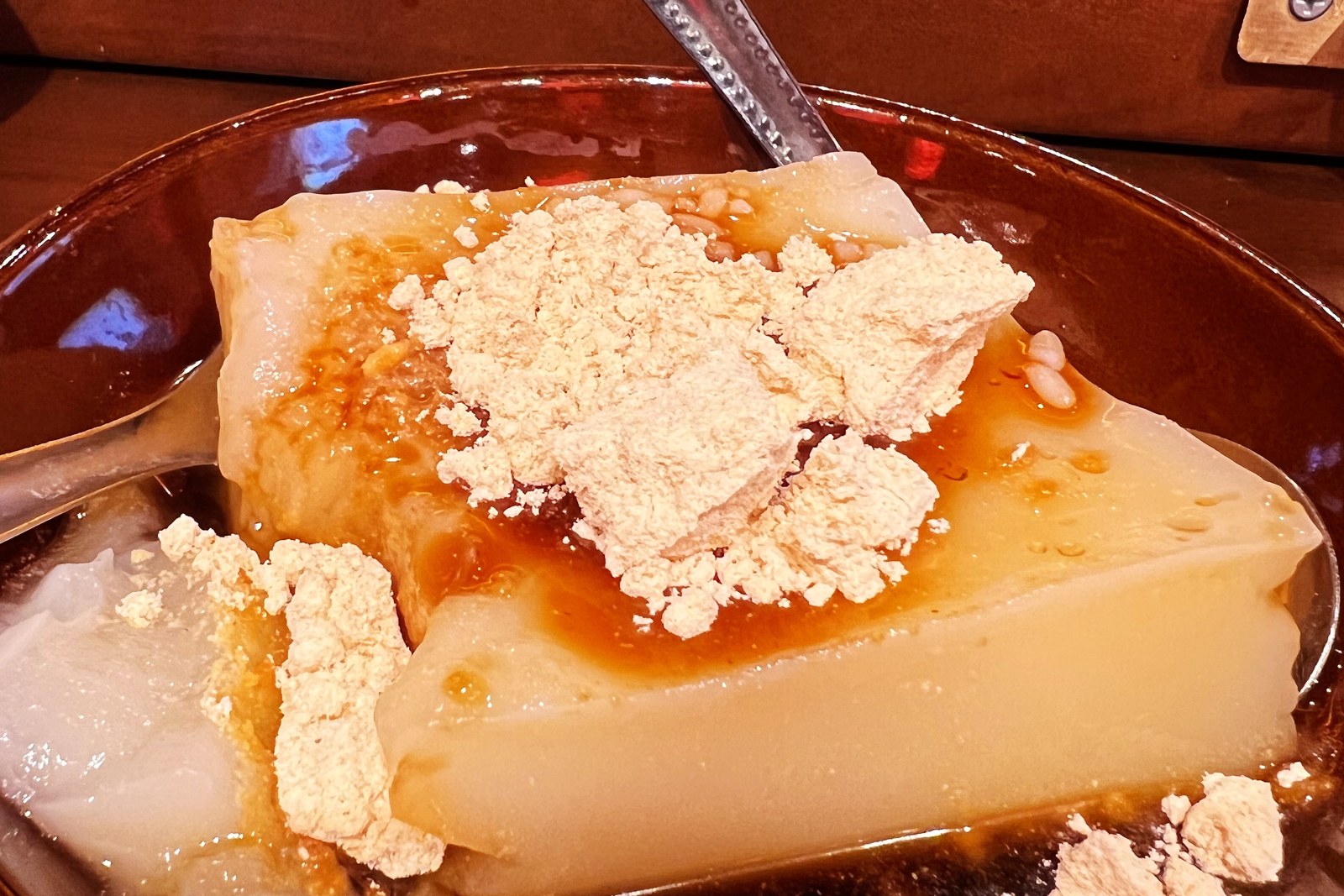
What the shop is known for is the thing the recipe took a month to get right. The owner worked on it at home for more than a month before it came out as it does now, in his own words many batches made and many poured away before it worked, and he is candid about the part that does not travel as a recipe: the making is an hour at the pan, standing, stirring, with real force and real timing, and the result is a callus on the cook’s hands. The ingredients are ordinary – glutinous rice and cornmeal – and that is the point. A rice-only lianggao comes out the pale opaque yellow the city is full of; set with cornmeal as well it comes out a pale brown, a plain watery tan rather than anything rich, and that colour is how you know which pot you are looking at. It is cut into blocks: firm cubes the size of a small dice, the density of jelly set hard rather than softly. The brown sugar syrup is deliberately not cloying – light, just sweet enough to carry, poured over at the counter and eaten cold.
The rest of the counter’s year runs on the same logic of cold things eaten quickly. 凉面 liángmiàn cold noodles, the dish the shop was already known for in the 1990s and which made it into the local papers before the jelly did, mixed with a house chilli paste whose fragrance arrives before the heat. 苕皮 sháopí wide sweet-potato starch sheets, cold in summer and hot in winter from the same pot. 冰粉 bīngfěn and 凉虾 liángxiā beside the jelly, the two coolers that finish the bowl. And dumplings and wontons boiled to order in the room’s own rice cookers, because there is no other kitchen. What needs this page is the jelly, because in this city the cornmeal version is not a variation. It is the only one of its kind the counter will admit to.
Words and Names
杨家坪 Yángjiāpíng Yangjiaping, the district’s old commercial heart on the west bank; 杨家坪地下商场 the Yangjiaping underground shopping hall, laid out of a civil-defence scheme and finished in 1991, with the tortoise pond installed in 2000. 洞中香 Dòngzhōngxiāng “fragrance in the tunnel”, the jelly counter’s name, given by a passer-by. 凉糕 liánggāo lianggao, the cold set jelly: here glutinous rice and cornmeal, pale brown rather than yellow, cut into blocks and drowned in brown sugar. 苞谷面 bàogǔmiàn cornmeal, the half of the recipe no other shop in the city will admit to. 凉面 liángmiàn cold noodles; 苕皮 sháopí wide sweet-potato starch sheets; 冰粉 bīngfěn ice jelly; 凉虾 liángxiā chilled rice-balls in syrup; 抄手 chāoshǒu wontons.
What the Locals Know
The knowing read the pot without talking to the owner. The colour tells you first: if the cubes went pale yellow, someone else made them, which in this district is a polite way of saying do not bother. The syrup tells you the second thing – if it is cloying, the sugar went in heavy and the jelly tastes flat behind it, and people dip rather than pour. The third is the eating itself: this is not a seated dessert but a bowl taken standing at the stall, four or five cubes, finished before the syrup has soaked to the bottom. Regulars order the jelly and then a cup of the cold rice-ball syrup as a chaser, and older residents take one home in a bowl to eat after dinner. And the queue behaves as a tunnel counter’s should: office workers from the buildings above are served first at the noon rush, the hour when a hand-cart could not have worked at all.
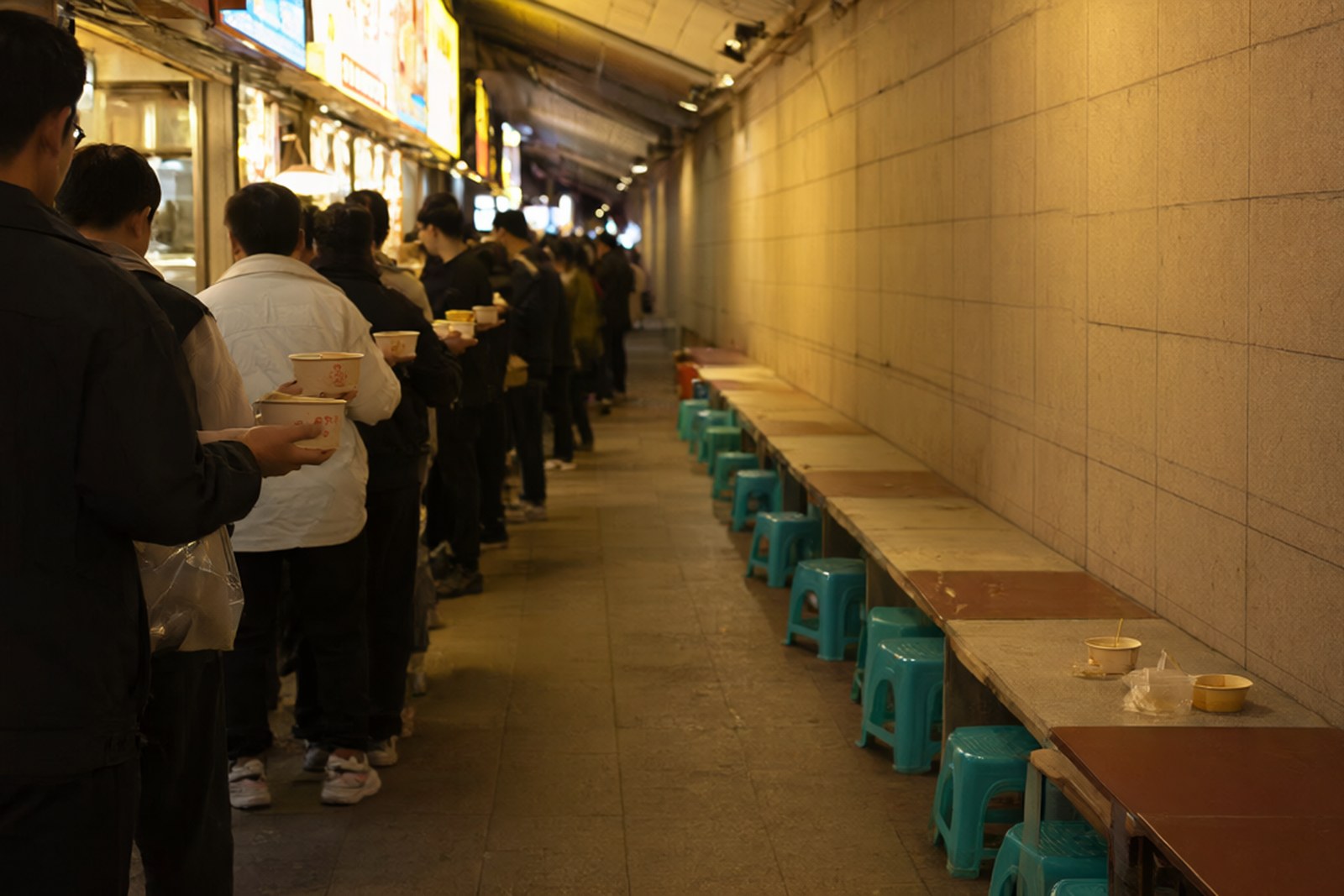
flowcloud would say that Yangjiaping’s 洞中香 is the cold-sweet counter that outlived the malls around it – a hand-cart in the tunnels that a passer-by named in passing, a stall under eleven square metres the mall management had to squeeze out near the northwest gate in 1996, and one recipe nobody else makes: glutinous rice set with cornmeal, so the jelly comes out a pale brown instead of the city’s usual yellow, cut into blocks like opaque jelly and drowned in brown sugar, after a month at home of batches made and poured away.
Where to find it: 洞中香 Dòngzhōngxiāng, the Yangjiaping underground shopping hall, 杨家坪街道 Yángjiāpíng Jiēdào Yangjiaping subdistrict, 九龙坡区 Jiǔlóngpō Qū Jiulongpo District, Chongqing Municipality – the third stall from the north entrance on the Yangjiaping side, near the northwest gate the 1996 stall was made out of. Metro line 2 to Yangjiaping station, then the walking street above the hall; the entrance opposite Yifang Bakery is the one most guides use. The counter is a walk-up stall with no seating and no English sign, and parts of the hall have closed and reopened, so go early in the day. No prices are quoted. The 1991 and 2000 dates are the hall’s own recorded history; the 1996 stall and the month of trial batches come from the owner’s account as carried in a 2018 retrospective.