
Yanjiang Hainanese Chicken Rice
The chicken arrives cold, and that is the first thing to understand about it. Not chilled — cold in the way that a thing is cold when it has been cooked, then plunged into ice water, then left to wait. The skin has gone tight and faintly translucent, the colour of pale ivory with a wash of yellow at the edges, and there is a thin jelly set between the skin and the meat that you will not notice until you put it in your mouth.
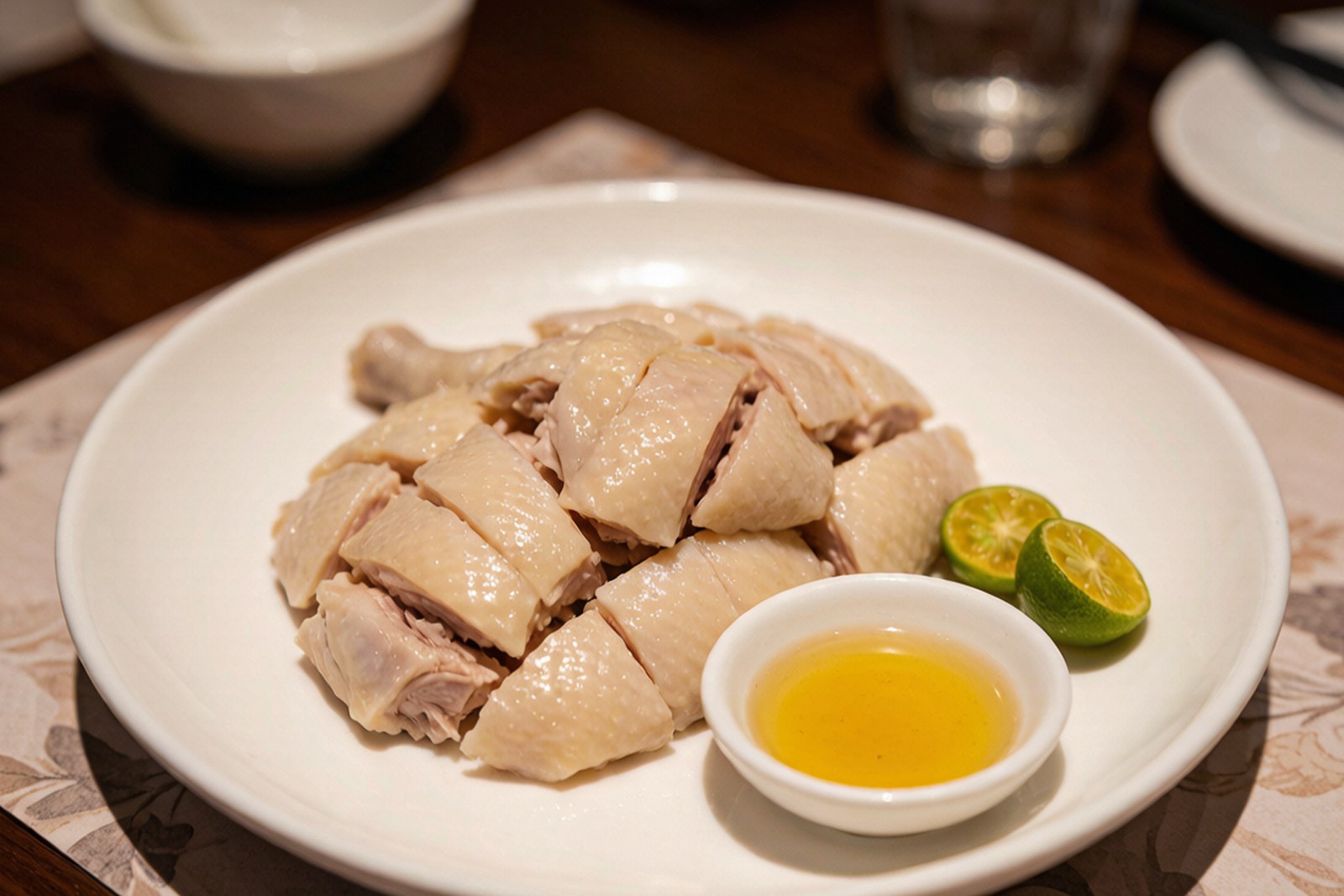
On the plate beside it: a small dish of dipping sauce, ginger and garlic pounded into oil, sharp with a squeeze of the little green calamansi limes they grow here. A bowl of rice that has been cooked in chicken fat, every grain separate and shining. And that is the whole meal. 文昌鸡 (Wenchang ji), Wenchang chicken — 海南四大名菜 (Hainan si da ming cai), the first of Hainan’s four famous dishes, served the way it has been served on this island for something close to a century.
There is a phrase in Hainan for what this dish means: 无鸡不成宴 (wu ji bu cheng yan). Without chicken there is no banquet. Nobody in this province says it as a joke.
A Brand Older Than the Province
The restaurant is on the third floor of a shopping plaza on 新风街 (Xinfeng Street), in the middle of Sanya, which is not where you would expect to find the oldest thing in Hainanese cooking. But the sign outside says 1936, and the sign is right, and it is worth unpacking, because the usual version of this story gets the dates wrong in both directions.
The lineage runs back to 1919, and to a man called 伍毓葵 (Wu Yukui) in 文昌 (Wenchang) county, who ran a chicken rice shop under his own name — 毓葵鸡饭店. 伍’s contribution was not a dish but a method: he worked out a particular way of choosing which birds were worth cooking and how to cook them, and in a county where every family fries chicken, that was enough to make him the reference point for the whole business. In the 1950s he passed the skills on to his daughter-in-law and then to his grandson’s wife.
That grandson’s wife is the hinge of this story. In 1982 the reforms opened up private business, and a man named 符国鑫 (Fu Guoxin) — who was 伍毓葵’s nephew by marriage — rented a small shop on 沿江路 (Yanjiang Road, “Riverside Road”) in 文昌 and opened 沿江鸡饭店, with 伍’s grandson’s wife standing in his kitchen teaching him the cooking, the dressing, and how to tell a good bird from a bad one. The name on the door came from the road; the recipes behind it were older.
What followed is a business story rather than a cooking one, and it is worth telling plainly: the shop prospered, moved to 海口 (Haikou) in the early 1990s when the new province was being built, grew into an eight-storey building with rooms as well as tables, registered the 沿江 name, and opened its own chicken farm in 1995 so that it would never again depend on someone else’s birds. In 2011 the Ministry of Commerce put it into the 中华老字号 (Zhonghua laozi hao) register — the official list of China’s time-honoured brands — and it is still the only restaurant in Hainan on that list.
In 2012 it came to Sanya, which is where you are eating.
The fifth generation is 符之望 (Fu Zhiwang), 符国鑫’s son, who took over in 2014 and who is himself the officially designated provincial inheritor of the technique. The chain runs to something like twenty branches now, in Haikou, Sanya, Guangzhou and Shanghai. All of that is true, and all of it is beside the point of the food, which I will get to. But the reason to open this article with the family tree is that the chicken on your plate is not a restaurant recipe. It is a county’s household cooking, taught by hand from one woman to a man who married into her family, and then written down and industrialised with unusual discipline. You are eating the standard version of something.
The Bird Is Most of the Argument
The single most useful thing to know about 文昌鸡 is that the breed has a passport, and the passport is a village. The story they tell — the version in the 文昌 county chronicles, and on the wall of the restaurant — is that a Ming official from 文昌 brought several of his local birds with him to the capital, and the emperor, having eaten one, remarked that a place producing such people would naturally produce such chickens. 文昌鸡: the chicken named after the county, because a ruler liked it.
The modern version of that pedigree is a production schedule, and here it is, because it explains the texture you are about to eat. Birds are free-ranged for roughly a hundred and twenty days, out on the ground where they scratch and range; then they are caged and fattened for another sixty. The finishing feed is the part that shows up in the flavour: sweet potato, rice bran, peanut cake — the residue left after pressing oil — and shredded coconut. That last ingredient is why the fat under the skin tastes faintly sweet and faintly of coconut rather than of chicken fat as you know it. A bird at slaughter is around three 斤, which is a kilo and a half, and it is ready at about six months of age. Not a large chicken. A carefully finished one.
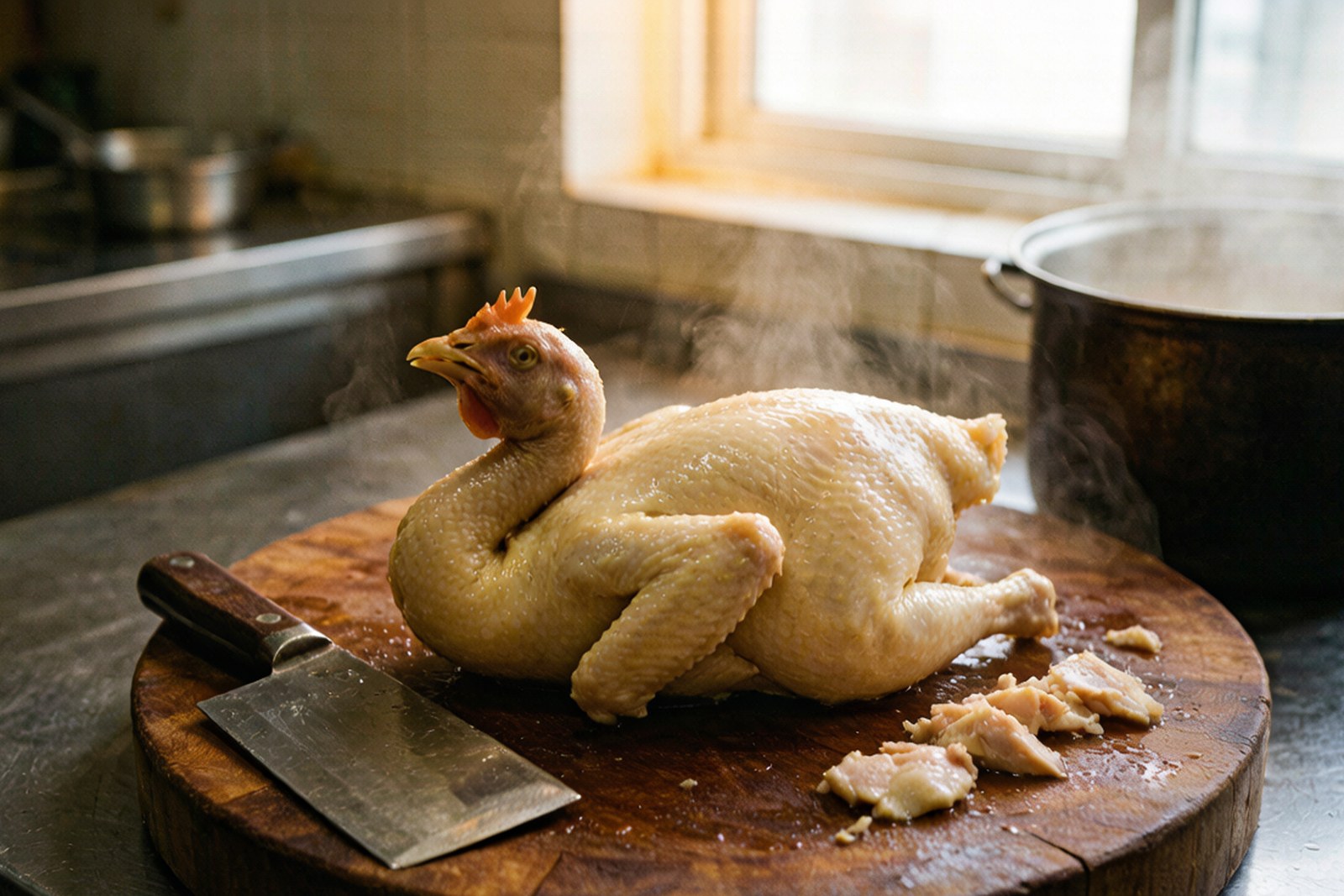
The cooking is the other half, and it is the part most visitors find counterintuitive. The bird is not roasted and it is not boiled. It is 白切 (bai qie, “white-cut”) — lowered into water flavoured with old coconut water and ginger, brought up to heat and held there only until it is just done through, and then taken out and dunked into ice water. The ice does two things: it stops the cooking dead at the exact moment you want it stopped, and it tightens the skin, which is how you get that layer of jelly and that clean snap under the teeth. Undercook it and the meat clings to the bone. Overcook it by three minutes and it goes from silken to merely fine, and the shop has wasted a bird.
Then it is hacked apart — bones in, skin on, not carved but chopped with a heavy cleaver into pieces of a size you can pick up with chopsticks — and served at room temperature. Cold chicken is the thing foreigners find hardest, and it is not a flaw. Warm, the fat turns runny and the skin slackens. The whole architecture of the dish depends on the temperature drop.
The Rice Is Not a Side
仙鸡饭, or 海南鸡饭 (Hainan ji fan) — Hainanese chicken rice — is a phrase most people know from Singapore, where it is a national dish and where the version served in hawker centres descends from exactly this island and exactly this method. Sanya is where a great deal of that lineage actually comes from, and the rice here is the reason the dish travelled.
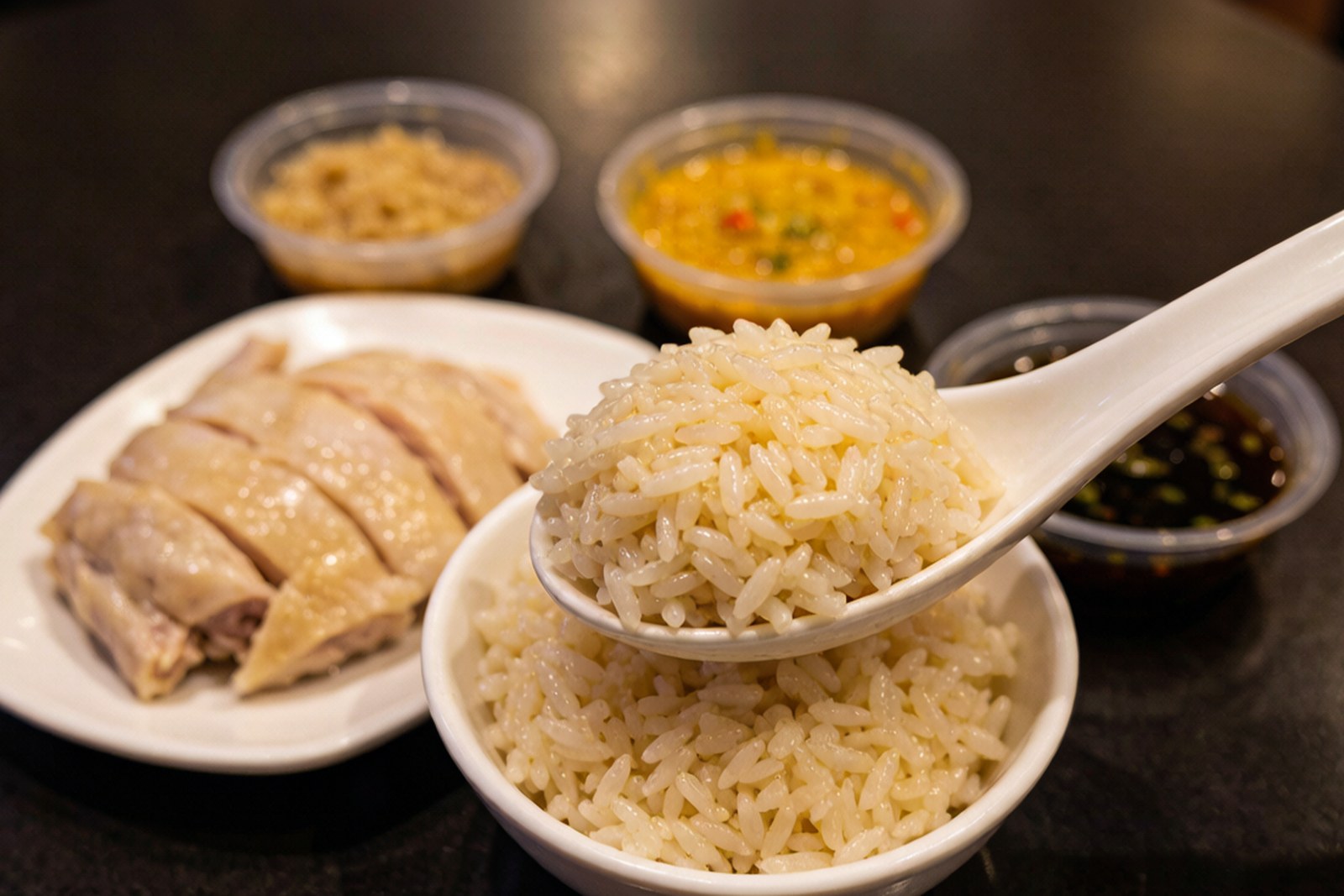
It is cooked in chicken stock and rendered chicken fat, with garlic and sometimes a knuckle of ginger, until each grain has gone glossy and separate and tastes of the bird it was cooked with. A bowl of plain white rice alongside this chicken would be a waste of a meal. They do not offer it.
Then the sauces, which are worth being precise about, because this is where the restaurant’s version differs from what you may have eaten in Singapore. Hainan does not do the thick sweet dark soy. On this table you get three things: 姜蓉 (jiang rong), the ginger-and-oil paste; a chilli sauce made with the local small yellow lantern chilli, 黄灯笼辣椒 (huang deng long la jiao), which is fruity and genuinely hot rather than merely sour; and a dish of sourness from the local lime, which is not the same as the lime you know — greener, more aromatic, almost floral. The chicken is generally eaten with a little of all three, which is how the regulars eat it: a piece of meat, a smear of ginger, a brush of lime, and then the rice.
A Chain That Is Also a Standard
I have to say something awkward here, because it is the honest thing and because it affects what you should expect.
沿江 is a 中华老字号 with twenty branches and a corporate structure, and it is located on the top floor of a shopping mall. If what you want from a trip is a rickety stool, a smoking wok and a grandmother who shouts at you, this is not that, and it does not pretend to be. The dining room is deliberate — screens and latticework, sandy yellow and sea blue, the colours of a Sanya beach, references to 天涯海角 and the 五公祠 worked into the panelling — and there is a certain amount of advertised heritage on the walls. It is a restaurant that knows it is a monument.
What redeems it, and the reason it belongs on a list of old shops rather than a list of chains, is that the standardisation went into the food rather than out of it. They built a farm so the birds would be right. They kept the ice-water method when cheaper kitchens dropped it. The 白切 chicken is still the dish the restaurant is judged on, and it is still the dish that arrives first on every table, and it is still the dish that tells you whether the kitchen is awake. Order it before you order anything else, and eat it before it comes to room temperature.
What Else Is Worth Your Table
The restaurant’s menu is long, and most of it exists because a chain has to cover every table’s preferences. A few things are worth the order regardless.
椰香烤椰子鸡 — the same breed, roasted, basted with coconut rather than poached. The skin goes lacquered and crisp and the meat stays juicy; this is the version for people who cannot get past cold chicken, and it is very good.
糟粕醋海鲜火锅 (zao po cu, “dregs vinegar”) — the Hainanese answer to a sour hotpot, made with the vinegar that comes out of rice-wine brewing at 铺前 (Puqian) on the north coast, and it is one of the more interesting things you can eat in this province: sour, faintly sweet, lightly hot, and used to poach seafood and vegetables. Locals call it the island’s tom yum, which is not quite right and is close enough to be useful.
疍家海杂鱼煲 (dan jia hai za yu bao) — a pot of mixed sea fish and shellfish in the style of the 疍家 (Dan jia), the boat-dwelling fishing people of the coast, who had no kitchen garden and cooked whatever came up in the net. It arrives wrapped in foil and opened at the table, which is theatre, but the fish is fresh and the broth is worth the rice.
虾酱地瓜叶 — sweet potato leaves stir-fried in shrimp paste, bitter-green against fermented salt, the standard southern-Chinese vegetable preparation done with the ferocity it needs.
What the Locals Know
Go late for lunch or early for dinner. The restaurant serves 11:00–14:00 and 17:00–21:00, and the Sanya branch fills with office tables in the first half hour.
Order by the half bird, not the dish. 半只文昌鸡 (ban zhi) plus a bowl of chicken rice and a soup is a proper meal for one person with an appetite. The soup to ask for is 肠红汤 — a clear broth with the congealed blood, which sounds alarming and tastes like the essence of the chicken.
Ask for the chicken to be served first and eat it first. Everything else on the table will wait. This will not.
Use the lime. The small green calamansi on the table is the difference between a good plate and a memorable one, and most visitors never touch it.
Do not order 白切 if you want your chicken hot. They will not argue with you, but you will have misunderstood the dish. Order the 椰香烤 for that.
Budget around 100 yuan a head and expect more if you add 东山羊 or 和乐蟹.
A Note on the Name
沿江 (Yanjiang) means “along the river”, and it is not poetic. The first shop opened in 1982 on 沿江路 in 文昌 — Riverside Road — and took the street’s name, the way small businesses did before anyone thought about brands. When the family registered a trademark in 1995, the road was the brand. The characters on the sign outside are simply a piece of a Hainanese county town, carried intact to a shopping plaza in Sanya four hundred kilometres away.
The older name, 毓葵鸡饭店, belonged to a man — 伍毓葵 — who taught his cooking to his family rather than to a school, and whose technique is today a provincial intangible cultural heritage item with two generations of officially designated inheritors. 符国鑫 died with the title of 中国餐饮文化大师, having also written a book on Hainanese food because no one else had. 符之望 holds the title now. The restaurant he runs serves around a hundred people a sitting and exists mostly so that a county’s household recipe can be eaten by whoever walks in.
That is what an old shop is, in the end. Not a building. A recipe that outlasted the family that made it, and then found another family willing to keep making it.
flowcloud would say that the most conservative thing you can do with a good dish is to freeze it at the moment it was best — and that a restaurant which built its own chicken farm rather than buy from a cheaper supplier has done precisely that, in the only way a restaurant can.
Where to find it: 沿江海南鸡饭店 (Yanjiang Hainanese Chicken Rice), third floor of 蓝海购物广场 (Lanhai Shopping Plaza), 新风街 261号, 吉阳区, Sanya — and other branches at 海棠湾免税城 和 临春河一横路 凤凰小区. Open 11:00–14:00 and 17:00–21:00. Order 半只白切文昌鸡 (bai qie Wenchang ji) with chicken rice and 肠红汤; ask for the 黄灯笼 chilli if it is not already on the table. Around 100 yuan a head. Reserve at weekends.