
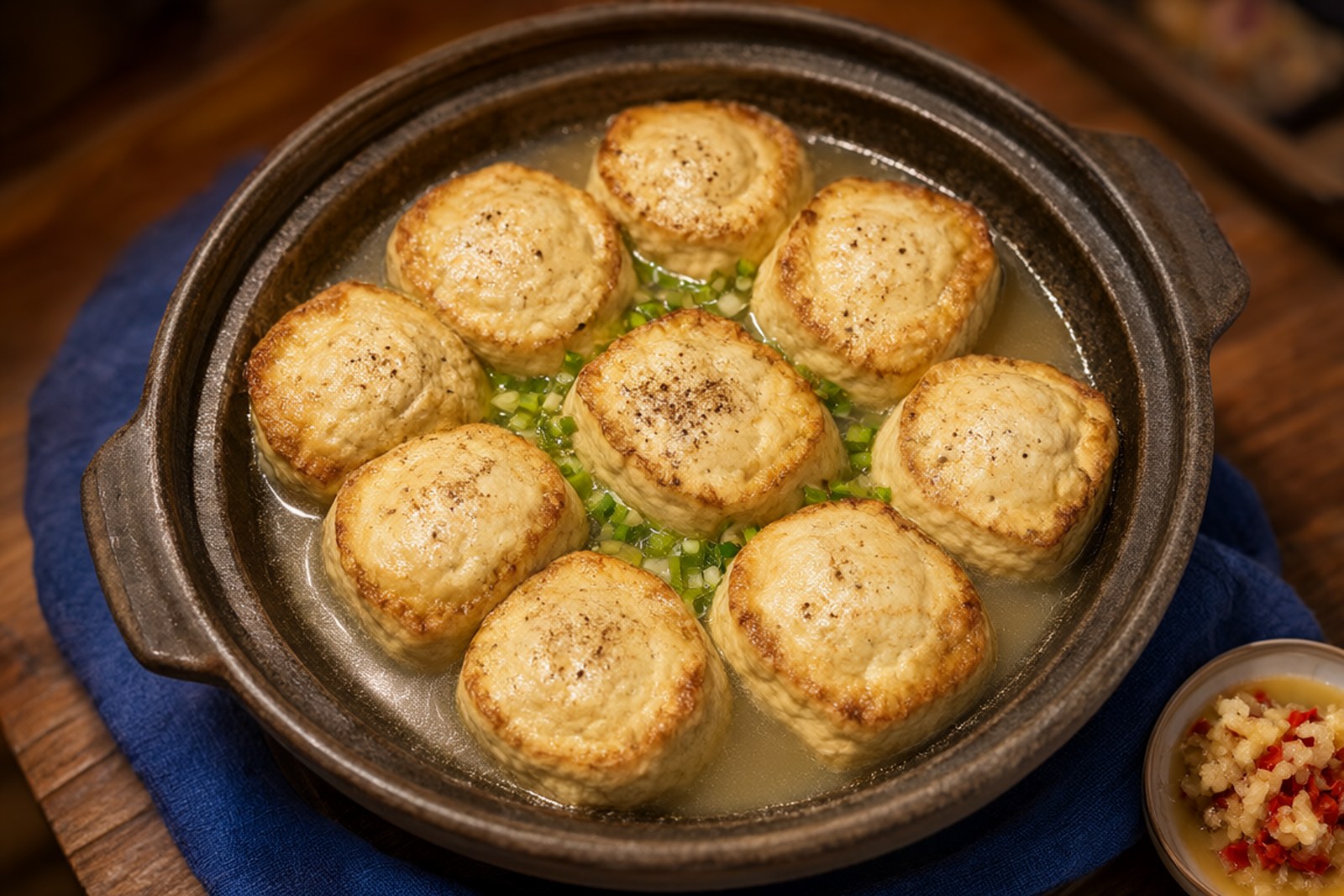
The parcels sit in the pot in a ring, each one a golden-brown cube with a faint seam on top and a bulge where the filling is pushing against the lid of its own skin, simmering in a shallow pool of pale broth. You lift one with a spoon and it holds — this is the test — and when you bite it the bean curd gives way to a dense, savoury mouthful of pork and dried shrimp and mushroom, and the broth inside the parcel runs out over your tongue. 炎陵酿豆腐 Yánlíng niàng dòufu is the defining dish of the Hakka communities of 炎陵县 Yánlíng Xiàn at the eastern edge of 株洲市, and like most Hakka food it is a story about migration told through what people could keep.
The Hakka — 客家 Kèjiā, “guest families” — are the descendants of northern Chinese populations who moved south in successive waves from the fourth century onward, and who ended up in the hill country of Guangdong, Fujian, Jiangxi and southern Hunan, where the good land was already taken. 炎陵 Yánlíng, tucked against the 罗霄山 Luóxiāo Shān range on the Jiangxi border, has one of the largest Hakka populations in Hunan; the local saying is that most of the county’s villages speak 客家话 Kèjiāhuà at home, and the food, the houses and the funeral customs all reflect it. The Hakka signature dishes — salt-baked chicken, preserved mustard green with pork, stuffed tofu — come from the same set of constraints: a long journey, poor land, a strong preference for pork, and a habit of stretching meat by putting it inside vegetables.
The claim on this dish is that it was invented as a substitute for dumplings. The Hakka came from the north, where a festival meant 饺子 jiǎozi — filled wheat dumplings — and the south they arrived in grows rice, not wheat, and has no flour worth the name. So the festival dumpling became a bean curd parcel: the same filling, the same shape of the meal, a totally different wrapper. It is a good story and it is more or less certainly at least partly true, because the same substitution recurs everywhere the Hakka settled.
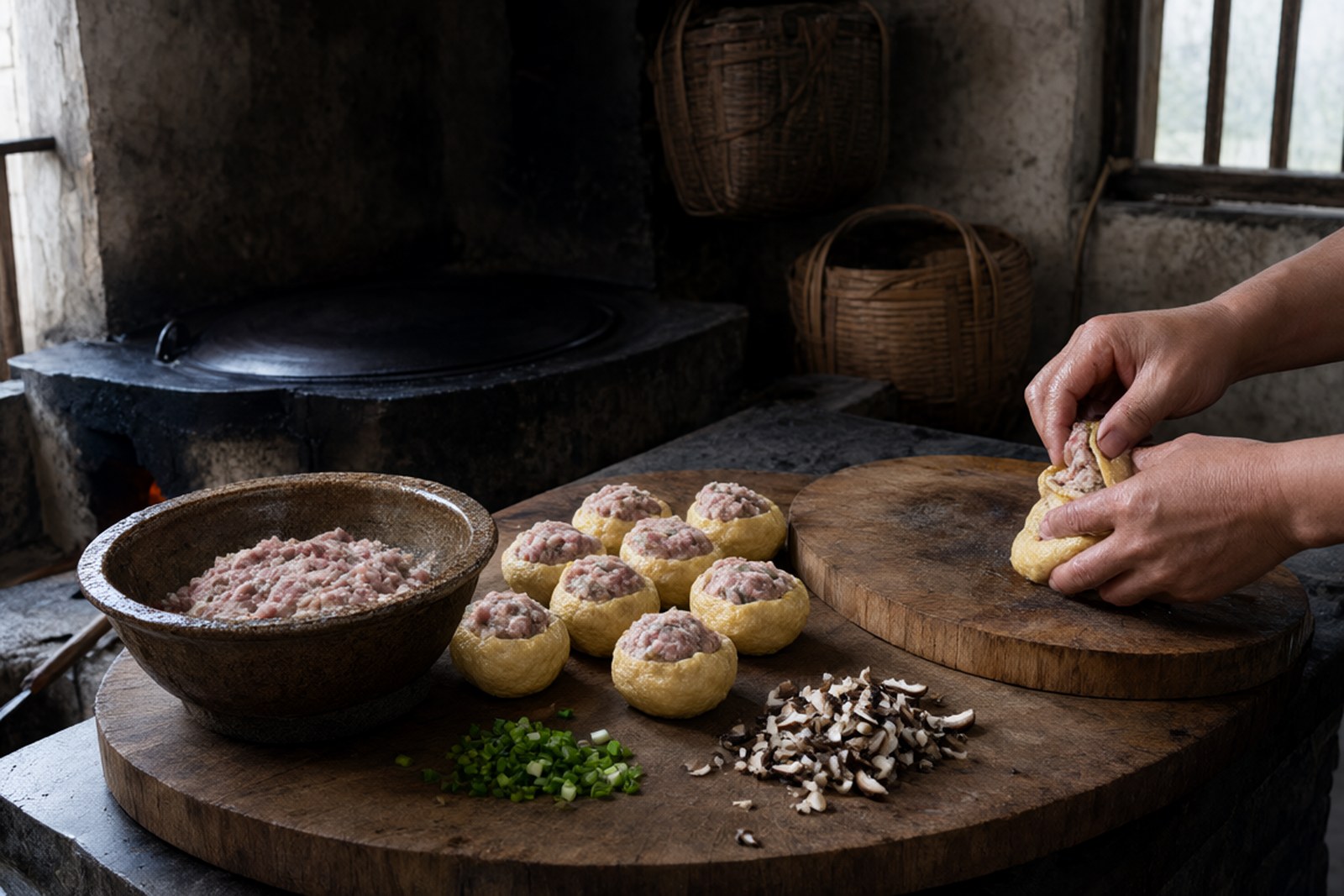
The technique is specific and unforgiving. 油豆腐 yóudòufu, fried bean curd, is the wrapper of choice in 炎陵 — the frying gives the surface enough structure to hold the filling without splitting, and the spongy interior absorbs broth. Each piece is slit or hollowed and packed with a mix of hand-chopped pork belly, dried shrimp, soaked shiitake, a little minced water chestnut or bamboo shoot, spring onion, soy and white pepper. The parcels are pan-fried seam-side down until the exposed filling browns, then braised in stock until the tofu has taken on the liquid, and finished with a thin starch glaze. Served in the pot, with rice, and with a chilli dip on the side.
Words and Names
酿 niàng is the same character used for the Yao stuffed dishes of 江华 Jiānghuá — to stuff one thing inside another — and it is the marker of a whole family of southern dishes. 客家 Kèjiā, guest people, is the term the Hakka use for themselves; 客家话 Kèjiāhuà, Hakka speech, is still the first language of many households in this county, and older people will switch into it with each other in the middle of a Mandarin conversation.
炎陵 Yánlíng means the “mausoleum of Yan”, the Yan Emperor — the county was renamed in 1994 from 酃县 Língxiàn because of the 炎帝陵 Yándì Líng, the tomb of the legendary Yan Emperor, which stands within its borders. The county’s cash crop is 炎陵黄桃 Yánlíng huángtáo, the Yanling yellow peach, a protected product worth more than two and a half billion yuan a year and exported across Asia.
What the Locals Know
Ask whether the filling has 虾米 xiāmǐ. Dried shrimp is traditional and is what gives the parcels their depth; a kitchen that has left it out is cooking for people who do not like seafood.
Eat them from the pot. Like most braised bean curd, they firm up and lose their broth as they cool.
Order a plate of 黄桃 huángtáo in August. The county’s peaches are absurdly good and are the only dessert you need.
Look for the seam. A well-made parcel has a visible line where the skin was slit, and the filling should be slightly proud of it. A smooth, uniform cube was probably machine-made.
Where to Eat It
Anywhere in 炎陵县 Yánlíng Xiàn, and specifically in the Hakka villages and the small restaurants of the county town. It is also standard on the menus of Hakka restaurants across 株洲 Zhūzhōu and in 长沙 Chángshā. A pot of eight to ten parcels is ¥30–55; a lunch of stuffed tofu, salt-baked chicken and a vegetable is ¥80–150 for two.
flowcloud would say that a people who lost their wheat, their land and their homes, and responded by keeping the dumpling and changing the wrapper, have made the most practical possible statement about what a culture is actually made of.
Where to find it: 炎陵酿豆腐 (Yánlíng niàng dòufu), 炎陵县 (Yánlíng Xiàn), 株洲市 (Zhūzhōushì), 湖南 (Húnán). Pot of 8–10 parcels ¥30–55; a Hakka meal for two ¥80–150. Eat it hot from the pot, ask about the 虾米 (xiāmǐ) in the filling, and buy the local yellow peaches in August.