
Hold it up to a window and the inside has a pattern in it. A 松花皮蛋 sōnghuā pídàn — a pine-flower preserved egg — is a duck egg that has been buried in a paste of wood ash, quicklime, salt and tea for several weeks, and the chemistry does two visible things. The white turns from clear to a dark amber or brown, firm and slightly gelatinous, and crystals of amino-acid salts grow inside it in branching shapes that look like pine needles or frost on glass, which is where the name comes from. The yolk becomes a dense blue-grey-green paste. It smells strongly of ammonia if you hold it close, tastes faintly of the same, and is one of the great acquired tastes in Chinese food and one of the most widely eaten in 益阳 Yìyáng, where the trade is old enough to be a local identity.
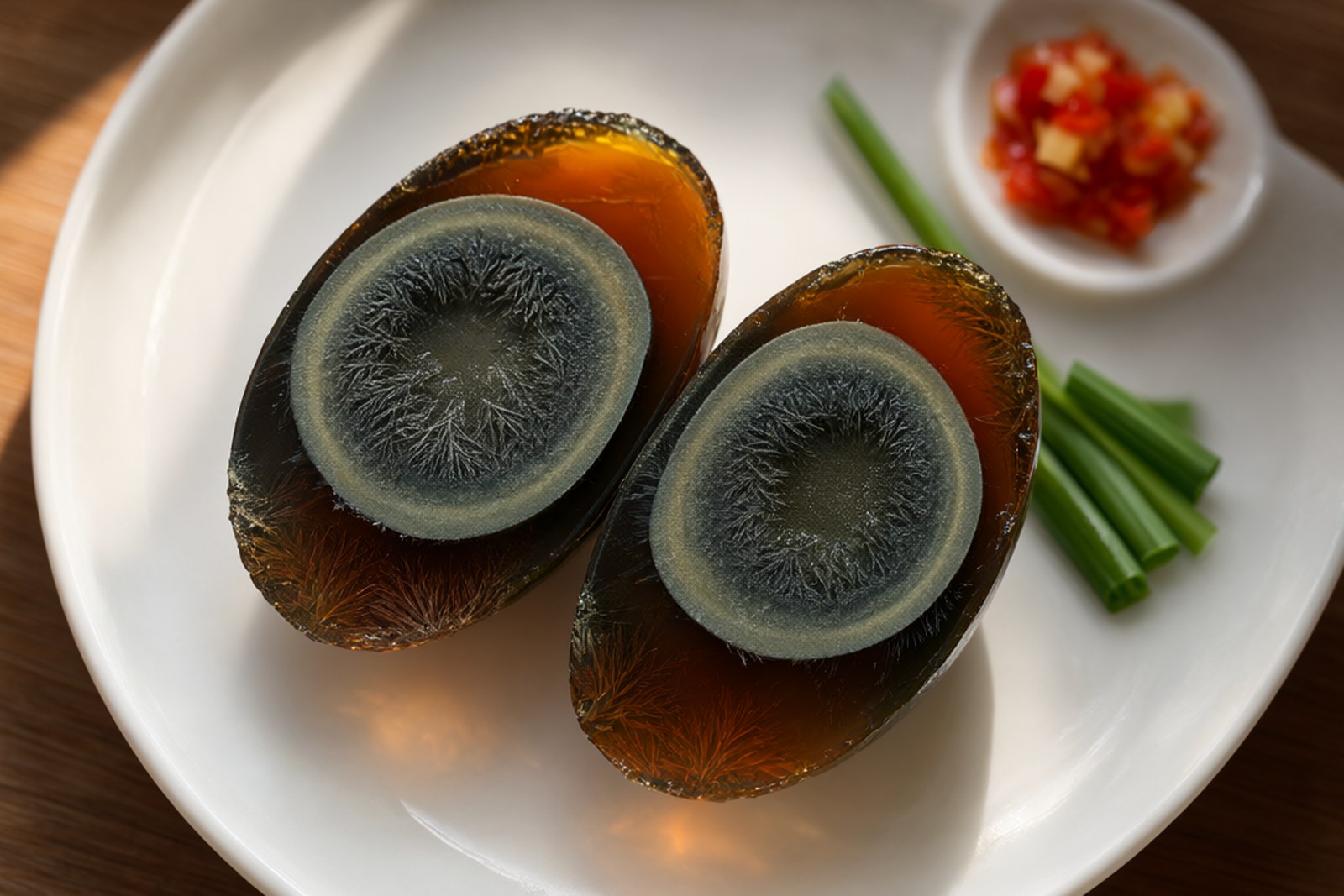
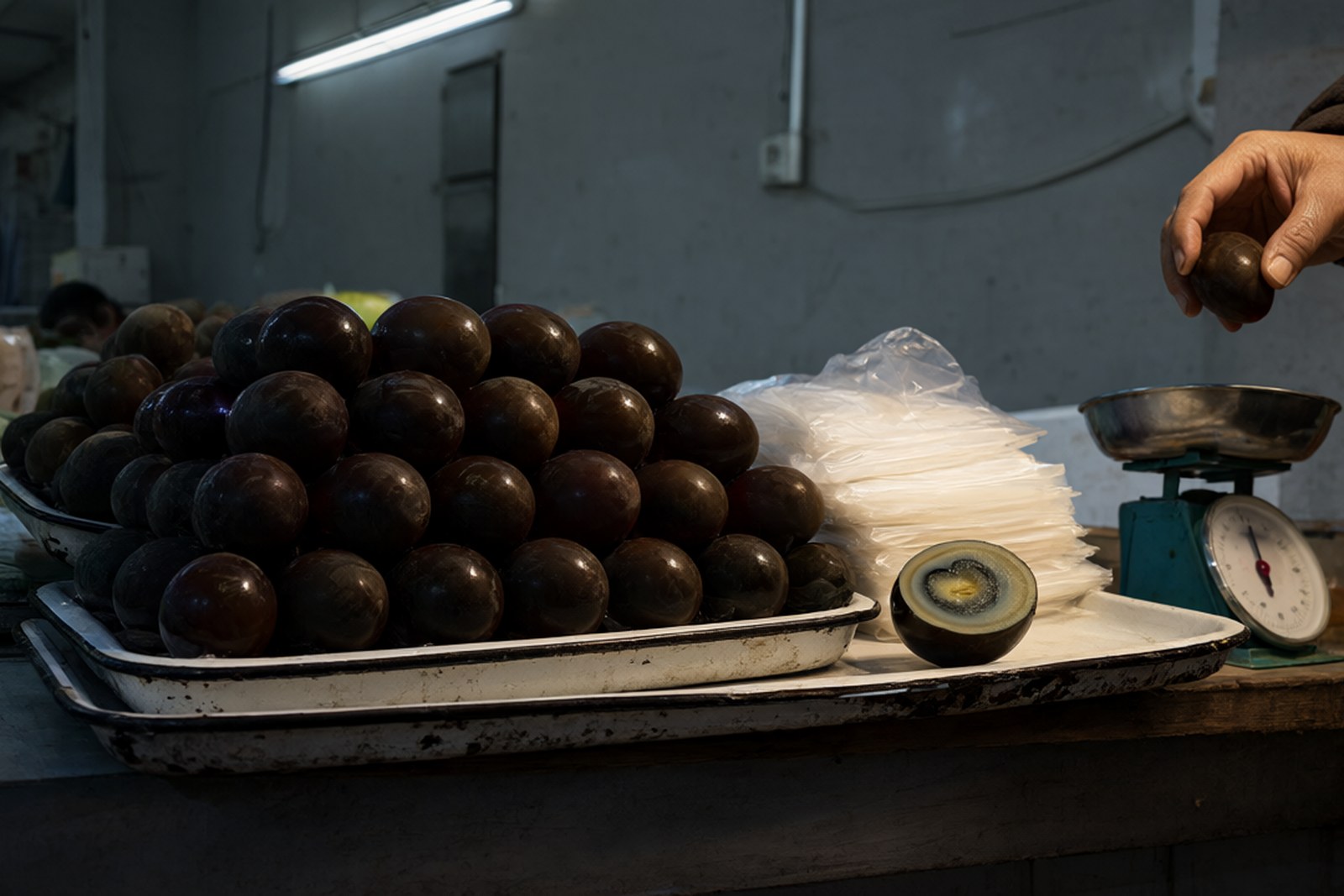
The curing is a matter of weeks and of proportions that every workshop guards. The alkali in the lime raises the pH enough that the proteins denature without heat, which is why the egg firms up without being cooked; the salt controls how fast the alkali penetrates; the tea and the ash contribute colour and aroma. Get the mixture wrong and the egg becomes either a rubbery, violently ammoniac object or a soft one that has not set. Yiyang’s makers have been doing this long enough that the county is one of the recognised centres of the trade in China, and the eggs are sold both loose and in the vacuum-sealed packs that carry them across the country.
How It Is Eaten
The commonest way is cold and simple. The egg is peeled, cut into wedges with a wet knife so the yolk does not drag, and served with nothing but a spoon of 剁辣椒 duò làjiāo, chopped salted chili, and a little vinegar — the acid cuts the ammonia and the chili covers it, and the combination, with a bowl of plain rice, is breakfast or a late-night snack across the province. 擂辣椒皮蛋 léi làjiāo pídàn is the dish that has travelled furthest: green chilies roasted until the skins blister, then pounded in a mortar with peeled preserved eggs and garlic into a rough, dark, deeply savoury mash that is eaten with rice and is far better than it sounds. In 益阳 the eggs also go into 皮蛋瘦肉粥 pídàn shòuròu zhōu, the rice congee with pork slivers and cubed preserved egg that is the standard Cantonese and now national breakfast dish, and into cold plates with tofu.
Words and Names
皮蛋 pídàn is the everyday name, literally skin egg, referring to the transformed white; 松花皮蛋 sōnghuā pídàn is the pine-flower kind and 松花 sōnghuā means pine flower, for the crystal pattern. 变蛋 biàndàn, changed egg, is the northern word, and 灰包蛋 huībāo dàn describes the ash coating. Outside China the same object is called a hundred-year egg or a century egg. 剁辣椒 duò làjiāo is the chopped salted chili served with it, 擂辣椒皮蛋 léi làjiāo pídàn the pounded chili and egg dish, and 皮蛋瘦肉粥 pídàn shòuròu zhōu the congee. 鸭蛋 yādàn is the duck egg, the only egg that works, since chicken eggs set too firm.
What the Locals Know
A good preserved egg has a firm, slightly springy white, a yolk that is creamy rather than hard, and a smell of ammonia that is present but not sharp; a violent smell means the curing went too long and the egg is only fit for congee. The pine-flower pattern is a quality mark, not a defect, and the presence of it means the curing was slow and even. Peel under running water to keep the shell fragments off, and cut with a knife dipped in water or with a length of thread. Anyone worried about the ammonia can leave the peeled egg in the air for ten minutes, or rest it in a little vinegar and sugar, both of which soften it noticeably. Buy from a shop that will open one for you; loose eggs run two to four yuan each, vacuum-packed ones slightly more, and the price difference between a good maker and a bad one is small enough that there is no reason to gamble.
flowcloud would say that the preserved egg is the most patient piece of cooking in China, since nobody ever applied heat to it, and that a food which turns a fresh egg into a dark one over six weeks is either a mistake or a tradition, and Yiyang has had the time to decide which.
Where to find it: the markets and food shops of 益阳市 Yìyáng Shì, and the preserved-egg workshops of the districts around it that sell from the front room. Ask the stallholder to open one so you can see the pattern, order 擂辣椒皮蛋 in any Hunan restaurant to eat it the way the province does, and take home a vacuum pack rather than loose eggs if the journey is long.