
Yongfeng Chilli Sauce, the Zeng Family’s Condiment
永丰辣酱 yǒng fēng là jiàng is a chilli paste, and it is the one product of 双峰县 Shuāng fēng xiàn, a county in the middle of 湖南 Hú nán administered from 娄底市 Lóu dǐ shì, that the Chinese chilli trade treats as a founding document. It is made in and around 永丰镇 Yǒng fēng zhèn, the county town and the place the paste is named after, from a fat local 灯笼椒 dēng long jiāo, the lantern chilli, fermented with wheat, soybean and glutinous rice and then dried down in the sun until it turns into a dark red paste that is 辣中带甜, hot with sweetness behind it. Old Hunan writing pairs it with 湘潭 Xiāng tán lotus seed and 长沙 Cháng shā stinky tofu as 湖南三宝 Hú nán sān bǎo, the three treasures of the province, and unlike most such trios this one is still made in household courtyards by people who have never sold a jar.
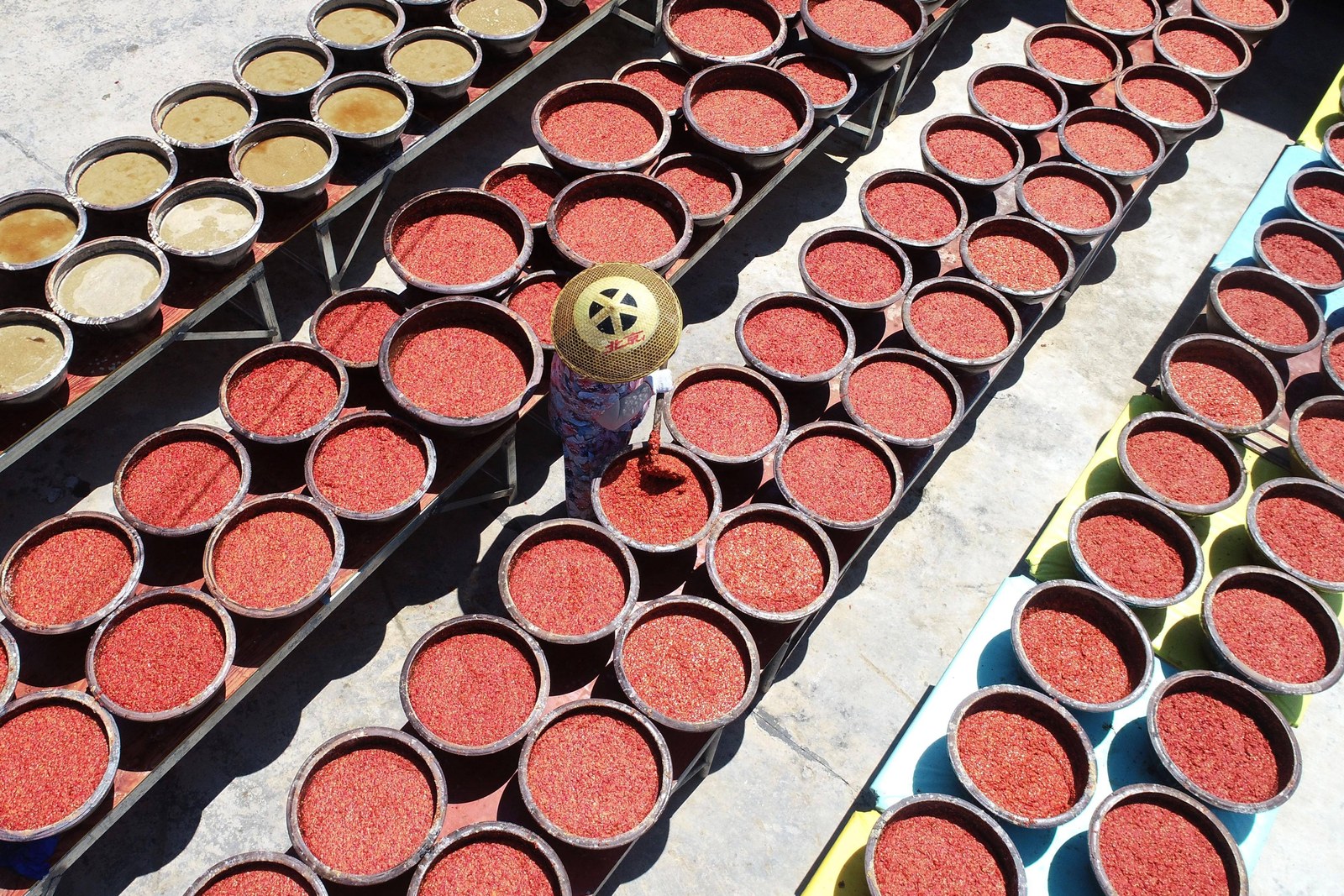
The paste is a ferment before it is a condiment, and the recipe is deliberately plain. Fresh lantern chillies are chopped and mixed with steamed wheat, boiled soybeans and glutinous rice; the mix is left to 酶化 méi huà, to break down under its own enzymes, and it is then spread out in shallow earthenware basins to dry – first the 晒胚 shài pēi, the drying of the mash, and then the 晒酱 shài jiàng, the drying of the paste – before it is finally jarred. The county counts five stages and twenty-nine small steps between the field and the lid. Nothing sweet is added at any point, and that is the fact the makers are proudest of: the sweetness in the finished paste is what the wheat and the soybean turn into as they ferment, which is why the taste is deep and a little sour at the edge rather than sugary. In the first weeks of autumn, when the chillies are in, the courtyards of 双峰 fill up with the evidence. Shallow basins stand on threshing floors, on the concrete slab of the laundry stand and along the tops of walls where the sun lasts longest, and the county describes the effect as a feature of the local landscape rather than as a chore.
The history is unusually well dated for a village product. The county’s record puts the first sun-dried chilli paste in 永丰镇 in the late Ming, in the 崇祯 Chóng zhēn years, and by the middle of the seventeenth century three brothers of the 蔡 Cài family had opened the 酱园 jiàng yuán, the sauce shops, that gave the trade its scale: 蔡广祥 Cài guǎng xiáng, 蔡广益 Cài guǎng yì and 蔡顺益 Cài shùn yì, of which 蔡广祥 was the largest, with more than ten smaller workshops following them in the same town. The fame arrived in the 咸丰 Xián fēng years of the 1850s. 曾国藩 Zēng Guó fān, the Hunan commander and the most powerful official the county has ever produced, is said to have carried a jar of his home town’s paste to the capital and given it to the emperor 咸丰帝 Xián fēng dì, who had grown tired of banquet food, found the rough country relish exactly what he wanted and had it entered on the list of 宫廷贡品 gōng tíng gòng pǐn, palace tribute. That story is why the paste is known outside the county at all. The other name attached to it is 蔡和森 Cài Hé sēn, a man of 双峰 who spent three years as an apprentice in the 蔡广祥 shop as a boy before leaving for 长沙 to study, and who went on to become one of the founders of the early Chinese communist movement.
Half of the 湘军 Xiāng jūn, the Hunan army of the 1850s and 1860s, is said to have marched with a jar of this in its kit, and the county’s own account observes that the paste was already the one thing every household here knew how to make, so there was nothing to organise. It is still made that way by families, and also by a small industry. 双峰 was named 中国辣酱第一县 Zhōng guó là jiàng dì yī xiàn, the country’s number-one chilli-paste county, at the first 长沙 chilli fair in 2007, and in the same year 永丰辣酱 came under national geographical-indication protection. Output is now put at around twenty thousand tonnes a year with sales in the region of 1.2 billion yuan, which is a great many jars for a county of this size, and the paste is exported to the United States, Canada, Saudi Arabia and South East Asia. The county records the earlier chapters of that trade as well: students leaving for Japan at the end of the Qing carried jars with them, and merchants from 双峰 took the recipe to Thailand, Singapore and Malaysia. What has not changed is the ingredient list. The label on a good jar is short, and people here maintain that anything with sugar in it is a different product wearing the same name.
Words and Names
辣酱 là jiàng is chilli paste, and 永丰辣酱 is the town’s name in front of it; the town, 永丰镇 Yǒng fēng zhèn, is also the county town of 双峰县 Shuāng fēng xiàn, the county taking its name from 双峰山 Shuāng fēng shān, the twin peaks standing south of it. 灯笼椒 dēng long jiāo, lantern chilli, is the fat, fleshy local pepper the paste is built on, and 晒酱 shài jiàng, sunning the paste, is the verb for the whole trade. 酱园 jiàng yuán is a sauce shop, 宫廷贡品 gōng tíng gòng pǐn means palace tribute, and 湘军 Xiāng jūn is the Hunan army, whose name turns up in the story of almost every strong-flavoured food in this part of the province.
What the Locals Know
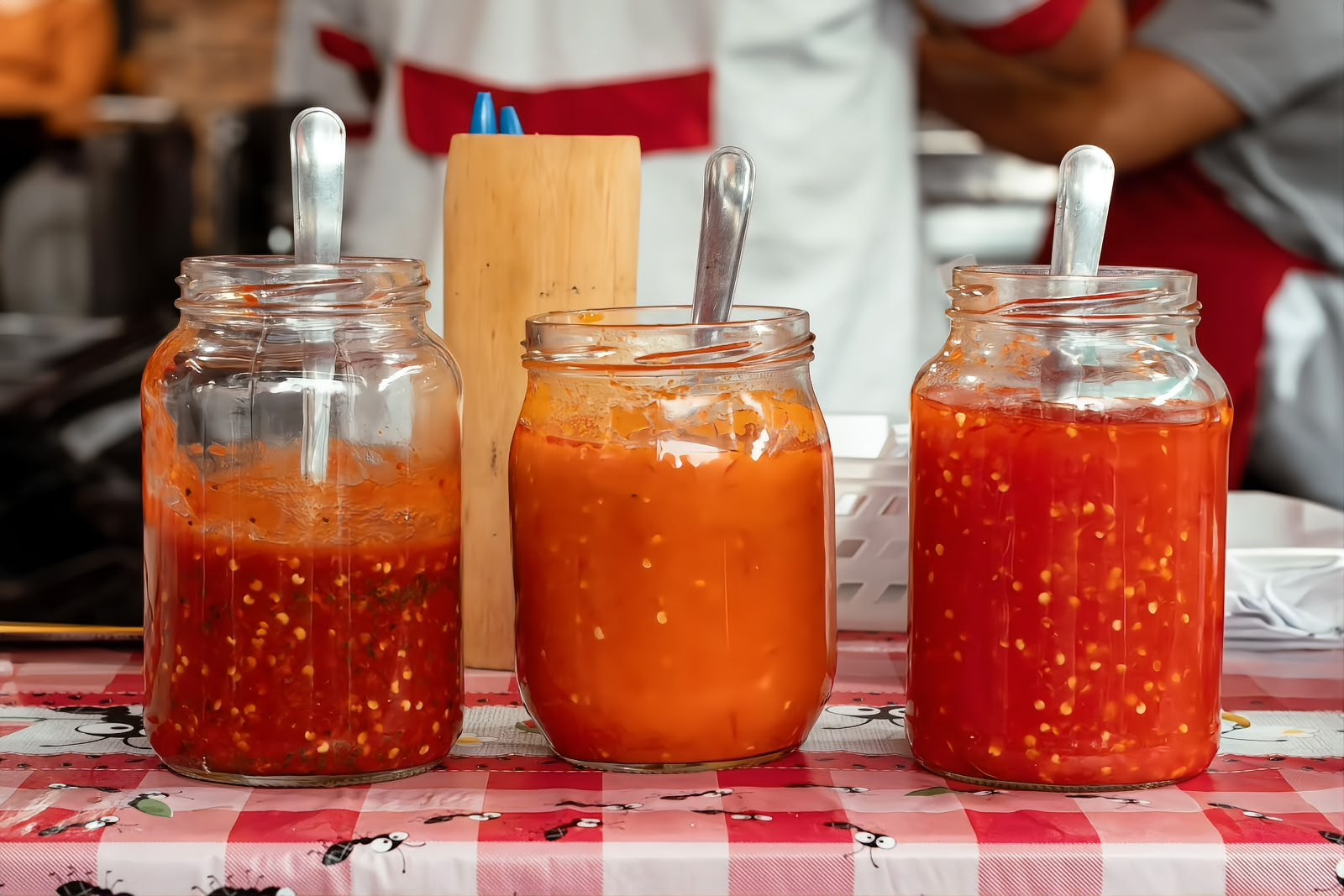
Buy it by the mark rather than by the name. 永丰辣酱 is protected as a geographical-indication product, so the jar worth carrying should carry the geographical-indication mark as well as the words, and the same goes for anything sold loose in a market, where the paste in an unmarked tub is often a neighbouring town’s. A good paste should be a deep brick red going almost black where it has dried hardest, and thick enough that a spoon stands up in it. The smell should be sour and savoury with the chilli behind it, never of vinegar alone and never musty; if the top has separated into clear liquid with the solids below, that is normal and wants stirring back in rather than pouring off. Because the paste is salty as well as hot, a kitchen here uses it the way a European one uses mustard or anchovy rather than the way it uses ketchup: a spoonful stirred into a bowl of plain noodles, a smear over steamed fish, or a spoonful fried with pork belly and green beans at the start of a dish. The family jars keep for years if they are treated properly. Keep the surface covered by its own oil, use a dry chopstick and never a wet spoon; a white film on top is common in a live ferment and can be skimmed away, but a jar that smells ammoniac or fizzes when it is opened has gone and should be thrown out.
flowcloud would say that the most valuable thing this county ever sent to the capital was not a tribute at all but a jar of fermented chilli that a homesick commander packed in his own luggage, and that the palace mistook a favour for a gift and made a law of it.
Where to find it: the sauce shops, workshops and household courtyards of 永丰镇 in 双峰县, and the county’s markets, where it is sold by the jar and by the ladle; the county sits in the east of 娄底市, about an hour and a half from 长沙 by road, and the high-speed line stops at 双峰北站, eleven minutes from 娄底南. The county is also the home of 曾国藩, whose walled mansion 富厚堂 at 荷叶镇 is a short drive west, so the paste is sold at the gate there as the souvenir the story belongs to. It is a cheap thing in a plain jar, and the version to look for is the small-batch 晒酱 rather than the pale machine-made paste, which is thinner, sweeter and considerably less interesting.