
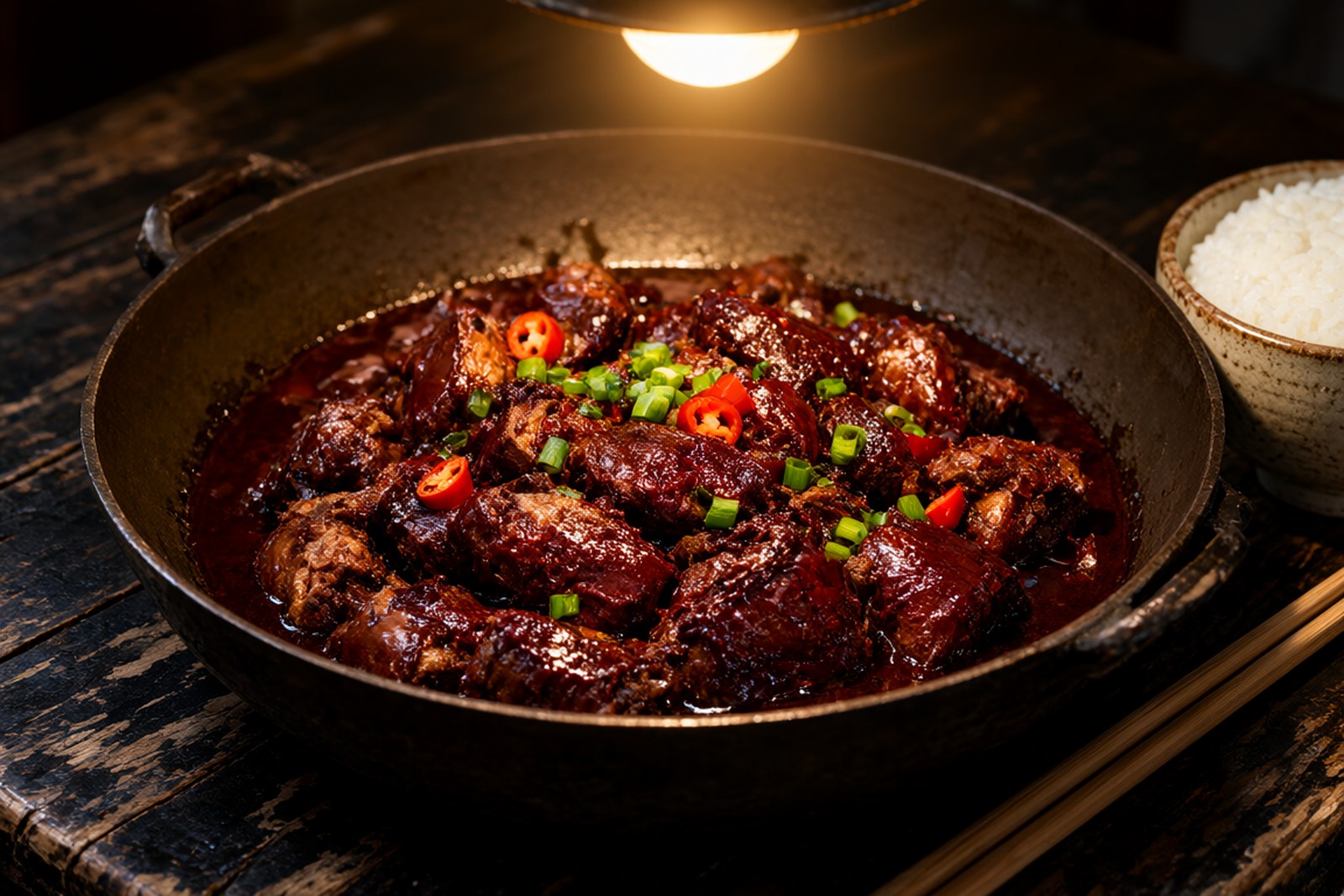
The duck arrives in a black iron wok and the first thing you notice is the colour. Not brown, not red, but a deep aubergine black with a red glow underneath, the way a scab looks in afternoon sun. It is duck cut into pieces the size of a thumb joint, cooked down in its own fat and its own blood until the sauce clings to every piece and almost no liquid is left in the pan. You eat it with your fingers if nobody is watching. You order rice to wipe the wok out with. You finish with a mouth that tastes of ginger, chilli and iron. 永州血鸭 Yǒngzhōu xuèyā — Yongzhou blood duck — is the dish people in this city name when you ask what here is theirs, and the argument over who cooks it properly has been running for about a hundred and seventy years.
The story everyone tells, and which the local government’s own heritage pages repeat, puts the dish in the middle of a war. When the Taiping army under 洪秀全 Hóng Xiùquán took 永州 Yǒngzhōu in the early 1850s, the townspeople went into the camps to help cook for the soldiers. Ducks were killed in a hurry, in the middle of moulting season, and the pinfeathers would not come out. A cook, facing a table and a deadline, chopped the birds into pieces, fried them, and then poured the bowl of fresh blood over the lot and stirred until it went to a paste — which hid the feathers and, as it turned out, tasted better than what he had been planning. It reached the table unnamed, and it was 洪宣娇 Hóng Xuānjiāo, the Taiping leader’s sister, who is supposed to have said: call it Yongzhou blood duck.
There is a second version, older and more melancholy, that has the dish invented in the last years of the Song, when 文天祥 Wén Tiānxiáng was raising troops against the Mongols and the assembled commanders swore an oath over cups of blood. There was no chicken blood to be had, so duck blood was used instead, and a cook mistook the bowl for chilli paste and tipped it into the pan. The result was so good that the oath acquired a menu. Two legends, one about a rebellion and one about a last stand: either way the dish was born with a temper, and the people of Yongzhou have spent the intervening centuries insisting that the temper is the point.
What Makes It Work
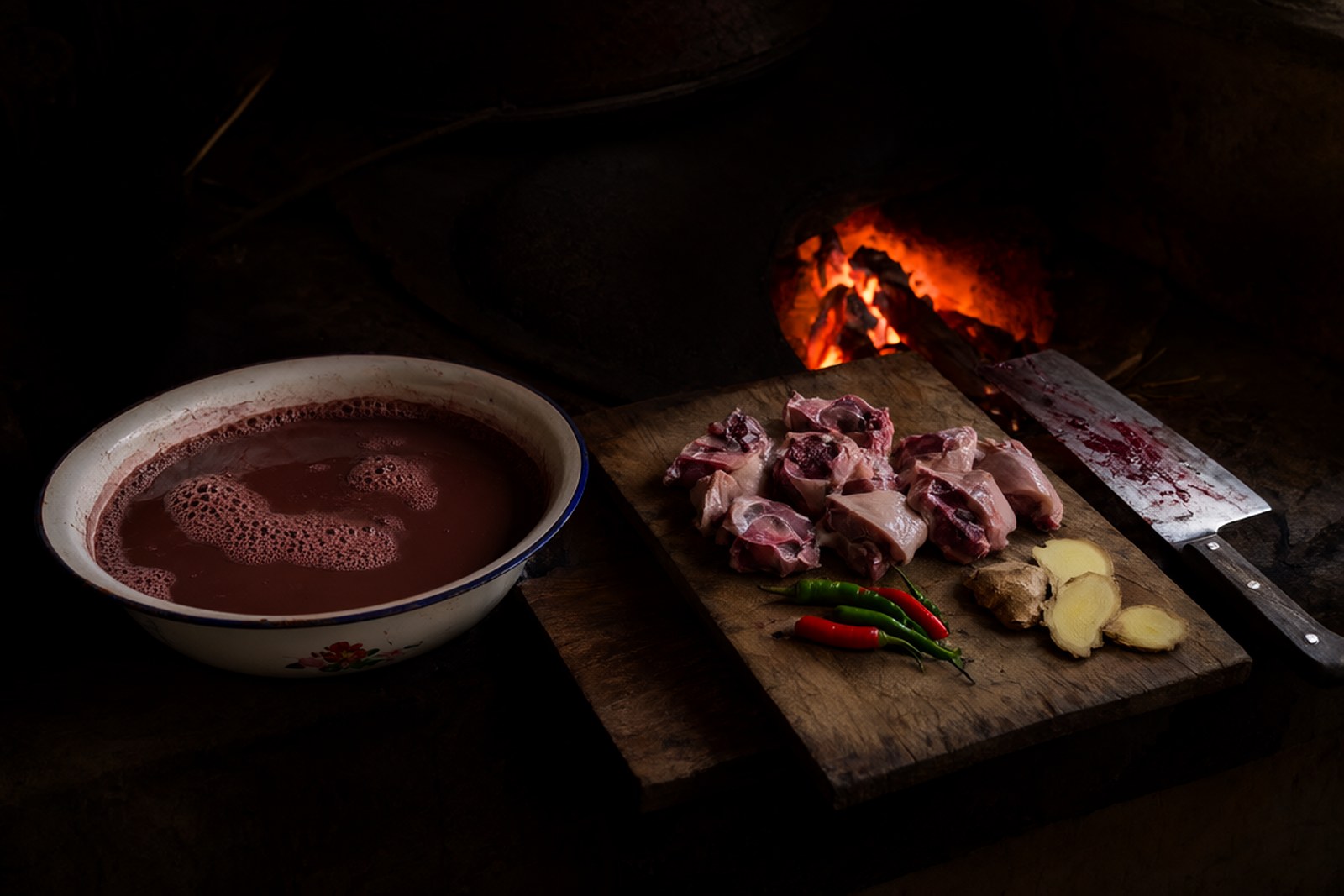
The bird matters more than the recipe. It has to be 麻鸭 máyā, a local duck, and it has to be young — two or three months, maybe up to a year, never an old layer, whose flesh will stay tough no matter how long you cook it. The blood is the other half of the equation and it is where most attempts fail. It is caught in a bowl at the killing and stirred one way with chopsticks until the fibres separate, so that it stays liquid instead of setting into a jelly. If it has already clotted, the dish is over before it starts.
The cooking runs in three stages. First the chopped duck goes into a dry hot wok with old ginger and Sichuan pepper to drive off its water and its rankness; the meat comes out and waits. Then a heavy charge of lard goes in with ginger and garlic, and the duck returns to be fried hard, then braised with rice wine and a little water until it is tender. Green and dried chillies go in, then 仔姜 zǐjiāng — young ginger, ideally the slender 竹枝姜 zhúzhījiāng grown around Yongzhou — and finally, with the sauce reduced to something thick enough to bubble, the blood goes in. One or two minutes of fast stirring, no more. The blood darkens, tightens around the meat, and becomes the sauce. Cook it longer and it turns grainy and glues itself to the pan.
Words and Names
血鸭 xuèyā is simply “blood duck”, and the dish is also called 血糊鸭子 xuèhú yāzi, the pasted duck, which is more descriptive and less appetising. 仔姜 zǐjiāng is young ginger harvested before the skin hardens: crisp, mild, and eaten as a vegetable here rather than treated as a seasoning. The city’s older name is 零陵 Línglíng, and the two together — 零陵 and 永州 — are the 潇湘 Xiāoxiāng, the confluence of the Xiao and Xiang rivers that poets have been using as shorthand for exile and melancholy for a thousand years.
That literary association is not decoration. 柳宗元 Liǔ Zōngyuán, exiled here as a minor official from 805 to 815, wrote the 永州八记 Yǒngzhōu bā jì, the Eight Records of Yongzhou, which turned a malarial frontier posting into some of the most quoted landscape prose in Chinese. He also wrote 捕蛇者说 Bǔ shé zhě shuō, on the snake-catchers, whose opening line — that the wilds of Yongzhou produce a strange snake — every schoolchild in the country can recite. The duck and the snake come from the same patch of ground.
What the Locals Know
Eat the ginger. The pale slices of 仔姜 zǐjiāng have absorbed the sauce and lost their heat; locals treat them as the best part of the dish and the test of a good cook.
Judge it by colour, not by heat. Properly made it is 黑紫色 or 酱红 — black-purple or soy-red — not bright red. A scarlet blood duck has had blood that was too fresh, or too much of it, and will taste raw in the middle.
Order beer, or sweet-potato spirit. The standard pairing is iced beer, on the theory that a fire hot enough to reach your skull needs a waterfall to put it out. In winter the same job is done by 红薯烧酒 hóngshǔ shāojiǔ, a rough home-distilled spirit from sweet potato.
Do not reheat it. Blood duck is a one-sitting dish. Reheated it goes grainy and the sauce separates; the restaurants that serve it well cook it to order for this reason and no other.
Finish with rice. The wok liquid after the duck is gone is the real prize. Ask for a bowl of rice, tip it in, pick out the dried chillies, and eat standing up if there is no chair left.
Where to Eat It
Every town in the prefecture makes its own, and the variations are named after them: 宁远血鸭 Níngyuǎn xuèyā, 道县血鸭 Dàoxiàn xuèyā, 新田血鸭 Xīntián xuèyā, 蓝山血鸭 Lánshān xuèyā. Ningyuan is usually called the most robust. In 零陵 Línglíng the restaurants cluster around the old town and along the Xiao River, and the small places with plastic stools and a single wok do it better than anything with a printed menu. A whole duck serves three or four people at around ¥80–130, depending on the bird. Order it 中辣 zhōnglà, medium, the first time: the chilli here is not scenery.
flowcloud would say that this is a dish about refusing to throw anything away — that the blood was waste until somebody was in a hurry, and that an entire regional cuisine has been built on the principle that nothing off a duck is rubbish, including the part that would have been poured onto the ground.
Where to find it: 永州血鸭 (Yǒngzhōu xuèyā), 永州市 (Yǒngzhōushì), 湖南 (Húnán). Best in the small family restaurants of 零陵 (Línglíng) and in the county towns along the 潇水 (Xiāoshuǐ). A whole duck ¥80–130 for three or four. Ask for 仔姜 (zǐjiāng) to be included, expect the colour 酱红 (jiàng hóng), drink iced beer with it, and do not plan on carrying any home.