
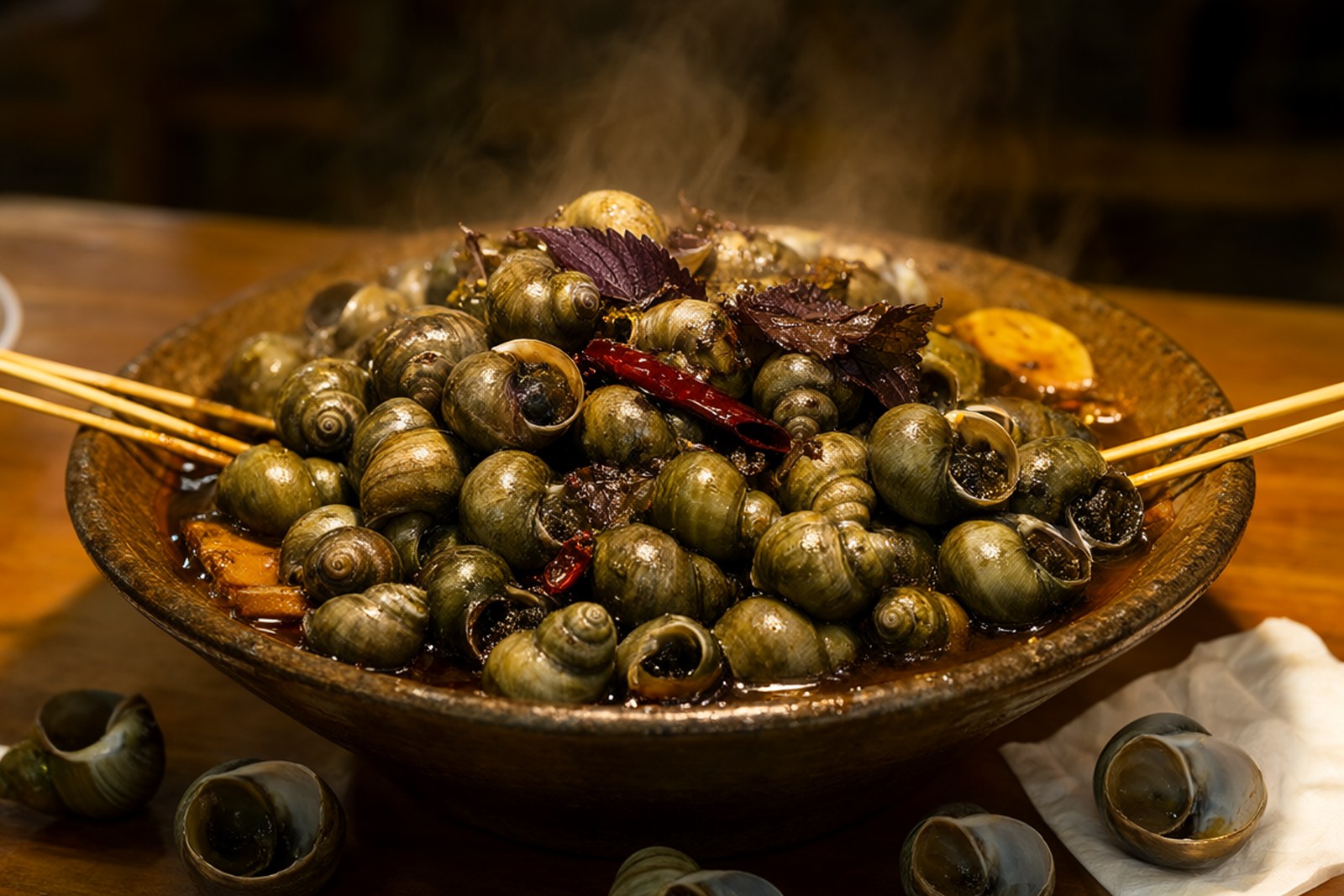
The stall appears at about five in the afternoon: a plastic table, a pot of something dark and steaming, a stack of bowls, and a bucket of river snails whose shells have been clipped at the tail so that air can get through. You get a bowl, a wooden skewer or nothing at all, and you suck. If you do it right the meat comes out whole with a mouthful of sauce behind it — fermented black bean, perilla, chilli, rice wine — and the shell goes into the pile growing beside your elbow. If you do it wrong you get a mouthful of chilli oil and a snail that will not budge. 永州喝螺 Yǒngzhōu hē luó, Yongzhou drinking snails, is the food this city eats after dark, and the verb is the whole point: 喝 hē means to drink, not to eat.
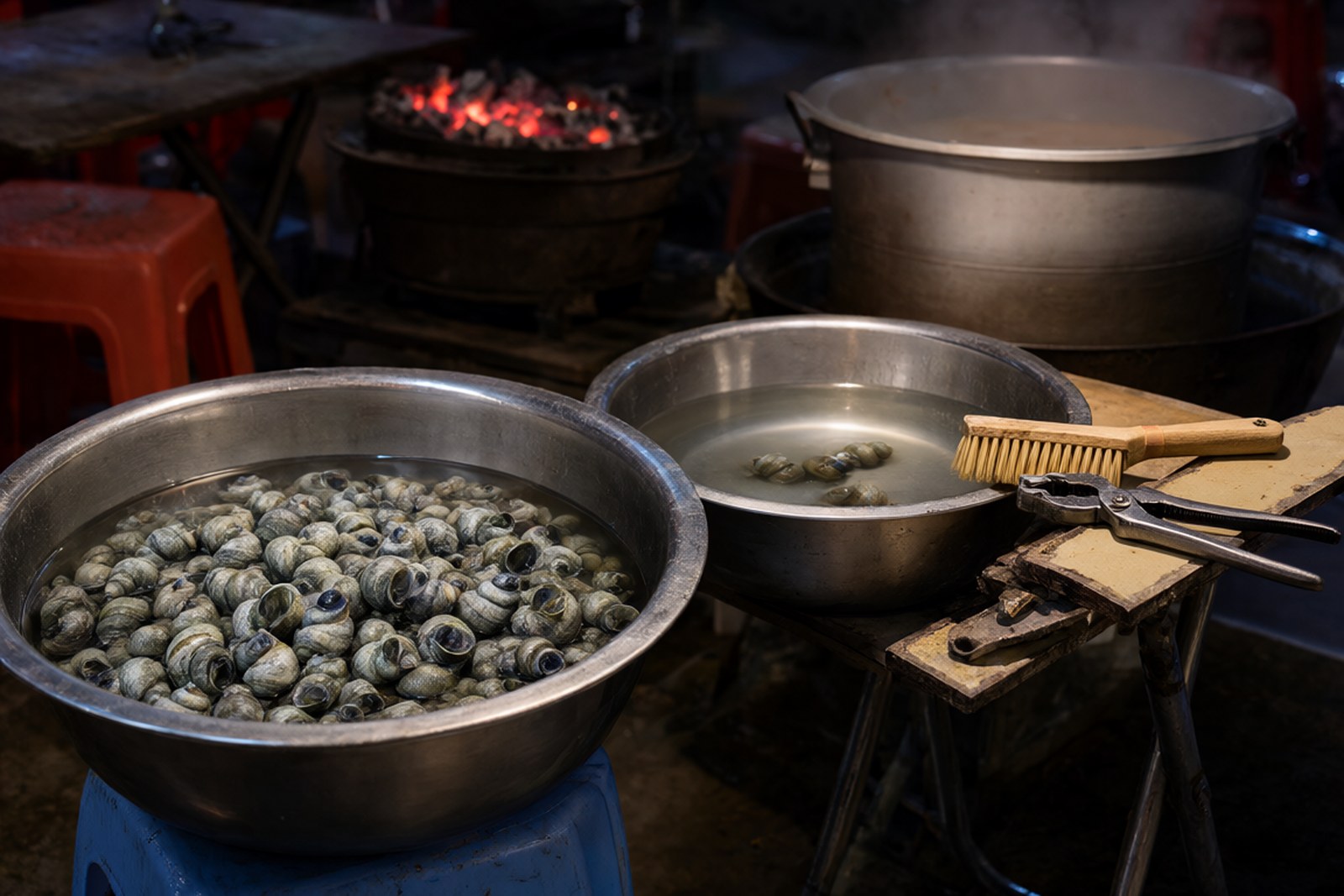
The snails come from the 潇水 Xiāoshuǐ, the Xiao River, and the older cooks insist on what they call 铁螺 tiěluó — iron snails, small, dark, heavy for their size, taken from running water rather than ponds. The preparation takes the better part of a day. They are kept in clean water for a day or two to purge themselves of mud and grit, then the pointed tip of each shell is cut off with a pair of pliers or a hammer, which is tedious work and the reason a good snail stall has a family behind it. Clipping the tail lets the cooking liquid enter the shell and lets you pull the meat out in one piece; unclipped snails are the mark of a kitchen cutting corners.
The cooking is fast and fierce. Tea-seed oil or rapeseed oil goes into a wok with 紫苏 zǐsū — perilla, the purple-leaved herb that is the signature aromatic of Hunan river cooking — along with dried chilli, ginger, garlic and fermented black beans. The snails go in and are tossed hard, then rice wine and a little water, then a lid, and they simmer for half an hour or more until the meat has taken on the sauce and loosened in the shell. What arrives is not really a soup; it is a bowl of shells in a small amount of very intense liquid, and the liquid is what you are drinking.
The local technique is described with a competitive number. A cook quoted in the city’s own food writing claims that locals can empty twenty shells a minute and that anyone who cannot get the meat out is a tourist — which is rude, accurate, and also a useful instruction, because the method is not intuitive. You put your mouth over the opening, not the clipped tail, and you suck from the tail end while the opening is sealed by your lips, so the pressure pushes the meat toward your mouth rather than away from it.
Words and Names
喝螺 hē luó is a local coinage: 喝 hē, to drink, plus 螺 luó, snail, and it describes the action rather than the ingredient. In most of China the same dish is called 嗦螺 suōluó, from 嗦 suō, the sucking noise — Yongzhou’s version foregrounds the liquid.
紫苏 zǐsū is perilla, an annual herb of the mint family whose purple or green leaves taste of something between basil and shiso; it is used all along the Xiang River with freshwater fish and shellfish, and it is the single flavour that most clearly marks a dish as coming from here. 铁螺 tiěluó, iron snail, is not a species but a description of snails from running water.
What the Locals Know
Order 酸萝卜 suānluóbó with it. The standard companion is pickled radish — sour, cold, crisp — which resets your mouth between snails. In 零陵 Línglíng the stalls sell it as a matter of course.
Ice beer, not tea. The pairing everyone recommends is cold beer, for the same reason the duck gets it: the chilli load is high and the beer is functional rather than festive.
Skip the ones that smell of mud. Fresh river snails have almost no smell; a stall whose bucket smells of pond bottom is working with the wrong catch.
Give it twenty minutes. This is not a dish you finish quickly, and the point is the sitting — the pile of shells is a record of time spent.
Where to Eat It
The night markets. The most often named in local writing is the cluster on 徐家井路 Xújiājǐng Lù in 零陵区 Línglíng Qū, where the snail stalls set up at five and the queue forms immediately; the same trade runs along the riverfront and outside the old town. A bowl is ¥15–30 and a large portion to share ¥40–60. Go hungry, roll your sleeves up, keep the paper towels within reach, and do not wear anything pale.
flowcloud would say that this is the least pretentious food in Hunan and possibly the most honest — that a city which invents a verb for getting a snail out of its shell with your mouth, and then builds its summer evenings around doing it in the street, has a clearer idea of what eating is for than most places with a tasting menu.
Where to find it: 永州喝螺 (Yǒngzhōu hē luó), 永州市 (Yǒngzhōushì), 湖南 (Húnán). Night markets in 零陵区 (Línglíng Qū), especially along 徐家井路 (Xújiājǐng Lù) and the 潇水 (Xiāoshuǐ) riverfront, from about 17:00. Bowl ¥15–30, large portion ¥40–60. Eat it standing, add 酸萝卜 (suānluóbó), and finish with the sauce in the bowl.