
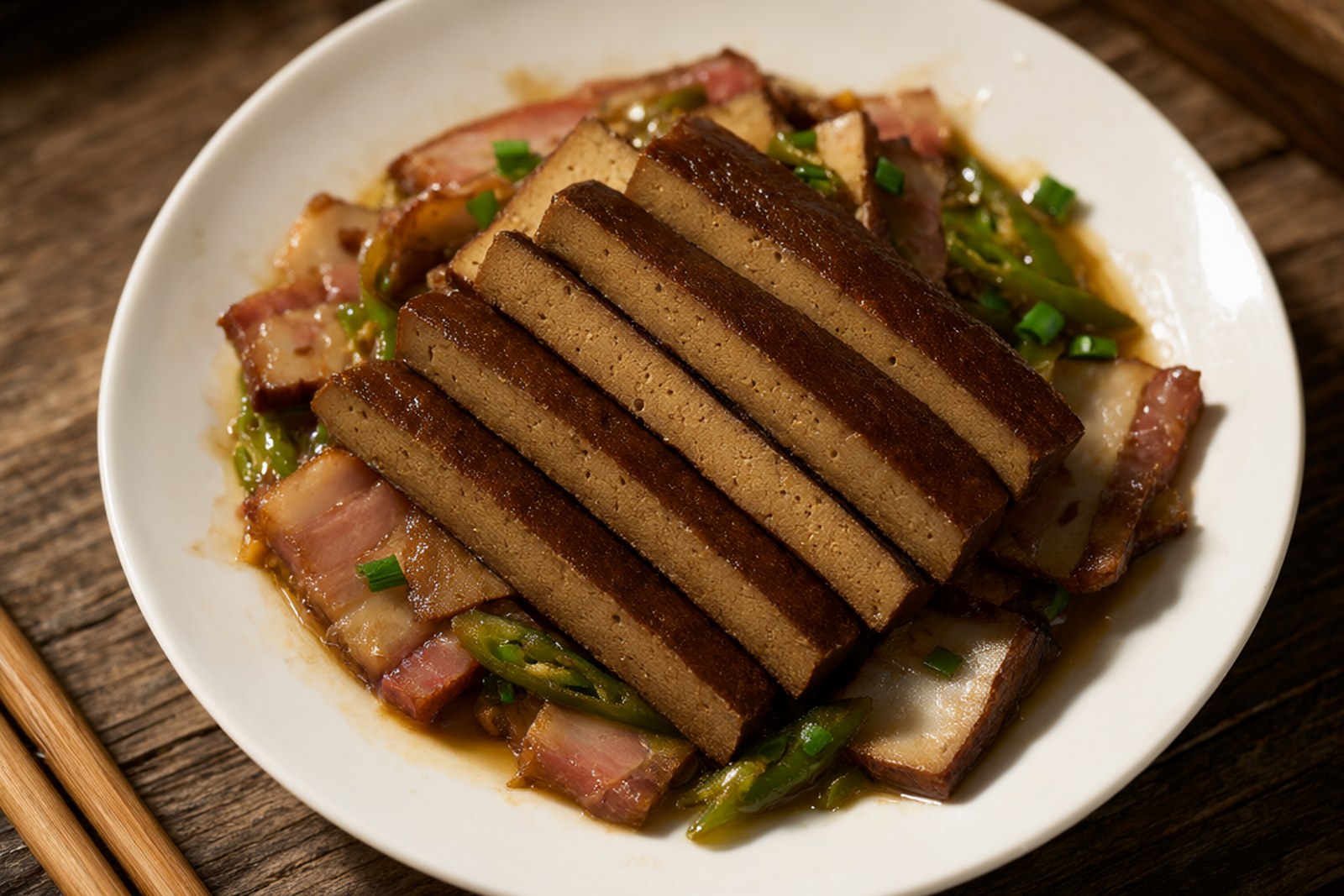
It looks like a mistake in the making. The blocks are the colour of dark tea, brown through and through rather than fried brown on the outside, and when you cut one the interior is dense and slightly rubbery with a faint grilled smell that is not smoke exactly. Sliced thin and fried hard with pork belly and green chilli it squeaks faintly against the teeth, holds its shape in the pan without crumbling, and tastes far more of itself than ordinary bean curd ever does — a concentrated, almost nutty flavour that survives the chilli. 攸县香干 Yōuxiàn xiānggān, the pressed dried tofu of Youxian, is a protected product with a written history going back to the Ming, and it is the single thing that the county is best known for.
攸县 Yōuxiàn is a county in the south of 株洲市 Zhūzhōushì, on the 攸水 Yōushuǐ, and its tofu tradition is old enough to be recorded in the county gazetteer, which says that by the Ming and Qing the product was already known along the Yangtze and the Pearl River valleys and that its method had been preserved without interruption. Two things about the modern product are specified by its geographical indication status, granted as a certification mark in 2021 (the county also holds marks for 攸县豆腐, 攸县麻鸭, 攸县米粉 and 攸县茶油 — it is an unusually well-protected corner of the province). The first is appearance: the blocks are evenly cut with rounded edges, a clear grain, and a golden colour with no off-colour spots. The second is composition: high protein and calcium, a good water ratio, low oil, moderate salt. None of that sounds like cooking, and all of it is the result of the process.
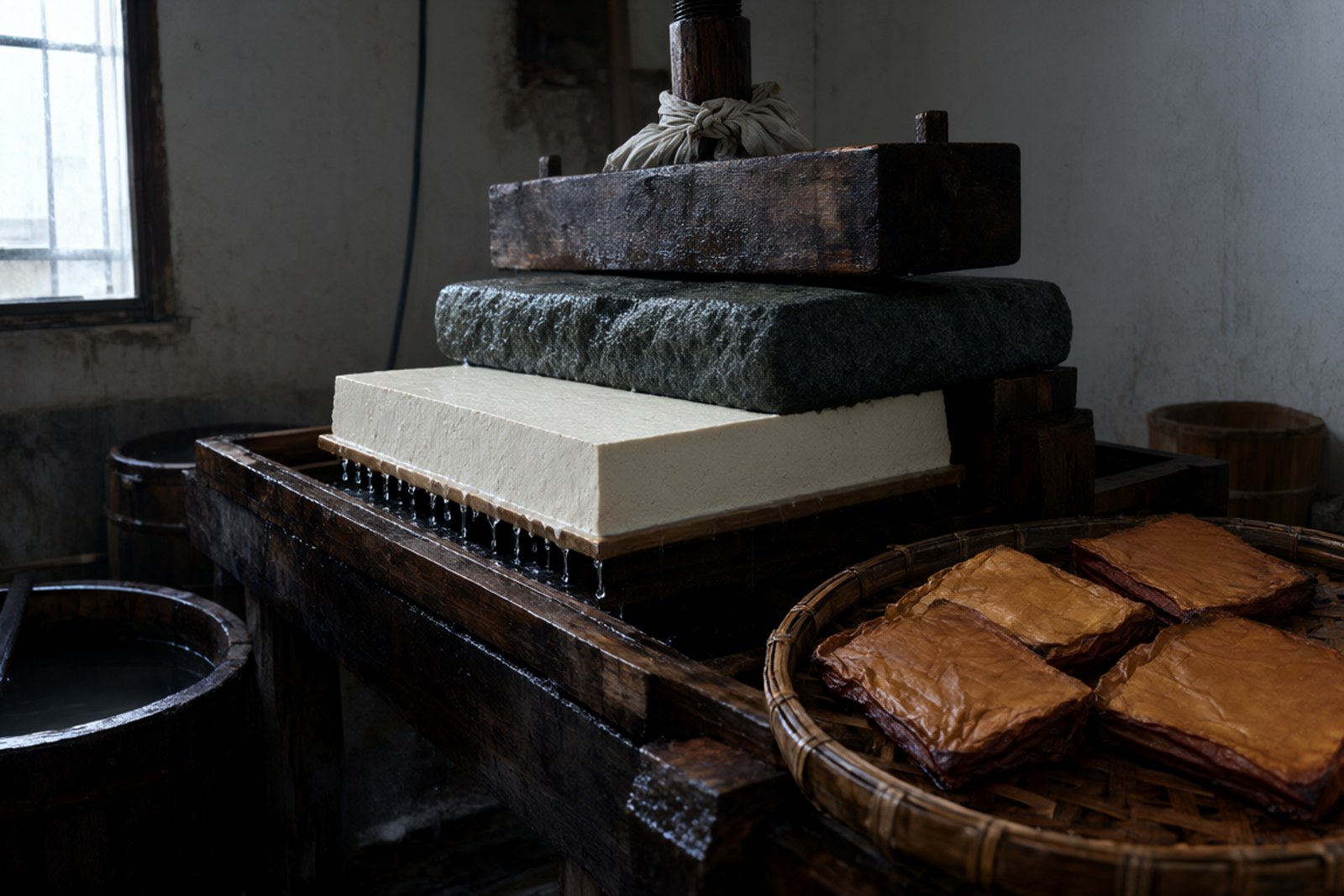
The process is the point. Local soybeans are soaked, ground and boiled in the usual way, then the curd is pressed much harder and for much longer than in ordinary tofu — traditionally under stacked stone slabs, with the cloth-wrapped blocks progressively weighted over several hours until most of the water is out and the texture becomes firm and slightly elastic rather than crumbly. The pressed blocks are then dried, or smoked lightly over a low fire, or both, which is where the brown colour and the faintly toasted aroma come from. What you get is a tofu that behaves like a firm cheese: it can be sliced thin, fried hard, braised for an hour, or cut into strips and eaten cold with chilli oil, and it will not fall apart in any of those situations.
In the kitchen the standard treatment is with pork. Belly pork is rendered until the fat runs, the tofu goes in and fries in it until the edges darken, then green chilli, garlic, a little soy and a splash of stock, and it comes out as a dark, glossy, intensely savoury plate that is served with rice and nothing much else. The other canonical use is cold: sliced, dressed with chilli oil, vinegar, garlic and sesame, and eaten as a drinking snack, which is how it appears in Hunan restaurants nationwide. The industry now employs something close to twenty thousand people directly in the county, and a purpose-built tofu industrial park has been built at 皇图岭 Huángtúlǐng to try to keep it that way.
Words and Names
香干 xiānggān is the general word for pressed, dried, flavoured bean curd — 香 xiāng here carrying the sense of “savoury, aromatic” rather than “fragrant”, and 干 gān meaning dried. It is distinct from 豆腐干 dòufugān, which is plainer and softer, and from 白干 báigān, which is unsmoked. 攸县 Yōuxiàn takes its name from the river, 攸水 Yōushuǐ.
The county is also where 谭震林 Tán Zhènlín, one of the early leaders of the Chinese revolution, was born, and the local literature will mention it. The tofu is older.
What the Locals Know
Buy it from a tofu shop, not a supermarket. The difference between a block made this week in the county and a vacuum-packed one from a factory is the difference between the dish and a photograph of it.
Fry it in pork fat. The tofu is dry and needs fat to come alive. Vegetable oil works and tastes thinner.
Do not over-sauce it. Because the flavour is concentrated, heavy use of soy or bean paste drowns it. Chilli, garlic and a little salt is the traditional approach.
Look at the grain when you cut it. Good 攸县香干 Yōuxiàn xiānggān has a fine, even texture with tiny pores and no large air holes. Loose holes mean it was pressed too fast and it will be crumbly.
Where to Eat It
Everywhere in 攸县 Yōuxiàn, including the county town’s markets where it is sold by weight at ¥10–20 per half kilo, and in the 株洲 Zhūzhōu and 长沙 Chángshā restaurants that make a point of listing the county on the menu. A plate of 香干炒肉 xiānggān chǎo ròu — dried tofu with pork — is ¥25–45 and is the standard introduction.
flowcloud would say that a county whose proudest product is a block of soybeans pressed under stones until nothing is left but flavour has, without meaning to, made an argument about the whole idea of adding things.
Where to find it: 攸县香干 (Yōuxiàn xiānggān), 攸县 (Yōuxiàn), 株洲市 (Zhūzhōushì), 湖南 (Húnán). Market price ¥10–20 per 500g; a restaurant plate of 香干炒肉 (xiānggān chǎo ròu) ¥25–45. Buy from a tofu shop rather than a supermarket and fry it in pork fat.