
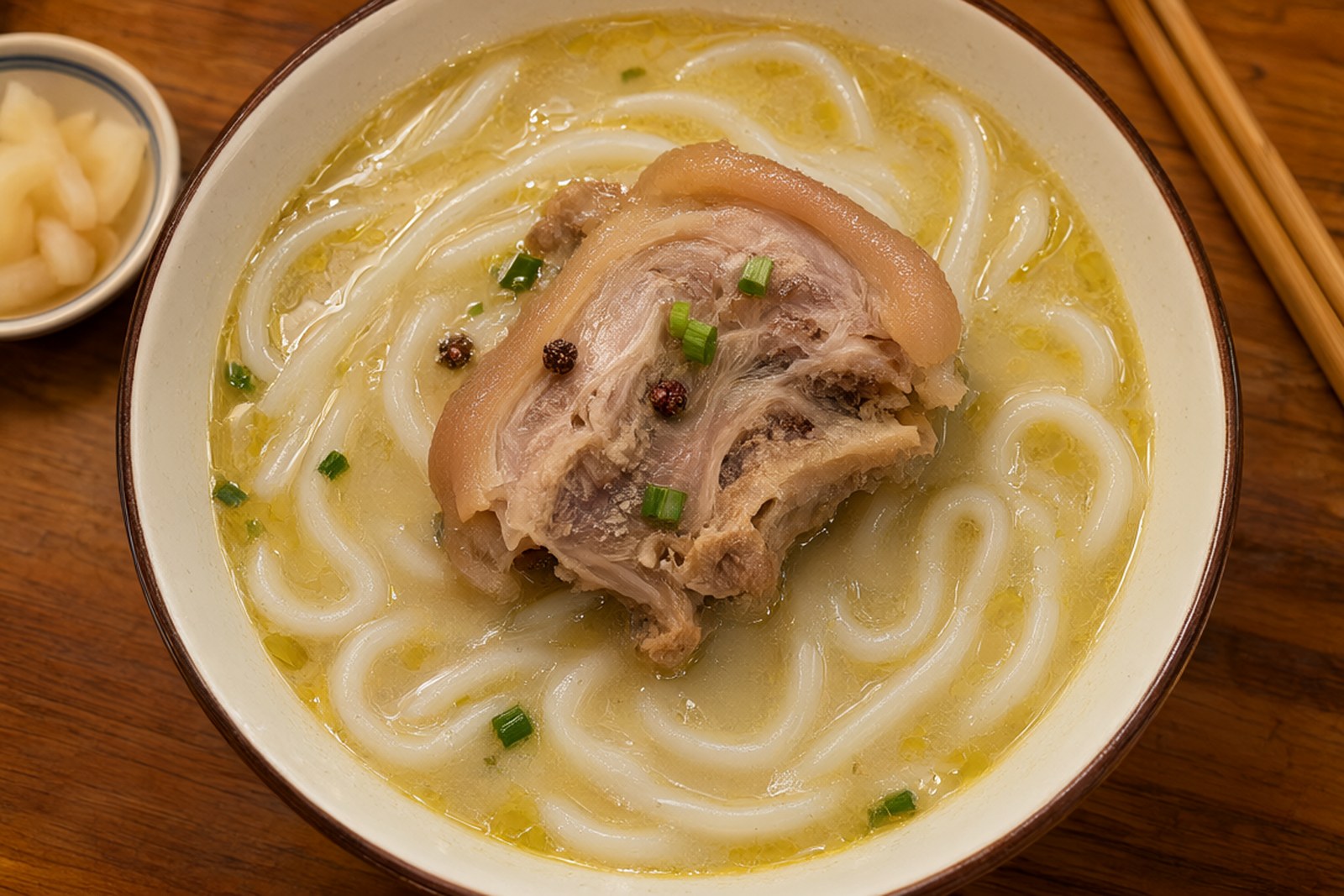
Breakfast in 沅陵 Yuánlíng is a bowl of rice noodles under half a pig’s foot. Not a garnish of pork, not a few shreds: the whole trotter, front or back, stewed for hours until the skin is gelatinous and the meat is one push from the bone, sitting on top of a bowl of round 米粉 mǐfěn with a ladle of its own braising liquid poured over. The broth is not a soup you drink; it is a sauce, thick and slightly tacky at the lip from dissolved collagen, dark with soy and 豆瓣酱 dòubànjiàng, and usually carrying a sweet anise note from 草果 cǎoguǒ and 桂皮 guìpí. There is a bowl of pickles on every table and you are expected to empty a good part of it into your own bowl.
沅陵 Yuánlíng sits where the 沅水 Yuánshuǐ and the 酉水 Yǒushuǐ meet, and for centuries it was the head of navigation on the great river that drains western Hunan into Dongting Lake. Everything that came down out of the mountains — timber, tung oil, hemp, opium — passed through here, and everything going up — salt, cloth, iron — passed through here too. A river town of boatmen and porters needs a breakfast with weight in it, and a pig’s foot is cheaper than pork loin and better than either.
What Makes It Work
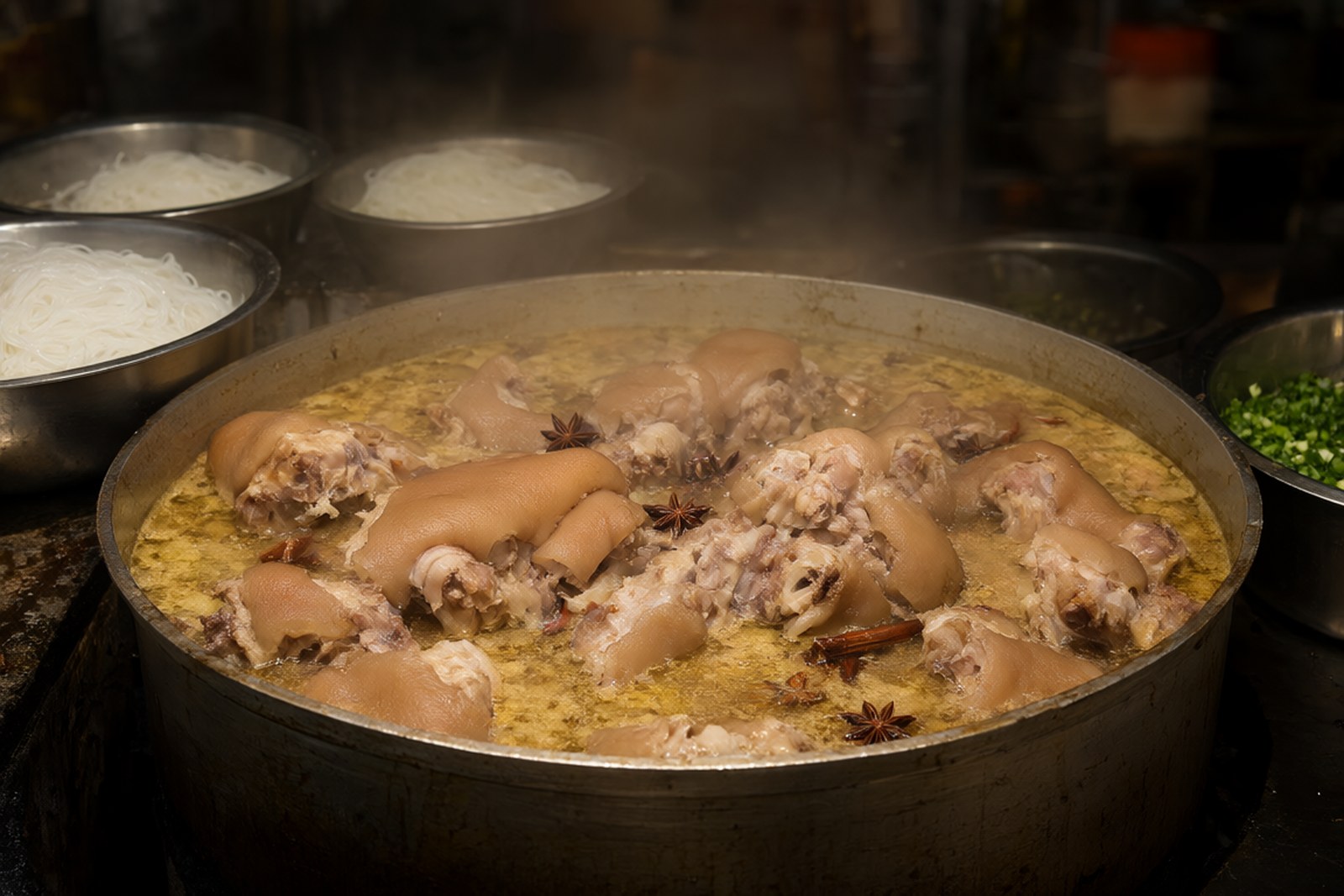
The trotter is bought in the morning and braised the day before. It is cleaned, singed over a flame, chopped into three or four pieces, blanched hard, and then stewed with soy, 豆瓣酱 dòubànjiàng, dried chilli, ginger, star anise, cassia and a small amount of rock sugar for two to three hours, until the skin holds its shape but yields to a spoon. The braising pot is never emptied: each day’s trotters go into yesterday’s liquid, and the best shops have a base that has not been started from scratch in years. Restaurants in 常德 Chángdé and 长沙 Chángshā sell “Yuanling pig-trotter noodles” all over the province, but the ones here are heavier, sourer and much less sweet.
The noodles are fresh 圆粉 yuánfěn, round rice noodles, cooked in a separate pot of plain water and never in the broth, then drained, put in the bowl, and dressed with a ladle of the braise, the trotter on top, and the table pickles — 榨菜 zhàcài, 酸萝卜 suān luóbo, 海带丝 hǎidàisī, peanuts — added by you. A spoon of 香醋 xiāngcù vinegar is customary and, in most shops, expected.
Words and Names
猪脚粉 zhūjiǎo fěn — literally pig-foot noodle. 猪脚板板 zhūjiǎo bǎnbǎn is the local expression for the flat cut of trotter laid across the top, the shape that means you got the good bowl. 沅 Yuán is the river; 陵 líng is a mound or an imperial tomb, and the town is named after a Western Han prince buried on the hill beside it. 辰州 Chénzhōu is the old name for the prefecture, which survives in 辰河戏 Chénhé xì, the local opera, and in 辰砂 chénshā, cinnabar, which was mined here and which gives the town one of its other exports.
The other piece of local geography worth knowing is 二酉山 Èryǒu Shān, the mountain a few kilometres upriver where, by the traditional account, the books that Qin Shi Huang ordered burned were hidden in a cave and thereby survived. 龙兴讲寺 Lóngxīng Jiǎngsì, the temple in the town itself, was founded by imperial decree in 628 and later hosted 王阳明 Wáng Yángmíng, who spent a month here in 1510 and lectured on 致良知 zhì liángzhī, the doctrine of innate moral knowledge, for the first time in public. A bowl of pig’s foot is a fair foundation for a morning of all that.
What the Locals Know
Go before eight. The good trotters are gone by nine; shops that are still open at eleven are selling the second-rate pieces at full price.
Say 加个板板 jiā ge bǎnbǎn. That gets you an extra slab of the flat cut. It costs a few yuan and it is the whole point.
Salt your own bowl. The broth is deliberately undersalted because the pickles are not, and the correct method is to add pickles first and vinegar second.
Do not order it in the evening. This is a morning dish and the town treats it as one; the shops close, mostly, at noon.
Where to Eat It
A bowl with a full trotter runs ¥18–30, and with an extra 板板 perhaps ¥35. The shops cluster around the old streets near 龙兴讲寺 Lóngxīng Jiǎngsì and along the road that follows the river, and the ones with the longest queue at seven in the morning are the ones worth joining. 沅陵站 Yuánlíng Zhàn is on the 沪昆 high-speed line, about ninety minutes from 长沙南 Chángshā Nán; the town itself is a hillside above the river, and most of it can be walked.
flowcloud would say that a town which begins every day with a pig’s foot has made a more honest proposition to its citizens than one that begins with coffee — that something is going to be asked of you today, so eat as though it is.
Where to find it: 猪脚粉 (zhūjiǎo fěn), 沅陵县 (Yuánlíng Xiàn), 怀化市 (Huáihuàshì), 湖南 (Húnán). Best between 06:30 and 08:30 in the old streets near 龙兴讲寺 (Lóngxīng Jiǎngsì). A bowl ¥18–30, extra trotter slab ¥35 all in. Ask for 猪脚板板, add the pickles before the vinegar, and do not come at night.