
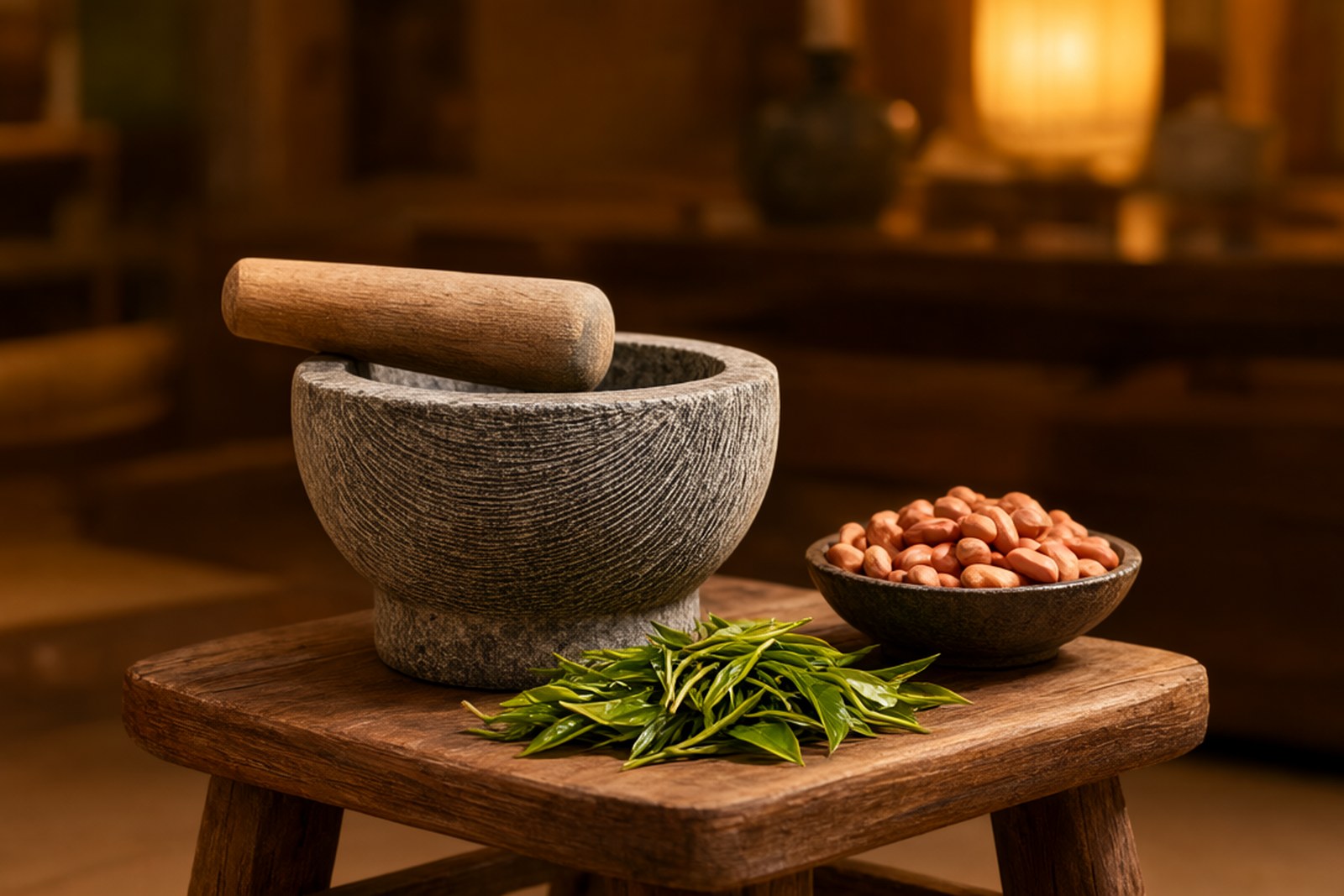
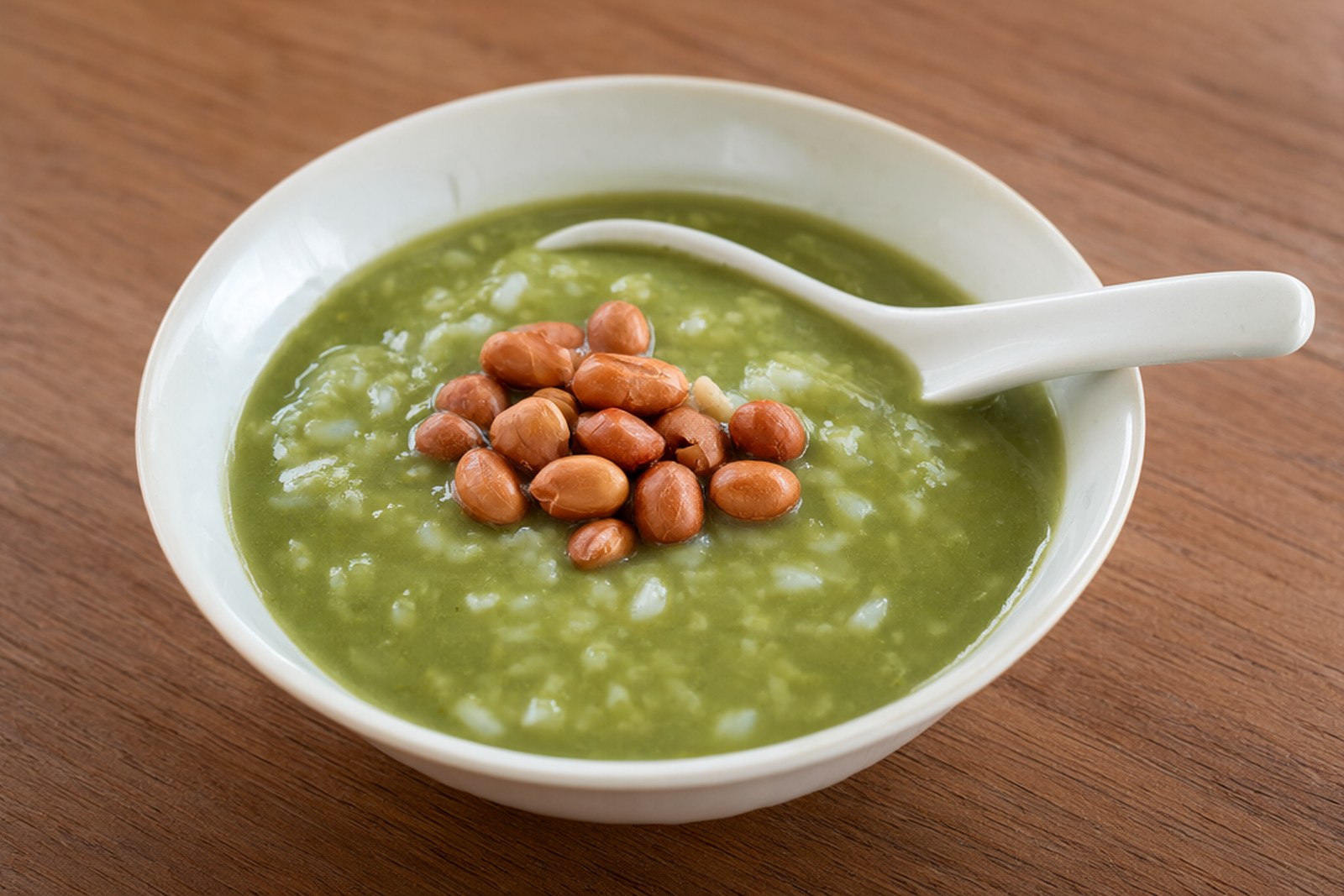
擂茶粥 léi chá zhōu is a bowl that is both tea and rice, and it is the most surprising thing on this list because it is not a dish at all in the ordinary sense but a way of turning a drink into a meal. Green tea is pounded with peanuts, herbs and spices into a thick paste, and that paste is then stirred into a pot of boiled rice gruel until it is a green, faintly bitter, strongly aromatic porridge that is eaten for breakfast out of a bowl with a spoon. 擂 léi is the verb and it means to grind or pound in a mortar, 茶 chá is tea and 粥 zhōu is rice gruel, so the name describes the whole operation in three characters. The dish belongs to the western hills of 云浮市 Yún fú shì – the county’s own papers locate it firmly in 石城镇茶洞 Shí chéng zhèn Chá dòng and the surrounding villages of 托洞 Tuō dòng and 镇安 Zhèn ān in 云安区 Yún ān qū, and it is made across the hill country from there into 郁南县 Yù nán xiàn – and the county’s alternative name for it is 擂味粥 léi wèi zhōu, the pounded-taste gruel, which is a fair description of what it is. It is a breakfast, a farm meal, a thing made for guests at New Year and a thing made for a stomach that needs settling, and the tool that makes it is a heavy stone or clay mortar whose inside is cut with a fine net of grooves so that it grinds rather than just crushes. That mortar is the identity of the dish: a kitchen that has a 牙盆 yá pén, a toothed basin, makes this, and a kitchen that does not makes something else.
The evidence that this is old is unusually good for a hill-village dish, and it comes from a gazetteer and a poem rather than from a marketing sheet. The 清道光《东安县志》 Qīng Dào guāng Dōng ān xiàn zhì, the Daoguang-period gazetteer of Dong’an county, the county that is now part of 云安区, records a spring at 茶洞水口村 Chá dòng Shuǐ kǒu cūn – 龙泉井在茶洞水口村后……地故产茶,嗜茶者每挈瓶远至,乡以是名 Lóng quán jǐng zài Chá dòng Shuǐ kǒu cūn hòu…… dì gù chǎn chá, shì chá zhě měi qiè píng yuǎn zhì, xiāng yǐ shì míng, the Dragon Spring well lies behind Shuikou village in Chadong, the land produces tea, and those who love tea carry their bottles from far away to it, and the township is named for it. That is the name 茶洞 Chá dòng, tea cave or tea hollow, explained by a Qing record: the hills produced real tea, there was a spring worth walking to for it, and the place was called after the drink. The 《云浮县志》 Yún fú xiàn zhì, the county gazetteer’s own section on local customs and food, records that the farmers of 茶洞, 托洞 and 镇安 have eaten 擂味粥 as a matter of habit 历来 lì lái, as long as anyone can remember, and the county’s own line about the depth of the tradition is that the gruel and the tea-growing of the place are 400 多年 sì bǎi duō nián, more than four hundred years old together, which is exactly the span the Daoguang gazetteer supports. The technique was entered on 云浮市 Yún fú shì’s intangible-heritage list of representative items in 2007, under the project name 擂茶粥制作技艺 léi chá zhōu zhì zuò jì yì, the technique of making pounded-tea gruel.
The comparison that matters is with the 擂茶 léi chá of the 客家 Kè jiā, the Hakka, which is the version most people outside the region have heard of, and the difference is not in the pounding but in what happens next. A Hakka 擂茶 is pounded tea with peanuts, sesame, perilla and coriander in it, and it is made into a paste and then 冲开水饮用 chōng kāi shuǐ yǐn yòng, dissolved in boiling water and drunk, sometimes with puffed rice or a bowl of rice on the side and a spread of pickles and vegetables around it. It is a drink and a tea soup, and the pounding is in service of a beverage. The 擂茶粥 of 云安 and 郁南 is a different thing at the last step, and the county’s own description is precise about it: the pounded green paste goes into a clay basin, part of the cooked rice is lifted out of the pot and stirred into the paste until the two are worked together – 捞起粥渣入砂盆与茶糊磨合,再把剩余白粥倒入拌匀 lāo qǐ zhōu zhā rù shā pén yǔ chá hú mó hé, zài bǎ shèng yú bái zhōu dào rù bàn yún, lift the rice grains into the sand basin and work them against the tea paste, then pour in the rest of the gruel and stir it through – and the result is a porridge, a staple food, not a drink. There is no version of the Hakka drink with that step in it, and the reason is probably hunger rather than taste: a hill farmer going out to work needs a breakfast with bulk in it, and a beverage, however nourishing, is not a meal.
The list of ingredients is long, uneven and deliberately variable, and the variation is part of the technique. The base is a pot of plain white rice gruel. The paste is built from tea leaves picked on the hills around 春分 Chūn fēn and 清明 Qīng míng, the equinox and the spring festival in late March and early April, 春分至清明前后采摘的山茶叶 chūn fēn zhì qīng míng qián hòu cǎi zhāi de shān chá yè, hill tea picked around those two terms; from 花生 huā shēng, peanuts, roasted and crushed; and from a shifting handful of aromatics and medicines that the county lists as 砂仁 shā rén, the amomum fruit, 风姜 fēng jiāng, a wild ginger, 小茴 xiǎo huí, fennel seed, 风拳头 fēng quán tóu, a local hill herb, 陈皮 chén pí, dried tangerine peel, 茴香籽 huí xiāng zǐ, 山姜籽 shān jiāng zǐ, 生姜 shēng jiāng, 八角 bā jiǎo, star anise, and 田糙米 tián cāo mǐ, unpolished field rice. No two households use the same list, and the county says so explicitly: each family adds or drops an item to suit its own taste, its own constitution and the season it is cooking in. That is not vagueness, it is the design. The paste is a vehicle for whatever the household believes the body needs in the weather it is in – more ginger in the cold, more 砂仁 when the stomach is off, more tea when the summer is hot – and a recipe fixed in a book would defeat the purpose.
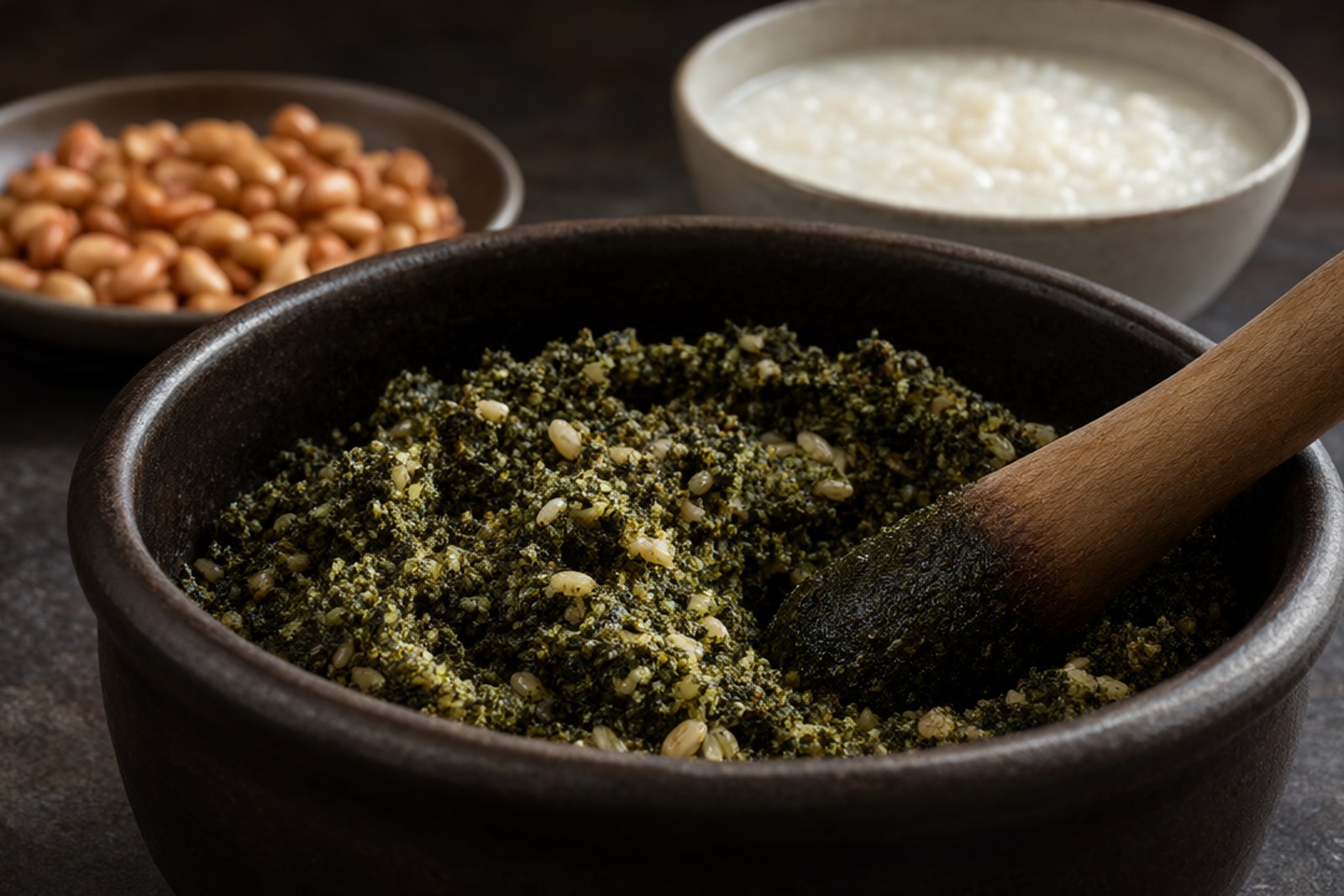
The pounding itself is the physical skill and it is done in the basin with a wooden pounder. The aromatics and the tea and the peanuts go into the 擂盆 léi pén, the pounding basin, whose inner wall is cut with a web of fine grooves and fine teeth, which is why the ordinary name for it is 牙盆 yá pén, the toothed basin; a smooth mortar will crush the ingredients but will not grind them, and the difference in the finished paste is the difference between a gritty suspension and a proper emulsion. A little 花生油 huā shēng yóu, peanut oil, is poured over the dry ingredients and they are pounded until they come together as a smooth, dense, dark-green paste, 细腻浓稠糊状 xì nì nóng chóu hú zhuàng, fine and thick and gluey. The pounder is traditionally cut from 桂树 guì shù, cassia, or 黄牛木 huáng niú mù, and in 云浮 the cassia available is 肉桂 ròu guì, the cinnamon tree the prefecture grows for bark, so the pestle is usually a stick of cassia wood and the county counts the stick itself as part of the recipe, which is a reasonable thing to do because wet cassia wood perfumes what it is grinding. The gruel is cooked separately over a wood fire and deliberately not cooked to softness: the county’s rule is that it should be just at the point of coming up to the surface, 不能煮得太软烂,刚浮上水面即可 bù néng zhǔ de tài ruǎn làn, gāng fú shàng shuǐ miàn jí kě, no softer than that, because the grains have to survive being stirred into the paste. Then the working-together step, then salt, and then the last thing is a handful of roasted peanuts scattered over the top of each bowl, and the dish is served warm. The stated eating order is worth following: the taste is described by the county as a chord of five notes – 陈皮的苦、姜的辣、砂仁的辛、茶叶的甘醇和花生的香脆 chén pí de kǔ, jiāng de là, shā rén de xīn, chá yè de gān chún hé huā shēng de xiāng cuì, the bitterness of the peel, the heat of the ginger, the pungency of the amomum, the sweet mellow depth of the tea and the crispness of the peanut – and the finish is 余味甘甜微带辛辣、齿颊留香 yú wèi gān tián wēi dài xīn là, chǐ jiá liú xiāng, sweet at the back with a little heat, and the taste staying in the mouth.
Why It Is Old, and What It Is For
The reason this dish is worth more attention than a village breakfast usually gets is that it is, in the county’s own phrase and in the judgement of the scholars who have written about it, a 古代茶叶食用方法的遗存 gǔ dài chá yè shí yòng fāng fǎ de yí cún, a survival of the ancient way of eating tea. Until tea became a drink, it was a food. The 晋 Jìn-era commentator 郭璞 Guō Pú, glossing the character 槚 jiǎ, one of the old words for tea, in the 《尔雅》 Ěr yǎ, wrote 树小如栀子,冬生叶,可煮羹饮 shù xiǎo rú zhī zǐ, dōng shēng yè, kě zhǔ gēng yǐn, a tree small like a gardenia, its leaves produced in winter, and it can be boiled into a soup and drunk. The 唐 Táng writer 杨晔 Yáng Yè, in the 《膳夫经手录》 Shàn fū jīng shǒu lù, put it more bluntly: 茶,古不闻食之,近晋宋以降,吴人采其叶煮,是为茗粥 chá, gǔ bù wén shí zhī, jìn Jìn Sòng yǐ jiàng, Wú rén cǎi qí yè zhǔ, shì wéi míng zhōu, tea was not eaten in antiquity, and from the Jin and the Song dynasties onward the people of Wu have picked its leaves and boiled them, and that is called 茗粥 míng zhōu, tea gruel. 茗粥 is the exact ancestor of what a pot in 茶洞 holds: tea boiled into a food, with pepper and ginger and other aromatics added to it, which is precisely the function the 砂仁 shā rén, the 风姜 fēng jiāng and the 陈皮 chén pí are serving in the modern dish. That an eighth-century writer named the thing this county still makes for breakfast and that a Qing gazetteer records the hills that grew the leaf is a chain of evidence that most regional foods cannot produce, and it is the reason the dish is interesting beyond its own valley.
What it is for, in the county’s account, is a list of practical jobs. It is a breakfast for people who are going out to work in the hills, because a pot of it is cheap, is made from what a household grows, and has both the volume of rice and the stimulant of tea in the same bowl. It is 开胃养胃 kāi wèi yǎng wèi, appetite-opening and stomach-soothing, and the county recommends it specifically for 胃寒者 wèi hán zhě, people with a cold stomach, which is why the ginger and the amomum are in it. It is 清热解暑 qīng rè jiě shǔ, cooling and heat-clearing, which is what the hill people want in a Guangdong summer, and the same dish with more tea and less ginger does that job. It is what a household makes when guests arrive, a 逢年过节或亲友到来 féng nián guò jié huò qīn yǒu dào lái, at New Year or when friends and relatives come, which is the usual fate of a food that costs more work than money, and it is demonstrated at public events: the 花生文化系列活动 huā shēng wén huà xì liè huó dòng, the peanut culture festivals of 富林镇 Fù lín zhèn in 云安区, include a live making of the gruel, which is where a visitor is most likely to see the whole thing done properly in one place.
Words and Names
擂茶粥 léi chá zhōu is the dish: 擂 léi to pound in a mortar, 茶 chá tea, 粥 zhōu rice gruel. 擂味粥 léi wèi zhōu, the pounded-taste gruel, is the everyday name. 擂盆 léi pén is the pounding basin and 牙盆 yá pén, the toothed basin, is what it is called because of the grooves cut into its inner wall; the pounder is traditionally cut from 桂树 guì shù, cassia, or 黄牛木 huáng niú mù. 茶洞 Chá dòng, tea hollow, is the district of 石城镇 Shí chéng zhèn where the dish is centred, and 龙泉井 Lóng quán jǐng, the Dragon Spring, is the well the Daoguang gazetteer records behind 水口村 Shuǐ kǒu cūn. 砂仁 shā rén is the amomum fruit and 风姜 fēng jiāng the wild ginger in the paste, 陈皮 chén pí is dried tangerine peel, and 茗粥 míng zhōu, tea gruel, is the Tang name for the thing this dish descends from.
What the Locals Know
Expect bitter. The first mouthful of a real 擂茶粥 is a surprise to anyone raised on sweet breakfasts, because the tea is at the front of it and there is a definite edge of the peel and the amomum behind it; the sweetness and the peanut come afterwards, and the county’s own description of the finish is exactly that. Eat it with a spoon out of a bowl and eat it warm rather than hot, and eat the peanuts on the surface while they still have their crunch, because they are the textural counterweight and once they have sunk they are gone. It is a breakfast and the local time to eat it is early, before the day gets hot. If you are being given it by a household, know that no two versions taste the same and that this is the point rather than a deficiency: the recipe is adjusted to the season and the person, and a host who makes it milder for a visitor who looks doubtful is exercising the same judgement. A good bowl is thick enough to hold a spoon upright for a moment, with visible grains of rice in a green suspension and a smell of roasted peanut and fresh tea leaf; one that is thin and watery is a gruel with tea flavouring rather than a proper 擂茶粥, and one that is smooth and even in colour with no grains at all was worked too hard. The other thing worth knowing is the thing that separates it from the Hakka dish if you have had that: this is a staple, so it is a meal and not a drink, and a bowl of it will hold you until lunch. It does not keep; it wants to be made and eaten the same morning, and a bowl that has sat for hours separates. If you want to taste it without a household to visit, the county’s peanut festivals at 富林镇 Fù lín zhèn run demonstrations, and the hill restaurants of 茶洞 Chá dòng in 云安区 Yún ān qū make it for breakfast for anyone who asks; ask before you go, because a dish that takes a pot of gruel and a session with a mortar is not something a kitchen will make at short notice.
flowcloud would say that the most interesting thing about 擂茶粥 is that it is a bowl of soup that has been eaten every morning in these hills since before tea was a drink, and that the only thing a modern kitchen has to add to an eighth-century description of tea gruel is a bag of peanuts.
Where to find it: the hill villages around 茶洞 Chá dòng in 石城镇 Shí chéng zhèn in 云安区 Yún ān qū, with 托洞 Tuō dòng and 镇安 Zhèn ān alongside it, which are the places the county gazetteer names; the farmhouse kitchens of 郁南县 Yù nán xiàn and the rest of the hill country of 云浮市 Yún fú shì where it is made for guests; and the food demonstrations at the peanut culture festivals of 富林镇 Fù lín zhèn, which are the reliable public place to watch a basin being worked. 云安区 lies immediately south of 云浮市区 Yún fú shì qū and the hills are twenty to forty minutes by road from the city centre; 郁南 is another hour and a half further west along the 西江 Xī jiāng. It is a breakfast and it is cooked early, so arrange it the day before if you want to eat it properly rather than see it made, and understand that the version you are given will have been adjusted for you, which is the local way of being polite.