
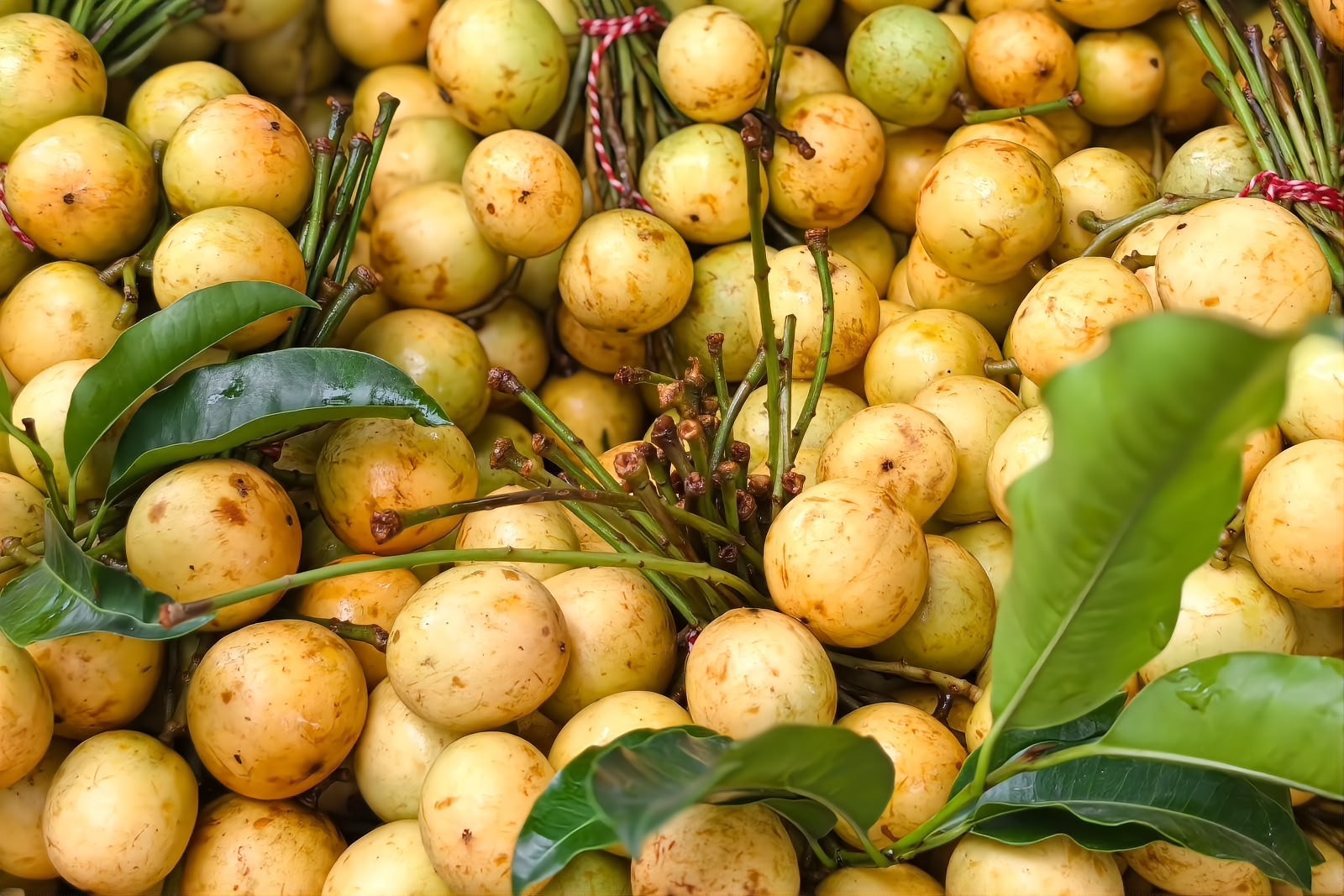
黄皮 huáng pí, the wampee, is a small yellow fruit of the southern Chinese summer that almost nobody outside the region has tasted, and the seedless form of it belongs to one county. 无核黄皮 wú hé huáng pí, the pitless wampee, is the fruit of 郁南县 Yù nán xiàn, in the south-west of 云浮市 Yún fú shì, and the botanical name is Clausena lansium, a member of the rue family and a relative of the citrus rather than of anything called a plum. The fruit is the size of a large grape, with a thin, slightly leathery, translucent skin, a pale amber flesh in two or three segments, and a taste that sits between a mandarin and a gooseberry with a resinous edge that is entirely its own; the local word for the character of it is 正气 zhèng qì, upright air, which is what the county calls a fruit it regards as medicine as much as food. A wampee in general has three or four green seeds in the middle. This one has almost none – the county’s own figure is a seedless rate above 95 per cent, 无核率达 95% 以上 wú hé lǜ dá jiǔ shí wǔ fēn zhī yǐ shàng, and an edible proportion of 79.4 per cent, 可食率 79.4% – and every seedless wampee tree in the world outside this county traces back to two old trees that are still standing in a garden in 建城镇 Jiàn chéng zhèn. The fruit is picked over a fortnight and a half in July and August and it does not travel well at full ripeness, which is why an article about it has to begin with the trees rather than with the taste.
Those two trees are the whole of the story and their dates are worth getting right. The garden is 干园 Gān yuán, the Gan Garden, at 建城镇 Jiàn chéng zhèn, and the man who planted it was 曾迺桢 Zēng Nǎi zhēn, also written 曾乃桢, a native of the town who had served as the magistrate of 乐昌县 Lè chāng xiàn in the last years of the Qing and the first of the Republic. Having left office he came home and built the garden, and in it he planted wampee trees. The county’s own gazetteer, the 《郁南县志》 Yù nán xiàn zhì, dates the planting to 民国 23 年 Mín guó èr shí sān nián, the twenty-third year of the Republic, which is 1934: 两株母本树为曾迺桢于民国 23 年(1934 年)在自建「干园」内种植 liǎng zhū mǔ běn shù wéi Zēng Nǎi zhēn yú Mín guó èr shí sān nián (1934 nián) zài zì jiàn Gān yuán nèi zhòng zhí, the two mother trees were planted by Zeng Naizhen in 1934 in the garden he built himself. Several of the province’s newspapers, writing the same story, give 1932 for the building of the garden; where the two disagree this article follows the gazetteer and prints 1934, and notes that the gap between the accounts is two years and not a century. Four years on, around 1936, the trees fruited, and two of them – the ones that are still there – were noticed at once to be different: the fruit was large, sweet with a sour edge, and had no seed in it. That the county’s entire modern fruit industry descends from two trees in one man’s garden is not a promotional flourish; it is what the breeding record shows, and the garden’s surviving trees are treated accordingly.
For a quarter of a century nothing much happened to them beyond the garden wall. What lifted the fruit into public knowledge was a provincial survey, and here too there are two accounts: the provincial government’s local-records office says the seedless wampee was found in a survey of the province’s fruit resources in 1960, and the county gazetteer and the horticultural work behind it put the discovery in 1964, when specialists from the provincial academy of agricultural sciences’ fruit-tree institute came through on a survey. Rather than choose, this article reports the decade and both versions, as the county’s own material does: it was identified in the 1960s, in one account 1960 and in another 1964, when the province was cataloguing what grew where. What followed is a list of dates and the list is the reason the fruit has the position it does. In 1986 the fruit was entered in the province’s second appraisal of rare and superior fruits and took first place on the total score, 获总分第一 huò zǒng fēn dì yī, and was named a 广东省优质品种 Guǎng dōng shěng yōu zhì pǐn zhǒng, a superior variety of Guangdong. In 1987 the county built a seedling nursery for the seedless wampee, and in 1988 it established budding bases at 建城 Jiàn chéng, the 河口农场 Hé kǒu nóng chǎng and 都城 Dū chéng. In 1988 the county had fifty-five trees in bearing and a crop of three hundred kilos, which is the size of the beginning and worth holding on to. From 1989 the planting went to scale. By 2000 the county had 453.33 hectares under the fruit and a crop of 2575 tonnes, and in 2004 the national quality inspection administration recognised 郁南无核黄皮 as a national geographical-indication product, which is the point at which a county fruit becomes a protected name.
The two mother trees are still worked, and the numbers attached to them are the most striking in the county’s material. 干园 Gān yuán yields about 200,000 cuttings a year, 每年可提供优质接穗 20 万条 měi nián kě tí gōng yōu zhì jiē suì èr shí wàn tiáo, which is the propagation material that the county’s nurseries graft onto rootstock, and the township those cuttings supply has more than 72,000 亩 mǔ under the fruit. The two problems the industry has spent years on are physical and both are named in the county’s own account: 裂果 liè guǒ, fruit that splits on the tree when the rain comes after a dry spell, and 日灼 rì zhuó, sunburn on the exposed shoulder of the fruit, and the county’s figures for the reduction achieved are a splitting rate brought down to 13 per cent and a sunburn rate to 10 per cent. A newer line of 华蜜 Huá mì varieties has stretched the picking season from about a fortnight into more than two months, which for a fruit whose season is its whole commercial weakness is the single most important thing anyone has done to it. The specifications of the fruit itself, as published, are an average single-fruit weight of 12 grams with a maximum of 29.3, a soluble solids content of 18.6 per cent, a solids-to-acid ratio of 10.7 to 1, citric acid at 1.74 per cent and vitamin C at 43.8 milligrams per hundred millilitres of juice. The shape the trade insists on is the 鸡心型 jī xīn xíng, the chicken-heart shape, which is a broad shoulder tapering to a point and is what a buyer looks for; a round one is a different tree.
The County and the Trade
郁南县 sits on the south bank of the middle 西江 Xī jiāng, the West River, in the far west of the prefecture where Guangdong meets Guangxi; the hills behind it are the last ridges of the 南岭 Nán lǐng, the soil is rich in selenium and potassium, and the county’s forest cover is 72.48 per cent, which is why it is nicknamed the green lung of Guangdong. It calls itself, with a straight face, the 广东大西关 Guǎng dōng Dà xī guān, the great west gate of the province, which is the same phrase 云浮 uses about itself, and for the same reason: this is where the province stops. In wampee terms it has no rival, and the county’s slogan puts it as 全球黄皮看中国,中国黄皮看郁南 quán qiú huáng pí kàn Zhōng guó, Zhōng guó huáng pí kàn Yù nán, for wampee look to China, and for Chinese wampee look to Yunan. The fruit’s own position is stated as the only place in the world where the seedless form originated and its largest producing area. The acreage and the value move every single year and must always be dated, which is why this article handles them one year at a time. In 2022 the county’s output value for the fruit was about 3.2 billion yuan and the brand was valued at 4.46 billion. In 2023 the county reported 192,000 亩 mǔ planted, 160,000 of them in bearing, with an expected crop of 100,000 tonnes; a separate and larger figure from the same period gives about 11.52 million trees and 225,000 亩, with the claim that this is three quarters of the world’s total. The most recent official figures, from the county government and the national news agency in 2025, are 197,000 亩 mǔ under the fruit, a crop of 140,000 tonnes, and a whole-chain output value of about 8.1 billion yuan, with the county growing three quarters of the world’s wampee, 占全球四分之三 zhàn quán qiú sì fēn zhī sān. The three-quarter figure is a real one and it is also the kind of number that only means something with a date on it, because the denominator moves too.
The use of the fruit in Chinese medicine is the half of its reputation that the county talks about first, and there is an old text behind it. The 《本草纲目》 Běn cǎo gāng mù, the great sixteenth-century materia medica of 李时珍 Lǐ Shí zhēn, records that the wampee 健脾胃、化痰止咳 jiàn pí wèi, huà tán zhǐ ké, strengthens the stomach and spleen and clears phlegm and stops coughing, and the county’s own fuller list of what it is good for runs through 消食健胃 xiāo shí jiàn wèi, digesting food and strengthening the stomach, 理气健脾 lǐ qì jiàn pí, moving the qi and tonifying the spleen, 行气止痛 xíng qì zhǐ tòng, moving qi and stopping pain, 消痰化气 xiāo tán huà qì, 润肺止咳 rùn fèi zhǐ ké, moistening the lung and stopping cough, 去疳积 qù gān jī, the wasting condition of malnourished children, and 生津解渴 shēng jīn jiě kě, generating fluids and slaking thirst. Both the fruit and the leaf are collected in the Guangdong provincial standard for Chinese medicinal materials, which is a formal statement that they are used as medicine, and the local nickname for the fruit is 正气果 zhèng qì guǒ, the upright-air fruit, which is what a Cantonese household calls something it eats because it is good for you. The fresh fruit is eaten out of the hand, but it is also eaten salted, dried and sugared, and stewed with pork as a soup, and the leaf is used in a decoction for coughs.
The processing side of the industry has grown behind the fresh fruit. The county’s own figure for the range of products made from wampee is between 42 and 50, running from 黄皮饼 huáng pí bǐng, the wampee cake, and 蜜饯 mì jiàn, candied wampee, through wampee wine and NFC juice to wampee essential oil; the annual processing capacity is over 20,000 tonnes; and there is a provincial modern agriculture park for the fruit. The showcase is the 世界黄皮公园 Shì jiè huáng pí gōng yuán, the World Wampee Park, at 建城镇 Jiàn chéng zhèn, which the county says receives more than a hundred thousand visitors a year and which is built around the surviving garden and the trees in it; the fruit also has a cartoon mascot, 黄小希 Huáng Xiǎo xī, and the industry is credited with raising the incomes of close to fifty thousand farming households. The fruit picked in July and August is at its best eaten within a day or two of coming off the tree, and the county’s own account of the season is a window from the middle of July into the middle of August, 7 月中下旬上市,7 月中旬至 8 月中旬结果 qī yuè zhōng xià xún shàng shì, qī yuè zhōng xún zhì bā yuè zhōng xún jié guǒ. Cumulative provincial and national honours for the fruit come to twenty-five, of which the ones worth naming are the geographical indication of 2004, the title 中华名果 Zhōng huá míng guǒ, famous fruit of China, and its inclusion in the first national list of famous, special and excellent new agricultural products in May 2020.
Words and Names
无核黄皮 wú hé huáng pí is the fruit: 无 wú without, 核 hé a stone or pit, 黄 huáng yellow, 皮 pí skin, so the pitless yellow-skin, the wampee. 干园 Gān yuán is the garden at 建城镇 Jiàn chéng zhèn where the two mother trees stand, and 曾迺桢 Zēng Nǎi zhēn, sometimes written 曾乃桢, is the man who planted them in 1934. 鸡心型 jī xīn xíng is the chicken-heart shape the trade requires, 接穗 jiē suì is the cutting material taken from the mother trees, and 裂果 liè guǒ and 日灼 rì zhuó are the splitting and the sunburn the growers work against. 正气果 zhèng qì guǒ, the upright-air fruit, is the household name for it, and 世界黄皮公园 Shì jiè huáng pí gōng yuán is the park the county has built around the garden.
What the Locals Know
Buy them in July and into the middle of August and eat them within a day or two, because this is a fruit that goes soft and loses its perfume very quickly. A good one is the shape of a chicken heart, broad at the stem and tapering to a point, with a thin skin you can see the flesh through, and it should be firm, heavy for its size and dry to the touch. The taste is the thing to learn and the reason so many visitors are surprised: the flesh is sweet and slightly sour, and between them there is a resinous, faintly turpentine note that is not a fault and is not present in any fruit a European eater is likely to know – the skin carries most of it and the local habit is to chew the skin rather than peel it, because peeling the fruit removes a great deal of what makes it interesting. Spit the seeds if you get any, and if you get none, that is what you paid for. The traditional household uses are worth knowing because they are part of why the fruit is called medicine: a few stewed with pork make a soup for a cough; salted and dried they keep for a year and are eaten one at a time for a stomach that has been overfed; and a handful eaten after a heavy meal is the local answer to indigestion. The leaf is used in a decoction and the county will tell you it is as much a part of the plant’s value as the fruit. Do not buy a wampee in a supermarket outside southern China and expect this fruit; what is exported is the processed version, and the fresh fruit, which is the point of the county, is a thing you have to come to the county for. If you are there in season, go to 建城镇 Jiàn chéng zhèn and stand in front of the two trees, because a fruit industry that runs to 197,000 亩 mǔ and 8.1 billion yuan as of 2025 and descends from two trees in a garden is not a story that happens often.
flowcloud would say that the most interesting thing about 郁南无核黄皮 is that every one of the hundreds of millions of these fruit trees in the world is descended from two trees in one retired magistrate’s garden, and that the county’s real achievement is not the fruit but the fact that it noticed them.
Where to find it: the orchards and the World Wampee Park at 建城镇 Jiàn chéng zhèn in 郁南县 Yù nán xiàn, above all the garden 干园 Gān yuán and the two surviving mother trees; the other producing townships of 河口镇 Hé kǒu zhèn and 都城镇 Dū chéng zhèn; the county’s fruit markets during the July to August season; and the processing shops that sell the cakes, the liquorice-cured wampee and the juice all year. 郁南 is in the far west of 云浮市 Yún fú shì, on the south bank of the 西江 Xī jiāng, about an hour and a half by road from 云浮市区 and reached by bus or car along the river corridor. Come in the second half of July or the first half of August for the fresh fruit, ask for the county’s own name 无核黄皮 wú hé huáng pí rather than a generic wampee, buy the chicken-heart shaped ones, and take the processed products home rather than the fresh ones, because a fresh wampee is a fruit to be eaten in the shade of the tree it came from.