
The morning of 渝中区 Yúzhōng Qū Yuzhong District has more than one bowl – Chongqing is a municipality of southwest China, and Yuzhong is its central district on the peninsula where the Yangtze meets the Jialing River – and the two subjects of this page are the ones no ordering code covers: 熨斗糕 yùndǒugāo, flatiron cakes, rice cakes griddled in small iron moulds shaped like the laundry iron they are named for; and 油茶 yóuchá, “oil tea”, a thick savoury rice paste under fried dough that contains no tea at all. Neither dish is on any heritage list, and the absence is the point of the page: this is the morning of the city’s unlisted kitchens, written as a record while the trade is still at the kerb.
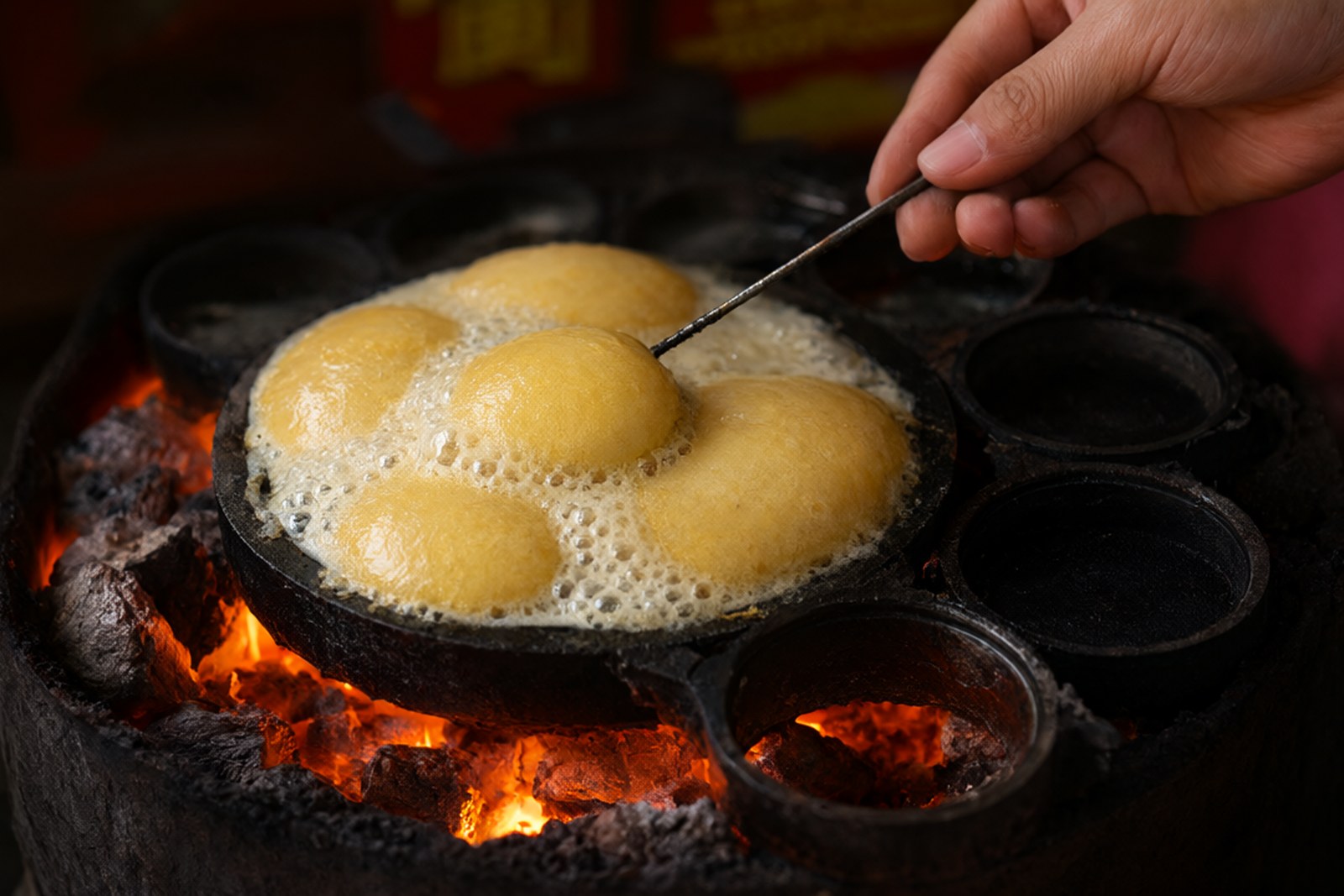
The flatiron cake is named after its tool. A dozen or so small iron cans, each about ten centimetres across and five deep, crowd a stove; the batter is rice soaked for hours, steamed and ground, set with a leaven, cut with alkaline water against sourness, enriched with egg and cooked lard, sweet with osmanthus or savoury with minced pork and bean sprouts; each mould is brushed with water and oil, filled, lidded, loosened with an iron pick, turned, drizzled with lard and griddled until both faces are gold. The cake eats hot, fragrant, crisp and tender – a crackling shell over a molten middle, straight off the iron and too hot to wait for. The folk story runs that the cake came down from the palace kitchens of the Ming, and it is told as a story here and nowhere else; the cake is also an old street food of Sichuan found well beyond Chongqing, so the peninsula’s claim is not the recipe but the living trade of it.
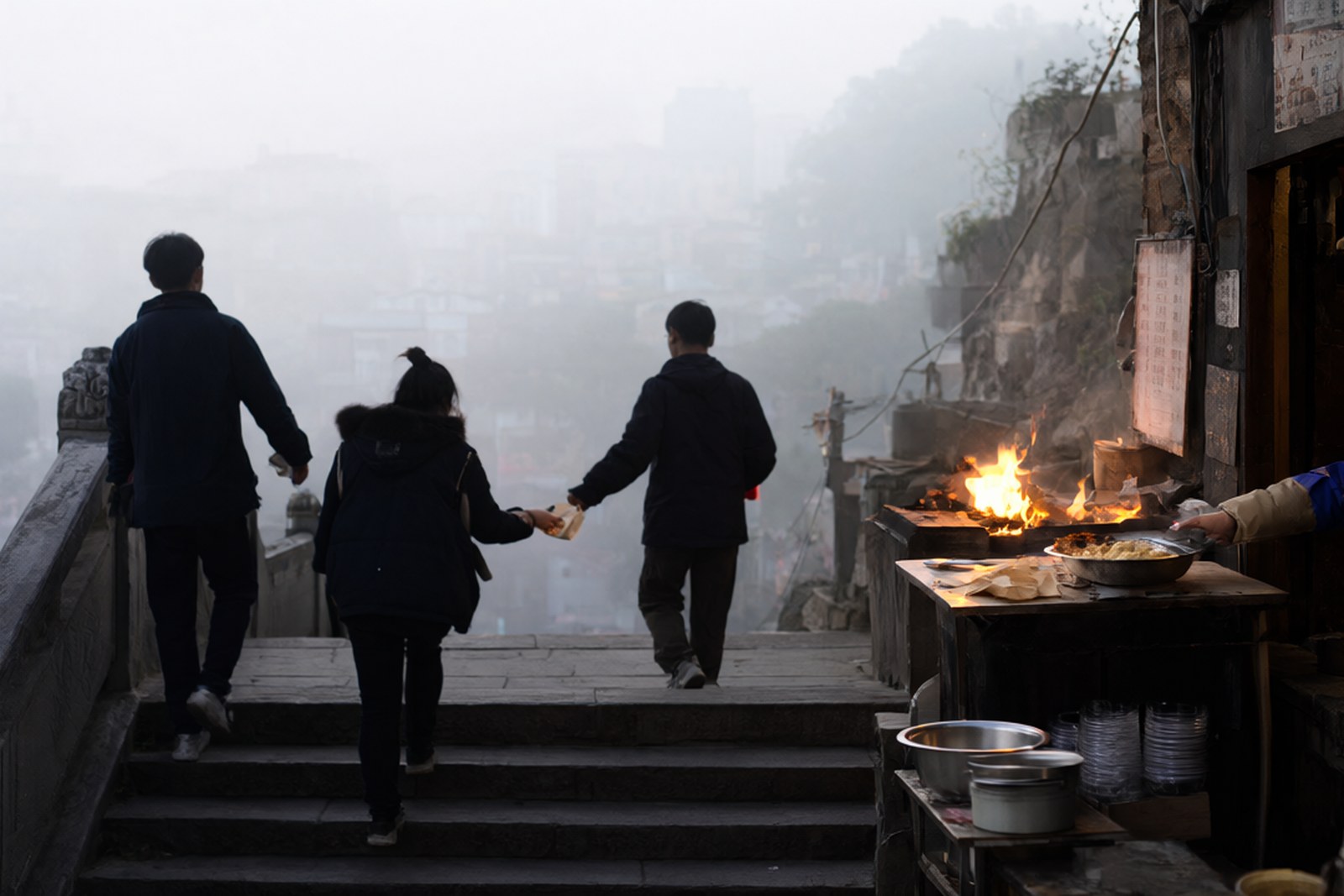
What the district does hold is a maker: 冉少文 Rǎn Shàowén Ran Shaowen learned the white-case pastry trade in 1976, took over an older master’s flatiron moulds in 1986, worked the river towns for years – the cakes went for two mao apiece back then, he recalls – and since 1998 has kept his stall at the foot of the 张家花园 Zhāngjiāhuāyuán Zhangjiahuayuan stairway, thirty years at one craft on one corner. The tongs he works the moulds with were hand-forged by a blacksmith, and nothing about the set-up is manufactured. City reporters who follow the trade describe the flatiron cake as thinning on the streets of the modern city, and the page keeps their word: this is a record, not a recommendation.
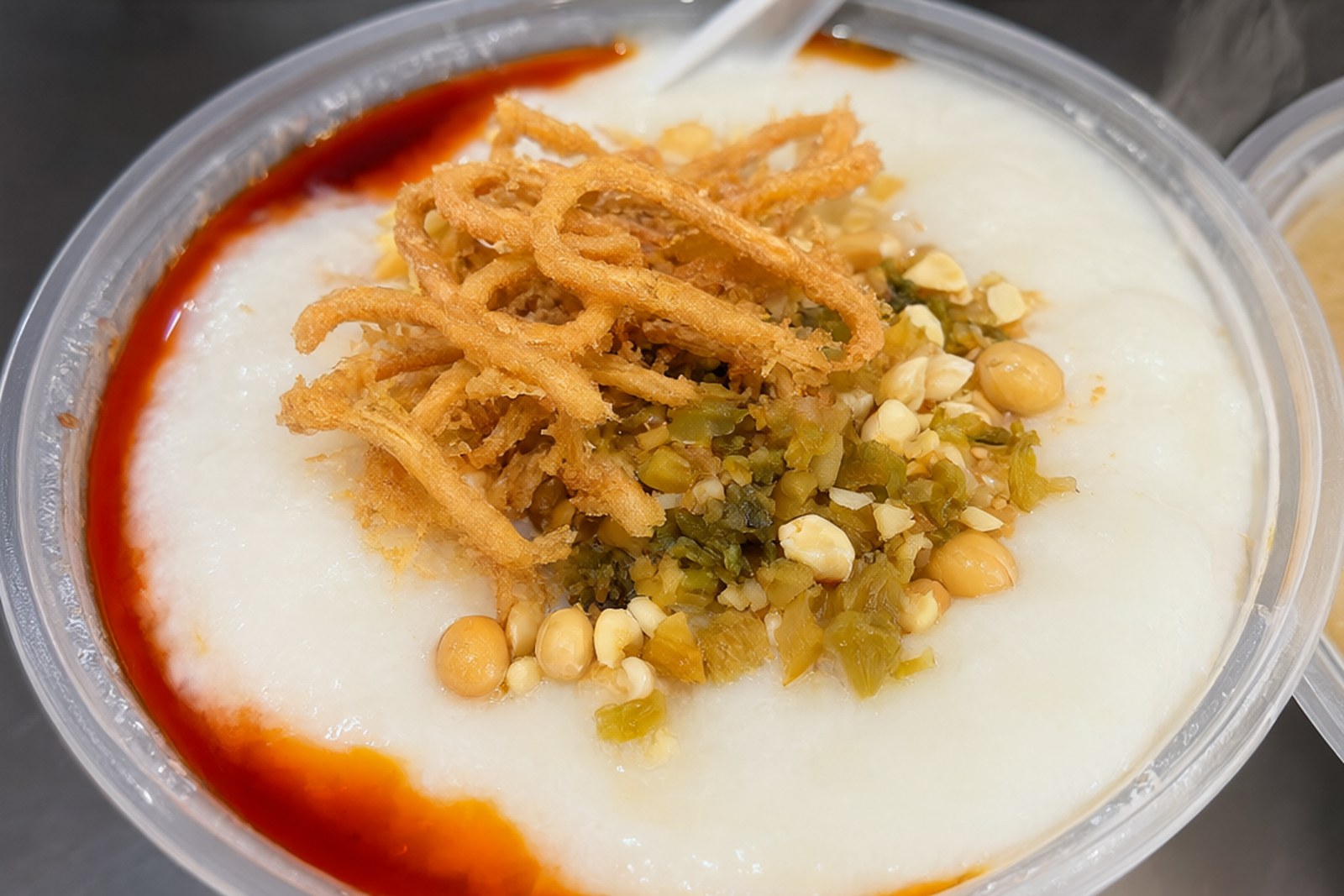
Urban 油茶 yóuchá has no tea in it. The base is rice paste, ground and boiled thick; over it goes a raft of 馓子 sǎnzi, deep-fried dough strands that crackle against the soft paste, then fried soybeans, crushed peanuts, diced preserved mustard, scallion, soy sauce and a rim of chilli oil – a savoury porridge built for a commute, eaten standing with the bowl in one hand. The name collides with two other things, and the collision is worth one sentence: in Nanchuan, south of the city, 大有油茶 Dàyòu yóuchá is a genuine tea broth thickened with cured-pork fat and entered on its district’s heritage list in 2014, and in Wulong the name belongs to a Gelao tea soup; neither is the urban sanzi oil tea this page covers, which is the plain breakfast of the city’s own river districts. Down the river in one of those districts a stall has ladled it since 1995 and counts three hundred bowls on an ordinary morning, grinding its rice fresh before dawn and discarding any sanzi gone soft – an ecology, not a monument, and the same ecology holds at the kerbs of this district.
Elsewhere on this site, Chongqing xiaomian is the breakfast with a code – a dozen seasonings ordered in a phrase at the counter. This is the morning without a code: a rice cake named after a laundry iron, and a bowl of “oil tea” that contains no tea, ordered by pointing, at stalls whose whole menu fits on one wooden board. It is not a tea food either – against the ground-tea bowls of the Hakka and the lei-cha family this is rice paste and fried dough, no tea leaf anywhere in it – and it is not the sweet of Bayi Road: the tangyuan there are the dessert you eat after the hot bowl; the flatiron cake is the hot-sweet you eat before anything else, straight off the iron. A third sibling, 三角粑 sānjiǎobā, the triangle griddled rice cake of the same iron-mould family, takes its one sentence here. Street breakfast costs coins, not notes (2026-10 snapshot, fluctuating), and neither dish on this page holds any heritage title – the city’s listed dishes have their own pages.
Words and Names
熨斗糕 yùndǒugāo is the flatiron cake, named for the iron it is cooked in, and 三角粑 sānjiǎobā the triangle cake of the same mould family. 油茶 yóuchá is urban oil tea – thick rice paste under 馓子 sǎnzi, the deep-fried dough strands, and no tea at all; the name collides with Nanchuan’s tea-broth version and Wulong’s Gelao soup, and this page keeps the urban sanzi version only. 张家花园 Zhāngjiāhuāyuán is the stairway lane where the cakes are still made, and 白案 bái’àn is the pastry trade, the white-case work of a kitchen as against the wok. Neither flatiron cake nor urban oil tea carries any heritage title in any list this page could verify, and the page treats that as a fact about the city rather than a fault in the dishes. The site’s xiaomian page keeps the coded, listed breakfast; this page keeps the morning without a code.
What the Locals Know
Finding the morning is a matter of slope. The stairways of the lower city – Zhangjiahuayuan and the lanes near the metro at 大溪沟 Dàxīgōu Daxigou and 曾家岩 Zēngjiāyán Zengjiayan – carry the cake stalls, and the oil-tea stalls sit at the mouths of the street markets; the queue forms between seven and nine and is gone by mid-morning. Order a cake off the iron and an oil tea beside it, eat standing, pocket the change, and take the third cake for the walk down the steps. Prices are coins rather than notes and move on a 2026-10 snapshot that fluctuates, so no figure is printed here; what is printed is the habit, which is older than any price list.
A day that makes sense of the page starts here and ends elsewhere: cakes and oil tea at the stair foot at dawn, the noodle at noon on its own page, the sweet of Bayi Road after dinner, the pot at night on a third page – one peninsula, four clocks. What the record refuses is stated plainly: no heritage status for either dish, because the pages that claim one are contradicted by the better source; no founding year for the flatiron cake, whose palace story is a legend and stays one; no current prices; and no claim that the trade is thriving, because the reporters’ word is thinning and the page keeps it. One master took over the iron moulds in 1986 and has been turning cakes at the foot of a stairway since 1998; down the river, one oil-tea stall ladles out three hundred bowls a morning. That is the size of the record, and it is enough.
flowcloud would say that the morning beyond the noodle in Yuzhong District is flatiron cakes – rice batter griddled in ten-centimetre iron moulds shaped like laundry irons at the foot of the Zhangjiahuayuan stairs since 1998 – and urban oil tea, a thick rice paste under a raft of fried sanzi with soybeans, peanuts and pickled mustard, containing no tea at all; neither dish is on any heritage list, and that is the point.
Where to find it: the flatiron-cake stalls at the foot of 张家花园 Zhāngjiāhuāyuán Zhangjiahuayuan and along the stairway lanes of the lower city, and the oil-tea stalls at the mouths of the street markets, in 渝中区 Yúzhōng Qū Yuzhong District, Chongqing Municipality, reached by the metro at Daxigou or Zengjiayan; the oil tea of this page is the urban sanzi version, not the tea broths of Nanchuan or Wulong, and neither dish holds any heritage title; breakfast is bought at a kerb and eaten standing, prices are coins rather than notes and move on a 2026-10 snapshot that fluctuates, and the cake is best in the first minutes off the iron.