
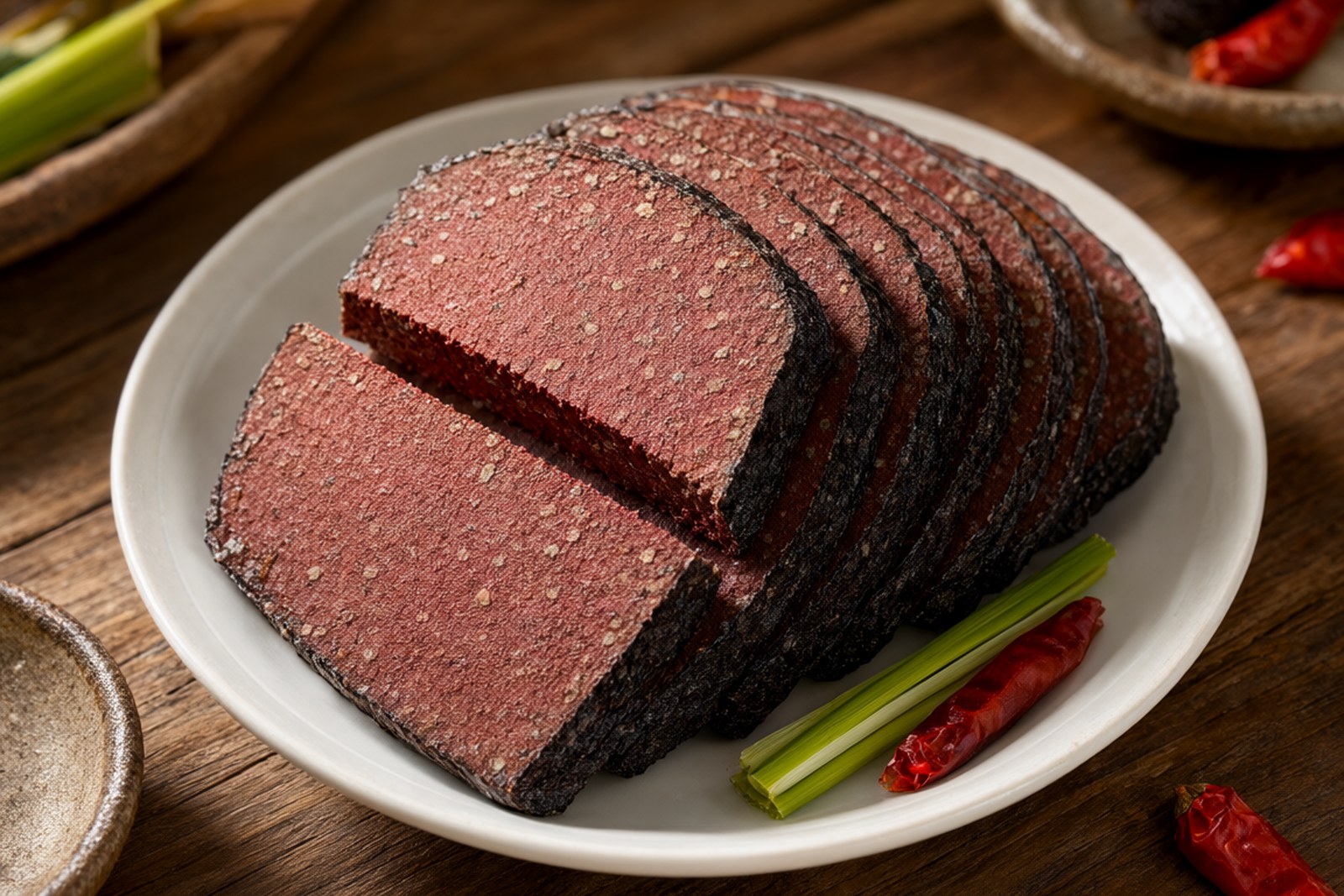
It arrives as a stack of slices the colour of old brick, each one firm enough to stand up on a plate, with a rim of darker rind where the smoke has done its work over weeks. Cut into it and the inside is dense, slightly grainy, studded with small pale flecks of fat. In the mouth it is chewy in a way tofu is never chewy, smoky in a way almost nothing else in Chinese cooking is smoky, and the flavour that comes through at the end is not really blood at all but fire, salt and time. 血豆腐 xuè dòufu is the other half of the Tujia smokehouse, the thing that hangs on the beam next to the cured pork, and it is one of the best arguments for eating in 张家界 Zhāngjiājiè that nobody makes.
What It Is
血豆腐 xuè dòufu, literally blood tofu, is a Tujia version of a preparation found in various forms across southern China, and the local version is built from three things: fresh pig’s blood, tofu, and pork.
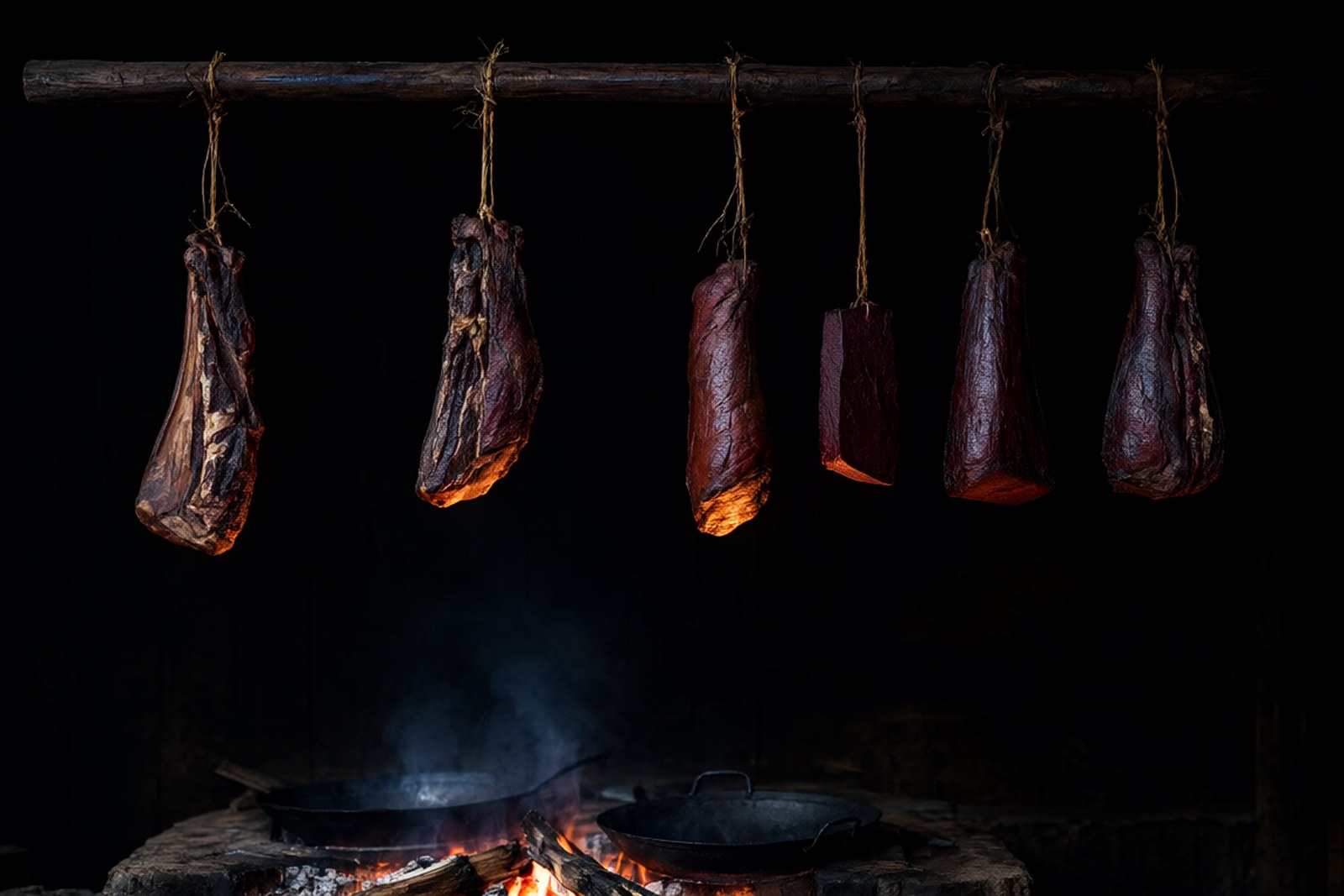
The standard method mixes fresh blood with mashed tofu — sometimes with a proportion of minced or diced pork fat — and works in salt and ground 花椒 huājiāo, Sichuan pepper, plus, in some household versions, a little dried tangerine peel powder. The whole mass is kneaded into a dense, even paste and formed into blocks. Then the blocks go where the family’s bacon goes: hung or laid in the smoke of the kitchen fire, over the fire pit, for weeks. Wood smoke, salt and slow dehydration turn them from a wet red paste into something firm, dry and dark, with a rind; some households leave them for months.
The result is a product somewhere between a cured sausage and a hard cheese in the way it works in a kitchen. It is not eaten raw. It keeps without refrigeration for a very long time — historically this is the whole point, and it is why the dish exists — and it can be put into a meal in several ways.
There is a second, faster version as well. Some households take white tofu, mix it with fresh blood, diced fat, pepper, tangerine peel and salt, form it into cakes and dry them over a low fire until they go a waxy yellow — 炕干 kànggān, dried over the stove — which produces a lighter, softer, less smoky thing that is ready in days rather than weeks. Both are called 血豆腐 xuè dòufu. What you buy in a market may be either.
How It Is Eaten
The simplest and most common treatment is steaming. The block is steamed or simmered for about fifteen minutes, then left to cool slightly and cut into slices. That is it — the smoke and the salt have done the seasoning, and the slice goes on the table beside the cured pork as part of a 腊味 làwèi plate.
The second standard way is to stir-fry the slices hard with 蒜苗 suànmiáo, garlic shoots, and chilli. The slices are firmer than tofu, so they hold their shape in the pan and take on a browned edge rather than breaking up, and the garlic and chilli cut through the smoke. This is the version to order in a restaurant if you have never had it, because it shows you both the texture and the flavour at once.
It also goes into 三下锅 sānxiàguō, the region’s famous dry pot, and into the 腊味 làwèi platters of sliced cured meats that open a serious Tujia meal. And it can simply be dropped into a pot of soup with vegetables to give the broth a smoky, mineral bass line.
There is a version of 血豆腐 xuè dòufu in almost every part of southern and western China, and this is one of the more robust ones: the smoke is heavy, the salt is confident, and the block is dried hard. If you have eaten 血豆腐 xuè dòufu elsewhere before and found it bland or soft, the one here is a different proposition.
Words and Names
血 xuè is blood, and the word is used without embarrassment in Chinese food names: 血肠 xuècháng, blood sausage, and 血鸭 xuèyā, duck cooked in its own blood, are staples of 湖南 Húnán cooking. 血豆腐 xuè dòufu uses 豆腐 dòufu in its broad sense of “something set into a block”, not necessarily made from soybeans, which is why the dish is named as it is even when the soybean proportion is small.
腊味 làwèi is the collective term for the whole family of smoke-cured products — 腊肉 làròu, cured pork; 腊肠 làcháng, cured sausage; 腊鱼 là yú, cured fish — and 腊 là refers to the twelfth lunar month, 腊月 làyuè, the traditional season for curing meat in the cold, dry window before the new year. 炕 kàng is a northern and western Chinese word for the heated platform or stove over which things are dried; 炕干 kànggān means dried over the stove, and it appears in the names of charcuterie across this part of the country. 土家 tǔjiā is the Tujia people, who make up a large part of the rural population of 张家界 Zhāngjiājiè.
What the Locals Know
Buy it dry and hard, not soft and red. The good article has a firm, almost board-like consistency, a dark brick-red to brownish colour and a visible rind. Soft, bright red blocks have not been smoked or dried enough and will taste of raw blood and salt. If the block bends, walk away.
Slice it thin for stir-frying and thick for steaming. Thin slices crisp at the edges in a hot pan with garlic shoots; thicker slices hold together for a 腊味 làwèi plate. The same block does both jobs.
Do not add much salt when you cook with it. The seasoning is already inside. A lot of cooks blanch the sliced block briefly in boiling water first, which removes excess salt and also softens the rind — worth doing if your block is old and hard.
Eat it with something acidic. The local habit is to serve it with pickled 酸萝卜 suānluóbo or 酸菜 suāncài, and it works: the smoke and the fat need the acid to make sense.
Take a block home if you can. It travels well, keeps for months in a cool dry place, and a couple of slices will improve a pot of beans, a stir-fry or a soup at home for a very long time. Buy it from a village market or a farmhouse, not a scenic-area souvenir stall, and ask whether it is 烟熏 yānxūn, smoked, or 炕干 kànggān, stove-dried — they are different products and the smoked one is the more intense.
Where to Eat It
血豆腐 xuè dòufu appears on the menus of farmhouse restaurants around 武陵源 Wǔlíngyuán and across 张家界 Zhāngjiājiè city, usually as 蒜苗炒血豆腐 suànmiáo chǎo xuè dòufu, garlic-shoot stir-fried blood tofu, at about ¥30–45 a plate, or as part of a 腊味拼盘 làwèi pīnpán, a platter of cured things, for ¥60–120 depending on how much is on it. Blocks to take home cost ¥40–80 apiece at village markets. Order it alongside the cured pork and a 三下锅 sānxiàguō, and eat it with rice.
flowcloud would say that a food whose entire purpose is to make November’s pig last until June is a truer monument to a mountain winter than any recipe designed to be admired, and that smoke is the only seasoning that records how long somebody has been paying attention.
Where to find it: 血豆腐 (xuè dòufu), 张家界 (Zhāngjiājiè) and 武陵源 (Wǔlíngyuán), north-western 湖南 (Húnán). Farmhouse restaurants throughout the region; look for 蒜苗炒血豆腐 (suànmiáo chǎo xuè dòufu) at ¥30–45 a plate or a 腊味拼盘 (làwèi pīnpán) of cured meats and tofu at ¥60–120. Blocks to take home ¥40–80 each from village markets and farmhouses. Buy the dry, hard, smoked version rather than the soft red one, blanch the slices if the block is very hard, and eat it with pickled radish and rice.