
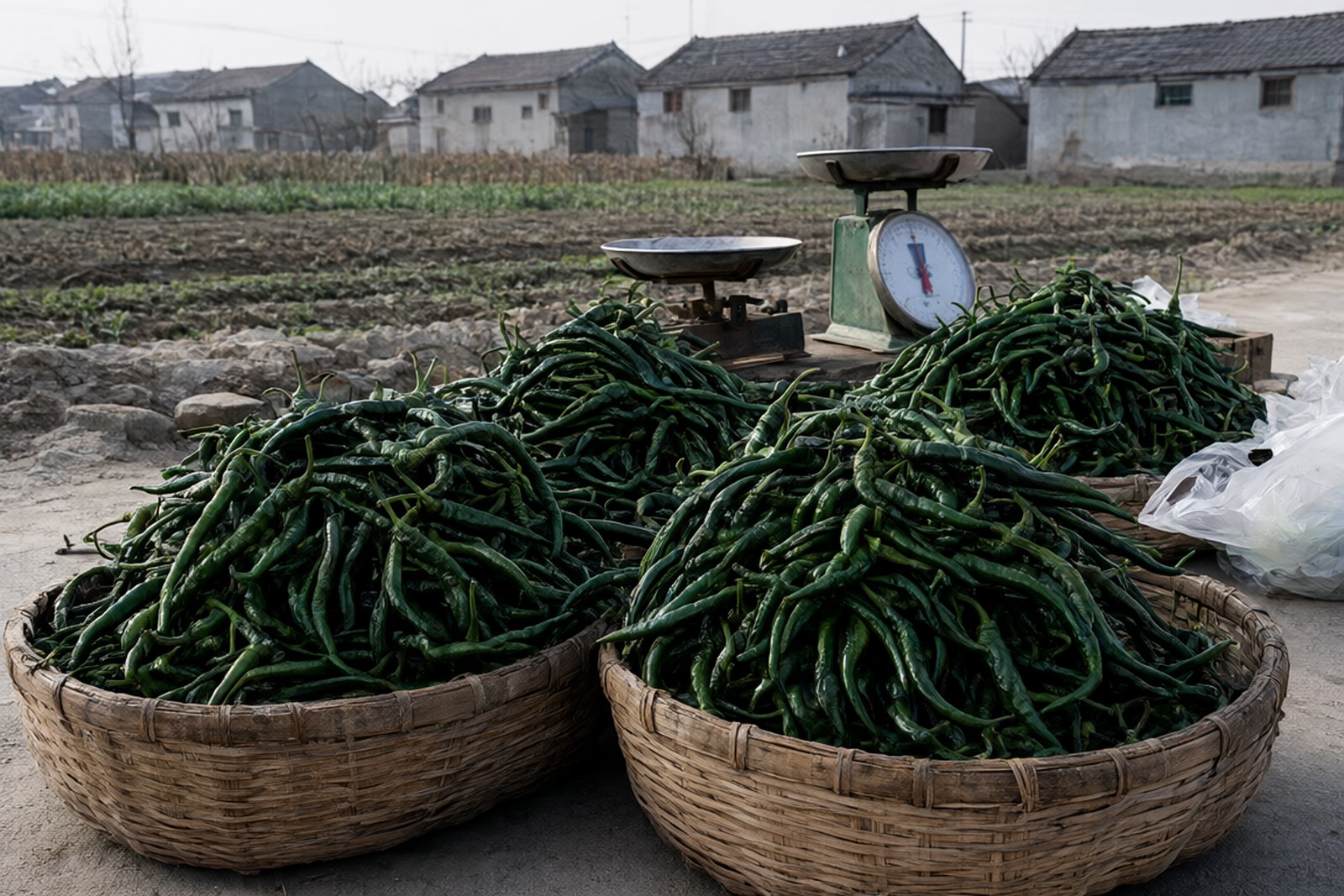
Two hundred grams of green chili, no bigger than a little finger, cost more than a kilo of pork. They are thin-skinned, slightly wrinkled, curved like a comma, and they are grown on a stretch of riverbank that is maybe a few kilometres long, in 湘阴县 Xiāngyīn Xiàn, on the western side of Dongting Lake. The variety is called 樟树港辣椒 Zhāngshùgǎng làjiāo, Zhangshugang chili, and it has become one of the most expensive vegetables in China — not because it is rare in the way a truffle is rare, but because everyone in Hunan who cares about food wants the small quantity that the one valley produces.
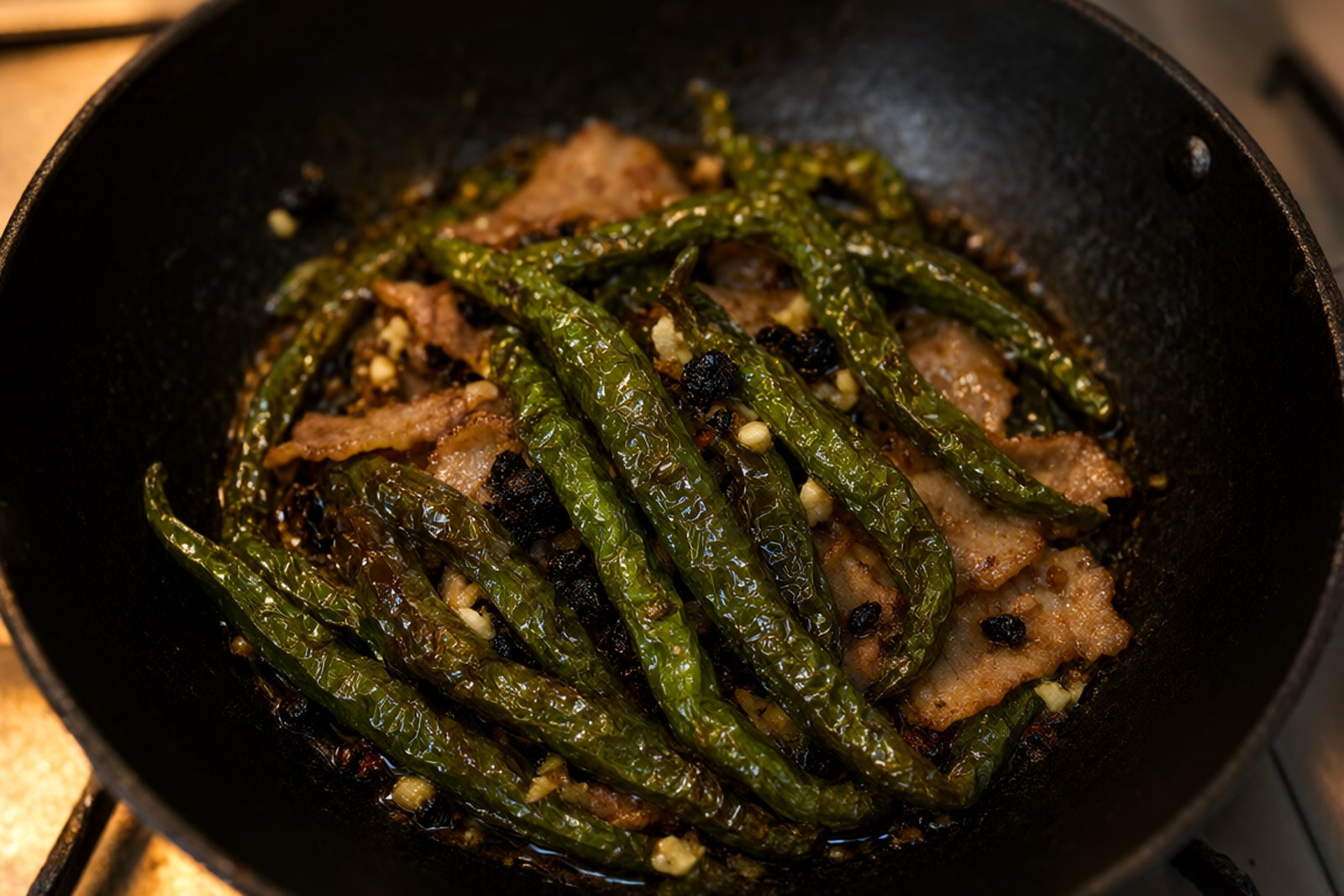
What makes it worth the money is that it breaks the rule for its own kind. A hot green chili in Hunan is normally eaten for the burn; this one is eaten for the flavour that arrives before the burn, and for a texture that is tender rather than crunchy or leathery. Picked young, it is aromatic and only moderately hot, with a fragrance that cooks describe as 清香 qīngxiāng, clean and fresh, and a thin skin that softens in seconds in the pan. In its most common treatment, 樟树港辣椒炒肉 Zhāngshùgǎng làjiāo chǎo ròu, the peppers are pressed flat in a dry wok first until their skins blister and smell of roasting, then set aside while thin slices of pork — belly or shoulder, with a little fat — are fried with garlic and fermented black beans. The peppers go back in, everything meets for perhaps forty seconds, and a splash of soy and rice wine finishes it.
Why One Riverbank
The claim made locally, and repeated in the agricultural literature, is that the flavour comes from the soil. Zhangshugang sits where the lake’s silt settles, on ground that is sandy, well drained, and rich in the minerals that river sediment carries. The climate of the lake basin adds a long, humid growing season with big day-night temperature swings. Whether or not the soil is really the whole explanation, the effect is real enough that the name is protected: peppers grown elsewhere and sold as Zhangshugang are a standing complaint in Hunan markets, and the genuine article is usually traded with the name of the specific village attached.
The harvest runs from late spring into autumn, and the quality changes as it goes. Early peppers are small, pale, and mild, and these are the ones that command the highest prices — in a bad year the first picking has sold for figures that make the local news. As the season advances the fruit grow longer, darker and considerably hotter, and by autumn they are ordinary chili peppers with an excellent pedigree, which is why local cooks buy in quantity at the start and pickle the rest. 剁辣椒 duò làjiāo, chopped chili, made from the later pickings with salt and a little rice wine, is what a Yueyang household puts on the table in winter.
Words and Names
辣椒 làjiāo is a chili pepper; 青椒 qīngjiāo is a green one, and 小米椒 xiǎomǐjiāo is the small, very hot bird’s-eye type that this is not. 樟树港 Zhāngshùgǎng is the place — the name means camphor-tree harbour. 辣椒炒肉 làjiāo chǎo ròu, chili fried with pork, is the basic Hunan dish, and adding the place-name in front of it is an assertion about quality. 剁辣椒 duò làjiāo is chopped salted chili, 擂辣椒 léi làjiāo is chilies pounded with garlic and served as a relish, and 虎皮 hǔpí, tiger skin, describes the blistered look of a pepper that has been dry-fried, as these are.
What the Locals Know
Never cook this pepper in oil from the start. The dry pan comes first, with a little salt, pressing the fruit down until the skin blisters and softens — that is where the aroma is, and a cook who skips it produces a dish that is hot and flat. Do not add water. Do not cook it so long that it loses its shape. If you are buying, look for peppers that are small, thin, slightly crumpled and very green; large, glossy, thick-walled ones are a different variety and will taste of nothing. Ask the price before you buy, because the early-season figures are startling, and be aware that most of what is sold under the name in cities outside Hunan is not from the valley.
flowcloud would say that Zhangshugang is what happens when a vegetable is allowed to be expensive, since the farmers stopped chasing yield and started chasing flavour, and the market followed them all the way to the till.
Where to find it: the farm stalls and restaurants around 樟树港 Zhāngshùgǎng in Xiangyin county, and the 湘菜 Xiāng cài restaurants across central 岳阳市. Order 樟树港辣椒炒肉 and ask whether the peppers are 本地 běndì, local — restaurants that have them will say so at once, and if the answer is hedged, order something else and come back in July.