
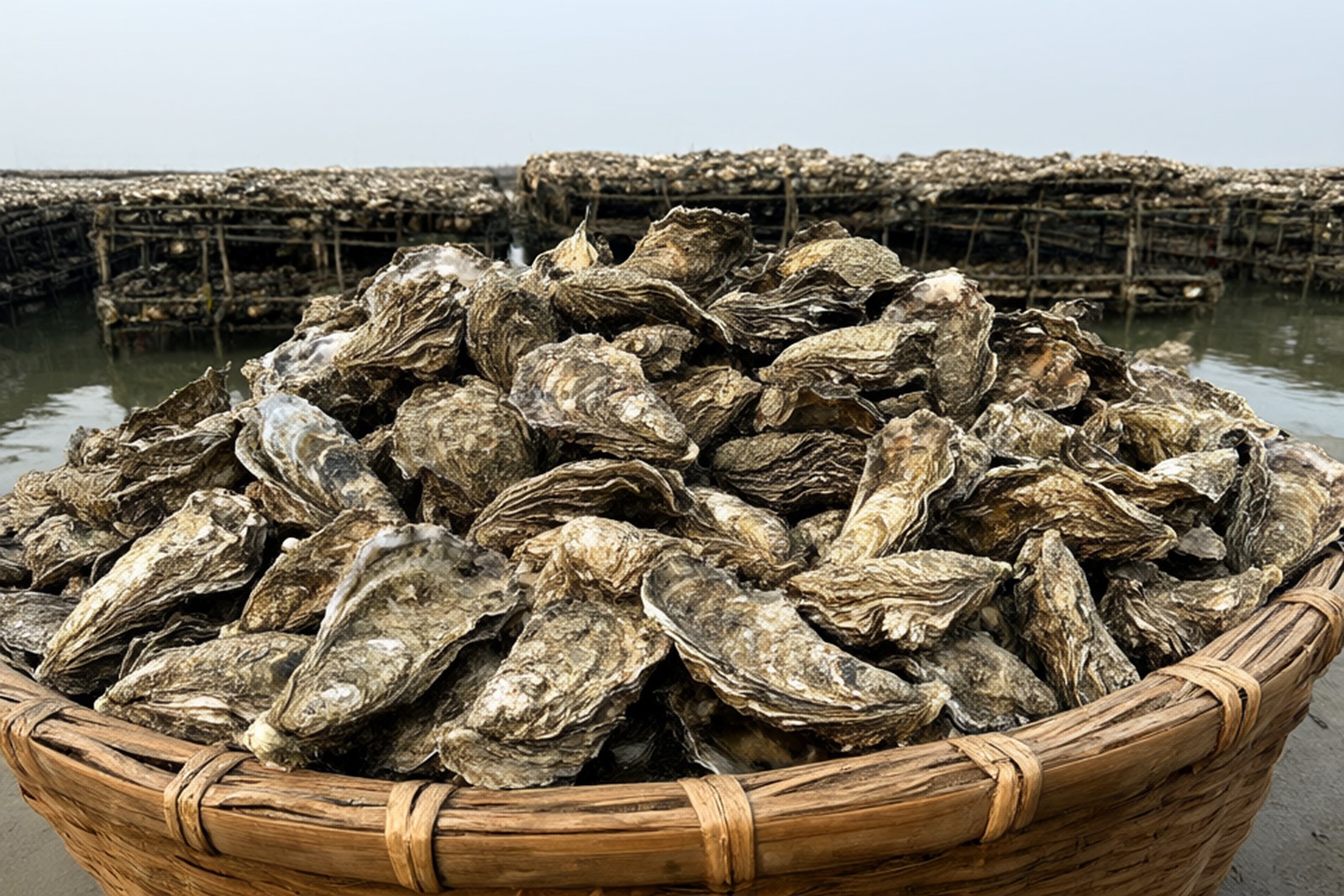
生蚝 shēng háo is the oyster of 湛江市 Zhànjiāng shì, and in this city it is the thing the evening is arranged around rather than an expensive garnish at the top of a menu. The name is the southern one, 蚝 háo, the same word that appears in 蚝油 háo yóu, oyster sauce. The animal farmed along the 雷州半岛 Léizhōu bàndǎo is the estuary oyster, 近江牡蛎 jìn jiāng mǔ lì, which grows in the half-salt water where the rivers meet the sea, and the two grounds the trade names above all others sit at river mouths with the right mixture: 官渡 Guān dù in 坡头区 Pōtóu qū on the 湛江湾, and 北潭 Běi tán in 遂溪县 Suìxī xiàn on the western shore.
湛江 has become the oyster capital of the country more or less quietly, and the scale is not obvious from the shore. The prefecture has more than twelve hundred kilometres of coastline; ten thousand hectares and more are under rafts, stakes and bottom culture; the annual crop is somewhere around four hundred thousand tons, which is close to a tenth of the national total and about a third of the Guangdong one; nearly a hundred thousand people are in the trade and the chain that hangs off it has been valued at about seven billion yuan. 湛江生蚝 Zhànjiāng shēng háo carries a national geographical indication and has been placed on the national list of famous, special and excellent agricultural products, and among farmed oysters the brand has been valued second in the country after 乳山 in Shandong. The top of the trade is at 官渡镇 Guān dù zhèn, where the 三角市场 Sān jiǎo shì chǎng holds something like two hundred stalls, moves ten thousand tons a year, and is where the restaurants of the whole province come to buy in the morning.
The season runs from late autumn through to the spring. The flesh is built up as the water cools and the animal fattens for the winter, and by high summer it is spawning and thin, so the local advice is to eat them in the months whose festival names contain an 月 and not in the hot weeks, which in practice means from about November to April. There is a second distinction the trade makes between 蚝 háo, the full-grown oyster, and 蚝仔 háo zǎi, the small one, and the small one is fried with egg or made into an omelette rather than grilled, because there is not enough of it to sit on a shell.
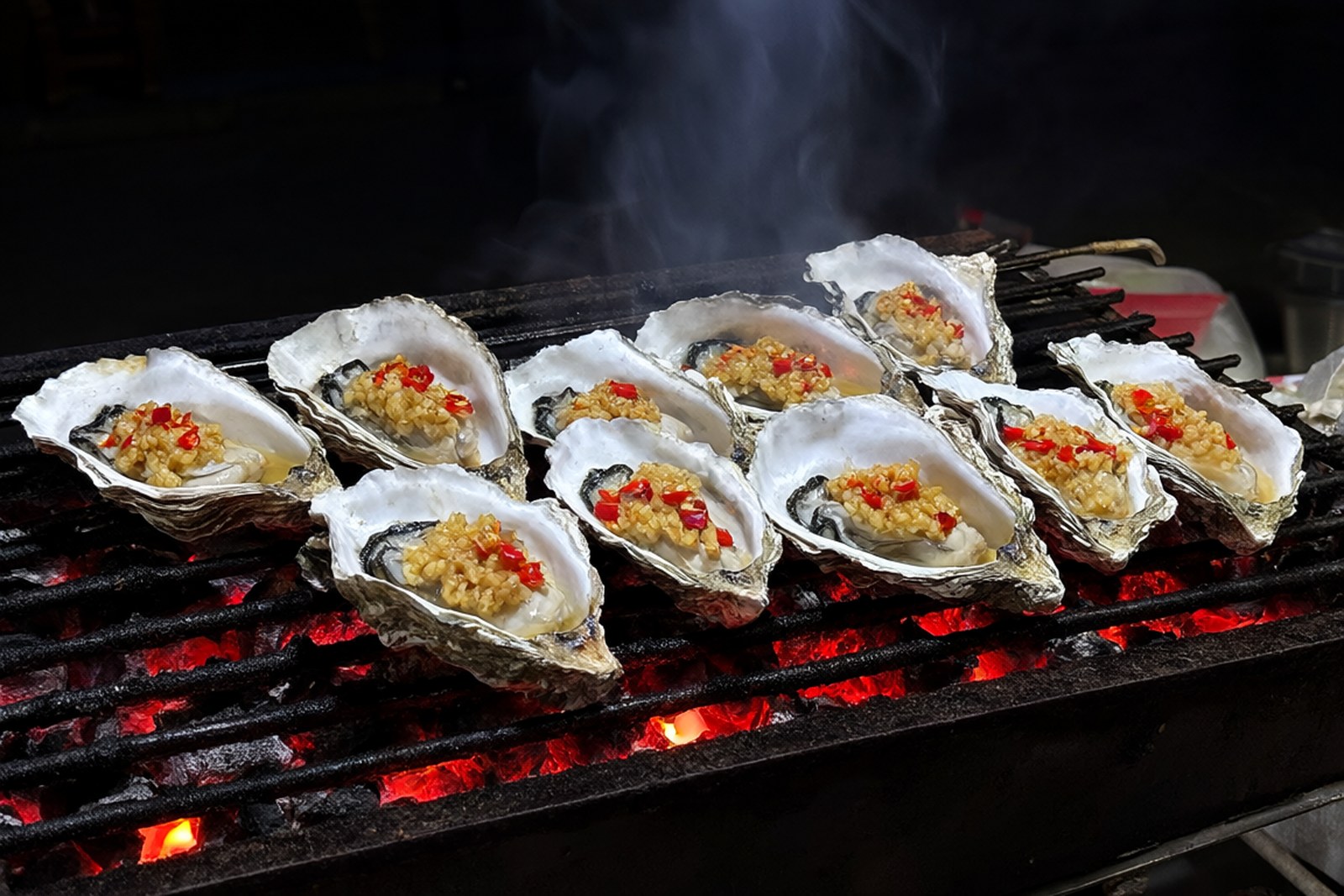
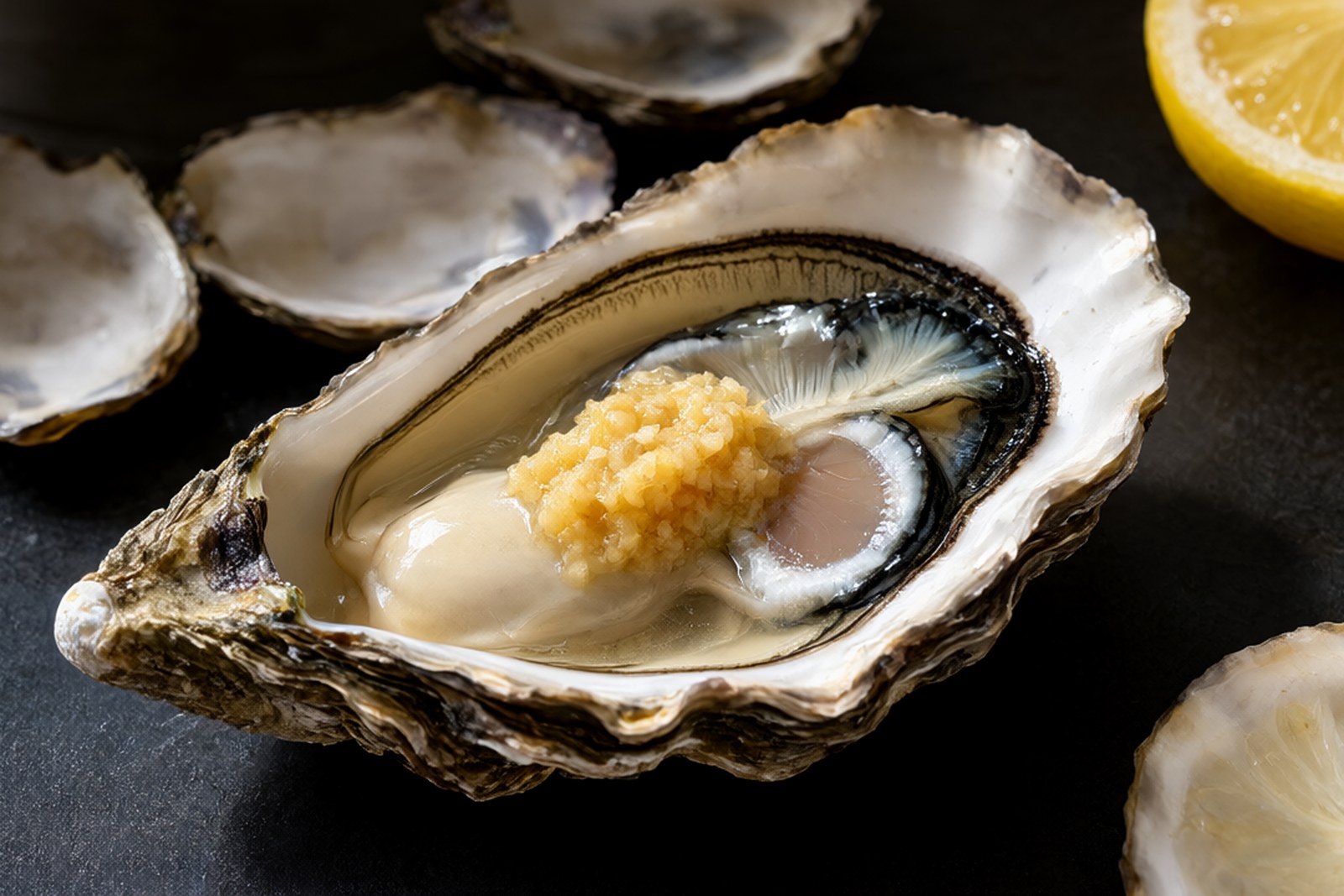
The grill itself is quick and it is the whole of the craft. The oyster is opened on the flat valve, the top shell twisted off and thrown away, and the meat left sitting in its own liquor; a spoon of the dressing goes over it; the shell is set on the charcoal and taken off again after a minute or two, at the moment the liquor has just come up to a bubble and the edge of the meat is beginning to curl. Leave it longer and the sweet oyster liquor boils off into the fire and what is left is a rubbery thing in salt water, which is the entire difference between a good grill and a bad one. The dressings are three. 蒜蓉 suàn róng, chopped garlic softened in oil, is the default and the one the stalls push. The same garlic with 指天椒 zhǐ tiān jiāo, the small fierce chilli, chopped into it, is the second. 豆豉 dòu chǐ, fermented black beans, is the third and the older 湛江 way, saltier and less sweet, and it is the one to ask for if you want to taste the oyster underneath rather than the garlic.
Eat them standing up off a paper plate with a cold beer and count the empty shells afterwards. The streets to look for are 霞山 Xiá shān around the 观海长廊 Guān hǎi cháng láng, the seafront promenade, where the stalls come out after dark; 赤坎 Chì kǎn, the old merchant quarter, where the oyster bars sit under the arcades; and the lanes off 海滨大道 and around 百姓村, which is where people go once the promenade is full. The price is not fixed at all and depends entirely on size: five to eight yuan for an ordinary one, fifteen and up for a 大蚝 dà háo, a really large one, so a plate of six ordinary oysters and a beer is a cheap dinner. The trade has a four-word description of what a good one should be and it is worth holding on to: 肥、脆、滑、甜 féi cuì huá tián, fat, crisp, slippery, sweet. If you can taste all four, you have been sold a good oyster.
Words and Names
生蚝 shēng háo oyster, 蚝 háo the same word as in 蚝油 háo yóu, oyster sauce. 近江牡蛎 jìn jiāng mǔ lì is the estuary oyster farmed here and 蚝仔 háo zǎi the small ones. 蒜蓉 suàn róng is chopped garlic in oil, 指天椒 zhǐ tiān jiāo the small chilli, 豆豉 dòu chǐ fermented black beans and 炭烧 tàn shāo grilled over charcoal. 官渡 Guān dù in 坡头区 and 北潭 Běi tán in 遂溪县 are the two great grounds, 三角市场 Sān jiǎo shì chǎng is the oyster market at 官渡, and 湛江湾 Zhàn jiāng wān is the bay the city is built around.
What the Locals Know
Ask for the oyster by its ground rather than only by its size, because 官渡 and 北潭 are the two names the trade respects and a stall that can tell you either is a stall worth buying from. Judge the meat before it is dressed: a good one is plump, pale grey-green and sitting in a full shell of liquor, and one that is watery or has pulled away from the shell has been out of the water too long. Order the 豆豉 version at least once, and eat the first one plain with nothing on it, because the point of a 湛江 oyster is the oyster and not the garlic. In summer, order the 蚝仔煎 instead, the small ones fried with egg, which is what the city does with the thin season.
flowcloud would say that a city which built a seven-billion-yuan industry out of a mollusc, and then worked out that the best way to serve it is to do almost nothing to it over a fire for ninety seconds, has understood that the whole art of the coast is knowing when to stop.
Where to find it: the grill stalls and oyster bars of 湛江市, with the seafront at 霞山 and the arcades of 赤坎 the busiest after dark, and the wholesale market at 官渡镇 in 坡头区 the place to see the trade itself in the morning. A 炭烧生蚝 is ¥5 to ¥8 for an ordinary one and ¥15 and up for a 大蚝, a plate of six ¥35 to ¥60, and a steamed or fried dish in a restaurant ¥40 to ¥90. 湛江 is the western terminus of the 深湛 high-speed line from 深圳北 and 广州南, and 湛江西站 Zhànjiāng xī zhàn is on it, about twenty minutes by road from the 霞山 waterfront.